

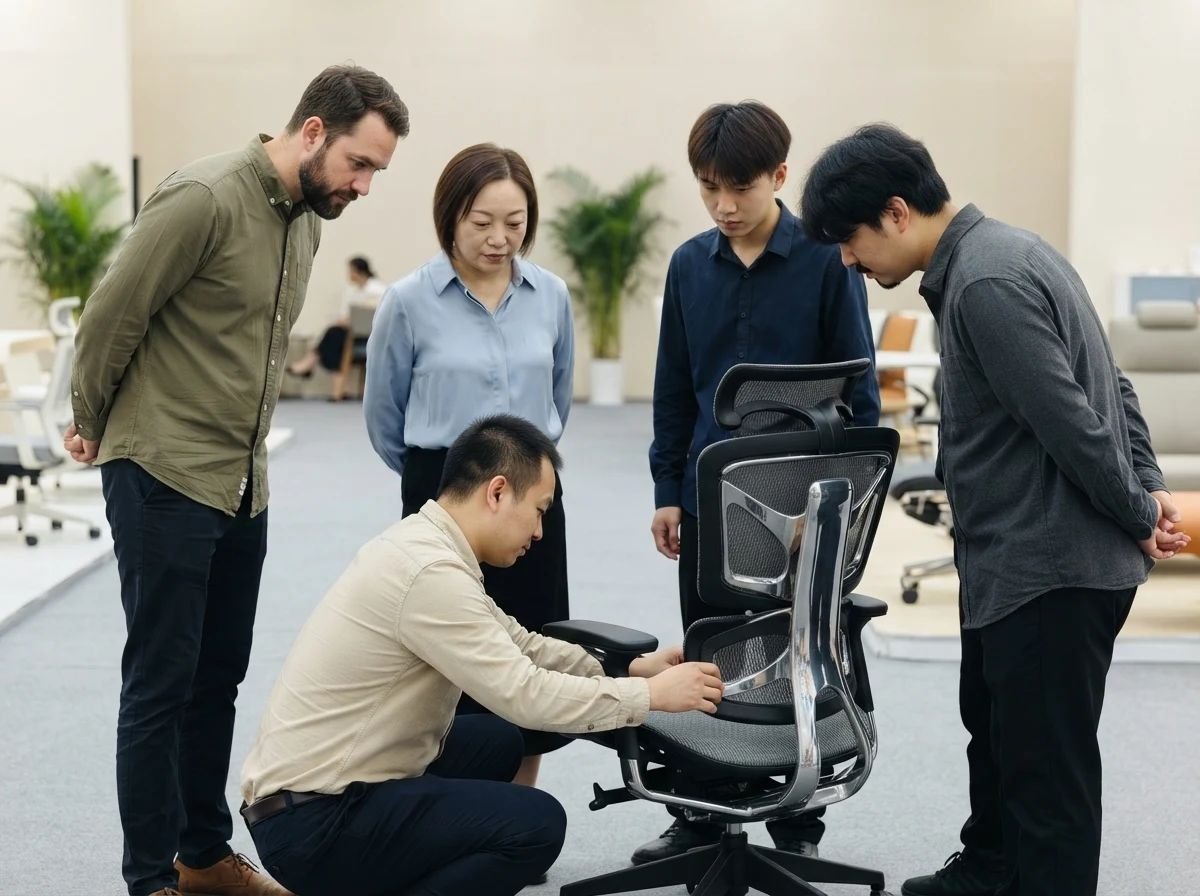
In March, I observed a procurement head from Chicago spend ~40 mins trying to sell a co-marketing program to a sofa producer based in Foshan. His request included producing a range of co-branded marketing materials, providing 3D BIM data, and hosting a ‘designer evening’ together in Dallas. The response from the factory was a further refill of oolong tea and: “Do you intend to place a minimum of 10 containers?”
Naturally, the Chicago buyer was left somewhat bemused. He was trying to identify a Chinese manufacturing base to support his sales activity into higher-end hotel rooms. The factory was happy to receive sufficient PO’s to ensure their 45+ lines could continue running until at least July.
This is a common scenario played out across CIFF, Furniture China, the Canton Fair etc. Most international buyers arrive hoping to establish a more sophisticated supplier partnership in China, including generating and sharing marketing content, supporting each other at trade fairs and engaging in various forms of B2B furniture marketing. But most Chinese manufacturers will happily accept your CADs, a substantial upfront payment and complete absence of communication until the container has departed port.
Chinese manufacturers and their attitude towards marketing
As a general statement, and one that many Western-based importers struggle to come to terms with, the typical Chinese manufacturer sees no benefit in allocating any budget to marketing their products.
During the last 3 decades, the formula for Chinese manufacturers to grow their businesses was straightforward: acquire higher quality equipment, reduce input costs (foam, board, etc.) by ~4%, and sit back for the foreign buyers to come calling with a product specification. Any attempt to generate significant levels of marketing spend to elevate and promote their brand (e.g. a corporate film, online catalogue) would simply be matched (or beaten) by the factory opposite.
This mindset continues to be prevalent in many factories to this day. Although you may hear repeated references from Chinese manufacturers about their desire to “climb the ladder” and offer “ODM” services, it’s highly unlikely they have gone beyond appointing 2 x newly-appointed in-house designers to create derivative designs of popular styles sourced from Europe. And they will continue to look to the overseas buyer to meet all of their customers’ needs.
One useful rule of thumb is that if the manufacturer leads with comments relating to their factory size, they will almost certainly be an OEM.
Takeaways: Identifying Manufacturers capable of supporting Co-Marketing
- The proportion of exhibitors at CIFF and similar events that are open to supporting B2B furniture marketing is relatively low. An estimated 80%+ will continue to work to an OEM basis.
- Clearly, a mutually-beneficial supplier partnership in China is required in order to incentivize manufacturers to commit resources to activities such as producing marketing content, additional sample stock and showrooms.
- As discussed below, many manufacturers will have invested heavily in their fair display, but this may well be a one-off expenditure. It is important to probe deeper into the manufacturer’s existing in-house marketing capability.
- Manufacturers that have recently progressed to their 2nd generation will likely be the most amenable to exploring a co-marketing opportunity, as they will want to avoid competing solely on price.
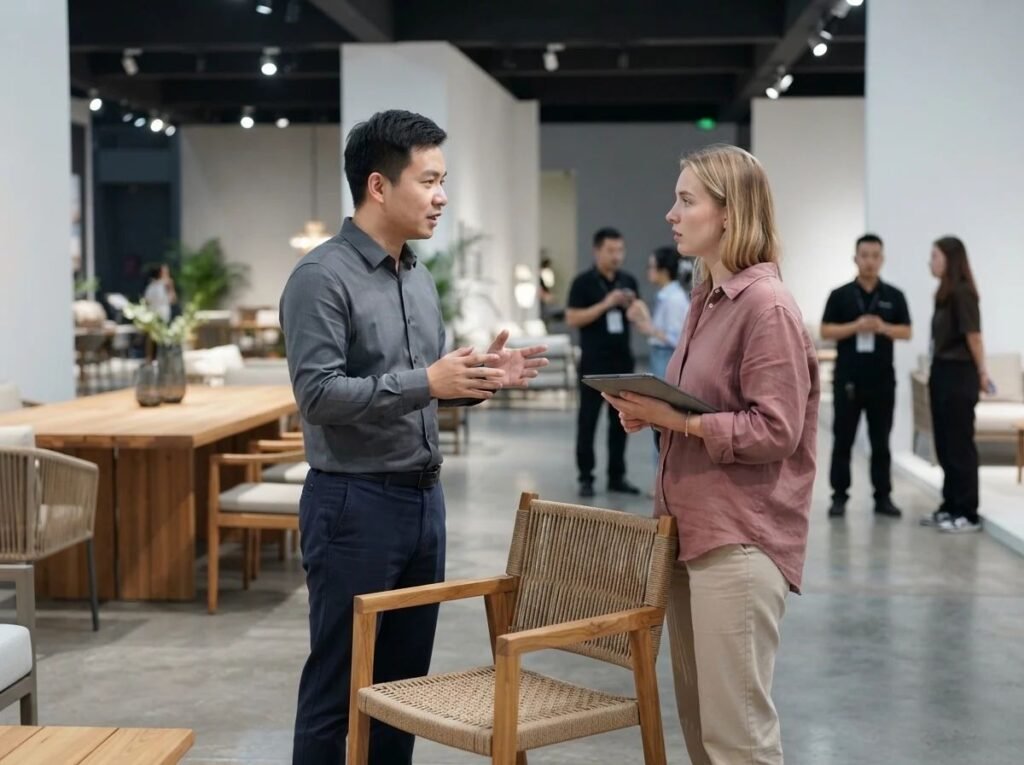
Why is the “OEM” mentality so difficult to overcome?
To summarize, B2B furniture marketing involves the generation and distribution (and potentially financing) of a suite of assets (images, 3D data, physical and digital samples, presence at industry events…) between a manufacturer and a downstream customer (importer, procurement house, architect…) to facilitate increased orders.
While seemingly self-explanatory, it’s akin to requiring your Chinese factory to contribute towards their advertising!
Chinese OEM manufacturers operate similarly to industrial-scale fishing boats. Their aim is to deploy their nets, return with a barge-full of fish and dispose of the catch. Expecting them to transition to supplying a ‘gourmet’ style fish and chip shop is somewhat beyond their current remit and skillset.
There are a couple of reasons why you will encounter significant resistance from manufacturers when discussing how you might jointly allocate a marketing spend:
Trauma
It’s fair to say that a significant number of Chinese factory directors experienced some degree of betrayal when they first attempted to engage in co-marketing with foreign buyers in the previous decade. Having discussed and committed a level of rebate or provision of free stock to be distributed in a customer’s showroom, they were frequently out-sourced to a lower-cost country 12-24 months later as import duties increased.
Of course, the above is not strictly true. Manufacturers also have a practical commercial reason for refusing to co-invest…
No Marketing Department
On entering the offices of most Chinese manufacturers, I would recommend that you take note of the function breakdown displayed prominently in the background of the foyer. Typically you will find: Manufacturing, Quality Control, Procurement and a “Trade Dept” consisting of 20-30 young staff responsible for managing inbound RFI’s via platforms such as Alibaba. You will rarely (if ever) see a separate function to oversee and drive the manufacturer’s external marketing. Furthermore, given this lack of an in-house marketing spend, any co-marketing contribution from the manufacturer will have to be met from the Shareholder’s own private funds.
Second Generation
However, there is currently a wave of change sweeping the Chinese manufacturing sector as the original Shareholders step down and pass the reins to the next generation. Many of the 2nd-generation owners have completed tertiary qualifications in countries including Australia, UK and Canada, and are keen to develop their factories to meet the expectations of the global market.
On a recent visit to a factory near Foshan, the outgoing Shareholder was primarily focused on maximizing the number of containers that could be loaded per shipment. In contrast, his 32yo daughter had appointed a 3D artist and Marketing Executive, and was keen to provide her US and European customers with the necessary 3D data and other branded information to expedite their decision-making process when considering her range of upholstered furniture.
What to consider when assessing Manufacturers on the Fair Floor
Of course, all of the above is academic if you cannot identify which of the hundreds of exhibitors at CIFF and Furniture China are suitable candidates. It can be a daunting task to sift through the myriad of attractive displays and attractive-looking staff members…
Look beyond the Fair Display
Much of what you will see at a fair stand is a product of the stand-builder and the amount paid by the exhibitor. Simply having a well-presented stand does not indicate the level of B2B furniture marketing that the manufacturer can deliver to your business.
Therefore, I would suggest that you avoid the initial conversation with the sales representative and instead focus your attention on their current marketing outputs. Request their key product information sheets and evaluate whether these contain the detail you require (e.g. image quality, Martindale data, fire certification [CAL 117, BS 5852], delivery schedule…). If the answer is “no”, move on.
Equally, enquire whether they are able to provide you with any 3D data or digital imagery. On one occasion, a manufacturer told me during our initial discussion in Dongguan that they would be happy to supply me with all of the requisite assets for my next hotel program. Some 8 weeks later, I received an invite to access a folder of images captured on a smartphone whilst standing on their freight loading bay.
Not ideal!
Clearly, an appropriate supplier partnership in China will have developed a suitable suite of assets to allow them to effectively market their products to architects and hoteliers. Ideally, you will find that these are readily available upon approaching their stand.
OEM vs. Co-Marketing Manufacturer
| Aspect | OEM-only | Co-Marketing Candidate |
|---|---|---|
| First enquiry to you | Target price and volume? | What is your target market and sales process? |
| Existing digital and physical assets | Generally poor quality and limited | High-quality images, 3D models, comprehensive product information |
| Samples | Likely to quote at 2-3x ex-factory price and decline to apply to subsequent PO | More reasonable quotation, potentially offset against a future PO |
| Resource allocation | Sales team only | Additional resource(s) to support external marketing initiatives |
| Contractual requirements | Unwilling to commit to any exclusivity; will seek large PO’s early on | May be prepared to accept some form of territorial exclusivity in exchange for continued joint marketing activity |
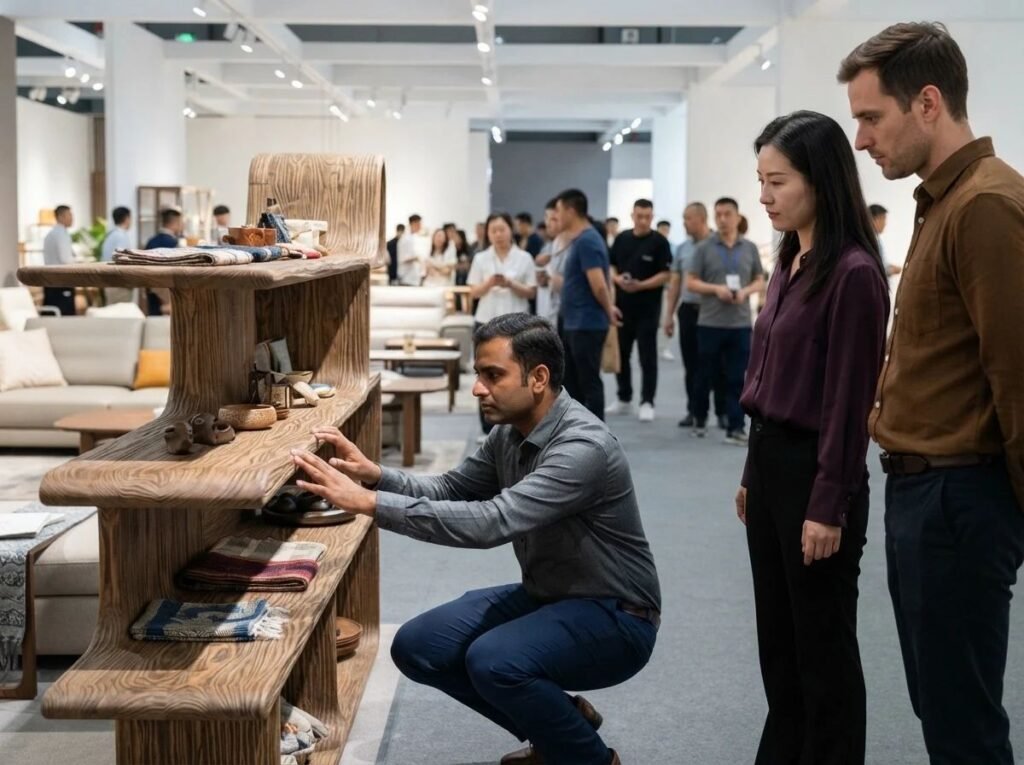
Where to look for Co-Marketing Candidates?
As noted above, if you confine your search to the largest and most established Chinese manufacturers (typically 100,000m2+) you will be largely unsuccessful. These businesses are predominantly supplying the world’s biggest home-furnishings retailers and have little incentive to collaborate with a mid-sized importer. Conversely, if you look to the smallest of Chinese manufacturers, they may lack the financial resources and/or language skills to produce adequate marketing collateral and support your activity.
Consequently, it seems likely that the optimum supplier partnership in China will be found among a group of mid-sized, specialized manufacturers. These companies will generally have achieved a sufficiently mature operation to ensure a steady supply of quality product and have the requisite in-house engineering and design teams. However, as they will typically not be supplying the ultra-large-scale retailers, they are more likely to be receptive to collaborating with a strong downstream sales force to generate business. Of course, many importers will continue to prioritize securing the lowest possible cost of purchase and source exclusively from the larger manufacturers in Foshan. Nevertheless, there are several excellent mid-sized producers, such as Interi Furniture, who specialize in manufacturing a broad range of upholstered furniture for both commercial and domestic applications and are well-placed to support a variety of marketing activities (e.g. tailored sample packs, bespoke photography, reduced PO thresholds…). You should also expect to observe a greater willingness from these companies to discuss their competitive position in relation to the lead-time and flexibility of their offering to your salespeople.
Practical Tips for identifying Co-Marketing Manufacturers in 5 minutes
Recognizing that you will need to cover a significant number of stands and therefore cannot devote substantial time to scrutinizing each potential supplier, below are 4 quick steps to eliminate the bulk of the OEM-only exhibitors from your shortlist:
- Ask the representative to show you their most recent collection of product images / 3D data from an iPad or tablet. If they state that they will send this through once the fair has concluded, they probably don’t have any.
- Review the manufacturer’s social media channels (LinkedIn, Instagram…). Stand by and type their company name into your mobile to check the frequency and standard of their posts. If their most recent update is a low-res picture of their stand and “Please come and see us”, they are unlikely to be helpful.
- Pose a low-level co-marketing question to the representative, e.g. would they consider working with you to produce a set of product samples to be supplied to your key contacts, and if so, whether they would be open to sharing the associated cost. Note the reaction of the Shareholder (behind the translator) and the subsequent line of questioning. You should be able to determine within a minute whether this is a viable option.
- Identify the individual(s) who would need to sign off any such activity, and gauge the depth of the approval chain. If multiple layers of seniority would be involved, it’s unlikely that you will be able to progress quickly.
Finally, be wary of any manufacturer that offers to meet all of your requests at no cost! Although this may initially appear to be a “free lunch”, you should consider whether the factory may be looking to mask deficiencies in their product (e.g. insufficient seasoning period of wood, sub-optimal foam) by increasing their marketing spend. A good candidate will push back and seek clarification of the activity you wish to undertake, and the level of contribution from each party.

FAQ
I don’t think I will be placing sufficient orders with a Chinese factory to warrant them investing in co-marketing with me…
If you reframe your request to the manufacturer to focus on the provision of underlying product assets (i.e. 3D data, photographs, samples) rather than seeking to secure a financial incentive, you may be surprised at the extent to which a factory will assist. In particular, if you can demonstrate an ongoing series of programs (e.g. 5-10 hotels per annum), many will be happy to extend this form of support, even if your total spend is <US$250k.
How can I protect myself if the manufacturer goes on to use the joint assets we create to promote their products to my US and EU competitors?
You will need to ensure that a robust NNN (non-disclosure, non-use and non-circumvention) agreement is in place prior to commencing any joint marketing activity, setting out the parties’ rights and obligations in respect of the relevant data and images. In particular, you should stipulate the territories in which the manufacturer is permitted to exploit these assets.
Should I raise the topic of B2B co-marketing with a manufacturer at their initial stand meeting?
Yes, although clearly you won’t expect to enter into a formal arrangement at this stage. You simply need to assess whether the manufacturer has the appetite and ability to engage in such an activity. If not, you don’t want to incur the expense of traveling to their facility.
Are there really any Chinese manufacturers that will co-invest in marketing my products at CIFF and similar events?
Provided that you are prepared to ignore the lowest-cost OEM options, yes. My assessment is that approximately 15-20% of the manufacturers exhibiting at these fairs are seeking a downstream sales organization to partner with in order to increase their overseas revenues.
Of course, as with much of the above, we also play our part in perpetuating the OEM culture. By relentlessly driving our prices and lead-times, and then complaining when our Chinese counterparts are unwilling to dedicate time and resources to growing our brands, we are arguably complicit.
So the final test for you as you walk the fair floors in Guangzhou or Shanghai is: what message are you sending the manufacturers when you introduce yourself?


