

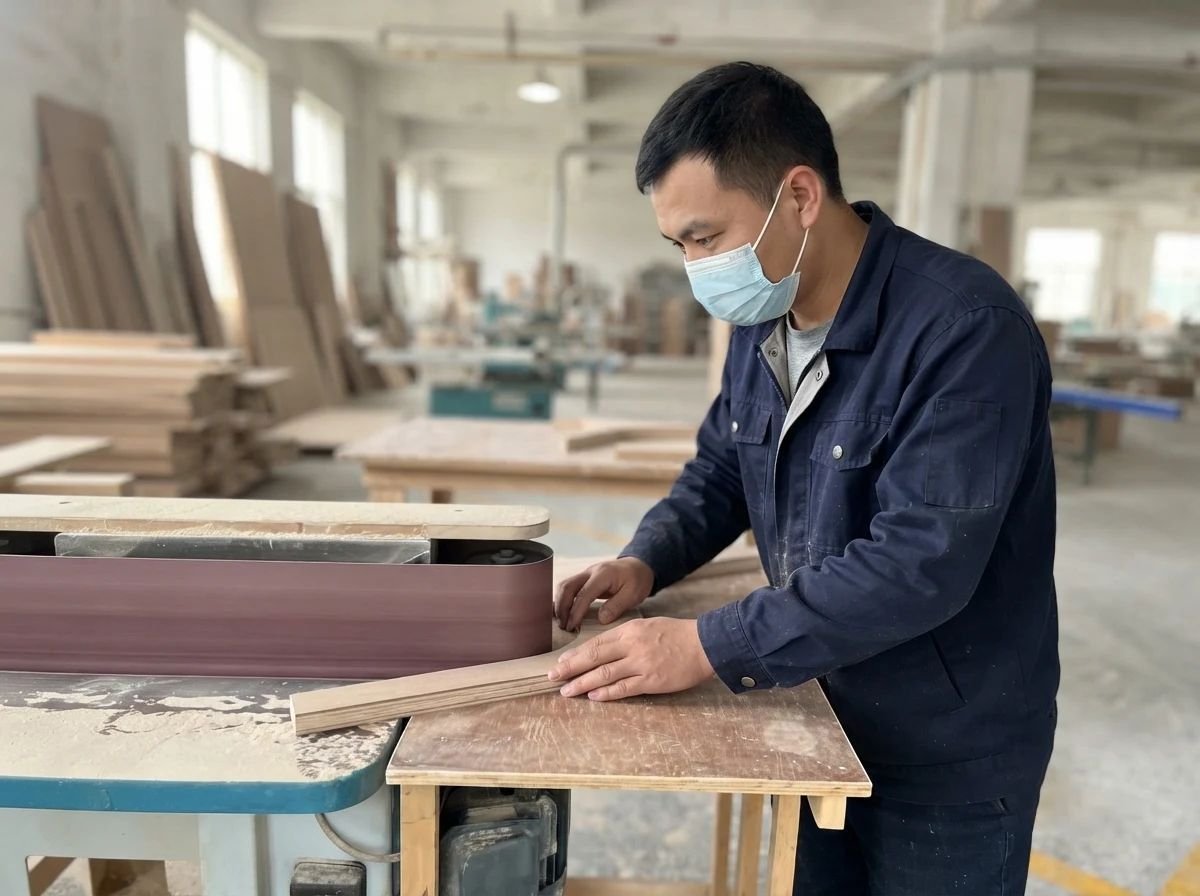
In April of last year, I was pulled into a grimy room full of samples in the town of Longjiang, Guangdong. My guide was a multi-family developer based in Dallas, fuming. His anger wasn’t directed at the Chinese businessman who was busy brewing us tea. Rather, he was fixated on a quote for ~$1.4m of FF&E on his tablet, from a “premium” US-based furniture house.
Directly to the right, leaning casually off a bare blockwork partition, was the identical walnut headboard. Routed LED pocket, matching brass insert, same poor mitre cut at the bottom-left.
The reason why? His US-based FF&E provider had simply lifted a complete room package from Guangdong, added ~60% to the cost and applied their logo to the document.
I’ve spent the last 15 years on the factory floor across the provinces of Guangdong and Zhejiang. At this point, it hardly registers with me. Developers don’t voluntarily subject themselves to 14+ hour flights and significant jet-lag to come and purchase from China. They are forced to. Either their local suppliers have failed to meet their budget or program requirements, or they’re unknowingly procuring directly from these Chinese manufacturers.
Why they don’t mention it in the sales pitch
Most developers will initially state an intention to procure locally. This is attractive for a number of reasons: it appears favorable in the business case, and obviates the requirement to manage the logistics of international shipping.
However, upon receipt of detailed quotations, it’s not uncommon to see an additional $750k+ required to furnish a 220-key scheme (or comparable lifestyle hotel) prior to the completion of interior partitions.
There is a significant reduction in domestic manufacturing of furniture in North America and Western Europe. As such, when developers seek to procure FF&E from US-based suppliers, they frequently end up sourcing from Chinese manufacturers at a substantial premium.
Of course, there will be excellent local companies who can undertake smaller scale fit-outs. Commission a number of bespoke, deep-upholstered booth seating units for a fine-dining restaurant? No issue. But scale that to 350x bathroom vanities, 280x beds and 600x dining set(s), to be completed within 14 weeks, and most will look to increase their quote materially (or pass the requirement onwards).
As a general principle, if you cannot be taken on a tour of a busy and noisy factory floor within ~20′ of a local FF&E provider’s display, then they are simply acting as an intermediary.
Summary of key benefits for developing in China:
- Access to all requisite raw inputs (timbers, foam, textile, fittings etc.) in the immediate vicinity e.g. Foshan, Dongguan. Prototypes and samples therefore can be generated much faster.
- Substantial reduction in landed cost to the site, notwithstanding freight, potential tariff exposure and engagement of external QA service. Typically in the range of 25-40%.
- Ability to manufacture to bespoke architect’s design, spanning hundreds of rooms, with minimal tooling charges.
- Avoidance of domestic intermediaries, and concomitant ability to specify raw material and production timing.
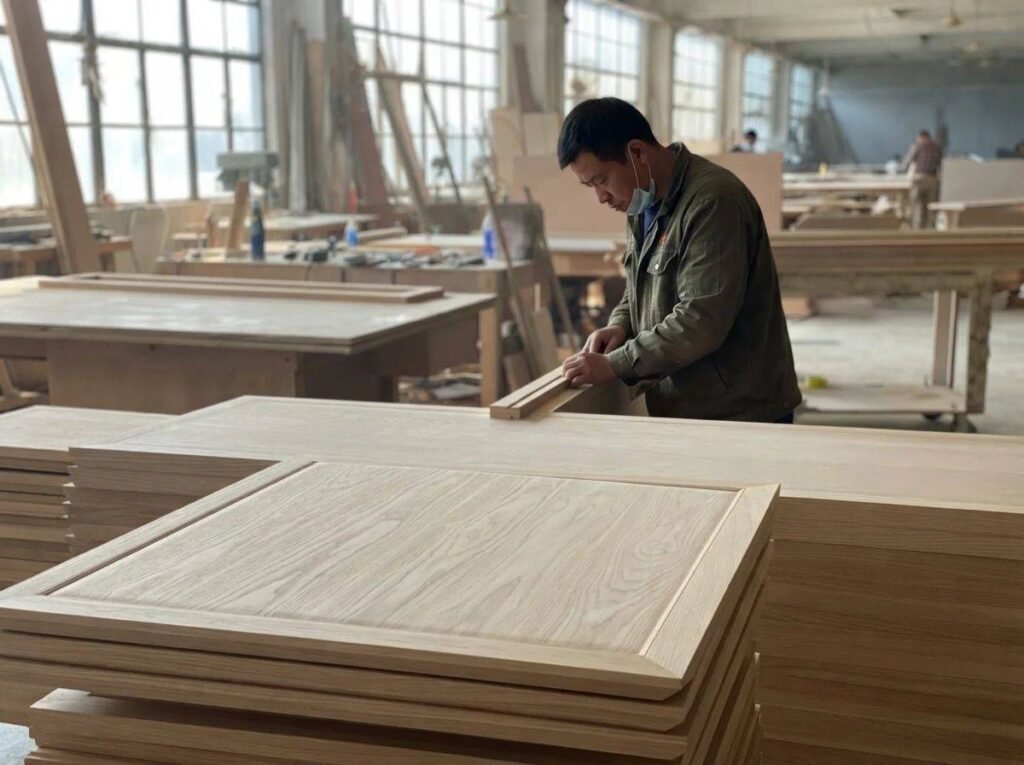
An entire province in one location
Sourcing FF&E from China refers to the procurement of made-to-measure furniture, fixtures and equipment from the various dedicated manufacturing clusters located throughout southern China. A common misconception is that this is purely a function of low-cost labor. Labor costs in the eastern seaboard of Guangdong province have risen steadily over the last decade. The true competitive advantage is the concentration of complementary industries and inputs.
How does a domestic supplier compete to deliver a sample in under 48 hours?
Visit the Longjiang area early one weekday AM, and you’ll find factory owners and senior operatives riding flimsy battery-powered motorbikes through narrow passages. They are collecting sample books of textiles, assessing the quality of different grades of veneer, negotiating the price of fittings… all located within a short radius of each other.
Should your in-house design team wish to amend the colorway of the proposed public space seating from natural linen to cognac-colored top-grain leather, a local supplier will instruct his team via a pair of WeChat audio messages. The relevant leathers should reach him by the following day.
Conversely, a domestic operation will need to source appropriate commercial-grade fittings and textiles (likely from further abroad), and arrange transportation of e.g. the metal sub-frame to a separate facility. The net effect is that the principal benefit of purchasing FF&E from China is the ready availability of all supporting industries in close proximity. Any dependency on external parties will inevitably impact the program, potentially causing significant financial loss.
So what does it look like when quantified?
As mentioned previously, developers will primarily assess the suitability of a supplier based on the final cost of the FF&E. It is difficult to sell the virtues of artisanally crafted pieces if the scheme will fall short of the investment required by the keyholders.
Can it compete post-freight, duty etc.?
Naturally. There are many variables including fluctuating sea-freight, specific product HS code and the cost of engaging a reliable QA firm.
More importantly, there is also the benefit of the level of engineering that can be achieved at a Chinese real estate furniture manufacturer, and the extent to which multiple products can be consolidated into a single container.
On one occasion, I observed a CNC machinist working a panel line in Houjie, Dongguan to produce 300 x 3-piece fluted Ash vanities. In ~20 minutes, he changed the CNC program to machine curved Oak elements to form the carcass of a large hotel-scale reception feature. He did not incur any charge to the customer for the additional design work, because the facility was producing a comprehensive range of bedroom and living room furniture (and associated stone and metal table-tops) in the same complex.
Were this task allocated to a series of US-based subcontractors, each would apply their respective base rate and variable costs.
| Direct from Chinese Manufacturer | US-based Supplier(s) | |
|---|---|---|
| Landed Cost | 25%-40% less (after accounting for freight and tariff) | N/A, but likely 30%-60% greater |
| Suitability to Architectural Drawings | Very. Can readily incorporate a wide variety of materials | Somewhat. Will attract significant upcharge for non-standard items |
| Consolidation | Multiple product types can be fitted into one 40’HC container | Will require multiple shipments |
| Delivery Time | 8-12 wks + 4-6 wks freight and clearance | 12-20+ wks. Note: may be delayed by long-lead foreign components |
| Minimum Order Size | Generally 15-20+ units per item | Suitable for low volumes, but will struggle to fulfill 200+ room order |
| Principal Concern | Risk of inferior materials, communication and tariffs | Failure to meet budget and available capacity |
From my perspective, once the value of FF&E required exceeds ~$250,000 per project, it becomes almost self-evident that China FF&E sourcing is the optimal route. Of course, at the other extreme, the economies of shipping multiple containers and the services provided by an agent will offset some of those benefits.
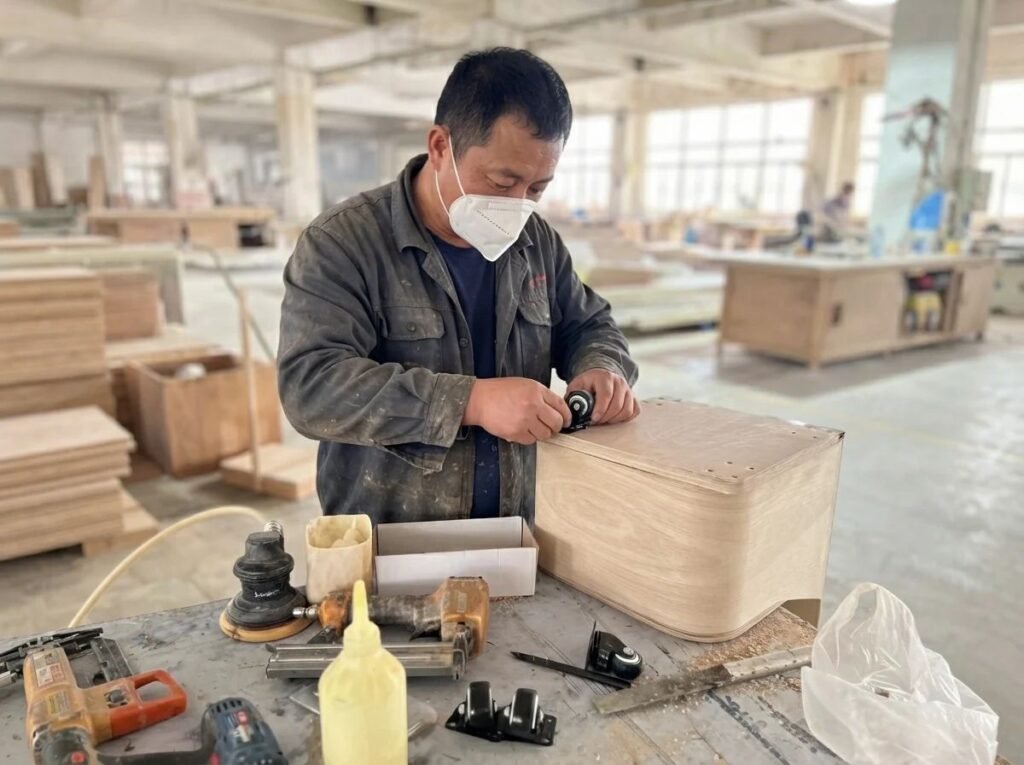
If the Architect specifies something unreasonable…
It’s somewhat unfair to blame architects for specifying challenging details in their designs. But there’s no escaping that a degree of “fantasy” creeps in. Extensive use of thin metal inserts, sweeping curves, delicate features and so forth.
If your architect elects to alter the specification of a product e.g. the timber colorway, once it has progressed into the production cycle, you will almost certainly face a formal CO, associated design time and a consequential delay.
In 2016, I assisted a client who required that all of the 160 rooms in a hotel be finished in a lighter, wire-brushed Walnut tone, having already commenced works in Dark Espresso. Having anticipated some friction, I was surprised that the production manager instructed the spraying department to add 4 x colored pigments to their formulation. Within an hour, and while I was having breakfast with the team, he produced 3 x test samples of veneered timber for my approval.
Naturally, this openness to meeting any request carries a risk. Manufacturers are keen to secure your order, and will generally fail to inform the architect if the detail specified is inadequate for its intended purpose. Supply a set of dining chairs with very light construction and a lesser-quality supplier will happily manufacture the piece exactly to the supplied shop drawing. And if the leg breaks after a 250kg occupant sits on the seat? Not their concern! That said, the leading manufacturers will invariably advise the client if a given element is deemed too fragile, prior to commencing works.
The role of agents and mid-market suppliers
If you attend the Canton Fair or CIFF in Guangzhou and blindly engage one of the exhibitors, you risk losing 30% of the value of your order.
The largest manufacturers are listed companies operating out of Foshan, Shenzhen, Hangzhou and surrounding areas. These are well-suited to supply the needs of large-scale hotel developments. However, they will not prioritize your requirements if a 5-star international hotel places an order.
At the opposite end of the spectrum, you’ll encounter pure agents and brokers, based in attractive office space in Guangzhou. They will be happy to provide you with a tour of their “network” of factories, but will be MIA once your container arrives and you discover that a proportion of the stock is damaged.
In practice, the majority of project buyers will identify a supplier in the mid-market. While the world’s largest hoteliers will continue to contract with the above mega-factories, many scheme developers have found a number of suitably scaled facilities (such as Interi Furniture) capable of delivering high quality custom-made FF&E. In doing so, these operators will typically house a breadth of workshops including sawn and profiled timber, upholstery and painting. Crucially, however, the scale of these businesses allows the key decision-maker to remain engaged with the progress of the order. It is important to select a supplier that aligns with your expected program and order volume.
Steps I take prior to committing to a supplier
Procuring Chinese real estate furniture requires due diligence if you intend to bypass the local intermediary. My key actions are:
- Do not visit the ‘showroom’. Enquire about the ‘graveyard’. All suppliers will have some degree of stock that has fallen outside the required parameters, or represents work in progress for another client. It is here that you will gain insight into the construction and quality of the product.
- Agree a comprehensive BOM with the supplier. Do not accept generic comments such as “100% solid timber” and “HD foam”. Specify the required %MC of the timbers, density of the HD, rating of the textile(s) and the make of any key components (e.g. Blum, Hettich, DTC).
- Obtain and sign off a ‘Golden Sample’. Ideally, you should not proceed directly from the CAD files to the production line. Commit to receiving a sample of the principal items, inspect and initial the reverse of the piece, and leave this in-situ to act as a reference.
- Seek to split the payment. The standard commercial arrangement is 30%/70%. Aim to extend this to 30% / 40% / 30%, with the second tranche payable subject to a ‘White Body’ check and the final on successful completion of the pre-shipment QA.
- Beware the pristine showroom. You will be told that nothing is ‘too difficult’ for the supplier, and their premises may be immaculate, with little evidence of ongoing works. These are generally indicators that the company is merely an agent. Furthermore, if they have no difficulty meeting your requirements, be suspicious.
Finally, ensure that you have a third party to confirm the condition of the bare timber and component packages prior to them being covered. Do not rely on images and representations from the supplier’s salesperson.

FAQs
Is the perception that Chinese-sourced products arrive deformed and smelling of glues still valid?
Undoubtedly, if you obtain a series of quotes and select the lowest. Deformation will result from the failure to adequately season the timber, and the smell from the application of inferior adhesives. However, provided you stipulate the use of E0-CARB2 compliant board(s) and coatings, and confirm the %MC of the ‘White Body’, the manufacturers will be able to deliver an equivalent (or better) product.
What lead-time should I allow?
Ideally 6-8 months from the commencement of the scheme. Expect to allow 4-6 weeks to finalize the detailed design and receive samples, 8-12 weeks to manufacture and 4-6 weeks for the vessel to sail and clear customs. Additionally, you will need to factor in the shutdown associated with the Chinese New Year.
Will the manufacturers be able to supply materials to comply with relevant fire regulations (CAL117, BS 5852, etc)?
Yes, provided this is raised at the outset and you confirm the relevant test reports. The majority of the larger facilities will routinely produce to these specifications. Please note that the use of fire-rated foam will incur a supplementary cost.
So, is it fair to say that developers favor Chinese-sourced FF&E over domestic options?
Yes, for any hotel, residential or other large-scale development requiring >$250k of FF&E. There is currently no equivalent alternative in the US to offer comparable reductions in landed cost, ability to consolidate multiple items and suitably fulfill high volumes of made-to-order product.
The Hard Lesson
My final advice to any developer flying to China: you will not receive what you anticipate, but rather what you can verify.
By using a domestic supplier, you are effectively allowing them to purchase from these locations at a discount and pass the cost on to you. By sourcing directly, you remove this ‘cushion’ and become aware of the true quality of the product on offer. You will also consume an excessive quantity of dubious tea in the region!
But once you have successfully delivered a container of FF&E to your project and retained the associated benefit, I doubt you will want to revert to the status quo.