

Picture this: a 10,000-square-meter showroom in Longjiang. The AC is blasting at meat-locker temperatures, they’re pumping some generic white-tea fragrance through the vents, and I’m watching a hospitality procurement guy from Manhattan lose his mind over a sofa. He’s sipping fifty-dollar aged pu’er tea, grinning like he just cracked a casino vault. Why? Because he’s signing a $450,000 contract for lobby casegoods and he genuinely thinks he’s secured “factory-direct” pricing.
Spoiler alert: He hasn’t.
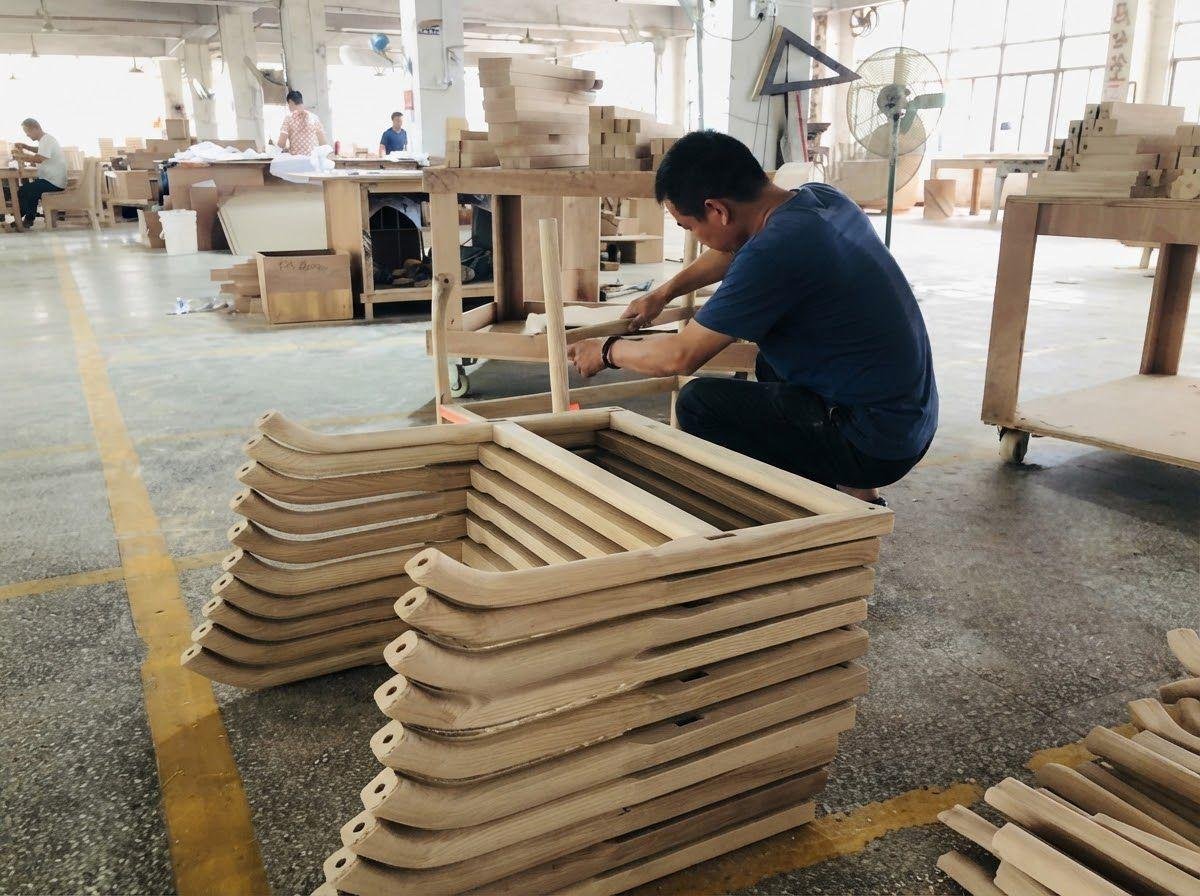
The actual manufacturing facility? The loud, glue-scented floor where guys in dusty aprons are meticulously pressing hand-rubbed walnut veneers and milling solid brass accents? That place is a windowless, 800-square-meter concrete box down a heavily potholed dirt road in Dongguan. The boss, a chain-smoking guy I’ll call Mr. Chen, hasn’t posted a WeChat update since late 2017.
That dynamic is the great, unspoken hustle of the Chinese luxury furniture game. Wiring funds to glittering Foshan showrooms means you aren’t paying for heavy machinery or master carpentry. You’re funding overhead. You’re floating the bill for the fancy tea, the marble floors, and a squad of slick, English-fluent reps whose main skill is formatting commercial invoices so Western accounting departments don’t ask questions.
If you actually want to access the elite tier of China custom workshops, you need to walk out of the lobby. You have to drag yourself to the industrial parks where the real sawdust is flying.
The Brutal Truth About “Factory Direct”
Let’s rip the band-aid off right now. Sourcing agents hate when buyers figure this out.
The most complex, highest-end custom pieces exporting out of Guangdong rarely—and I mean almost never—originate inside the massive mega-factories plastered all over Alibaba’s front page. Those sprawling behemoths are financially engineered for one single purpose: cubic volume. They exist to push out container after container of flat-packed, standardized MDF bedroom sets.
The minute you throw a complicated spec at them—intricate dovetail joinery, custom brass inlay, or complex upholstery mapping that requires hand-tufting—the big guys panic. It destroys their assembly line metrics. So they quietly farm your bespoke headache out to a highly fragmented, underground network of specialized micro-workshops.
Rule of thumb: If a sales rep looks you dead in the eye and swears their single facility builds tufted velvet sectionals, carved marble credenzas, and molded plywood dining chairs all under one roof, you are dealing with a broker.
Or, honestly, you might be dealing with a real factory that’s just brokering out your specific order. Complex, low-volume stuff wrecks their flow. So they take your deposit, skim a fat 40% margin right off the top, and toss the CAD files to a guy just like Mr. Chen.
Key Takeaways: Surviving the Custom Sourcing Meat Grinder
- China furniture sourcing is the process of aggressively auditing and managing manufacturing partners across hyper-localized industrial hubs, bypassing showroom brokers to find the actual makers.
- True luxury craftsmanship here is almost always outsourced by mega-factories to independent, hyper-specialized micro-workshops.
- Getting direct access requires deep local connections, messy cash flow logistics, and abandoning traditional showroom comfort.
- Relentless auditing for material swaps (like sneaking fake veneer onto hidden back panels) is your only real defense against margin theft.
The Invisible Ecosystem of Master Craftsmen
Hunting down a legitimate, tier-one premium workshop is basically like searching for a trustworthy transmission mechanic when your truck dies in a strange city. You don’t pull into the massive dealership with the neon sign. You look for a dusty cinderblock garage with three vintage Porsches out front and a mechanic who looks annoyed that you even walked in.
That exact same logic governs Chinese luxury furniture.
Where the Magic Actually Happens
Take a brutally humid Tuesday I survived last month. I dragged myself up three flights of cracked concrete stairs in a totally nondescript industrial park over in Anji. No corporate signage. No glossy catalogs in the lobby.
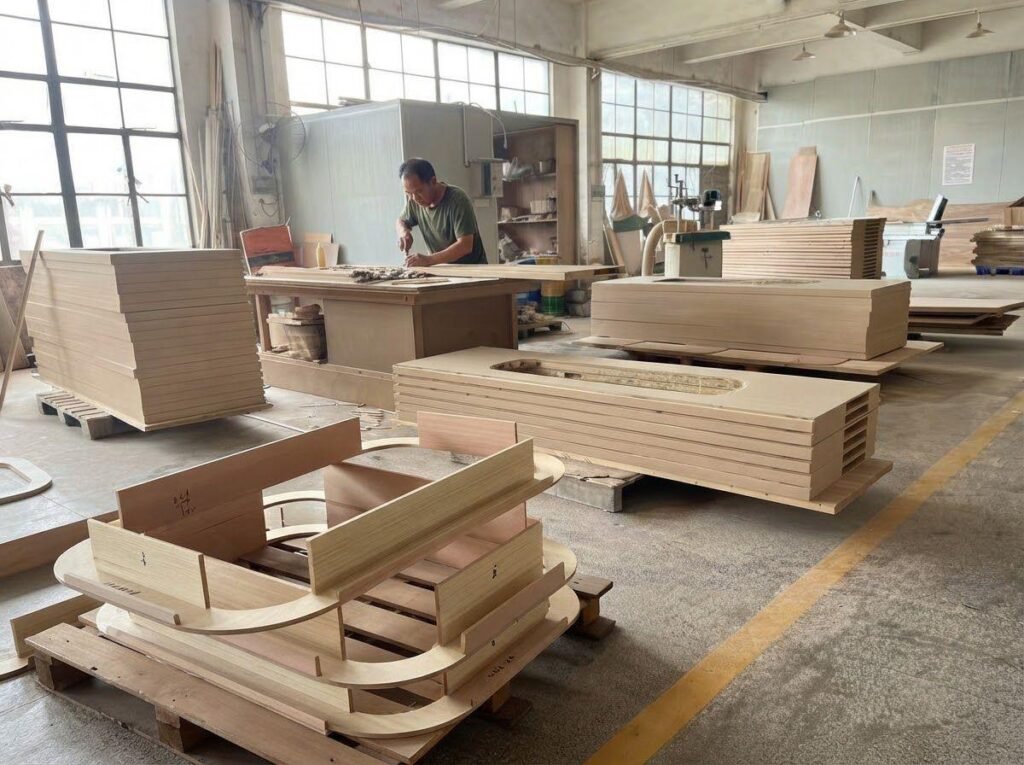
But inside? Absolute chaos and magic. Thirty seasoned artisans were hand-stitching imported Italian full-grain leather onto cold-rolled steel frames. They were furiously building inventory for a massive European heritage brand that I probably shouldn’t name (rhymes with “Smash”). The best Chinese luxury furniture workshops blow their entire budget on 5-axis HOMAG CNC machines from Germany, leaving zero dollars for fancy reception desks.
It’s just raw obsession with the craft. No marketing. No slick websites.
And that’s exactly why these shops are entirely invisible to Western buyers. You won’t bump into these guys walking the floor at High Point Market. They survive strictly on local word-of-mouth, quietly eating up overflow luxury orders from massive export houses that lack the technical skill to execute wild designer renderings. (Ghost-contracting happens way more than anyone in the industry admits. It’s an open secret).
Learning the Language of the Factory Floor
Here’s the kicker about dealing directly with these top-tier workshops. They don’t give a damn about your Pinterest mood boards.
They care about shear strength. Moisture content percentages. Kiln-drying schedules. Foam density metrics.
When you sit down on a plastic stool with a workshop boss, you aren’t talking about “aesthetic journeys.” It’s a rapid-fire, highly technical street fight over whether a specific mortise and tenon joint is going to snap when a 250-pound hotel guest flops onto it repeatedly over a five-year commercial lifecycle.
The Art of the “Bait and Switch”
We need to talk about raw materials. Because this is the exact spot where dreams die and budgets completely evaporate for uninitiated buyers.
Why the Hell Does My Container Look Different From My Sample?
Here is a classic nightmare. You sign off on a flawless, golden sample of a solid American ash dining chair. You wire the 70% balance. Three months later, you pop the container doors in a sweltering Miami warehouse. You pick up the first chair. It feels… suspiciously light.
Welcome to the infamous rubberwood swap. They stained it dark, buried it under a layer of thick PU lacquer, and shipped it.
The fundamental law of offshore procurement is that you get exactly what you physically inspect, not one millimeter more. If you aren’t standing on the factory floor, shoving a moisture meter into the raw wood before it gets sealed in plastic wrap, you are gambling with your client’s money.
Look, roughly 30% of mid-tier workshops will try a minor material downgrade if they sense you aren’t paying attention. It’s rarely out of pure malice. It’s just a brutal tactic to protect razor-thin margins in an insanely competitive market. They’ll use the heavy 304 stainless steel you demanded on the visible exterior legs, sure. But they’ll swap the hidden internal seat framing for a cheaper, thinner gauge. They’ll use premium high-resilience foam on the seat, but stuff the armrests with cheap recycled scrap that breaks down in eight months.
| Sourcing Reality | MOQ (Minimum Order) | Bespoke Capability | Language Barrier | Material Swap Risk |
| The Mega-Factory | Massive (50+ units) | Clunky / Rigid | Low (English reps) | Medium |
| Premium Workshop | Tiny (5-10 units) | Limitless | Extreme (Mandarin only) | High (if unaudited) |
| Trading Company | Flexible | Hit or Miss | Low | Terrifyingly High |

Finding the Pragmatic Middle Ground
So, what’s the play? How do you survive the massive gap between an inflexible mega-factory and an invisible, technically brilliant but potentially risky micro-workshop?
You find the aggregators. The mid-sized specialists who have already bled out figuring this stuff out.
Veteran procurement directors eventually build a tiered roster to handle different risk profiles. If they need 500 standard wooden nightstands for a resort tower, they’ll dump that order onto a massive Foshan conglomerate. It’s a volume play.
But for the penthouse suites? The bespoke lobby centerpieces? They pivot hard. While naive buyers chase fragmented micro-workshops to squeeze every last penny out of the unit cost, pros realize that mid-sized specialists — operations like Interi Furniture, which specifically target high-quality export manufacturing and custom project work — offer a much better risk-reward balance. They actually have enough operational juice to book containers and guarantee QC, but they maintain enough floor agility to execute bespoke designs without laughing you out of the room for failing to hit a 500-piece minimum.
The absolute holy grail in China furniture sourcing is finding a manufacturer big enough to sue, but small enough to actually care about your order.
The Vetting Playbook for Going Rogue
If you read all this and still decide to go rogue, hunting down these premium independent custom workshops yourself without a safety net, you need a ruthless system. You can’t just point at a pretty chair in a sample room and wire a 30% deposit.
Here is how you separate master craftsmen from guys selling smoke:
- The “Three Material” torture test — Force them to quote a piece that demands wood, metal, and complex upholstery. A true premium workshop has deep-rooted local sub-contractors for whatever they don’t do in-house. If the wood finishing is pristine but the metal welding looks like chewed bubblegum painted black? Walk out immediately.
- Follow the dust. Seriously, look at your shoes. A shop producing high-end luxury veneer must have a nearly sterile, climate-controlled finishing room. If they are spraying high-gloss lacquer in the exact same open-air room where three guys are aggressively sanding raw MDF, your luxury pieces will arrive in the States permanently embedded with grit.
- The “Too Easy” Red Flag: They say “Yes, no problem” to everything. If a factory boss doesn’t argue with you about your technical drawings, they aren’t actually looking at them. The best workshops push back on stupid joint designs or impossible fabric specs within 48 hours because they know it’ll fail on the line.
- The phantom engineer check — Ask to speak face-to-face with their CAD draftsman. If they awkwardly claim he’s “working from the other building today,” he doesn’t work there. They are outsourcing your engineering, which means they lose control of the technical specs the minute things get complicated.

The Questions Buyers Hate Asking Out Loud
Q: My sourcing agent absolutely refuses to give me the actual factory name. How do I get around this?
A: You mandate factory-direct payments in your initial contract. Period. If the agent refuses to let you wire funds directly to the actual manufacturing facility’s registered business account, they are hiding a massive, undisclosed markup. Fire them today. Find a transparent local partner who works on a flat, agreed-upon commission.
Q: Are Chinese custom workshops actually cheaper than just biting the bullet and buying from a European heritage brand?
A: Yes. But only if you value your own time at zero dollars an hour. The raw FOB cost on a custom curved sectional might be 60% lower than buying it out of Italy. But the management friction—the midnight WeChat arguments, paying for third-party QC inspections, and endless logistics wrangling—will eat up a massive chunk of those on-paper savings.
Q: What actually happens if a premium workshop completely ruins the finish on a $5,000 custom table?
A: If you already wired the final balance before it got on the boat? Absolutely nothing happens. You now proudly own a deeply flawed $5,000 table. This is exactly why you never, ever release the final 70% payment without an independent third-party QC inspector physically standing on the factory floor scratching, measuring, and photographing the piece.
Q: Can I really trust a factory that only has a sketchy Alibaba page and no real website?
A: Honestly, it depends entirely on their export history. A shiny, SEO-optimized website is just a marketing expense. What actually matters is pulling their shipping data and finding a verified trail of customs B/Ls (bills of lading). If they consistently ship complex goods to your target market, they are real.
The Sawdust Principle
Look, eventually, you have to stop and ask yourself what you’re actually trying to build. Are you just trying to fill empty hotel rooms with passable wooden boxes to meet a frantic opening deadline? Or are you genuinely trying to craft an environment that feels bespoke, heavy, and real?
The hidden rolodex of China’s premium workshops isn’t locked in a vault in some gleaming Guangzhou office tower. It’s out there on the dirt roads. It’s hiding behind unmarked rolling steel doors, fueled by lukewarm instant noodles, chain-smoking engineers, and sheer, stubborn technical brilliance.
You just have to be willing to get your shoes a little dirty to find it. The biggest lesson I ever learned the hard way in Dongguan is simple, but it hurts to admit: stop buying the showroom, and start buying the sawdust.
See you out on the factory floor.