

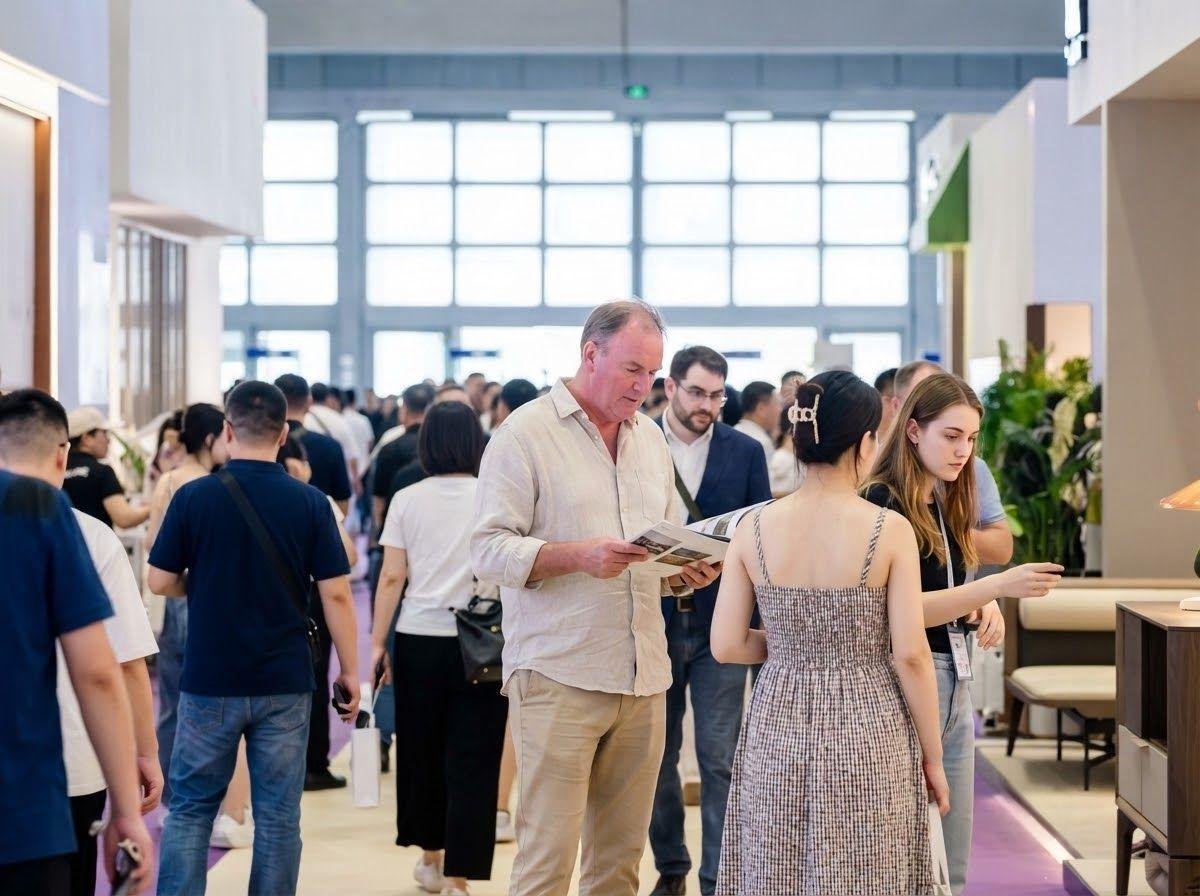
The booth smelled like hot carpet and new plywood. Guangzhou, Pazhou, Tuesday before lunch. A salesman in a navy polo had my client’s drawing open on an iPad, and he kept saying “no problem” in the same tone other men say “trust me” right before a bad karaoke song. Twenty-six guestrooms. A lobby bar. One curved headboard the designer called “quiet luxury,” though the brass detail was loud enough to wake the minibar. The salesman circled something with his finger. “Seven days,” he said. “We send sample.”
My client, a hotel procurement director with tired eyes and a very good spreadsheet, looked pleased. That’s the dangerous moment. Not anger. Pleased.
Because “seven days” at a fair rarely means seven days to the thing you can approve. It means seven days to three photos, a wobbly video, and a message saying the master is checking. It means somebody counted the calendar before counting the foam, the fabric roll, the stain booth, the courier cutoff, and the one finisher who actually knows how to make walnut look expensive instead of muddy.
I’ve chased furniture prototype China jobs through Foshan, Dongguan, Longjiang, Anji, Nankang. Different towns, same smell: solvent, hot glue, coffee in paper cups, and sales confidence thick enough to cut. The confident ones are not always lying. That would be easier. They’re often just speaking booth English, where “prototype” can mean a stock frame wearing your fabric like a costume, and “custom” can mean custom until the foam supplier runs out.
The ugly part nobody says at the fair
Most buyers don’t get burned by evil factories. They get burned by polite optimism.
A sales guy meets you at 11:40. By lunch he has promised your curved arm, your COM fabric, your “brushed champagne but not yellow” metal, and a QC video on day four. Has he called the mill? Maybe. Has he found out the dye lot you want is sitting in a trader’s warehouse near Guangzhou under three other rolls? Unlikely. Does he know the senior upholsterer is fighting a migraine and a container for Germany got pushed ahead of your sample? No. Why would he? His job is to stop you walking to the next booth.
Then Monday lands. The fabric is “similar,” which in factory language means same color family, different behavior under steam. The foam density changed because the good block is reserved for a bigger PO. The frame is fine, which is the annoying thing, because fine frames make bad foam feel personal. The sample lead time you were quoted starts breathing hard.
Here’s my rough field count, not an audit: in about seven out of ten “seven-day” sampling jobs I’ve been called into after the fact, the buyer got pictures around day seven and an approval-worthy sample closer to twelve or twenty days. Sometimes faster if the design was basically a tweak. Sometimes worse if the designer moved the arm radius after the frame was already cut. The pattern is boring. Materials first. Chemistry second. Courage third.
If the promised sample lead time is shorter than sourcing plus one honest screw-up, you’re not buying speed. You’re buying theater.
Actually, scrap that. The problem usually isn’t the factory lying. It’s the buyer hearing “date” when the factory meant “target if nothing argues back.”

Booth English vs floor reality
At the fair, time gets soft. A “sample” can be last year’s sales chair re-dressed. A “prototype” can be built from stock parts and prayers. “Seven days” can mean seven working days after materials arrive, which is not seven days from your handshake. It can also mean seven days if you accept substitutions and don’t ask why the stain looks orange under LED.
A custom sample is closer to a suit fitting than a pizza. Worse, actually. The tailor has to find cloth, hope the dye is sane, cut around your ego, and still let the seams settle. Glue needs open time. Lacquer needs cure. Foam needs to stop pretending it’s comfortable for five minutes and admit where it sags. You can rush a person with overtime. You cannot rush solvent evaporation with charisma.
I saw this in Foshan once. Not a scam. Just pressure. A hotel lounge chair had to leave before the buyer’s flight. Frame good. Sewing fine. Then the iron touched the polyester and the seam puckered like it disapproved of the whole project. The factory sent photos anyway. Beautiful light. Bad truth. The project manager wrote “almost final,” which is sourcing for: we fixed the big sin and photographed around the small ones.
A sample is a promise made in glue. Glue does not care about your flight.
Not broken. Busy.
That’s the insider bit people miss. Rush sampling borrows time from paid production or from QC. There is no secret sample elf. When a factory says yes to your date, your fabric, your finish, your weekend delivery, and your designer’s last-minute “warmer” stain, ask what slowed down. Because something did.
So what should you believe?
A serious furniture prototype China process has gates. Not pretty gates. Ugly, useful gates.
First, freeze the drawing. Not “frozen unless inspiration strikes.” Frozen. Dimensions. Joinery. Foam density. Fabric. Dye lot if you can get it. Stain code. Metal finish. Hardware. Carton size. If the designer is still flirting with the curve, stop.
Second, make them prove materials. Not “same quality.” Mill. Trader. Roll length. Foam supplier. Wood moisture if the piece cares. Metal stock. If they can’t name sources fast, the clock is decorative.
Third, build and let chemistry behave. Adhesive, lacquer, upholstery tension, foam recovery. Then QC under mean light. Then pack. Then courier. Each gate can betray the next one.
A buyer can steal this planning range and still get punched by a weird spec:
| Piece | Booth promise | Believe this unless proven otherwise |
|---|---|---|
| Stock-frame chair, standard fabric | 5–8 days | Possible after material lands |
| Custom wood chair, standard finish | 10–18 days | More honest once cure and QC count |
| Upholstered lounge with COM | 12–25 days | Add fabric reality and one failure loop |
| Mixed-material showpiece | 18–35 days | If they say seven, ask what got deleted |
Ranges, not scripture. A tiny brass cap can become a three-market hunt. A “small” fabric change can make two chairs from the same carton look like cousins instead of twins.
If they can’t show what’s in stock, the sample lead time is talk with a logo.
Some factories do hit aggressive dates. Not magic. Discipline. In-house cutting. Stable foam. A sample room with real machines, not a clean table near sales. A project manager who says, “That won’t dry by then,” and lets you be annoyed today instead of furious in a suite. Annoyed now is cheaper.
Category matters too. Powder-coated metal in stock color can move quicker than open-pore walnut. Repeat hotel casegoods can be mocked up faster than a new sculptural lounge from a napkin sketch. Don’t compare a tweak to a birth.

Where Interi Furniture fits
Buyers split into two tribes. One wants the biggest hall in Foshan because scale feels like a seatbelt. The other goes looking for mid-sized specialists—operations in the Interi Furniture lane, meaning export-oriented Guangdong or Zhejiang factories touching hotel, project, or residential work—and hopes flexibility beats muscle. Sometimes it does. Sometimes it’s the same old sampling problem wearing a nicer apron. Big or boutique matters less than whether sampling is treated like engineering or bait.
Ask nastier questions
Stop asking, “Can you do seven days?” Anybody can say yes with a smile.
Ask: “What happens on day three, day six, and day nine if my fabric is late?” Then shut up. The pause tells you plenty.
Get material truth in writing. Mill, trader, foam density, wood, stain, metal, hardware. If the answer is “same,” hear “substitution with confidence.”
Set photo gates. Frame before upholstery. Upholstery before finish. Finish before pack. It feels fussy until you find a crooked seam after your designer already posted the render internally.
Split mock-up from approval piece. A rough prototype can be quick. Approval has to survive sitting, wiping, leaning, freight rattles, and your designer going silent. Silence is never good.
Budget for Sample B. Not because factories are stupid. Because custom work is custom. If you can’t afford a second sample emotionally or financially, Sample A becomes a hostage.
Here’s the red flag that sounds wrong: be suspicious of total yes. The factory that accepts your date, any fabric, any finish, weekend delivery, and your aunt’s swatch is not flexible. It’s hungry. Hunger is not QC.
Ask for live video during work hours. Cutting. Sewing. Sanding. Spraying. QC. If the sample room looks like a museum, ask where the real samples bleed.
And put cure in the PO. Adhesive. Lacquer. Foam recovery. Packed cartons. Humidity. “Ship by” should not bully “ready to perform.”
Keep the phrase where it belongs: a realistic sample lead time is evidence; a trustworthy furniture prototype China process is proof with upholstery on it.

FAQ, buyer-style
Q: Sample’s late. Factory bad?
A: Not automatically. Bad is hiding it. Better is warning early, showing day-three proof, and offering a fix without sliding in “similar” fabric. Judge the alarm, not just the delay.
Q: Real custom sample in seven days, ever?
A: Sometimes, if materials are already there and “sample” means mock-up. For true custom upholstered or finished work with COM input, seven days is usually a photo schedule.
Q: Refundable sampling fee, good or bad?
A: Fine as a carrot. Useless as proof. Refundable just means the argument moves to production.
Q: Dumbest hotel-buyer mistake?
A: Approving the vibe before evidence. Nice salesman. Pretty render. Late sample. Calm designer. Signed PO. Then production inherits every shortcut and calls it minor.
Q: So the seven-day promise is a lie?
A: As a blanket promise for custom work, mostly yes. Not always. If stock materials and a near-stock design are involved, fast can be real. Otherwise treat seven days as photos until the factory proves otherwise.
The bill comes later
Next time somebody circles seven days on a brochure, don’t nod. Ask what gets slower. Not faster. Faster is free to say. Slower shows where the body is buried: in glue cure, dye lot, sanding before stain, the QC bench after everyone else went to dinner.
A sample lead time is not a souvenir from the fair. It’s the factory telling you whether it knows its own floor. If the honest answer is twelve days, take twelve. Your future self, standing in Room 1104 with a tape measure and a clicking chair, won’t care that the promise sounded brave. They’ll care that the thing is true.