

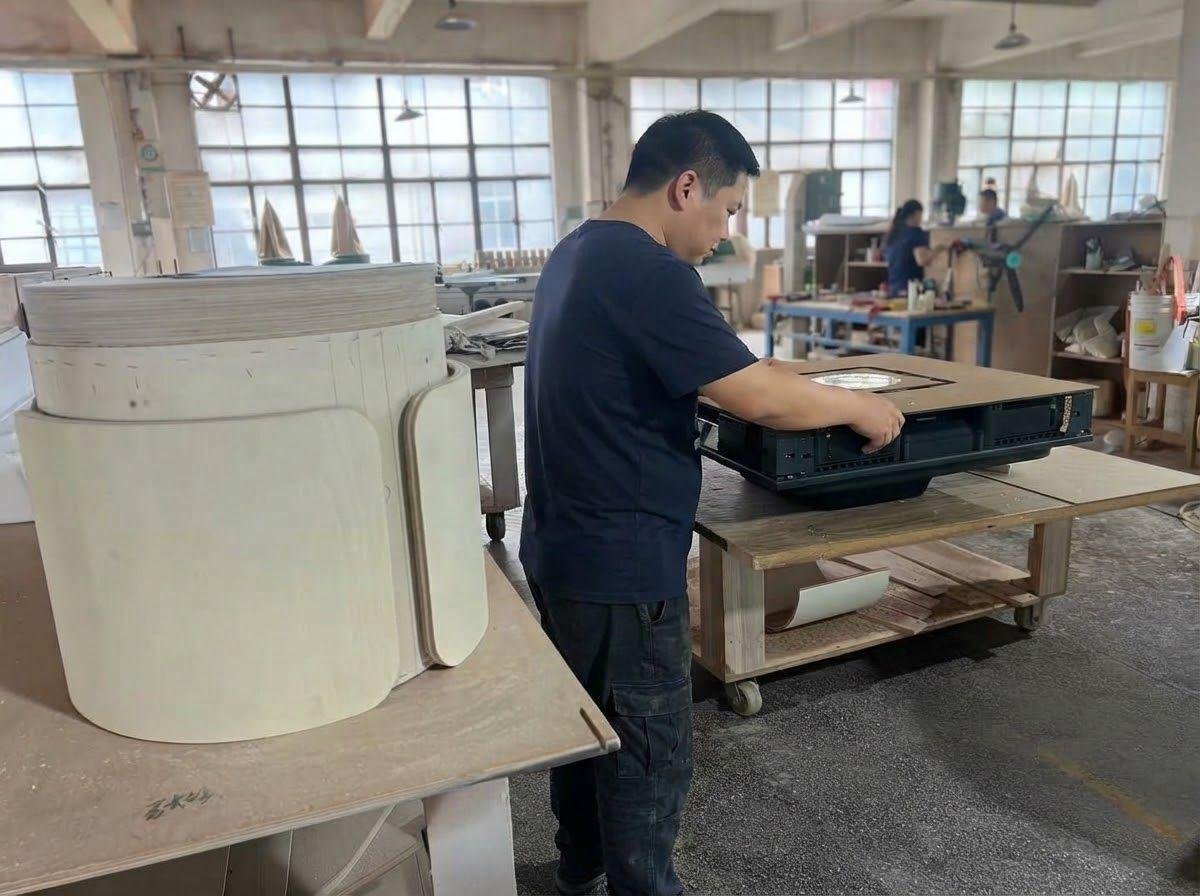
Last Tuesday, I was standing in a freezing Shunde warehouse, choking on fine MDF dust. A depressing realization hit me right there by the loading dock. Western buyers are still falling for the exact same sourcing traps I called out back in 2022.
You know the setup. You’re sitting in some beautifully lit Longjiang showroom. The sales girl pours you a genuinely fantastic cup of Tieguanyin tea. You’re eyeing a gorgeous Italian-style leather sectional. Top-stitching? Immaculate. Leather grade? Surprisingly legit. The $2,400 FOB price is aggressive, sure, but not totally out of the realm of possibility.
But the sales manager is sweating through his polo shirt. Not from the November humidity. It’s because I just asked to use the restroom, walked out the showroom door, and deliberately took a wrong turn into the actual assembly area. Or, more accurately, the right turn.
There wasn’t a single scrap of top-grain leather back there. Just leaning towers of cheap, off-gassing particle board. Mountains of that awful, low-density yellow foam meant for budget domestic motels.
China furniture sourcing isn’t some elegant international trade waltz. It’s a messy, exhausting process of identifying, auditing, and arguing with mainland manufacturers to get commercial or residential goods made at scale—without getting scammed. Miss the subtle cues? This industry will eat you alive. Because you are never just buying a sofa. You are buying that specific supplier’s operational reality.
The Brutal Truth About Factory ‘Capabilities’
Here’s the uncomfortable reality nobody wants to talk about at industry mixers. A beautiful showroom means absolutely nothing.
Factories know you just flew in on a Cathay Pacific red-eye for a frantic three-day sourcing sprint. They know you’re jet-lagged. You just want to see shiny things under LED track lighting, snap a few iPhone photos, and report back to your purchasing director. So what do the shady operators do? They buy premium “golden samples” from top-tier competitors, drag them into their own showrooms, and lie right to your face. They’ll claim they manufactured every piece.
Then you drop a massive container order. The absolute second your 30% wire transfer clears, they scramble. They reverse-engineer that premium sample using absolute garbage materials just to hit the margin they promised you.
Need a survival rule for this game? Burn this into your brain: If they can’t show you the sawdust, they didn’t build the furniture.
Key Takeaways: Ground-Level Survival Rules
- Trust the floor, ignore the showroom: A factory’s real capability is proven at the edgebanding machine, nowhere else.
- Silence is a massive red flag: A quiet factory floor during the Q3 export rush? They’re farming your order out to a ghost operation.
- Friction equals reality: Suppliers who aggressively push back on your crazy timelines or lowball budgets are usually the guys actually doing the heavy lifting.
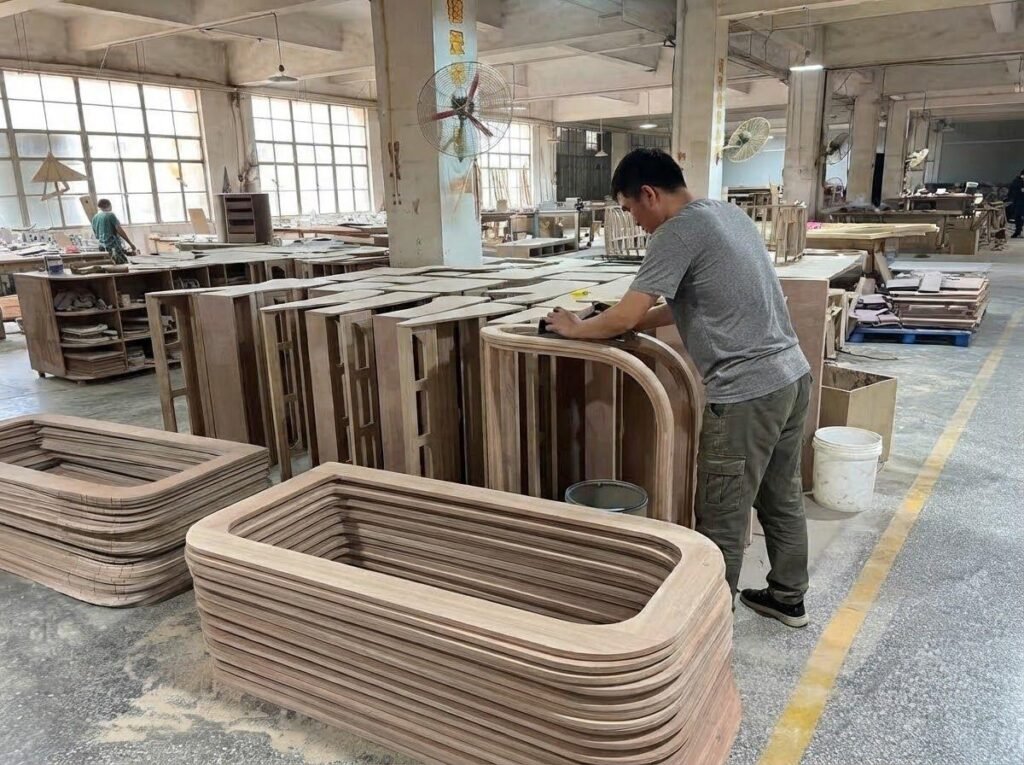
Red Flag #1: The Phantom Production Line
You walk into a massive, 10,000-square-meter facility in Dongguan. The CNC routers look relatively new. Floors are swept clean. Yet your gut tells you something is terribly off.
Why is everyone just standing around?
Trying to gauge actual output capacity during a walkthrough? It’s exactly like eating at a sketchy roadside seafood joint. If the dining room is completely empty at 7:00 PM on a Friday, you probably shouldn’t order the crab. Same logic applies to a manufacturing facility in mid-September. If the production line is dead quiet, grab your Tumi bag and leave.
(And yes, I learned this the hard way after a 400-room hospitality project went completely sideways back in 2018).
I once walked a factory where workers were literally sitting on pallets of cardboard, playing mobile games on their phones. The boss smiled. Claimed they were just “between shifts.” Total nonsense. What most western buyers miss isn’t just the lack of bodies. It’s the lack of mess.
Real factories are absolute chaos. They smell intensely of fresh PU lacquer, toluene, and pine dust. You constantly trip over tangled air hoses. Half-finished chair frames pile up haphazardly near the upholstery stations because a bottleneck happened at the sanding line two hours ago.
Spot a pristine, library-quiet factory? You’re standing inside a trading company’s rented shell. A facility lacking a constant, humming backlog of raw materials is one that fully intends to sub-contract your order to a cheaper, un-audited sweatshop two towns over. Total smoke and mirrors.
Red Flag #2: The Sample Room Bait-and-Switch
This right here is where a lack of rigorous Chinese supplier QC completely obliterates profit margins.
You approve a pre-production sample. It’s heavy. Uses D45 high-resilience foam. The internal framing is legitimately kiln-dried North American Ash. You sign off. Eight weeks later, your first 40HQ container hits the Port of Long Beach. The warehouse guys swing the container doors open—and the smell of cheap yellow glue practically knocks them backward.
Are you actually paying for the guts?
The bait-and-switch almost never happens on the visible exterior. Nobody is dumb enough to swap a blue velvet for a red cotton. The crime happens entirely inside the guts of the furniture. A supplier will quietly swap that 45kg/m³ high-density foam for 25kg/m³ junk. Stuff that flattens out into a sad pancake after three months of hotel guests sitting on it. They’ll swap solid wood internal blocking for cheap plywood offcuts stapled together. They’ll space the sinuous springs six inches apart instead of three.
Proper China furniture inspection isn’t about looking at the finish or checking a basic carton drop-test. It’s about doing a forensic autopsy on the product. You have to literally cut the sofa open. I carry a heavy-duty utility knife on factory tours for this exact reason. The sheer panic on a sales rep’s face when I slice open a seat cushion? Priceless.
The most dangerous vendor isn’t the one making bad furniture; it’s the one who knows exactly how to make bad furniture look good for exactly 90 days.
| Trading Company / Shell | Authentic Manufacturer |
| Showroom has 50 completely disconnected aesthetics | Showroom focuses heavily on 1-2 core product categories |
| Rep says “yes” to major structural changes instantly | Rep has to grab a production engineer to verify changes |
| Floor is suspiciously clean, zero raw material staging | Floor has distinct, messy, highly active material zones |
| Fights you on bringing in third-party auditors | Welcomes auditors (though they’ll still grumble about it) |

The Middle-Market Ecosystem: Finding Your Weight Class
A lot of sourcing disasters happen simply because buyers don’t understand their own weight class in the Chinese market.
Everyone wants to go direct to the massive, million-square-meter megaplants in Foshan. Sure, they have incredible machinery. But if you’re dropping a five-container order into a facility that just inked a 5,000-room Middle Eastern casino contract? You do not matter to them. Your emails will be ignored. Your production run will get pushed back. Simple as that.
Conversely, some of the smartest money I’ve seen lately gravitates toward mid-sized specialists. Take operations like Interi Furniture, for example. They focus heavily on scalable production for project and high-end residential clients. That’s a totally different risk-reward equation. Factories in that specific tier are big enough to maintain actual, documented quality control systems and proper CAD engineering, but hungry enough that your order actually keeps their lights on. You desperately need a supplier who genuinely values your specific volume.
Red Flag #3: The “No Problem” Syndrome
I violently despise the phrase “no problem.” Over here, “no problem” (没问题 / mei wenti) rarely means they have a solution. It usually means “I haven’t thought about this enough to realize there is a massive engineering flaw.”
Why is complete agreement terrifying?
Imagine telling a contractor you want to build a glass house in a hurricane zone, but you want it done in three weeks for half the market price. If they look you in the eye and say “no problem,” you run for the hills.
But buyers hear this from furniture reps constantly. They mistakenly think it’s excellent customer service. You ask for a complex curved walnut veneer finish on a ridiculously tight 25-day lead time. The rep nods, smiles, pours more tea. They take your wire transfer.
And then the excuses start rolling in.
First, it’s a sudden delay with the local lumber supplier. Next, the local government is implementing rolling power cuts so they can’t run the kilns. Then, a critical Homag edgebander broke down. By the time your goods finally hit the water, you are 45 days late and the veneer is already peeling at the seams. A legitimate supplier will argue with you, push back on your unhinged timelines, and tell you bluntly when your target price will compromise the structural integrity of the piece.
If they aren’t fighting you on the details before the deposit, they are absolutely going to fight you on the quality after delivery.
The Pre-Deposit Survival Framework
Before you wire a single dollar to a new vendor, you need a rigid, cynical vetting process. Do not rely on Alibaba “Gold Supplier” badges. Those are paid marketing subscriptions. Not actual verification documents.
Here is how you actually protect yourself on the ground:
- Demand a live video walk-through, zero warning. Not a slick, drone-shot promotional video. Call them on WeChat at 2:00 PM local time. Ask them to physically walk from the showroom to the raw materials warehouse while you watch. Note every hesitation. Watch how the camera moves—does the Wi-Fi magically cut out when they get near the production floor?
- Audit the lumber yard. If a factory claims they specialize in solid wood, they need a massive, climate-controlled space for acclimating lumber. No lumber yard? No factory. Period.
- Check the moisture content. Did they actually acclimate the wood? Ask them to stick a moisture meter in a piece of raw oak right in front of you. 8-12% is what you want. Anything higher, and that table is splitting in half the second it hits the dry heat in Arizona.
- The Contrarian Red Flag: Avoid the factory with a spotless, completely quiet showroom. You want noise. Chaos. You want to see workers actively arguing over a G-code on a routing machine. Chaos means they have real orders and real production problems they are actively solving.

Frequently Asked Questions From the Trenches
Q: How do I know if they are a real factory or just a trading company front?
A: Ask for their VAT invoices for raw material purchases. A trading company buys finished goods and won’t have bulk invoices for raw FSC oak, hardware, or foam. A real factory can produce a paper trail of raw material sourcing within ten minutes. A fake one will tell you those documents are “confidential.”
Q: If I hire a third-party QC company, am I fully protected?
A: Absolutely not. A standard final random inspection (FRI) only checks the superficial finish and packaging of maybe 10% of the goods right before shipping. By then, it’s way too late to fix internal structural issues without destroying the product. You need in-line inspections when the frames are naked, before the upholstery ever goes on.
Q: What is a reasonable defect rate to accept on a container?
A: Anyone who tells you “zero percent” is lying through their teeth to get your business. For mass-market upholstery, a 2% to 3% minor defect rate (a loose thread, a slightly misaligned staple on the underside) is totally standard. For high-end architectural millwork, it needs to be strictly under 1%.
Q: Is it normal for a factory to refuse to use my custom COM fabric?
A: It depends entirely on their business model. Some export mills only work with their localized supply chains because they know exactly how a specific fabric behaves on their automated cutting machines. If they refuse to use your weird velvet, it’s often a sign of strict internal process control. Which is actually a massive green flag.
The Final Word
Next time you are sitting in a beautifully lit Foshan showroom, sipping that premium tea, and listening to a 22-year-old sales rep promise you the world at an unbelievable 40% discount—take a breath. Look past the imported Italian leather swatches.
Ask to see the restrooms. Ask to see the employee canteen. Demand to see the messy scrap pile out behind the cutting room. Because at the end of the day, you aren’t investing in the polished furniture sitting under those warm spotlights. You are investing in the dirty, noisy, complicated machine that builds it.
Are you willing to bet your company’s reputation on a factory that won’t even let you see their sawdust?