

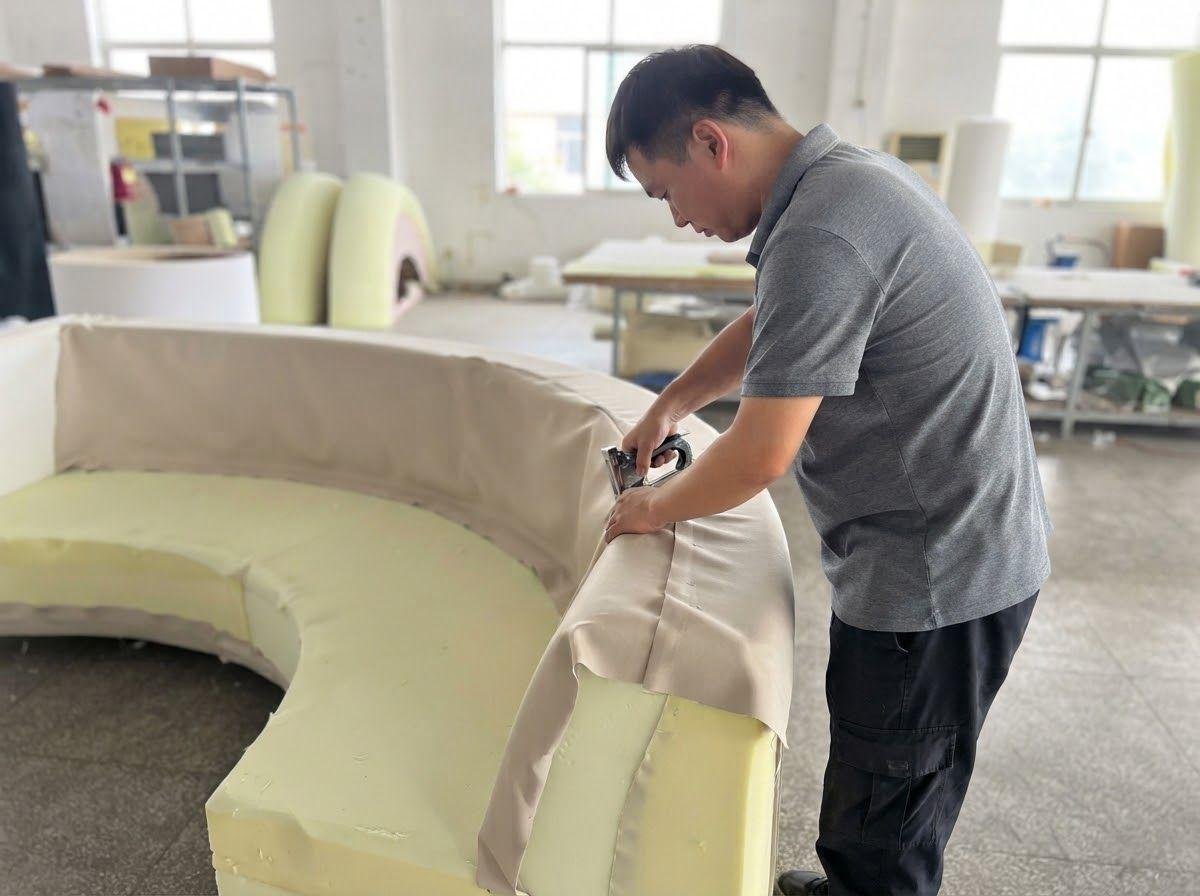
Toluene. If you haven’t spent serious time on a factory floor in southern China, you don’t know the smell. It’s a sickly-sweet chemical stench from cheap spray adhesive that burrows into your clothes and stays there for days.
I was choking on it last September in a sweltering 1,200-square-meter packing bay just outside Dongguan. Standing next to me was Sarah, a procurement lead for a Miami hospitality group. She honestly looked like she was about to cry.
Sitting on the cracked concrete between us was her Q4 lobby anchor piece. A $2,400 prototype of a curved, sweeping bouclé sectional.
Except it didn’t sweep. It bulged.
It looked like a ruptured tube of Pillsbury biscuit dough. Jagged edges of raw pine physically poked through the expensive textile. The seams along the inner radius were puckering so violently they resembled a badly stitched surgical scar. I kicked the wooden base with my steel-toe boot. The whole frame rocked back and forth. Her install deadline was totally cooked, yet the factory boss just stood there, flicking cigarette ashes, swearing up and down that this was “standard export quality.”
How does a supplier who perfectly executed 200 rigid, minimalist dining chairs a month prior manage to completely butcher a sofa?
That right there is the infuriating, unfiltered reality of ordering custom furniture from China. You sign a PO because a 3D render looks slick and the quote saves your budget. You expect heirloom engineering. What you actually get is a crew of underpaid, totally overwhelmed assemblers making it up as they go.
The Brutal Truth About the “Custom” Game
Let’s stop kidding ourselves. Buyers hate hearing this part. I tell it to clients weekly anyway.
Curves bleed cash.
When a random 15-guy garage operation in Longjiang promises to pump out your bespoke, serpentine luxury sofa for a quarter of the Italian wholesale price, they aren’t necessarily running a scam. They aren’t cartoon villains trying to steal your deposit. They literally just do not understand the physics of what you are asking them to build.
Here is my non-negotiable rule for this business: If your CAD file requires foam and upholstery to bend across two competing planes at the exact same time, tear up your budget. Triple it.
Actually, forget the money. The money is just the start of your headache. You have to double your timeline. You are going to suffer through at least two agonizing sample failures. You cannot fast-track geometry. You are asking a 19-year-old kid with a pneumatic stapler to solve a three-dimensional tension problem using stretchy fabric. It never works on the first try.
The Sourcing Reality Check
- China furniture sourcing is a hyper-segmented minefield. The factory welding your brass barstools flawlessy is usually completely clueless about compound upholstery curves.
- Straight lines hide manufacturing sins. Curves broadcast them to everyone in the room.
- Budget shops refuse to pour custom foam molds. They rely on glued-together toxic scrap foam. It deforms in weeks.
- Real customization isn’t copying a photo from Pinterest. It’s hardcore structural engineering.

The Anatomy of a Deflated Marshmallow
Think about trying to gift-wrap a bowling ball with stiff cardboard. No creases allowed. You can’t do it. You need relief cuts. Master tailoring. You really have to understand exactly where the fabric bias naturally wants to pull.
A couple of years back, I dropped in unannounced on a Tier-3 supplier. Corrugated metal roof. Stray dogs sleeping by the loading dock. Guys running heavy band saws in flip-flops. They were tackling a crescent-shaped lounge piece. Now, the correct way to build high-end commercial curves is by pouring high-density injection-molded foam over a steel chassis. But that requires a $5,000 custom mold and huge minimum order quantities.
So what did these guys do instead? They hacked at blocks of cheap yellow slab foam with literal electric turkey carving knives.
Then they blasted industrial adhesive everywhere, aggressively squishing mismatched foam offcuts together to form the curve. Franken-foam.
This is exactly how Chinese workshop flaws manifest on the factory floor. Total smoke and mirrors. A sofa stuffed with glued-together scrap might look passable for a quick, grainy WeChat video before shipping. But a month into sitting in a busy hotel lobby? The internal glued seams violently rupture under human body weight. The fabric bags out. You’re left with a deformed mess. Industry vets know a terrifying volume of budget exports rely entirely on this garbage shortcut.
The Frame Is Always Lying to You
Velvet covers a multitude of sins. Once the fabric goes on, the frame turns into a locked black box. The workshops know you aren’t bringing a crowbar to pry off the bottom dust cover before wiring your 70% balance.
When a 220-pound guest drops onto a 12-foot sectional, the kinetic load on that central arch is massive. Good shops handle this. They route interlocking joints from 18mm Baltic birch plywood, drowning them in wood glue and heavy structural screws.
The budget guys? Wet, unkilned pine cut-offs. Screwed together with staple guns and blind hope.
They also love to improvise when they shouldn’t. I once spec’d a minimalist slatted bed headboard for a client. My drawings explicitly said NO backlighting. Keep it raw. Keep it clean. I show up for the inspection, and the factory boss had glued warm white LED strips completely hidden inside the wooden grilles. His excuse? “It makes it look more premium, boss.” They just guess what you want.
And moisture content is the real killer. If that raw timber hits a moisture meter reading above 12%, you just bought a sponge. Think about the transit journey. That frame sits inside a dark steel shipping container baking at 130 degrees for four weeks on the ocean. It essentially pressure-cooks your sofa. The wood dries out rapidly and twists violently. Staples pop out. By the time it hits your Los Angeles receiving dock, the geometry is toast. Skeletons matter. If the inside of that sofa is junk, the expensive fabric on the outside won’t save you.
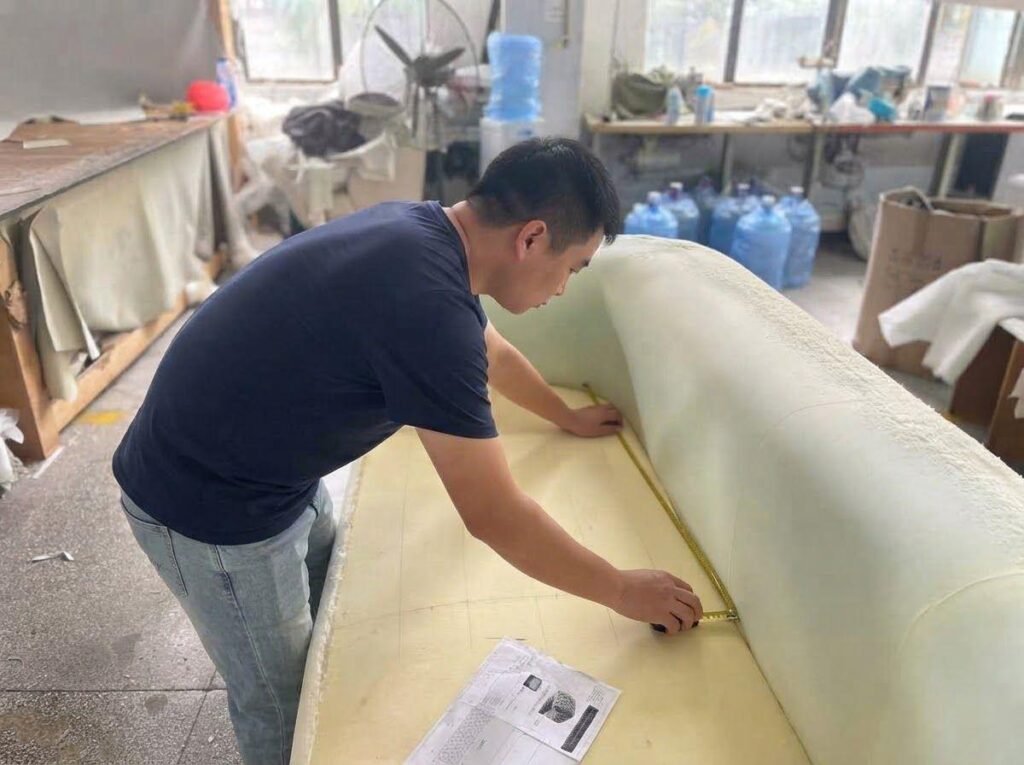
Skip the “white wood” inspection—the raw skeleton phase before the foam goes on—and you are flying totally blind.
Finding the Middle Ground
The manufacturing landscape over here is weirdly polarized. Most buyers fall into two distinct traps. Either you pay an extortionate premium to a massive OEM that treats your 50-piece hospitality order like an annoying distraction, or you roll the dice on a five-man Alibaba garage pretending to be a massive factory.
You don’t have to choose between extremes.
You need a middleweight. I was talking to the R&D folks over at Interi Furniture recently. Smart buyers use mid-sized setups like them because their core business is actually upper-end residential and commercial project engineering. They don’t just blindly copy photos; they keep dedicated designers on staff who think in systems.
For example, they organize their custom R&D using a seasonal material taxonomy. Spring lines mix wood and soft upholstery. Summer strips down to pure solid wood. Autumn introduces metal joints and saddle leather. Winter transitions to heavy, full upholstery. Because they operate on an actual foundational design logic, their CAD engineers understand shear strength and material behavior before a single board gets cut. You’ll pay 20% more than the bottom-feeders, sure. But they actually want your 50-piece order. And they have the CNC routers to execute it without taking stupid shortcuts.
Match your design’s complexity to your vendor’s operational ceiling. Here is how I break it down for clients on the back of a napkin:
| Factory Type | Best For | The Engineering Vibe | The Hidden Risk |
| Massive OEM | 1,000+ unit runs | Automated, rigid, zero flexibility | They flat-out ignore you if you request a 2-inch curve tweak. |
| Mid-Sized Specialist | Hospitality, 50-200 units | In-house CAD, CNC routing, they actually care | Higher unit cost than the budget guys; longer lead times. |
| Cheap Workshop | 1-10 units, budget buyers | Bread-knives, wet pine, staple guns | Complete structural collapse within 6 months. |
The Survival Framework
How do you prevent a container full of garbage from tanking your project? Get ruthless. Enforce a rigid auditing protocol before a single dollar of your T/T deposit clears.
- Demand the “White Wood” Audit: Never let them apply webbing or foam until you see the bare timber frame. Demand raw video walk-arounds. If they resist, walk away.
- — The Dual-Density Interrogation: Ask the sales rep for the exact density (in kg/m³) of the seat cushions versus the backrest. If they give you a single blanket number? Amateurs. Seats need high-resilience foam to prevent bottoming out. Backs require a lower density for plushness.
- Contractual Moisture Limits: Put it in the PO right at the top. “Internal timber moisture must not exceed 10% prior to upholstery.” Buy a $40 moisture meter on Amazon and make your inspector use it right there on the factory floor.
- The Backing Test: Ask how they plan to back a boucle on an inner curve. Good shops apply a fleece or tricot backing to stabilize the textile before it ever touches foam.
Here is the one red flag that completely contradicts conventional wisdom.
If a factory looks at your complicated, sweeping curved CAD drawing and says “Yes, friend, no problem” within two hours? Kill the deal immediately.
A legitimate factory pushes back. They complain about fabric bias. They warn you about puckering on the radius. They ask to move a seam location to relieve tension. A fast ‘yes’ on a custom curve is the most dangerous phrase in Guangdong.
Force a mock-up. You don’t have to drop $3,000 for a full prototype every single time. Sometimes, paying 300 bucks for a one-meter section of the curve proves if they can actually handle the pattern matching.

FAQs from the Sourcing Trenches
Q: My custom sofa just arrived on site, and the inner curve fabric is super wrinkled and baggy. Why did this happen?
A: Usually? Someone skipped mapping the pattern with relief darts because it takes too long. Or worse, you specced a fabric with zero multi-directional stretch. Compound curves require textiles that physically move. Forcing a rigid linen to hug a tight inner radius without puckering is a losing battle against math.
Q: Can I just WhatsApp my factory a screenshot from 1stDibs and get a good replica?
A: Absolutely not. A low-res JPG provides zero data on internal pitch, suspension systems, or joinery. When you send just a photo, the workshop is forced to guess the dimensions. That’s exactly how you get that weird, fun-house mirror distortion that screams “cheap knock-off” the second you unbox it.
Q: If they totally botch the first prototype, should I let them try again?
A: It depends. I watch buyers agonize over this choice weekly. If the topstitching is a little wavy or a leg is off by a centimeter, let them fix it. But if the internal frame is scrap wood and the foam is pieced together with spray adhesive? Cancel the order. They aren’t making a mistake. They are showing you their fundamental manufacturing philosophy.
Q: What about COM (Customer’s Own Material)? Can I just ship my own luxury fabric to a budget shop?
A: That is the fastest way to ruin expensive fabric. A budget factory isn’t used to handling $150-a-yard Schumacher velvet. They won’t check for flaws before cutting. If they mess up a cut, they won’t tell you until they’ve ruined the whole roll. Keep COM away from cheap shops.
Q: Does the math still work? Is importing custom luxury furniture actually cheaper after freight and tariffs?
A: It depends entirely on your scale. Buying one single curved sofa for a living room? By the time you pay for the sample, ocean freight, and tariffs, you might as well just buy domestic. But if you’re outfitting a 40-room boutique resort, the economies of scale are massive—provided you act like a hawk on quality control.
At the close of business, a curved sectional is the ultimate lie detector test on the factory floor. It instantly separates legitimate manufacturing engineers from the guys who just casually assemble parts. Anyone can fake a minimalist, straight-lined tuxedo sofa. But a sweeping, organically shaped piece will loudly broadcast every single manufacturing shortcut the second it catches the afternoon light in your hotel lobby.
Next time you get a quote that seems suspiciously cheap for a highly complex design, take a breath. Ask yourself what you’re actually funding. Are you paying for a meticulously engineered piece of functional art, or are you just buying a really expensive pile of glued-together scrap disguised in velvet?
Good luck out there. Stay skeptical.