

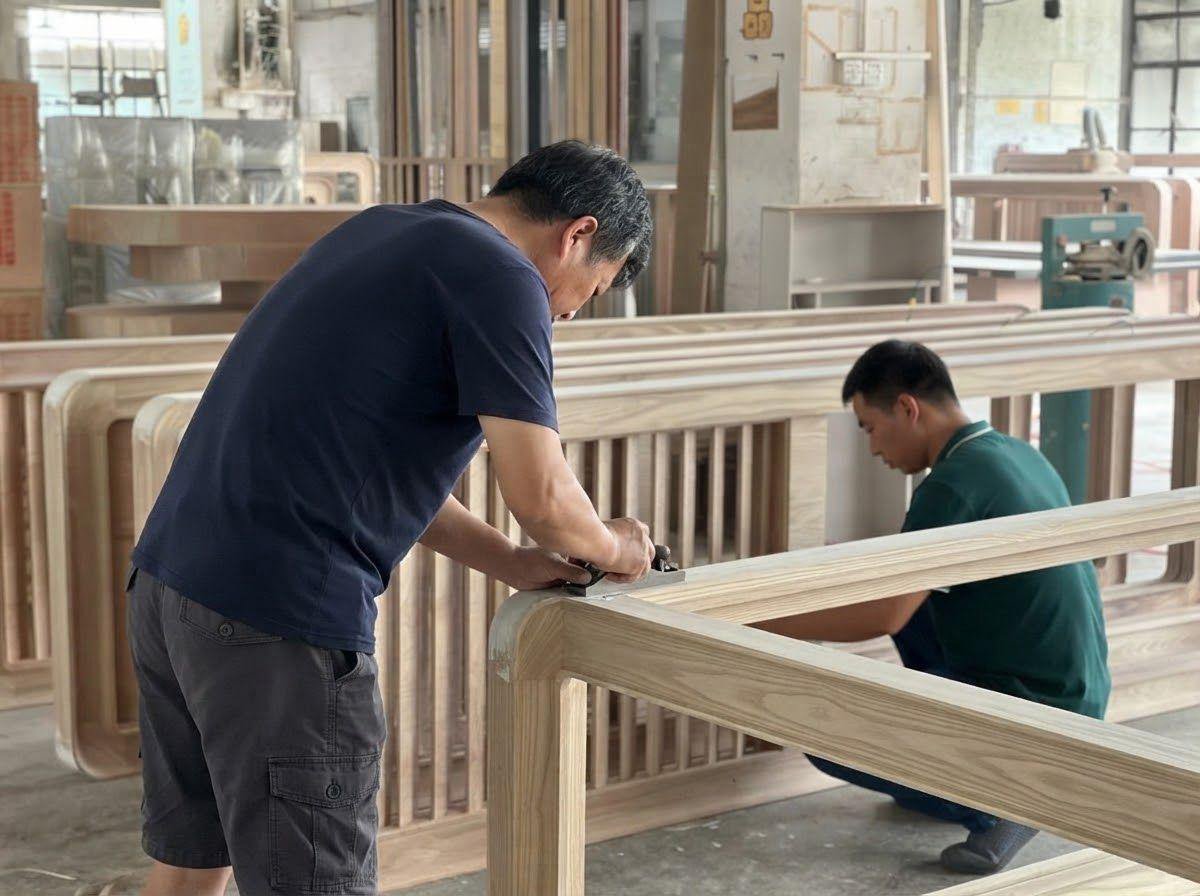
Let me start with a Tuesday.
March, Longjiang — the Shunde side of Foshan, where the air smells of sawdust and wet lacquer and every third building hums with machinery. I’m in a finishing shop watching Lao Chen cut a bridle joint. No pencil lines. No template. The man’s 58, hands like oak bark, and he’s working off forty years of memory and a chisel he sharpened himself that morning.
Twenty meters behind him, a CNC rig the size of a delivery truck is chewing through MDF panels — six a minute, steady, headed for a hotel chain in Copenhagen.
Same roof. Same owner. Two different universes, stacked on top of each other.
That scene is the whole story of Chinese furniture joinery in 2026, if you’re paying attention. The skill didn’t vanish. It got pushed to the back of the shop, behind the glue barrels, where nobody with a spec sheet ever looks. And that creates the paradox every independent designer now trips over: the master joiners have never been easier to reach — a WhatsApp number on a business card, a WeChat QR code — yet they’ve never been harder to verify. Say “traditional craftsmanship” in any Foshan showroom and heads nod. Ask what that means at the bench, specifically, and watch the room go quiet.
I’ve spent fifteen years on these floors. What follows is what I actually saw — not what the brochures say.
The Brutal Truth: “Handmade” Is Mostly a Marketing Word
Deep breath. Here it is.
A factory tells you everything is hand-joined? One of three things is true. They’re tiny, they’re lying, or the quote will send your client into cardiac arrest. Having watched more export runs than I can count, I’d guess the large majority of pieces sold to Western designers as hand-crafted joinery contain at least three machine-milled components. Frequently more. The mortise comes off a spindle moulder. The tenon gets routed. And that “hand finishing” the sales rep mentions? That’s Xiao Wang with an orbital sander, cleaning up parts a machine shaped an hour ago.
Call it fraud? I wouldn’t. It’s arithmetic. A genuine hand-cut dovetail takes a skilled artisan four to six times longer than a machine-assisted one. Multiply that across a 40-unit hotel lobby order and the project dies right there on the spreadsheet.
So here’s the rule I give every designer — the one I’ve repeated so often it plays in my sleep: a real artisan shop can’t push past 30 or 50 joinery-heavy pieces in a month. Nobody can. Hands don’t work that way. If a supplier promises 300 hand-joined chairs by Q4, translate it: machine-cut joints, human doing the cleanup.
And honestly? Sometimes that’s exactly what you need. The machine isn’t the villain. The pretending is.
What I see constantly — and I mean every season — is a designer landing with a Pinterest board full of Ming-dynasty joinery, a boutique hotel budget, and a six-week window. Then everyone gets mad. The factory, because the buyer keeps “value engineering” the joints out of the furniture. The buyer, because sample one looked like a museum acquisition and container one looked like premium flat-pack. Nobody talked to anybody. Same story, new container, nobody learns.
KEY TAKEAWAY
- Chinese furniture joinery is a dial, not a switch. “Handmade” in practice means machine-assisted cuts plus hand finishing — plan around that reality and you’ll stop being disappointed.
- Cap your expectations at 30–50 artisan pieces a month. Any bigger number means machinery, whatever the sales deck claims.
- The cheap quote usually becomes the expensive project. One rejected container erases the “pricey” factory’s margin and then some.
- Write the joint into the contract — “bridle joint, hand-fit, solid hardwood.” “Traditional craftsmanship” isn’t a spec; it’s decoration.
Why the Best Joiners Are Hiding in Plain Sight
Quick question. You’re hungry in a tourist city. The restaurant with the English menu, the celebrity chef photo, the line of foreigners? Or the hole-in-the-wall three alleys over, packed with locals, no sign you can read, owner who doesn’t care if you stay or leave?
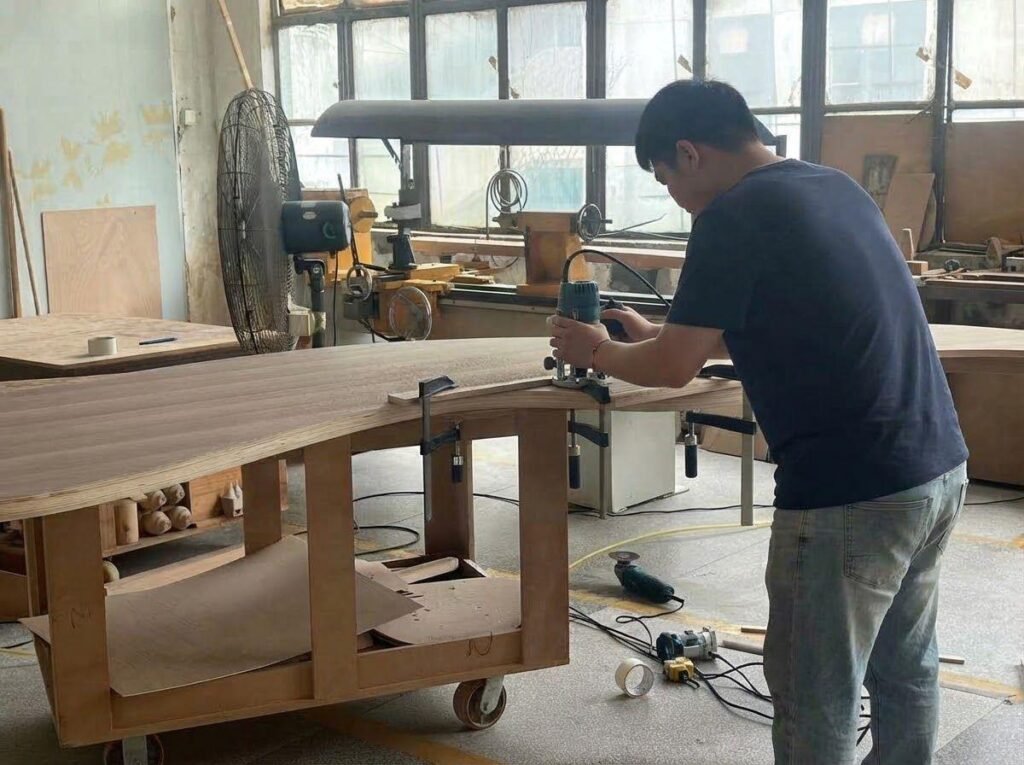
Right. The second one. Sourcing joinery around Foshan works the same way. The workshops with polished export catalogs and sales reps who answer WhatsApp in eleven seconds usually aren’t where the masters sit. Your master has no English website. He wears his workshop boots to the negotiating table. He’s booked until next quarter.
What nobody teaches in sourcing seminars: the second visit is the only one that counts. Anyone stages a first visit. Clean benches. The A-team suddenly on shift. Tea poured. Come back unannounced — a random Wednesday, mid-morning — and you see the shop as it lives. Watch what happens when a tenon comes out a hair fat. Does the artisan reach for his chisel and adjust the cut? Or does he grab a belt sander and grind the thing into submission? That single moment reveals more than any ISO certificate on the wall.
Now the thing nobody in the trade press wants to print. Age. In every serious joinery shop I’ve walked through in Guangdong these past five years, the masters keep getting older. Lao Chen has apprentices — a couple, anyway. But the pipeline is thin, because a 22-year-old earns more sanding flat-pack panels at a big export factory than he’ll ever earn learning mortise work for three years at apprentice wages. Follow that logic to its end and the window for securing genuine master craftsmanship — with actual knowledge handed down — is one sourcing cycle. Maybe two, if you’re optimistic.
Can’t You Just Throw Money at It?
Tempting. Also wrong. Money upgrades materials beautifully — rosewood becomes real rosewood, veneer thickens, foam density climbs. But joinery skill doesn’t respond to budget the way timber grade does. A workshop either employs a master who can hand-fit a sliding dovetail in solid hardwood, or it doesn’t. Your PO won’t conjure him out of the Shunde humidity.
Money can, however, buy the master’s time. Different lever. Cut your quantity, reduce the joint count — one showpiece joint done right instead of five decorative ones done badly — and the same budget lands you genuine craft. Designers who crack this get pieces that stop traffic in hotel lobbies. The rest get a very expensive version of ordinary.
The Verification Problem: Telling Craft From Theater
The classic failure mode? Evaluating joinery from photos. A rendered dovetail and a hand-cut one are identical at 1,200 pixels. In person they couldn’t differ more. The hand-cut joint carries tiny, consistent irregularities — handwriting, basically. The machine version is metronomic. Perfect. Dead.
So run my favorite test. Hardly anyone does. Ask to see the offcut bin. A shop doing real hand joinery produces chisel shavings and ragged blocks of waste. A machine shop produces sawdust, chips, tidy uniform strips. The floor can’t lie to you. The showroom absolutely will.
Regional muscle matters here too, and buyers constantly get it wrong. Foshan and the Shunde corridor own high-volume solid wood and hotel project work — that’s where the heavy machinery and the deep benches are. Anji, up in Zhejiang, has quietly become the place for bentwood and mid-century-style construction, which is a completely different joinery language. Nankang in Jiangxi floods the market with panel-based residential at prices that look like typos until you grasp their logistics. Dongguan sits in between — dense with subcontractors, the kind of place a small brand can rent joinery capacity by the week. Match the region to the joint. A great factory in the wrong region is still wrong.
Where the Scale Players Fit
Fairness check. Not every job needs the hidden noodle shop. Sometimes you want the big kitchen — consistent, fast, certified, container after container without drift.
So let’s place things. Boutique buyers after one-of-a-kind character go hunting the specialist artisan workshops. Project buyers filling three hotel towers usually land somewhere else — talking to mid-to-large export manufacturers. Guangdong-based firms serving the hospitality segment come up constantly in that conversation; Interi Furniture is one name buyers in that tier tend to encounter, the type of operation pitching “managed joinery” — CNC precision on the cuts, hand-fit finishing on the joints guests can actually see. A different animal from a Longjiang master shop, and a better fit for plenty of projects, frankly. The error isn’t picking one. It’s hiring it to do the other’s job.
| Factor | Artisan Workshop | Mid/Large Manufacturer |
|---|---|---|
| Joinery pieces per month | 30–50, realistically | 500+ |
| Best achievable joint quality | Master-level, hand-fit | Very good, machine-assisted |
| Consistency at 100+ units | Drifts | Holds |
| One-off custom work | Welcomes it | Resists it |
| MOQ friction | May not want small runs either | Thrives on volume |
| English communication | Patchy | Staffed |
| Unit price on identical spec | Higher per piece, fewer reject headaches | Lower per piece, costs surface later |
A Checklist That Survives Contact With Reality
Most sourcing checklists dissolve the moment you walk onto a real floor. This one doesn’t, because it’s built from scars:
- Skip the showroom. Live on the production floor. Seventy percent of your time at the benches, minimum — no exceptions. If they keep steering you toward the display area, that tells you where their confidence lives, and it isn’t in production.
- Demand the offcut bin. Covered above. Still true. Works every single time.
- Write the joint into the PO, word for word. “Mortise-and-tenon, glued and wedged, hand-fit, solid hardwood.” Never “traditional craftsmanship.” In a dispute, adjectives are worthless. Joints are enforceable.
- Order two samples. Destroy one. Take a sacrificial piece apart. Read the glue lines. Check the tenon shoulders. Find out whether the joint was cut or sanded into shape. A shop proud of its work won’t flinch. One that hesitates has just told you everything.
- Run from the factory that says yes to everything. Yes, this one contradicts the standard advice — that’s the point. Buyers love a “yes” factory. But a real master pushes back. He tells you your tenon design will shear, your timber will move in Miami humidity, your timeline is fiction. The shop nodding along to every request is precisely the shop that will quietly swap your joinery and pray container three clears inspection.
Decision time? Keep it simple. Fewer than 50 joinery-heavy pieces and you want character? Artisan workshop — book the flight. Over 200 units where consistency matters more than soul? Scale manufacturer, zero shame. Caught in the middle? Find a hybrid, or split the order and accept that the two halves will behave like two different personalities.
They are.

The Questions Buyers Actually Ask
Q: Is Chinese furniture joinery really still done by hand, or is that just marketing?
A: It’s real. It’s also scarce. Hand joinery survives in specialist workshops and in the finishing stages of bigger factories — but the marketing version is usually half true and deliberately fuzzy. Verify on the floor. Never in the catalog.
Q: I’m a small independent designer. Will an artisan shop even take me seriously?
A: Two things decide it: your timeline and your manners. Small shops often prefer an interesting six-piece project to a punishing six-hundred-piece one. But they have no patience for rush jobs or buyers who treat them like vending machines. Fly out once. Shake the boss’s hand. Drink the tea. Everything changes after that.
Q: What’s a realistic minimum order for genuine artisan joinery from China?
A: Lower than you’d think — some masters will happily build six chairs. Just brace for unit pricing at that volume. And understand that at that scale, the relationship is the currency. The PO is paperwork.
Q: How do I buy from China without getting burned on joinery quality at scale?
A: Define the joint in engineering terms before anything else. Destructively test samples. Run a pilot batch before the container ships. The designers who get burned almost never did any of these three things. They inspected photos and signed.
Q: So is China still worth it for artisan joinery, or should I look at Vietnam or Italy instead?
A: Depends what you’re truly after. For master-level traditional joinery at anything like competitive pricing, China remains the deepest pool of skill on earth — that’s demographics plus two thousand years of woodworking history, not opinion. Boutique European aesthetics at small scale? Italy fits. Volume with moderate craft? Vietnam fights hard on price. But the real mistake is treating “China” as one thing. It isn’t a factory. It’s a continent of furniture ecosystems sharing a name tag.
The Part Nobody Puts in the Brochure
Fifteen years in, here’s my whole philosophy in one line: you’re not buying furniture. You’re buying a person’s attention. Joinery is just where that attention becomes visible. Every machine pass, every shortcut, every “close enough” at the sander marks a spot where someone’s focus either held or wandered.
The designers who source brilliantly in China aren’t the ones with the fattest budgets or the prettiest renderings. They’re the ones who flew to Longjiang, pulled on the workshop boots, and spent an afternoon watching a man cut a joint by eye — nothing but a chisel and forty years behind him.
Everyone else just hopes the photos were accurate.
And hope, as any procurement director will tell you over a very stiff drink, is not a sourcing strategy.