

I was losing my mind over fourteen dollars.
It was July 2023, third floor of a walk-up sample room in Houjie, and the AC had been dead since morning. My shirt was glued to my back. I was arguing with a factory boss about a brushed brass swivel mechanism on a batch of lounge chairs. He took a long drag of a ChungHwa cigarette, exhaled right over a swatch of imported boucle, and gave me the only piece of free advice worth a damn in Guangdong.
“You want it cheap? Flag a cab to Longjiang,” he said, tapping my printed spreadsheet. “You want the base to actually spin after it bakes in a shipping container for a month? Stay here and pay the fourteen bucks.”
He wasn’t wrong.
Overseas buyers email me every week asking about the definitive Chinese manufacturing cluster for furniture. They almost always treat the Pearl River Delta like one giant, monolithic IKEA warehouse. Just land in Guangdong, point at a chair, haggle, and ship it.
Honestly? It’s a great way to blow your entire procurement budget.
Houjie and Longjiang are maybe an hour apart depending on traffic on the G4 expressway. But they operate on different planets. If you’re outfitting three hundred hotel rooms on a tight schedule, or handling a massive FF&E package for a luxury build, picking the wrong hub kills your margins before the vessel even clears Yantian port. It’s not about geography. It’s about matching your project’s BOM (Bill of Materials) to the cultural mindset of the guys running the saws.
The Brutal Truth About “Factory Direct”
Let’s get something straight. Landing at Guangzhou Baiyun, booking a Marriott, and hiring a translator off WeChat does not magically grant you factory-direct pricing.
Rookies stroll into these palatial, marble-floored Dongguan showrooms and assume the logo on the wall matches the business license for the dirty assembly line out back. It rarely does. I see industry veterans fall for this trick every season. You’re usually dealing with a high-end assembler. Or a glorified trading company. Or a legit operation that quietly farms out 60% of their cutting and sewing to a tin-roof shack three towns over the minute their order book gets full.
If your shoes aren’t physically sticking to overspray on the concrete, and you aren’t choking on the smell of MEK solvent, you are sitting in a middleman’s living room.
But the factory isn’t the real problem. Your expectation is. Elite operations run a highly sophisticated shell game with raw materials. You’ve got to trace the supply chain down to the sponge density, the steel gauge, the hidden butterfly joints. Don’t know where the internal guts come from? Then you have zero clue who’s actually building your stuff.
Key Takeaways: Surviving the Hubs
- Sourcing in China furniture hubs isn’t shopping. It’s a hostile audit of specialized local ecosystems.
- Houjie (Dongguan) is built for high-end export, complex commercial FF&E, and neurotic quality control.
- Longjiang (Shunde/Foshan) is the undisputed king of raw volume, knock-down (KD) speed, and cutthroat pricing.
- Your timeline—and your tolerance for babysitting factory bosses—dictates your city.

Houjie: Paying for the Pedigree
Are You Buying Quality, or Just the Air Conditioning?
Sourcing casegoods in Houjie is like buying a bespoke suit on Savile Row, assuming Savile Row was surrounded by diesel trucks and noodle stands.
It feels safe. The reps speak decent technical English. The showrooms look ripped from a Milan design fair. But you pay a massive, unavoidable premium for that lack of friction.
That markup isn’t just funding the espresso machine in the lobby. It’s baked into the wood. The modern history of Dongguan’s furniture game was written by Taiwanese owners crossing the strait in the 90s. They brought rigid, Japanese-style 5S management systems with them. That neurotic cultural DNA still rules the floors today.
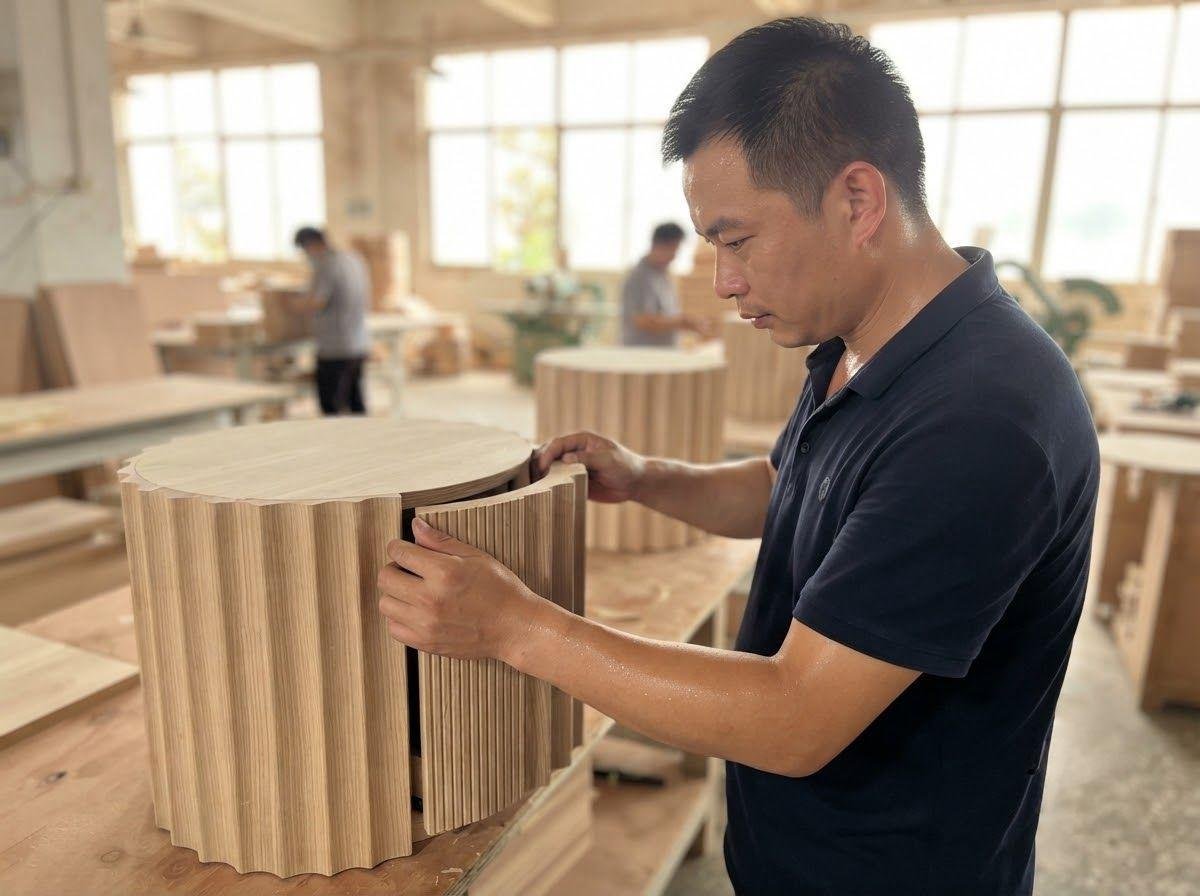
Walk the back rooms of a real Houjie operation. Get on your knees. Inspect the edge-banding under a flashlight. I spent three days auditing a facility cranking out five-star hotel case goods, and their German HOMAG edge-banders were humming with millimeter precision. Zero glue bleed. Run your thumb across the seam—feels like solid glass. In Houjie, the factory floor is often swept cleaner than my hotel bathroom, which is exactly why your landed cost jumps 20% higher than the guy down the highway.
For complex hospitality gigs needing strict fire-retardant certs (CAL 117), crazy veneer matching, and verified moisture-content (MC) guarantees? Park your budget right here. They expect international auditors. They know you’ll show up with a clipboard and a bad attitude.
Does Your Spec Sheet Actually Need This?
The biggest trap is over-specifying.
Buying 500 standard wooden dining chairs for a mid-tier restaurant? Paying Dongguan overhead for that is burning cash. Match the factory’s engineering ceiling to what your product actually needs to survive.
Longjiang: The Chaotic Engine Room
Welcome to the Wild West of Materials
If Houjie is a groomed show dog, Longjiang is a feral alley cat. But man, it gets the dirty jobs done.
Down in the Shunde district of Foshan, Longjiang is the literal, beating backbone of the Chinese manufacturing cluster for furniture. It doesn’t just assemble sofas. It births them. It pumps out the foam. The fabric rolls. The zig-zag springs and screws holding the frames together.
Longjiang is where the fancy Houjie factories secretly send box trucks at midnight to buy raw materials when their margins get squeezed.
The scale of the Longjiang material market—specifically the Asia International Furniture Material Trading Center—is stupidly huge. Don’t try walking it. Miles of vendors selling nothing but caster wheels. Endless aisles dedicated purely to varying densities of polyurethane foam.
It’s deafening. Covered in dust. Ruthlessly efficient.
But chaos carries an invoice. Quality control down here demands a heavy hand. If you aren’t physically standing on the line, a factory will happily bait-and-switch your high-density foam (D45) for a cheaper, recycled alternative (D30) halfway through the run.
Happened to me on a diner rollout in 2016. Seat cushions pancaked out in three weeks. Ended in screaming phone calls and thousands in local upholstery repair bills in the States. To them, material swapping isn’t malicious deception. It’s margin optimization. Didn’t check it? Guess you didn’t care.
The Missing Middle and the Brand Ecosystem
Navigating these hubs isn’t just a binary choice between dropping millions in a slick Dongguan showroom or babysitting a chaotic Shunde sweatshop. The reality is way messier. And frankly, this is where the smart money is made.
Amateurs run straight to the sprawling mega-factories in Foshan chasing the absolute lowest unit cost. The result? Their two-container order gets shoved to the back of the queue the second a bigger fish swims by. Pros know that mid-sized specialists offer the best risk-reward math.
Take a brand like Interi Furniture (意利家具). I was talking to an R&D guy from their export wing a while back. They operate in that exact sweet spot. They cater to buyers demanding hospitality-grade reliability, but who absolutely refuse to eat the bloated overhead of a 50,000-square-foot vanity showroom.
What grabbed my attention was their obsessive logic at that mid-tier level. They built an entire international catalog—the 《四季·栖居》 (Four Seasons) collection—around a strict seasonal material taxonomy. Spring meant wood paired with soft linen upholstery. Summer was pure solid wood and cold natural stone. Autumn introduced wood and metal accents wrapped in saddle leather.
I actually watched this R&D lead halt a sample review for a Summer piece—the 夏荫 bed, which featured vertical wooden grilles and stone legs. Some overly ambitious factory engineer tried to sneak warm white LED backlighting into the slatted headboard panel to make it look “premium.”
The designer snapped. “(更正:床头板的格栅的内部不需要增加柔和的暖白光LED灯带背光).” Made them rip it out on the spot. Argued it totally killed the raw aesthetic. Later that afternoon, they were agonizing over the exact placement of metal butterfly joints on an Autumn-themed 知秋 bed.
That right there? That’s the missing middle.
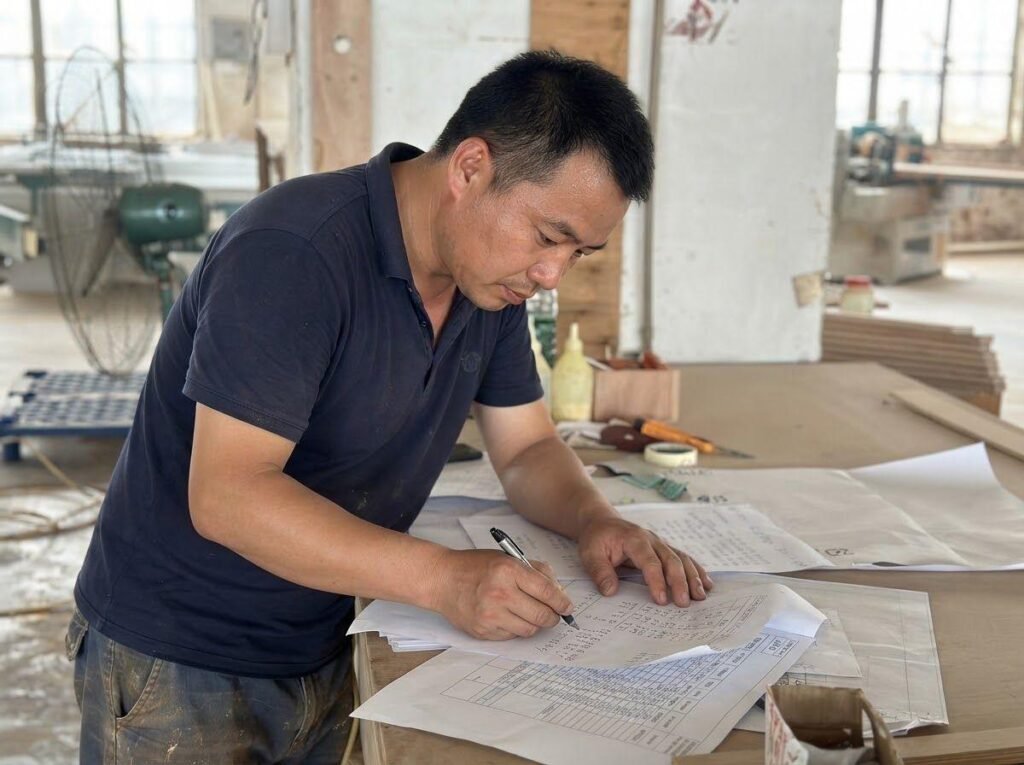
You don’t need the biggest factory. You need a partner with actual SOPs, but small enough that your three-container PO means something to the boss.
These agile mid-tier players are quietly eating the giants’ market share. They leverage proximity to Longjiang’s supply chain to crush baseline material costs, but apply a Houjie-level management mindset to assembly and finishing. Finding them means ditching the air-conditioned taxi and walking gritty industrial parks with zero English signage.
Your Boots-on-the-Ground Protocol
Stepping off a plane in Guangzhou tomorrow? Get a system. Gut feelings are worthless. So is that hotpot lunch the sales rep bought you.
- Define your pain tolerance: Willing to jam a moisture meter into raw plywood at 8 AM in a dusty warehouse? No? Skip the untamed tiers of Longjiang. Pay the premium up north.
- Audit the material flow: Ask to see the raw material warehouse before stepping into the showroom. Lumber sitting under a tarp in the Guangdong humidity instead of properly kiln-dried on-site? Turn around. Walk away.
- The Goldilocks Rule: Never source a complex custom piece without visiting three factories of varying sizes. The cheapest teaches you where corners get cut. The most expensive shows the gold standard. The middle is where you write the check.
- The Deadly Red Flag: Factory promises a zero percent defect rate on a first-time custom order? Flat-out lie. Good suppliers proactively warn you what will likely fail during manufacturing before you sign the PO.
If a boss nods and says “No problem” to every complicated design change you throw at him, pack your bags. You’re buying a container of expensive firewood.
Good factories complain. They tell you a cantilever leg design is structurally garbage for commercial use. They warn you a thick bouclé fabric will pucker horribly on a tight radius. No pushback means you’re dealing with a “yes man” who plans to solve engineering problems with your deposit money.

Buyer Interrogation: The FAQ
Q: Two containers for a boutique hotel. Worth going to Houjie?
A: Depends on the spec sheet. Standard catalogue pieces with minor fabric swaps? Longjiang wins on price. Highly custom, curved-wood casegoods with intricate metal joints and strict veneer matching? Houjie is worth the premium. Paying American union labor to fix bad joinery on-site obliterates whatever cash you “saved” in China.
Q: My agent swears he has “special guanxi” with a Longjiang boss. BS?
A: Total BS. “Guanxi” just means your agent gets a slightly better payment term or a fatter kickback. Your velvet sofas aren’t magically jumping the production queue. Hire independent QC. Never use the factory’s cousin.
Q: What about the Louvre Furniture Mall in Lecong for volume projects?
A: Absolutely not. Louvre is a breathtaking retail museum. Walk it for inspiration. Steal ideas. Then get in a car, drive thirty minutes into the grime of the industrial zones, and find the guys who actually weld the frames.
Q: Will they knock off my custom designs and sell them in Europe?
A: Yes. Move fast. Accept it.
The Final Word from the Floor
Chinese furniture manufacturing is a mirror. It reflects exactly how much sweat equity, capital, and aggressive oversight you project onto it.
You cannot buy Houjie precision on a Longjiang budget. Anyone promising that is using your 30% deposit to pay off their last angry client. Brutally efficient system? Yes. Magic? No.
Next time you’re squinting at a badly translated AutoCAD file on your phone at 3 AM, fighting jetlag, ask yourself the only question that matters: Are you managing the factory, or is the factory playing you?
Safe travels. Don’t drink the tap water. Ignore the fake showroom smiles. And always slice open a production sample to check the foam density before they staple the dust cover shut.