

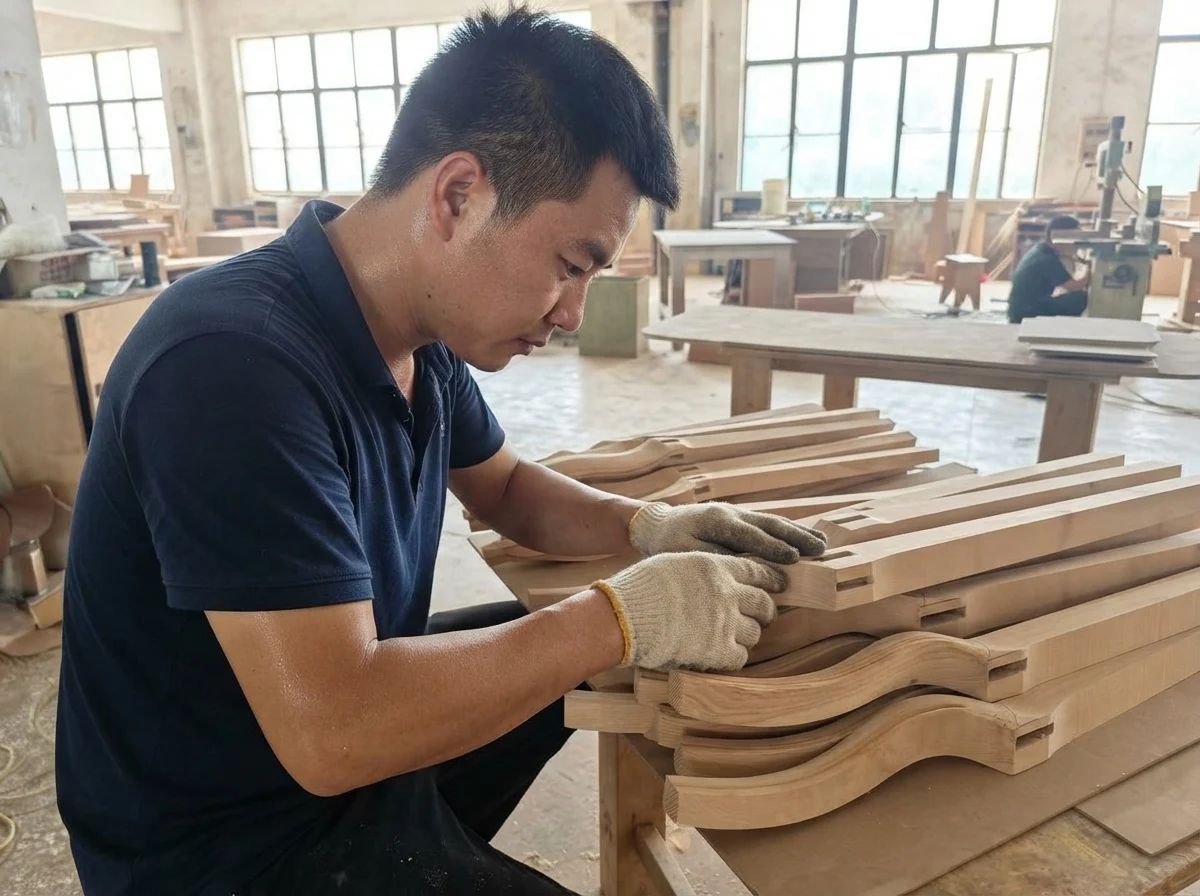
It was raining sideways in Houjie, Dongguan. The kind of oppressive, heavy summer rain that makes a factory floor smell intensely of wet cardboard and curing adhesives. I was sitting on a wobbly plastic stool in a windowless office. Across from me was Boss Wang, tapping a grease-stained pen against a scarred laminate desk. My client—a procurement director from a mid-sized London hospitality group—kept jabbing his finger at a beautifully rendered CAD drawing.
Wang didn’t even blink. “Two hundred pieces?” he finally rasped, lighting a cigarette. “My guys don’t even calibrate the CNC routers for two hundred pieces. Go look on Taobao.”
My client went the color of wet cement. He had spent three agonizing months trying to find Chinese suppliers on page six of Alibaba, convinced he had cracked some secret code. He thought he had completely outsmarted the global supply chain.
He hadn’t. He had just slammed face-first into the brick wall of reality.
Finding a Chinese supplier who can actually execute complex, high-end designs without quietly substituting your materials isn’t some digital exercise. It’s trench warfare. The factories you desperately want building your goods aren’t looking for you. They don’t hire twenty-two-year-old sales reps to spam your inbox. And they definitely don’t want to be found by buyers who don’t know exactly what they are doing.
The Brutal Truth About “Hidden” Factories
Listen. Most buyers hate hearing this. But the factories you actually want to work with are actively hiding from you.
Why? Because western startups and boutique brands are a massive, margin-killing headache. Rookies ask for five rounds of prototype revisions. They complain about the natural grain variance in solid timber. Then, after eight months of endless WeChat messaging, they place a microscopic order that barely covers the factory’s cost of cutting the jigs.
Actually, that’s not quite right — the real problem isn’t just the buyer’s attitude, it’s the factory’s existing bandwidth.
The best specialized manufacturers in Guangdong or Zhejiang are already running at 90% capacity. They are quietly feeding massive domestic Chinese project giants or pumping out white-label goods for legacy European brands. They simply do not need your half-container of mixed dining chairs to keep their lights on.
If a supplier’s Alibaba page looks like it was designed by a Madison Avenue ad agency, and they speak flawless Oxford English while offering a 10-piece minimum, you are talking to a trading company marking up the real factory’s price by 40%.
That is the ironclad rule of thumb on the ground. The worse the showroom lighting, the better the factory’s actual engineering capabilities tend to be. You want a partner who dumps all their capital into buying brand-new German five-axis CNC machines, not someone who buys fake leather sofas for their lobby to impress foreign tourists.
Key Takeaway: The Unvarnished Sourcing Playbook
- Skip the megacity traps: The actual specialists are buried in tier-3 industrial zones, not paying premium rent in massive exhibition halls.
- Follow the parts: You find the best furniture assemblers by tracking who buys the highest-quality raw materials (premium linen, high-density foam, imported hardware).
- Target the middle: Megafactories will bump your order; micro-workshops might disappear overnight. Mid-sized specialists are the sweet spot.
- Boots on the ground: A glossy B2B profile is cheap to fake. A disorganized, solvent-heavy spray room with an active extraction system cannot be faked.

Secret #1: The “Follow the Sub-Components” Strategy
Here is a tactic you will never, ever find in a corporate supply chain management course. Stop looking for the finished product. Look for the parts.
If you want to find a niche manufacturer of luxury seating, do not search for a sofa factory. That’s a rookie move that leads you straight to the middlemen. Instead, search for the local distributors of high-end Italian reclining mechanisms. Or find the premium foam vendors operating out of Shunde.
Then, you take those local component reps out to a loud, chaotic dinner. You pour them a few glasses of Baijiu. And you simply ask them who their best, most consistent clients are.
(And yes, this happens vastly more than anyone admits in the polite circles of global procurement).
A fabric vendor will happily gossip over beers about which factories are consistently buying premium materials, and which ones are secretly downgrading their orders to pad their margins. You find the best assemblers by tracking the flow of the best raw materials. It’s an undeniable truth. A factory buying premium Blum hinges cannot afford to employ a hack assembly line.
The R&D Argument You Want to Overhear
I’ll give you a perfect example from a recent factory visit. A foreign buyer was trying to develop a high-end seasonal bed collection—four distinct designs reflecting a strict cycle of Spring, Summer, Autumn, and Winter.
The buyer kept aggressively pushing the factory to use cheap genuine leather on the headboard and install warm white LED backlighting inside the headboard slats. He thought it looked expensive.
The R&D director of this mid-sized factory pushed back hard. He pulled out the CAD drawings and flatly refused to build it that way. He explained that true modern Eastern aesthetics demand off-white bouclé for the main body and pure linen for the headboard upholstery. No leather. He mandated dark wood paired strictly with metal for the structural frame. And he completely stripped out the tacky LED backlights.
Pure gold.
You want the assemblers who will argue with you over the raw materials.
By sourcing backward from the component level, you bypass the trading companies entirely. You go straight to the operators who care deeply about what goes inside the frame, not just how it looks rendered in an isolated pure white background.
Secret #2: Ignore the Megacity Trade Shows (Mostly)
China’s manufacturing map is a mess of hyper-specialized fiefdoms. But that textbook definition makes it sound sterile and organized. Trust me, it’s not.
Let’s talk about the Canton Fair and CIFF. Every single year, thousands of buyers fly into Guangzhou. They walk the heavily carpeted aisles until their feet literally bleed. They collect hundreds of glossy brochures, eat a terrible sandwich, and fly home thinking they’ve seen the whole market.
They haven’t. They’ve seen the polished, heavily sanitized veneer.
Finding a truly capable niche supplier is exactly like trying to find an authentic dive bar in a gentrifying city. If there’s a giant neon sign pointing to it, the massive retail conglomerates have already moved in and ruined the pricing structure for everyone else.
The factories doing the most innovative material mixing rarely bother paying for massive export show booths. Their production lines are already booked out six months in advance.
Are You Looking in the Wrong Province Entirely?
I remember getting tipped off by a local logistics driver a few years back. We drove deep into a dilapidated industrial park. We were looking for a workshop doing incredible reclaimed teak pieces.
No website. No English speakers.
They were literally buried down an alley behind a massive facility churning out cheap plastic wash basins. Most buyers fail right out of the gate because they fundamentally do not understand regional specialization. If you want glass and metal dining tables, what on earth are you doing in South China? You need to be up north in Hebei province, specifically Shengfang. If you want high-end ergonomic office chairs, you go to Anji. Solid rubberwood living room sets? Nankang.
When you sit in a comfortable office in London and search “China furniture sourcing” online, the algorithm just feeds you whoever paid the most for SEO in Shenzhen. It has absolutely zero correlation with what they actually know how to build on the floor.

Secret #3: Navigating the Mid-Sized Sweet Spot
Buyers usually make a massive binary mistake when they finally land in China. They either gravitate toward the massive, faceless OEM giants who demand 500-piece minimums per SKU, or they gamble their entire deposit on a tiny, undercapitalized micro-workshop that might vanish into thin air.
But the real magic — the actual innovation — happens squarely in the middle.
While some buyers try to force mega-factories to do delicate custom work (which always ends in tears), smart money looks at mid-sized specialists. Take an operation like Interi Furniture, for example. They built their model around being a high end custom furniture solution provider, rather than chasing pure volume. Their stated mission is to make design more achievable, and they anchor their entire B2B operation on a single core claim: Never let clients down.
That is exactly the type of ecosystem you want to tap into.
These mid-sized facilities usually run with 150 to 300 workers. That means they are big enough to have real in-house engineering chops and AutoCAD draftspersons to handle your complex custom tech-packs. But they aren’t so massive that your three-container boutique hotel project gets unceremoniously shoved to the back of the production schedule the second a big-box retailer places a rush order.
The mid-sized factory tier is where genuine OEM and ODM innovation actually happens in China today.
They are hungry enough to care about your specific niche. But they are established enough to have real, verifiable quality control protocols in place. They have dedicated white-wood inspection areas where you can check the joints before the paint goes on. They aren’t figuring out basic manufacturing principles on your dime.
The “First-In” Sourcing Framework
So how do you actually execute this without moving to Guangdong and losing your mind? Here is the unvarnished framework I use when a client needs to uncover a supplier before their competitors do.
- Trace the Domestic Project GiantsLook at who is supplying the domestic Chinese 5-star hotels. The internal hospitality market is exploding, and the factories servicing these domestic luxury brands are often entirely invisible to western buyers. Track down the procurement lists for new resort builds in Hainan. That’s your target list.
- The WeChat AuditForget their website. A dead website means absolutely nothing in China. But if they don’t have a WeChat Official Account with regular, unedited video updates of their factory floor and recent container shipments? Run. A dead WeChat means they aren’t doing real business.
- Check the Photography BayReal factories building high-end goods take their product photography seriously. Look at their in-house studio. If they know to shoot their furniture against beige latex paint walls using soft 4:30 PM spring lighting, they understand modern CMF (Color-Material-Finish). If they just slap it against a dirty white sheet under harsh fluorescents, they don’t get it.
- Ask for the “Graveyard” TourWhen you finally visit a factory, do not let them trap you in the air-conditioned showroom. Ask to see their reject pile. Ask to see the rework station. A confident factory boss will openly show you what failed QC and explain exactly why the line manager caught it. A bad factory will pretend they have never made a single mistake.
- Red flag: Framed ISO 9001 certificates in the lobby.I know this sounds totally backwards, but hear me out. Every factory has these. You can practically buy them. The real red flag is when a factory relies on these pieces of paper as their primary proof of quality, rather than physically dragging you onto the floor to show you their timber moisture-content testing room.
- The “B-City” RuleGet out of Foshan proper. Hire a driver and go two hours into the surrounding towns like Heshan, Jiangmen, or Zhaoqing. The industrial rent is cheaper. The labor force is slightly more stable. And the factory bosses are usually much more willing to negotiate on initial MOQs to build a long-term export relationship.

Frequently Asked Questions on China Furniture Sourcing
Q: How do I know if I’m talking to a real factory or just a middleman who is lying to me?
A: You ask to see their environmental compliance certificates for their specific spray booths. A trading company won’t have these. They will instantly make up a wild excuse to stall while they beg the real factory for copies. You can also tell them you want to jump on a live WeChat video call right now so they can walk out onto the production floor. If they claim it’s “too noisy” or “against company policy,” hang up the phone. You are talking to a middleman sitting in a high-rise office.
Q: Do I really need to hire a local sourcing agent to find these factories, or can I just grind it out myself online?
A: You absolutely need trusted feet on the ground, whether it’s your own shoes or an agent’s. Alibaba is just a directory of who is best at e-commerce SEO, not who is best at building furniture. Relying solely on B2B platforms guarantees you will only ever find the exact same suppliers your competitors found three years ago.
Q: What happens if I visit a factory and they refuse to show me their sample room or active R&D department?
A: Walk away immediately. If a factory won’t show you their sample room or the active line, they are either a trading company masquerading as a manufacturer, or they are actively producing counterfeit proprietary designs for another client. There are no harmless secrets in this specific industry.
Q: Can I get decent quality from the really cheap suppliers if my third-party QC team watches them like hawks?
A: No. You cannot inspect quality into a product that was engineered poorly from the very start. If the factory’s internal culture is based on cutting corners, using unseasoned wood, and rushing the glue curing times, no amount of aggressive third-party quality control will save your production run. You will just end up with a massive rejection rate, angry emails, and painfully delayed shipments.
Closing Thoughts from the Floor
Finding a niche furniture supplier before the rest of the market catches on isn’t about having a better search algorithm. It’s about getting your boots dirty.
Are you willing to fly into a secondary manufacturing city on a rainy Tuesday? Are you willing to drink dangerously strong tea with a factory boss you just met? Are you willing to ask the hard, uncomfortable questions about exactly where they source their kiln-dried lumber?
The buyers who consistently win over here aren’t the ones who scream the loudest for a discount on the very first order. They are the ones who understand a very basic, uncomfortable truth. The best factories evaluate buyers just as ruthlessly as buyers evaluate factories.
Stop looking for the easiest supplier to find. Start looking for the one that’s genuinely hard to reach. That’s exactly where your margin is waiting. Catch you on the next factory tour.


