


Three weeks before a $180,000 boutique hotel order was due to arrive in Shenzhen port I was in a dusty office in Longjiang, Foshan. There had still not been any arrival of fabric to upholster the furniture and neither had the walnut frames been manufactured. As I questioned a production director regarding the Friday deadline for container loading he refilled my tieguanyin tea and replied: “Try Our Best” We will try our best.
If you have bought anything in China for over 10 minutes then you will know that your blood pressure has just surged.
Whilst not technically a status update, ‘we’ll see’ is effectively a polite euphemism for your delivery date is doomed. Week after week experienced hotel buyers and design experts exit Guangdong showrooms feeling strangely comforted by responses such as “should be no problem!” or “we are studying it.” They return home, revise their Gantt charts and are astounded when their container arrives 21 days late. However, in Western terms you were not lied to. But you failed to recognise the lack of response as a red flag.
Understanding Chinese factory communication
Compared to Westerners, Chinese people place a much greater value on maintaining good interpersonal relations, which shapes every aspect of China supplier communication—especially when it comes to conveying unwelcome messages. Most westerners view communication with a factory in China as akin to giving evidence in court. They want definitive information – ‘yes/no’, ‘on time/off time’ and ‘good/bad’.
For Chinese factory managers it is extremely uncomfortable and potentially even rude to say ‘no’. So they present you with a cushion instead of a brick.
My basic rule for all newly-appointed procurement personnel is that if a factory does not specify a time, quantify something or provide current photographic evidence then the answer is no. Anything beyond this is typically a polite tactic to put off the customer, whilst the factory scrambles to solve an issue which it fervently hopes the customer will not detect.
However, it is not that factories are necessarily dishonest. Rather, western customers tend to ask leading questions which effectively prompt positive speculation.
Key lessons:
- Uncertainty is often used as a deflection. Expressions such as “We’ll see. We will try our best,” or ‘we are investigating’ typically indicate that there is already a production issue.
- Silence can also be a red flag. Within China’s manufacturing environment, negative news tends to filter up the chain slowly. Therefore, a lack of WeChat updates from a factory is seldom synonymous with smooth production.
- Concentrating on objective, verifiable issues ensures that polite deflection is removed.
- Speak to people on the shop floor. Although export sales personnel act as a sort of ‘middle man’ and soften bad news, real production information is generally held by both the production planner and workshop supervisor.
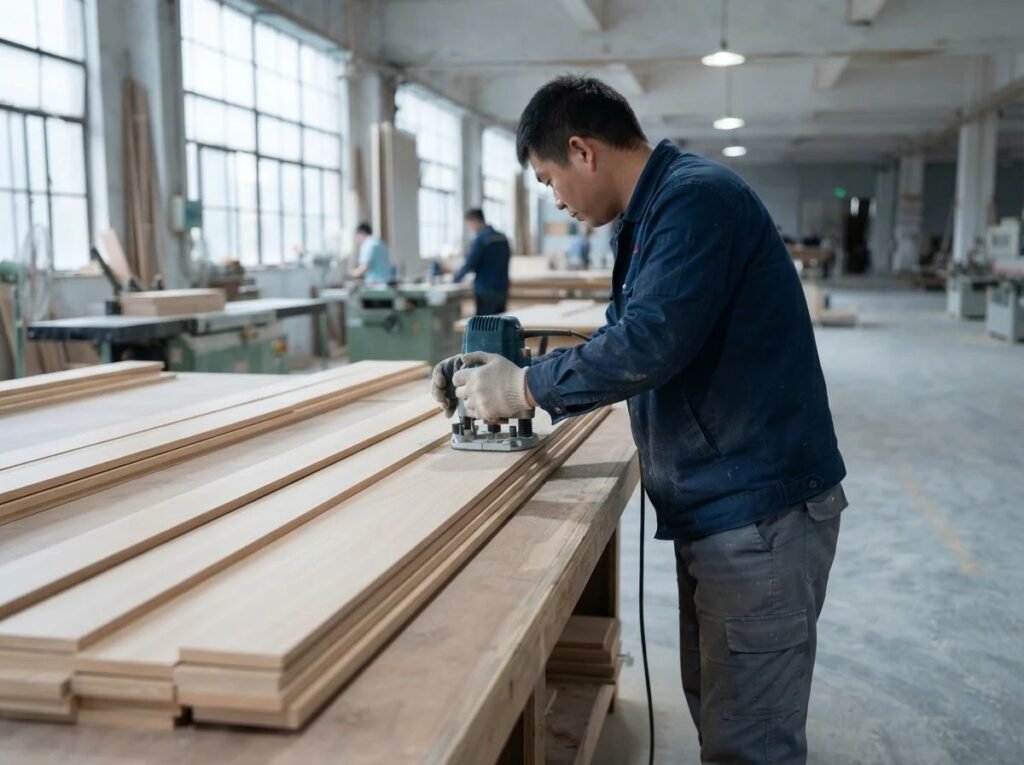
Why Chinese Factory Managers loathe saying no
To successfully communicate with factories in Dongguan or Anji, you must move away from viewing exchanges in purely commercial terms and endeavour to understand the Chinese emphasis on avoiding risk. Just as a timid chef would not meet your gaze and state plainly that the sea bass has been in the fridge since Tuesday, he would instead extol the wonderful taste of the sauce and emphasise how hard the kitchen staff are working on it. Likewise, Chinese factory managers will invariably avoid telling you directly that a veneer supplier or CNC router has failed. They sincerely hope they can perform a miracle and resolve the situation by Thursday. Why damage the relationship unnecessarily on Monday?
Is ‘we will try our best’ a red flag?
Yes, always.
Whilst touring a factory in Dongguan I ignore what a sales manager has stated to me in the showroom and look at whiteboards which are displayed near to sanding stations. (I learnt this the hard way in 2014 when a dining chair order which had supposedly been 90% completed in fact comprised nothing but a pile of beech wood planks!) These boards clearly illustrate what is really important to a factory – either local developer or large European retail orders which are responsible for paying the electricity bill. Should your 40 item hotel order not appear on this list then ‘we will try our best’ indicates that you will be moved to next Tuesday.
Complete theatre.
Interestingly, the more serious the issue, the more vague the language generally used. For example, should a factory be two days late due to a spray booth humidity issue then they may disclose this. However, if they have incorrectly cut the mortise depth on 200 headboards and must re-source timber from their yard, you are suddenly told of their ‘optimisation’ of quality and ‘meticulous’ inspection procedures.
Translation matrix – what is said and what is really happening
Without needing to speak fluent Mandarin you can identify when a factory is being evasive. Simply compare common English expressions with the likely true production scenario.
| Factory expression | Usually means | Appropriate response |
| ‘We will try our best.’ | Behind schedule and unable to establish a solution. | Request photographic evidence of current production with today’s date clearly noted on paper. |
| ‘Should be no problem.’ | Workshop supervisor has yet to be consulted. | Respond: ‘Kindly consult the workshop supervisor and advise me precisely at what time production will complete by 4pm today.’ |
| “It’s under arrangement” | Production has yet to commence or material has not yet reached the dock. | Request the raw material purchasing invoice or photographic evidence of fabric/wood in the factory warehouse. |
| “We are studying the drawing.” | Your specification is too intricate, expensive or unsuitable given our equipment. | Query: “Which two joints or materials on this drawing are causing the biggest headache?” |
| “Everything is smooth.” | Either nothing in the factory is ablaze today or I have not toured the site since Monday. | Disregard this and request a 15 second WeChat video of the production line. |
Talking to the incorrect person
Generally speaking, China supplier communication fails long before any material is ever loaded onto a table saw.This is frequently due to buyers communicating with a factory’s human ‘buffer’. In mid and large scale Chinese furniture factories the export sales representative is seldom in charge of overseeing production.
Trying to discuss a complicated car transmission repair with an auto showroom’s receptionist is similarly unproductive. Although she is polite, an excellent note-taker and keen to ensure you depart content, she has no control over the garage technician in bay four. When you query your export sales representative via WeChat for a definite shipping date she must cross the courtyard to discuss this with the production manager. Typically this gentleman is both overworked and underpaid and is furthermore frustrated by bespoke hotel orders. Should he dismissively reply to her query with a generic grunt she will interpret this as enthusiasm and respond to you with an upbeat ‘we’ll see’.
Why Does the boss suddenly become so quiet?
Whilst visiting a factory in Anji – China’s centre for swivel and office seating – I observed a typical Chinese tea table ‘battle of wits’. The factory laoban (boss) spent two hours serving aged pu’er tea and demonstrating his recently acquired Italian edge banding machine. However, as soon as I produced a late delivery penalty clause, he beamed, nodded and passed the document to his 25 year old sales assistant without even glancing at it.
He was not agreeing with me. He was mentally checking out.
In my experience around 70% of major late delivery issues stem from a buyer wrongly believing that the export sales representative’s positive attitude was congruent with that of the factory laoban. As soon as a factory owner recognises that an order’s margin is diminishing for example due to a sudden surge in foam prices or a designer amending a welt cord requirement then they no longer prioritise that order. Rather than phoning you to debate the issue, the boss will allow his sales representative to suffer the brunt of your angry emails. His employees will meanwhile continue to manufacture more lucrative products.
How Do You Bypass the human buffer?
Never embarrass a sales representative. (Should she feel humiliated in front of her boss she will actively hinder your progress.) Demand that a WeChat chat group be formed comprising yourself, the sales representative and the quality control head – even if the latter only understands Chinese. Utilise WeChat’s translation function. As soon as the production planner can see your queries the ‘Chinese whispers’ game is over.

Constructing binary questions
To extract precise information from Chinese factories, avoid posing questions which can be answered using non-specific words. Enforcing clear communication with Chinese suppliers therefore involves substituting subjective inquiries for quantifiable issues.
Compare the difference between conversing with a friend and interrogating a witness. Whereas asking “Are the lounge chairs looking good for next week?” encourages a more artistic response, requesting “Are all 60 frames sanded and sitting in the primer booth right now—yes or no?” compels an individual to tell the truth.
No scope for manoeuvre.
When inspecting casegoods production in Jiangxi’s Nankang region – a huge and highly dynamic solid and veneered furniture manufacturing region – I never inquire about a production run’s completion date. Instead I ask what the current production bottleneck is. Has the kiln dried ash attained the correct 10% moisture level? Has the brass furniture fittings been delivered from the Zhongshan hardware supplier? By requiring information regarding specific production components, factory bosses actually relax. They recognise that you understand the furniture manufacturing process and so have no need to engage in smoke and mirrors.
Can you create an environment in which the factory is comfortable in conveying adverse information?
Unfortunately, if you react explosively each time a factory concedes that there is a delay then you are in fact encouraging them to continue to misinform you.
On average factories tend to conceal issues for 10-14 days if they are apprehensive about a buyer’s temperament. To receive early warning signals you must firstly acknowledge and reward honesty. Clearly communicate to your factory manager that if fabric is late then you want to be informed on Monday so that we can jointly amend the air freight expenditure. If he only alerts you on Friday then we face a monumental issue. Once a factory appreciates that you are not prone to erupt over minor issues then the ‘we’ll see’ approach rapidly loses its appeal.
Recognising factory size – and adapting your communication style accordingly
Different factories employ differing tactics when it comes to deflecting information. You must tailor your communication style to suit the factory’s working structure.
Dongguan and Foshan mega-factories which supply global retail brands and employ in excess of 500 staff operate via highly structured ERP computer systems and numerous account managers. Although you will receive slick PDF documents and professional language, there is little adaptability if urgent alterations are required for a bespoke hotel order. Conversely, the tiniest family-run factories in locations such as Longjiang will readily say yes to your requests (even if they have never previously manipulated a sheet of ply) just to obtain your 30% deposit.
Sitting squarely in the middle are nimble, mid-sized operations built specifically for project-driven exports. Take a supplier like Interi Furniture, for instance—instead of relying on rigid corporate scripts or reckless over-promising, these setups bridge the gap by pairing dedicated engineering teams directly with overseas design specs. Because their business model lives or dies on recurring hospitality and high-end residential contracts, they actually welcome technical pushback upfront rather than hiding behind vague reassurances. Even so, you still need to audit their third-party workshops for raw materials and finishes just as tightly as you would with a mega-plant.
Irrespective of which category of factory you are working with, always remember that a factory’s communication style is closely related to its internal structure. Typically, if a factory’s WeChat channel is in disarray then so is its warehouse.
The 4 point verification process
Cease passively expecting information and begin actively generating it. Apply the following 4 point process to each active order prior to despatching any of your remaining balance payment.
- The “Show, Don’t Tell” principle Never accept verbal information. Demand a 10 second un-edited WeChat video of items in production. Alongside this, request either a detailed shot of a production ticket or a piece of paper displaying today’s date.
- Provide an easy route out. Rather than asking “Can you finish by the 15th?” present two alternative dates – for example, “If we can’t hit the 15th, is the 19th realistic, or are we looking at the 24th?” Giving a customer two tangible options reduces someone’s reluctance to concede that a deadline may not be met.
- Investigate sub-suppliers. Typically furniture production delays do not stem from a factory but from sub-suppliers including foam cutters, powder coating facilities and marble yards. On day 1 obtain details of the names and expected delivery dates of all outsourced items.
- The surprising ‘instant consensus’ principle Whilst it is commonly believed that an adaptable and positive supplier is highly desirable, within Chinese furniture procurement if a factory manager is able to affirmatively respond to a complex bespoke design within 10 minutes – without even querying aspects such as joinery type, fabric friction rating or packaging requirements – then they are most probably either skimping on quality or intend to sort out the issue post deposit clearance. Real professionals will challenge you.

FAQ
I keep sending emails to my factory manager regarding a late delivery but he never responds. However he does answer my sales representative. Should I then threaten to withdraw my order?
No, unless you are genuinely willing to do this and forfeit your deposit. Empty threats are ineffective within the Chinese context. Immediately transfer the conversation from email to a WeChat video or audio call. Include your third party quality control officer and demand a precise remediation plan within 24 hours.
Is it beneficial to appoint a bilingual procurement agent to obtain more accurate information from factories?
Only if this agent is solely employed by you and does not secretly receive kickbacks from the factory. (Unfortunately, double dipping occurs more frequently than people like to admit.) A competent independent agent can adeptly discern the mood in a Mandarin speaking environment and will also be able to detect non-committal body language which would go unnoticed via email. However, a conflicted agent will merely translate a factory’s evasive responses into more palatable English.
How do I know whether a factory is genuinely awaiting material or has decided to prioritise another client’s order?
Request photographic evidence of a purchasing invoice or delivery note for the relevant factory’s timber or fabric mill. Ensure that costs are covered in black ink. Should a factory have purchased the required material then they will be able to swiftly take a photograph. Should they prove evasive or claim that the accounts section is ‘closed’, then you are likely to be trailing behind a larger client in the production queue.
Can you compel Chinese factories to be more direct? Or is ‘we’ll see’ just how business is done in China?
Yes. You can achieve this by avoiding open ended queries and attaching importance to tangible evidence. Obviously you cannot fundamentally alter 5,000 years of high-context business culture during a Zoom meeting. Yet it is straightforward to implement a process whereby a factory is unable to continue with evasive responses.
Final thoughts
Whilst a Chinese factory manager’s role is essentially to keep machinery functioning and money flowing in, it is your responsibility to ensure that your project is not utilised to compensate for another party’s poor timekeeping.
Next time a supplier offers you a cup of tea, smiles and says ‘we’ll see’, refrain from nodding agreeably and crossing fingers. Put the tea down and use your phone to request a tour of the factory. Within this industry, clear information is not freely given to you. Rather, you must personally collect it, question by question, in a binary format.
What are you currently assuming about your production timescale?


