


I was standing in a Longjiang showroom last March, watching a buyer from Melbourne lose his temper over a dining table quote. Same oak top. Same brass legs. Same dimensions. One factory asked $480 per unit. Another, three blocks away, wanted $820. The buyer — let’s call him Dave — threw his hands up. “Someone’s lying,” he said. “And I’m not paying an extra three hundred bucks because someone thinks I’m stupid.”
He wasn’t stupid. He was just missing the map. That $340 gap wasn’t a scam. It was the China furniture price gap in its purest form — a gap built on information most buyers never get access to until they’ve already wired the deposit.
Dave ended up buying from the $820 factory. Not because he got played. Because once he understood what the cheaper quote actually included — or rather, what it didn’t — the expensive one started looking like a bargain. This happens every single day in Foshan, Dongguan, and Nankang. And most buyers walk in with the wrong question. They ask “Why is this so expensive?” when they should be asking “What am I not seeing?”
The Brutal Truth
Here’s the uncomfortable reality nobody puts on their Alibaba profile.
The cheaper quote is almost never the cheaper deal.
Most buyers treat Chinese supplier quote comparison like shopping for a used car. They line up numbers, pick the lowest one, and assume the rest is negotiation. It doesn’t work that way. In China’s furniture ecosystem, a low opening quote is often a filter — a way to hook buyers who don’t know enough to ask the next ten questions.
A rule of thumb I picked up after fifteen years: if two factories quote the same spec and the gap is wider than 25%, you’re not comparing prices. You’re comparing two completely different products wearing the same costume.
One factory might be quoting FOB with raw plywood. The other is quoting CIF with CARB Phase 2 compliant boards and a pre-shipment third-party inspection. They look identical on paper. They aren’t. And the factory with the higher quote usually assumes you already know why.
What Actually Drives the Price Spread
Is It Just Materials, or Something Deeper?
Think of furniture sourcing China cost like ordering a custom suit. You can walk into two tailors in the same city. Both say “wool suit, $500.” But one is using surplus fabric from a textile mill in Keqiao. The other is sourcing merino from a specific supplier in Biella, Italy, with a three-week lead time on the lining. Same word. Two universes.
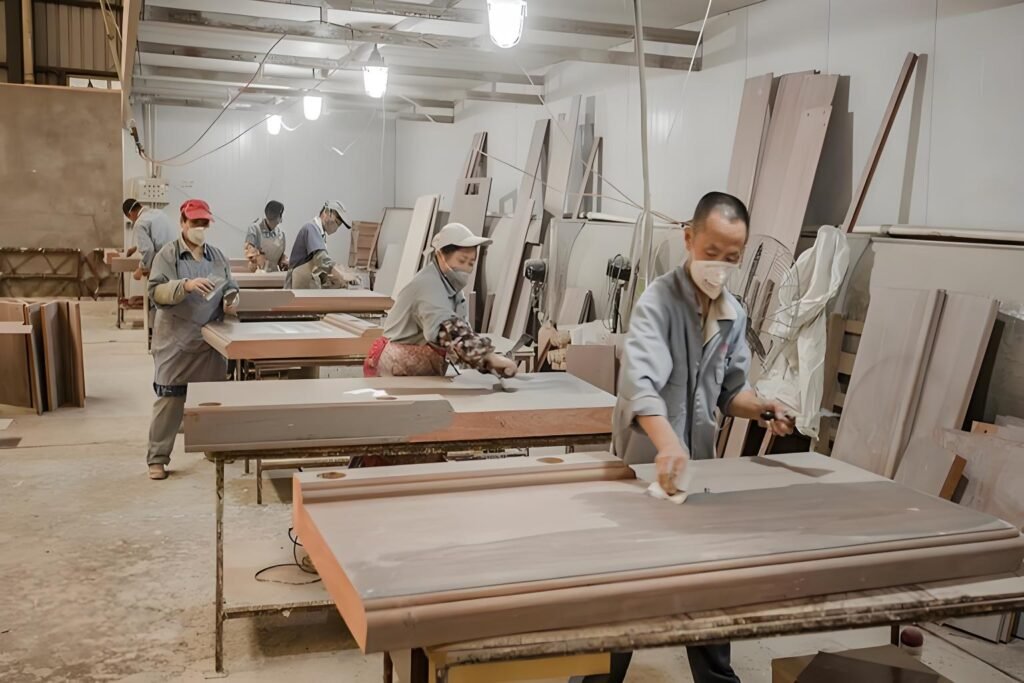
The same thing happens with furniture specs. One factory writes “solid wood” on their quote. That could mean rubberwood. It could mean a solid-wood frame with 3mm veneer on MDF panels. It could mean a single piece of oak. The term is a container. What’s inside depends entirely on who’s filling it.
And here’s the thing most buyers miss — the factory isn’t trying to trick you. They’re assuming you know the standard. Because in their world, “solid wood” has a default meaning. It’s just not the same default as yours.
The real kicker: the factory with the higher quote often isn’t gouging. They’re simply quoting to the spec they think you want. The cheaper one is quoting to the spec they think you’ll accept.
The Information Asymmetry Nobody Talks About
I learned this the hard way in Dongguan. A hotel project I was advising received three quotes for 200 bedside tables. The spread was $65 to $110 per unit. We went with the $75 option. Seemed reasonable. Middle of the road.
Six months later, the client was replacing drawer slides. The $75 factory had used 0.7mm cold-rolled steel runners instead of the 1.0mm ball-bearing soft-close slides we’d discussed. “But you didn’t specify the brand,” they said. And they were right. We hadn’t. We assumed.
Actually, that’s not quite right — what most buyers miss is that the factory doesn’t see assumptions as their problem. They see them as yours. The $110 quote had included Hettich slides. The $65 quote had included unbranded local hardware that looked identical in a photo. In a hotel room after 200 guest cycles, the difference is catastrophic.
This is the core of the China furniture price gap. It isn’t greed. It’s a language barrier where both sides think they’re speaking the same dialect.
The Hidden Cost Layers
Where Does the Money Actually Go?
Let’s pull the quote apart. Not the numbers — the structure.
Most buyers see a line item like “Coffee table — $340 FOB Shenzhen” and think that’s the price. It isn’t. It’s a starting coordinate. The real cost is buried in what the factory didn’t include: packaging, assembly complexity, finish grade, hardware tier, and — this one stings — the cost of fixing mistakes when the spec was vague.
Or rather, the problem isn’t the factory, it’s the expectation. Buyers expect a quote to be a ceiling. In China, it’s often a floor.
The general pattern suggests that mid-sized factories in Foshan operate on thinner margins than most buyers realize. Their profit isn’t in inflating the unit price. It’s in the change orders, the upgrades, and the “oh, you wanted that grade of leather?” conversations that happen after the deposit is locked.
Here’s a breakdown that mirrors what I see in actual quotes:
| Cost Layer | What Buyers Assume | What It Often Means |
|---|---|---|
| Base Unit Price | The total cost | Just the carcass, unfinished |
| Hardware | Included standard | Unbranded, or not included |
| Finish/Coating | “Same as sample” | One coat vs. three coats |
| Packaging | “Export standard” | Thin carton vs. crate |
| QC/Inspection | Factory does it | No third-party verification |
That table alone explains most Chinese supplier quote comparison failures. Buyers compare the top line. Factories build the real number in the footnotes.
The Geography of Cost
Different cities, different math.
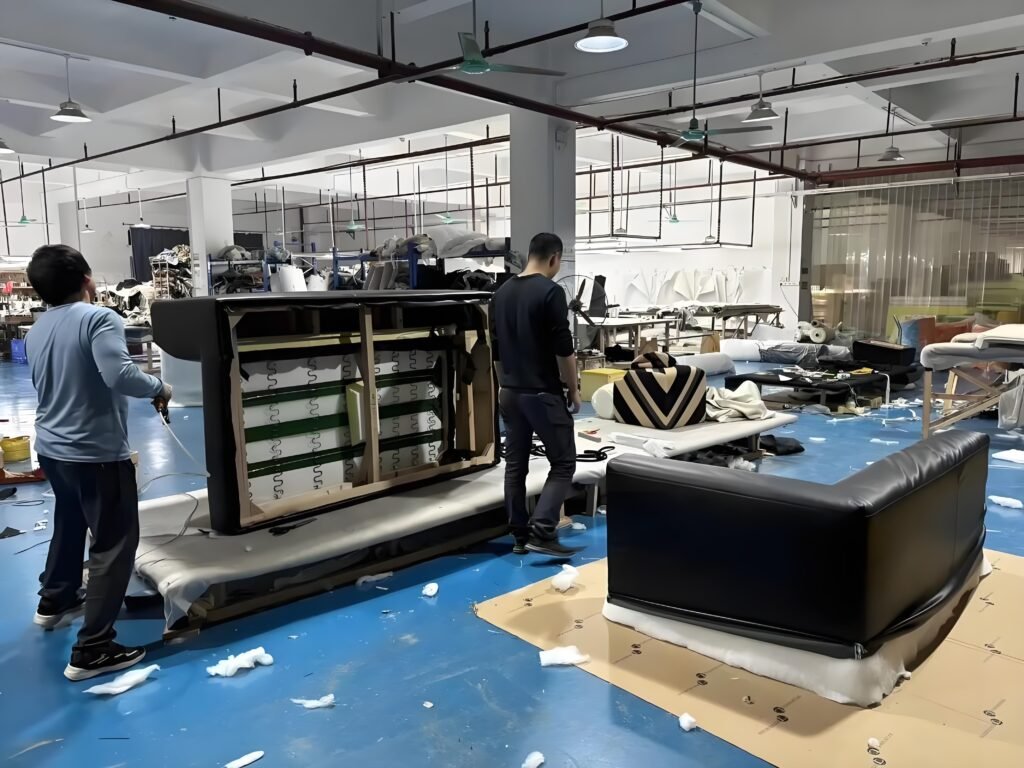
Foshan is the heavyweight for upholstered and solid-wood furniture. Dongguan leans toward metal-and-wood hybrids and mid-century modern reproductions. Longjiang, a district within Foshan, is sofa and mattress territory. Anji in Zhejiang dominates office and bamboo. Nankang in Jiangxi is the rising challenger for cost-driven solid wood.
A factory in Longjiang quoting sofas will have access to foam suppliers, fabric wholesalers, and leg manufacturers within a 15-minute drive. That density drives down their base cost. But it also means they’re optimized for volume, not customization. Ask them for a one-off design tweak and the price explodes. Not because they’re difficult. Because their entire supply chain is tuned for speed and scale.
While some buyers gravitate toward large-scale manufacturers in Foshan, others find that mid-sized specialists — operations like Interi Furniture, which focuses on high-end hospitality and residential custom projects — offer a different risk-reward equation. They aren’t always cheaper. But their quoting tends to be more granular, which means fewer surprises when the container lands.
How to Read a Quote Like a Professional
A Framework That Actually Works
Don’t compare quotes. Compare quote structures. Here’s what I do:
Step 1 — Demand the Bill of Materials
If the factory won’t break down the wood species, board thickness, foam density, and hardware brand, you’re flying blind. A real quote has teeth. “Solid wood” is not a material. “Ash, 20mm thickness, FSC certified” is.
Step 2 — Map the Hidden Costs
Ask specifically:
- Is packaging included? (Crated? Carton? ISPM-15 wood treatment?)
- Who pays for the third-party inspection? (And if they say “not needed,” that’s a red flag.)
- What’s the change-order protocol? (Because you will change something.)
Step 3 — Check the Factory’s Default Setting
Every factory has a “normal.” Find out what theirs is. Ask: “If I don’t specify the finish grade, what do you use?” Their answer tells you whether they default to the standard you want, or the standard that’s cheapest.
Step 4 — Reverse-Engineer the Margin
This one’s uncomfortable. Ask the factory directly: “Where do you make your profit?” Some will dodge. The honest ones will tell you — “We don’t make money on the bed frame, we make it on the mattress upsell” — and that honesty is worth more than a 10% discount.
Step 5 — Build a Reference Library
Keep a running file of past quotes. Same product, different factories. Over time, you’ll spot the patterns. You’ll know that a $45 dining chair from Nankang is probably using a different joint method than a $45 chair from Foshan. The price is the same. The product isn’t.
Red flag that contradicts conventional wisdom: A factory that asks too many questions before quoting is usually the safer bet. The one that fires back a number in two hours hasn’t thought about your project. They’ve pasted a template.

FAQ
Q: If two factories quote the same spec and one is 40% cheaper, is the expensive one overcharging?
A: Almost never. In my experience, roughly 80% of wide price gaps come from spec interpretation differences, not markup. The expensive factory is usually quoting to a higher default standard, or including costs the cheaper one plans to add later. Ask both for a detailed BOM. The real answer lives there.
Q: Can I just send the cheaper factory the expensive factory’s spec and ask them to match it?
A: You can. But watch what happens. They’ll either raise their price — often above the original expensive quote — or they’ll agree and quietly downgrade something you didn’t think to specify. (And yes, this happens more than anyone admits.) The better move is to write your own spec so tight that both factories are quoting the same thing.
Q: Is it true that factories in Guangzhou charge more than factories in Foshan for the same item?
A: Sometimes. But it’s not about the city name on the business card. It’s about supply-chain proximity. A Guangzhou factory making marble furniture might be cheaper than a Foshan factory doing the same thing if they’re closer to Yunfu’s stone quarries. Geography matters, but only in context.
Q: What’s the biggest mistake buyers make when comparing Chinese furniture quotes?
A: They treat the first quote as the real number. It isn’t. The first quote is a conversation starter. The real number comes after three rounds of clarification, a sample, and a pre-shipment inspection. If you’re budgeting off the first email, you’re already behind.
Q: Does the information gap ever close, or will I always be at a disadvantage?
A: It closes. But not because the factory becomes more transparent. It closes because you learn to ask better questions. The disadvantage isn’t permanent — it’s just expensive to fix.
The Hard Question
So here’s what I’d ask Dave if I saw him again in that Longjiang showroom.
Are you looking for the lowest quote, or are you looking for the quote you can actually trust? Because in fifteen years of walking factory floors, I’ve never seen a buyer save money by choosing the cheapest option. I’ve only seen them pay the difference later — in replacement costs, in missed deadlines, in the quiet embarrassment of explaining to a client why the finish is peeling off a $400 chair.
Furniture sourcing China cost isn’t about finding the hidden bargain. It’s about understanding why the bargain was hidden from you in the first place. The factories aren’t the enemy. The information gap is. And the only way to close it is to stop comparing numbers and start comparing the assumptions underneath them.
At the end of the day, the $820 table and the $480 table weren’t the same product. They never were. The only real question is whether you knew that before you wired the money.