

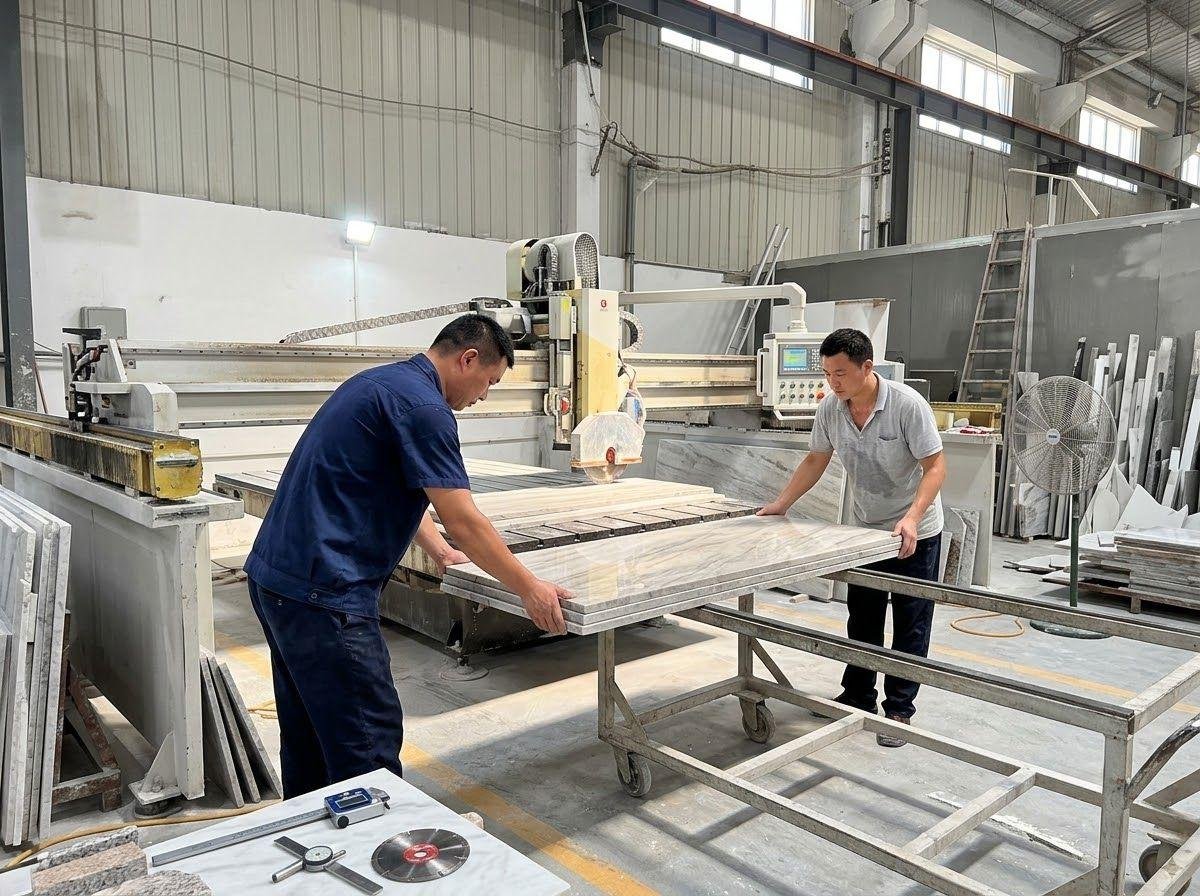
Yunfu. March. The kind of damp that gets into your boots and stays there.
I was standing in a slab yard off the G324, watching a kid — couldn’t have been twenty — hose down a stack of Guangxi White. The water hit the stone, and for about three seconds, before the dust came back, you could see what this stuff really looked like. Beautiful. Cold. Honest. Then a ute pulled up. Melbourne plates. Out climbs this buyer, red-faced, wearing hiking boots that had never seen a hike. He walks straight past the wet slabs, past the cutters, past the whole operation, and points at a finished table in the corner. White top. Thin legs. The kind of thing that ends up in a Sydney Airbnb with a $4,000 price tag and a caption about “quiet luxury.”
“How much?”
The kid looks at the boss. The boss looks at me. Then he says: 4,200. Yuan. Not dollars. Yuan.
The Australian nods. Takes a photo. Walks out. Doesn’t even haggle. Three hours later I’m in a Foshan showroom — polished concrete, that specific smell of new money and old glue — and I see what looks like the same table. Same dimensions. Probably the same slab, if I’m being honest. Price tag? $2,800 USD. And here’s what kills me: that buyer wasn’t dumb. He just didn’t know about the water between the slab yard and the showroom floor. Nobody tells you about the water. They just sell you the boat.
The Brutal Truth
Most buyers think they’re paying for the rock. They’re not.
China marble furniture isn’t a materials business. It’s a layers business. Every hand that touches that slab adds a story, and every story adds a zero.**
A slab leaves Yunfu at maybe — maybe — $18 a square meter for decent domestic white. By the time it’s sitting in a warehouse in Melbourne with a SKU number and a warranty card, that same stone has been through four pricing transformations. Four. And the factory that cut it? They got maybe 12% of the final price. Tops.
Here’s the rule of thumb I give people who ask me over beers: if your supplier spends more time talking about the Italian mountain than the Chinese workshop, you’re not buying stone. You’re buying geography lessons. And geography lessons are expensive.
Key Takeaways
- Markups in China marble furniture don’t start at the factory. They pile up in the gaps between people.
- The gap between a $600 table and a $3,000 table usually isn’t the stone. It’s the photo shoot, the edge profile, and how much resin got pumped into the cracks.
- Being close to the quarry sounds nice. It doesn’t matter as much as controlling the finishing room.
- Chinese stone suppliers aren’t all the same animal. You’ve got slab traders, fabricators, export packagers, and brand storytellers — and half the time they all wear the same badge.
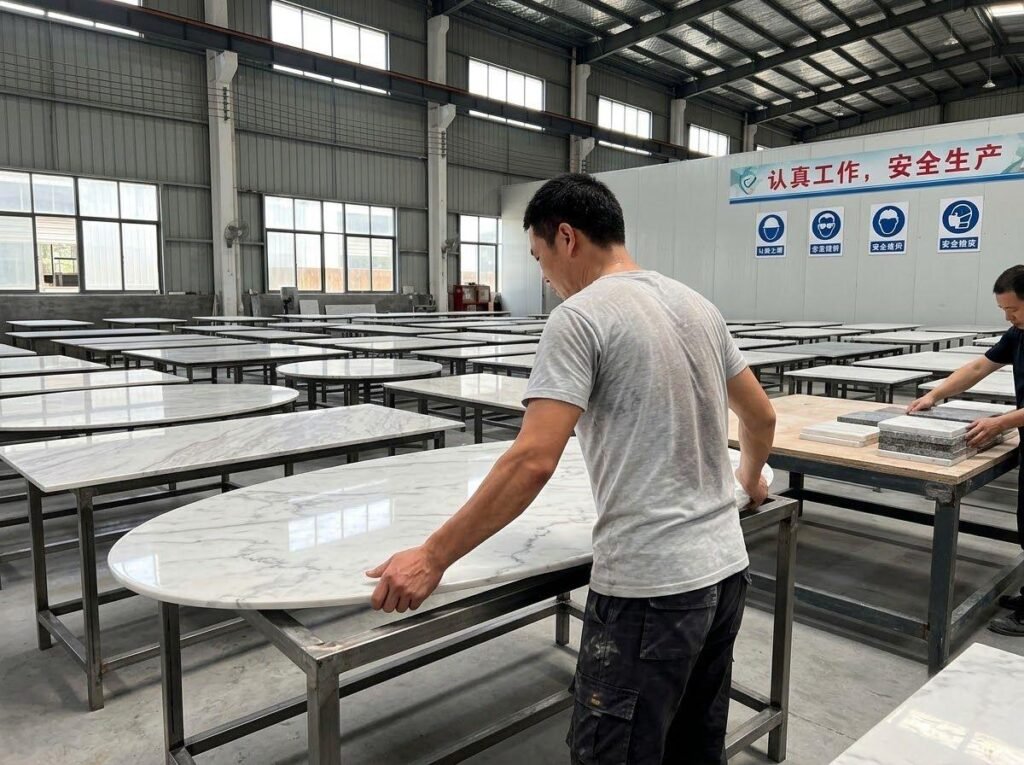
The Factory Floor vs. The Showroom
A marble shop doesn’t sound like a furniture factory. It sounds like a dentist’s office crossed with a car wash. The water jets scream at 60,000 PSI — that’s not a typo, sixty thousand — and the air tastes like you’re licking a chalkboard. Workers in rubber boots that have seen better days move slabs with suction cups the size of hubcaps. Gray dust everywhere. On the floor. In your hair. On the inside of your coffee cup if you left the lid off.
Then you walk into the showroom. Foshan. Shunde. Somewhere with AC that actually works. Recessed lighting. A fiddle-leaf fig in the corner that probably has its own Instagram account. Same table. Completely different planet.
One is a kitchen. The other is the restaurant. And judging the chef by the dining room lighting? That’s exactly what most buyers do. Every time.
Is That “Italian Carrara” Actually From Italy?
Actually, hold on. That’s not the right question.
What most buyers miss isn’t where the stone was born. It’s what grade they got.
A workshop in Yunfu can buy real Carrara. Ship it in. Pay the freight. Hold the certificate. They can also buy something out of Sichuan that looks — I mean really looks — identical under showroom lights. Both are stone. Both are “marble.” One has a shipping container from Carrara and a piece of paper that cost less than lunch to print. The other came up on a truck from Chengdu and has no romantic backstory. Industry observers estimate that the majority of mid-range “Italian marble” furniture in the export market is running Chinese stone with Italian finishing standards. It’s not a scam. It’s just… fuzzy. The catalog says “Italian design.” The fine print says something else. And nobody reads the fine print. They read the Instagram caption.
But here’s what I saw in Dongguan that still sticks with me. A worker mixing polyester resin with white pigment. Heating it to 80 degrees. Pouring it into natural fissures like he was filling teeth. The slab was gorgeous. And it was cracked to hell underneath. Twenty-four hours later? Sanded. Polished. Gone. Looked like a single flawless piece of geological perfection. It wasn’t. It was geology plus dentistry.
Resin filling isn’t the devil. High-end Italian shops do it too. The issue is whether anyone tells you. Chinese stone suppliers run the full spectrum. On one end, you get the guy who walks you over to the slab and says, “See this line? We filled it. Here’s why.” On the other end, you get silence and a warranty that somehow excludes “natural stone characteristics” — which is lawyer-speak for “we filled it and we’re not talking about it.” Based on export data patterns, the vast majority of glossy-finish marble furniture shipped out of China has had some resin work. The question isn’t if. It’s where. And whether your end client cares enough to ask.
And here’s the part agents don’t volunteer: resin work is where the factory actually makes money. The stone? That’s a commodity. The cutting? Machine does that. But the hand-finishing? That’s labor. That’s skill. That’s where a $400 slab becomes an $1,100 table without changing the rock underneath.
The real cost isn’t the stone you see. It’s the labor you don’t.
The Geography of Markups
Buyers love maps. They want to believe that driving two hours closer to the quarry knocks 40% off the price. It doesn’t. Not in this market.
Yunfu cuts the slabs. Foshan frames them into furniture. Xiamen handles the fancy export finishing and the shipping docs. Each city adds a layer. But the real markup doesn’t happen on the highway. It happens in the handoff.
Think of it like a relay race where every runner changes the baton a little. Runner one sells you raw stone cheap. Runner two adds legs, base, hardware. Runner three slaps on compliance docs, hires a photographer, writes a brand story. By the time that baton hits Los Angeles, it’s not the same product. It’s been polished, packaged, and positioned into something else entirely.
The $600 table and the $3,000 table might have started on the exact same cutting bed.
| Factor | Yunfu (Raw) | Foshan (Fabrication) | Xiamen/Export (Finish & Logistics) |
|---|---|---|---|
| What they add | Slab cutting, basic polish | Base, hardware, assembly | QC, photos, docs, brand story |
| Margin layer | 8-15% | 20-35% | 40-60% |
| Buyer visibility | Low | Medium | High |
| Risk profile | Stone variance | Assembly issues | Markup games, story inflation |
Who Adds the Most Value?
If you put a gun to my head? The photographer adds more than the foreman. (And yeah, this happens way more than anyone wants to admit.) A factory in Longjiang with bad fluorescent lighting and a concrete floor will sell you a table at cost-plus-15%. Move that same table to a Foshan showroom with a stylist, a decent camera, and some dried pampas grass in a ceramic vase? Cost-plus-120%. Object didn’t change. Context did.
This isn’t some trick. It’s just how the market breathes. Buyers don’t buy stone. They buy the idea of stone in their space. The Chinese stone suppliers who get this — the ones who invest in renders, sample boxes, English catalogs — they’re not ripping you off. They’re playing a different game than the guy running the water jet.
Why Your “Direct Factory” Price Isn’t Direct
Found a supplier on Alibaba. “Direct factory. No middleman.” They pick you up in a black Audi. Showroom gleams. Here’s what I learned the hard way in Dongguan: that Audi’s a rental. The showroom’s shared by six different “factories.” The actual cutting happens ninety minutes away in a building with no sign and a dog out front. The “direct” price? It includes the Audi, the espresso machine, the showroom rent, and the commission of the sales rep who spent three years at university in Brisbane.
You’re not buying from a factory. You’re buying from a theater troupe that holds a subscription to a factory.
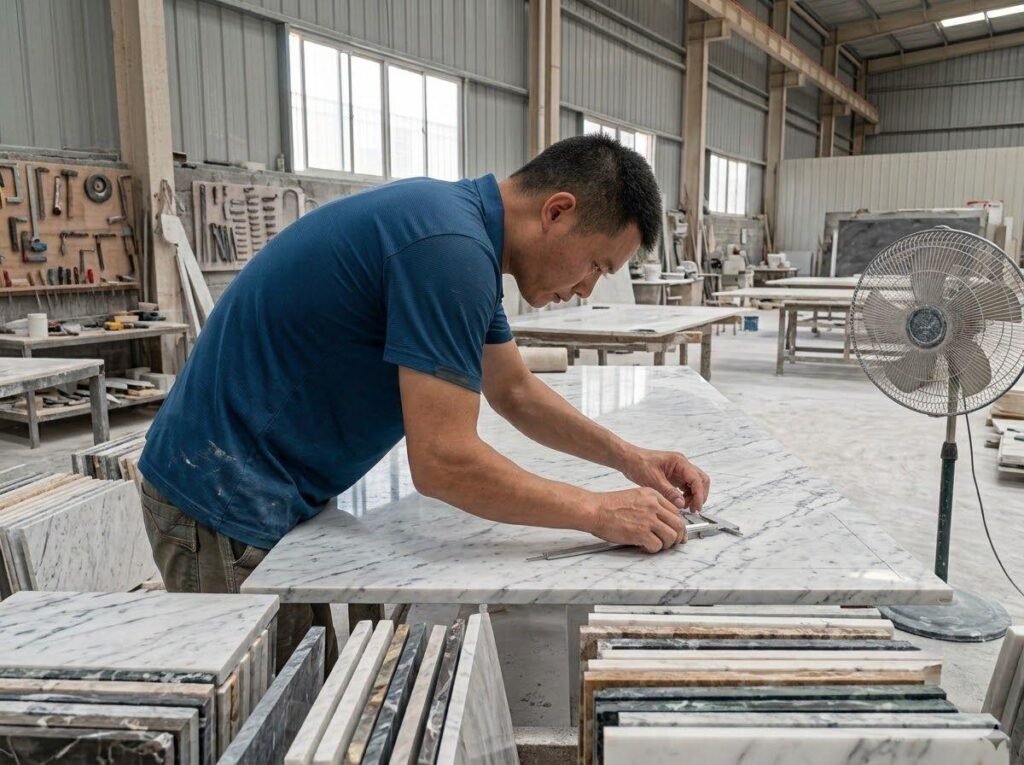
The Ecosystem — Who Actually Makes What
China’s marble furniture scene isn’t split by quality. It’s split by how much risk you can stomach.
At the top, you’ve got the big integrated groups. They own quarries — sometimes in Pakistan, Turkey, not even China — they own the cutters, they own the export license. They sell you consistency. They also sell at 40% above market because they’ve swallowed all the volatility so you don’t have to.
Then you’ve got the specialists. Operations like Interi Furniture, working out of Guangdong, focused on project and hospitality furnishings. They don’t try to be everything. They don’t stock four hundred SKUs like a catalog company. What they offer is curated stone, controlled finishing, and a supply chain short enough that you can see where the money goes. For buyers who’ve been burned by showroom theater, that kind of transparency — knowing exactly which workshop cut your slab — can matter more than a 15% discount from some faceless giant.
At the bottom, you’ve got the aggregators. The traders. The Alibaba generalists who’ll sell you marble tables, rattan chairs, and LED bathroom mirrors without blinking. They’re not evil. They’re just not in the stone business. They’re in the order-fulfillment business. And when something cracks in shipping, they dissolve into a WeChat chat that suddenly goes quiet.
**The real cost of *China marble furniture* isn’t the rock. It’s not knowing who touched it last.**
A Buyer’s Decision Framework
Use this. Ignore the parts that don’t fit. Steal the parts that do.
Before You Get on the Plane
- Ask for a video of the water jet running your actual slab. Not a stock video from 2019. Your slab. If they stall, you’re not talking to the factory. You’re talking to someone who knows the factory.
- Ask about resin. Specifically. Where? How much? If they send a generic “quality certificate,” push harder. A real supplier knows exactly which fissures got filled.
- Check the map. If they say “factory direct” but can’t get you to the production floor within ninety minutes of the showroom, you’re paying for the commute.
Reading the Quote
- Stone cost — Should be 20-30% of your FOB price for standard whites. Higher than that? They’re either using genuine imported Italian (rare in mid-market) or padding.
- Fabrication — Cutting, edging, base work. This is where China is genuinely efficient. Budget 15-25%.
- Finishing & QC — The quiet killer. Hand-polishing, resin, protective coat. Call it 10-20%, but know this is where corners get cut when you push too hard.
- Logistics & margin — Everything else. If this bucket is eating more than 40%, start asking who else is at the table.
Red Flags That Go Against the Grain
Most buyers see an ISO 9001 certificate on the wall and relax. Don’t. That certificate means someone paid a consultant. It doesn’t mean your table won’t wobble. The real signal is the opposite: a factory that won’t show you plaques but will walk you through the resin station and explain why they use 30% hardener on soft stone. That messy, unpolished honesty? It’s rarer than any certificate.
Also: if a supplier fires back a quote within two hours of your first email, that’s not eagerness. That’s automation. Good stone work takes time. Slab selection takes time.
A fast quote is a generic quote. And a generic quote is a markup wearing a disguise.

What Buyers Actually Ask Me
Q: How do I know if the marble is real or some kind of resin composite?
A: Scratch it. Real marble gives you white powder under a knife blade. A resin-heavy surface either fights back or shows a different color underneath. But the better question is how much resin got pumped into natural cracks. Most “real” marble tables in the export game are 95% stone, 5% resin in the fissures. That’s normal. What you want to dodge is a table that’s 60% stone powder and 40% resin pressed into a mold. That’s engineered stone, not marble furniture. Ask for the block number. Ask for the quarry. If they can’t tell you, you’re not buying natural stone — you’re buying a narrative.
Q: Why does the same-looking table cost $800 from one supplier and $3,200 from another?
A: Four things. Only one is the stone. First, slab grade — “Carrara” can mean quarry-block A-grade or tailings D-grade. Second, finishing depth — a 5-step polish and an 11-step polish look identical in photos, but not after six months of actual use. Third, structure — cheap bases use hollow steel with thin tops; good ones use solid wood subframes and full-thickness stone. Fourth, and this is the big bite, narrative markup: the $3,200 table passed through a brand agency, a photographer, and a Western distributor who each took their cut. The $800 table came from a Yunfu trader who doesn’t know what Instagram is. Both might work for your project. The question is which risk profile you can sleep with.
Q: Should I fly to China or just hire an agent?
A: Five tables for a boutique hotel? Stay home. Use an agent who knows stone, not just furniture. Developing a collection or spending north of $50K? Get on the plane. Not because you’ll find cheaper prices — the market’s too transparent for that now — but because you’ll find different suppliers. The ones worth building around don’t live in their inbox. They live in their workshop. And workshops require shared air.
Q: Is Italian marble actually better than Chinese marble?
A: For furniture? Mostly marketing. Italian Carrara has tighter veining and a whiter background. Photographs better. Chinese whites like Guangxi White or Sichuan White are harder, less porous, often more durable for tables that actually get used. The “Italian is better” story survives because it justifies the margin. In my experience, most residential and hospitality buyers would be better served by a high-grade Chinese marble with proper finishing than by a mid-grade Italian slab with a premium freight bill attached. The exception is ultra-high-end residential where provenance is the product. For that crowd, fly to Carrara. For everyone else? Yunfu’s waiting.
Q: Can I negotiate 40% off without the factory swapping materials on me?
A: No. A 40% cut either comes from the supplier’s margin — and factory margins are already thin — or from your spec. What usually happens: you push for 40% off, they say yes, and six months later you find the base is hollow steel instead of solid ash, or the slab dropped from A-grade to B-grade with extra resin to hide the difference. Negotiate 10-15% on volume. Negotiate payment terms. Negotiate QC holdbacks. But if you’re squeezing for 40%, you’re not negotiating. You’re commissioning a downgrade.
I once watched a buyer in Foshan sign a $90,000 order because the showroom made exceptional cappuccinos. The tables were fine. They were also available — same slab source, same resin treatment — eighty kilometers west for 60% less. He didn’t overpay for furniture. He overpaid for confidence. And in the China marble furniture market, confidence is the most expensive raw material of all.
So here’s the hard lesson: the markup isn’t your enemy. Not knowing where the markup lives — that’s what pulls you under.
What’s the most you’ve ever paid for a story you didn’t know you were buying?