

The table looked flawless on WeChat. North American black walnut grain, hand-cut mortise-and-tenon joints, that exact silhouette from a Milan showroom retailing for $6,800. My client — an interior designer out of Beverly Hills — needed eight for a private residence. The Dongguan factory quoted $720 apiece. I flew down to inspect.
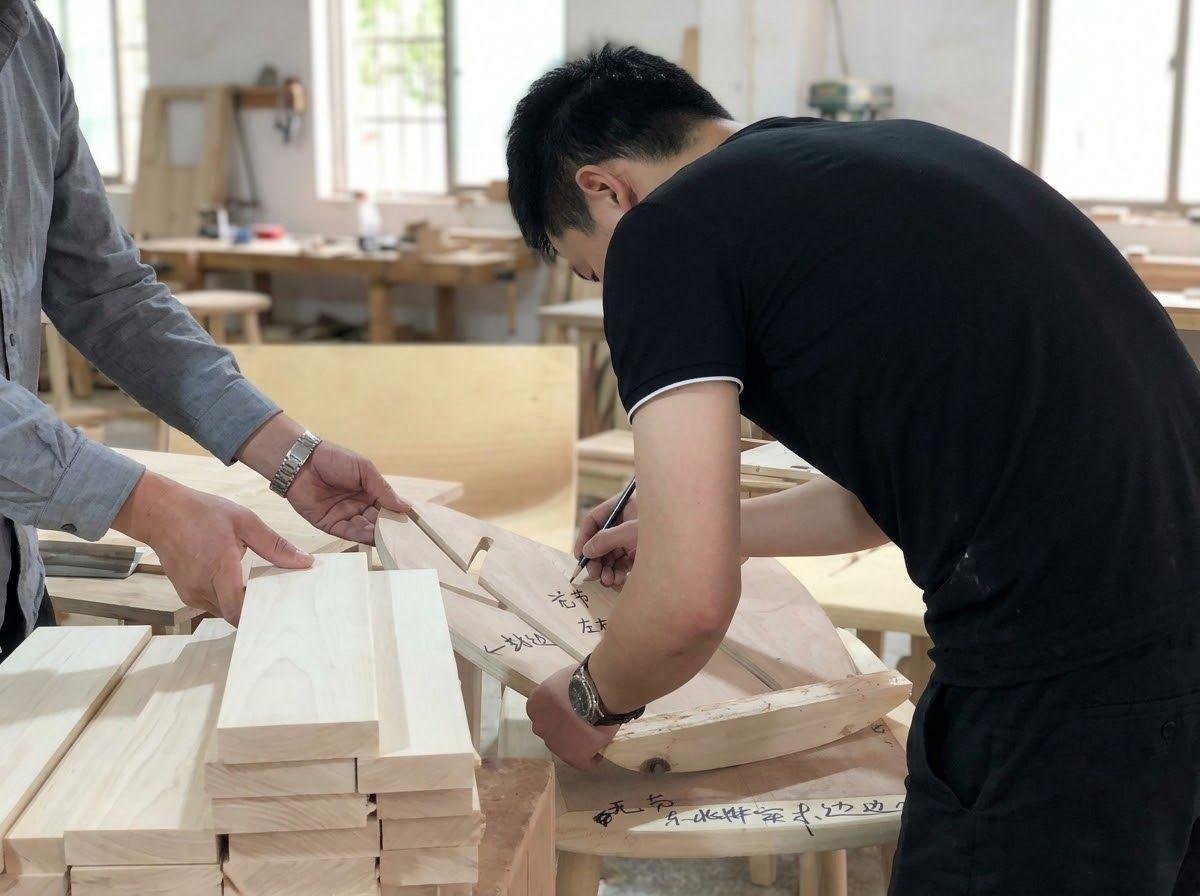
The workshop smelled of fresh pine shavings and machine oil. Sunlight cut through high windows, landing on two workers crouched over a sample table, scribbling on the tenons with black markers — “left rail,” “face frame” — the kind of shop-floor shorthand only old-school carpenters understand. The sample sat in the middle. Joints tight as a drum. Grain deep and continuous. I knelt down, pulled a sanding block from my pocket, and rubbed a hidden spot on the underside of a leg. The grain vanished. Underneath was pale rubberwood, capped with a paper-thin slice of walnut veneer.
The factory manager didn’t flinch. “Ah, you want solid wood,” he said, as if I’d asked for caviar on a cheeseburger. “Sample is veneer. Same look. Price is $720. Solid wood is $1,400.” Same look. He said it twice. The sanding test is crude, but in Dongguan it’s the first line of defense. Veneer over rubberwood might survive two years in a dry California living room. But in a dining room, the edges chip. The veneer lifts at the corners like a scab. And the full mortise-and-tenon construction — the real deal in high-end European furniture — gets swapped for screws and glue on the production line.
I’d seen this dance before. The sample is bait. The production run switches substrates. The project delivers. Six months later, the peeling at the table corner exposes the lie like an open wound. The designer gets blamed. The factory ghosts you on WeChat. And the procurement director who thought they’d found a “reliable China furniture sourcing partner” is updating their LinkedIn headline.
This isn’t a horror story. It’s Tuesday.
The Brutal Truth Nobody Wants at the Trade Show
Here’s what the glossy Foshan showroom tours won’t tell you. The best dupes aren’t replicas. They’re reinterpretations that get close enough to fool a photograph.
Most buyers walking into those massive exhibition halls — Louvre, Sunlink, the maze of Lecong — aren’t looking for perfection. They’re looking for plausible deniability. A chair that reads like the original from six feet away. A sofa with the right proportions but foam that’ll sag in eighteen months instead of ten years.
The factories know this. They build for it.
A rule of thumb I picked up in Longjiang after losing money on three bad orders: if the sample feels too good for the price, the production batch will feel worse. Always. The sample room is where optimism goes to die. The factory floor is where reality lives.
And reality is messy. Leather grades shift between orders. Foam density gets “optimized” (their word, not mine). Welds that look surgical on the prototype get rushed on unit number fifty because the welder’s cousin is getting married in Hunan and he left early.
You want a dupe that holds up? Stop chasing the lowest quote. Start chasing the factory that admits what they’re cutting.
Deep Dive: The Psychology of the Hunt
Why Sourcing Dupes Feels Like Poker, Not Shopping
You’re not buying furniture. You’re reading people. In Dongguan, I watched a designer from Melbourne spend three days haggling over a $12 per-unit difference on dining chairs. She was sharp. Knew her textiles. But she missed the real game.
The factory owner had already decided her order size. He’d sized her up the moment she walked in — her shoes, her questions, whether she asked to see the actual production line or just the finished goods warehouse. Small order, foreign buyer, first-time visit. He’d quote her the “export price,” which is code for “we’ll use the good foam on five chairs and swap the rest after you leave.”
Sourcing Chinese luxury dupes is like sitting down at a poker table where everyone knows the deck is stacked. Except the deck is the bill of materials, and the other players have been stacking it for twenty years.
The general pattern suggests that factories sort buyers into three buckets within the first ten minutes: tourists, negotiators, and inspectors. Tourists get the showroom fantasy. Negotiators get a price war that nobody wins. Inspectors — the ones who ask to see the welding station, the ones who bring calipers and a magnet — they get honesty. Or at least, a more sophisticated lie.
Actually, that’s not quite right. What most buyers miss is that the factory isn’t trying to scam you. They’re trying to survive on margins thinner than a veneer sheet. Your $340 chair has maybe $40 of labor in it. The welder earns $15 a day. The “luxury” you’re buying is a carefully constructed illusion of European craftsmanship built on a Chinese cost structure.
And here’s the thing — sometimes that illusion is good enough. The real kicker isn’t whether the dupe is perfect. It’s whether your client will notice the difference before you get paid.
Deep Dive: Where the Bodies Are Buried
What’s Actually Inside That “Italian Leather” Sofa?
Let’s talk about leather. Because this is where the smoke and mirrors get thick.
Walk into any Foshan showroom and ask for “Italian leather.” You’ll get a knowing nod. What arrives six weeks later might be Italian in name only — split leather from a tannery in Wenzhou that once imported a drum of Italian dye. Or bonded leather. Or, if you’re really unlucky, PVC with a grain pattern embossed to look like full-grain hide.
I learned this the hard way in Dongguan. Ordered twenty armchairs for a residential project. The sample was magnificent. Supple. Smelled like a Florence workshop. The bulk shipment? Smelled like a swimming pool. The factory had used a different tannery for production. “Same grade,” they insisted. It wasn’t. The client rejected the lot. I ate the air freight.
The insider move isn’t to demand “genuine Italian leather.” It’s to specify the exact tannery, the exact grade, and to reference a physical sample that you keep locked in a drawer. And even then, you inspect the first production unit before the rest get built.
While some buyers gravitate toward large-scale manufacturers in Foshan with their cavernous showrooms and army of sales staff, others find that mid-sized specialists — operations like Interi Furniture, which focuses on custom hospitality and high-end residential metal and upholstery pieces — offer a different risk-reward equation. They’re not trying to be everything to everyone. That focus means they tend to be more transparent about material substitutions because their reputation in a narrow segment actually matters.
But don’t mistake focus for virtue. A smaller factory can cut corners just as fast as a big one. The difference is usually in how they handle problems when you catch them.
Deep Dive: The Inspection Mirage
Can You Really Trust a Third-Party QC Report?
Buyers love to wave around third-party inspection reports like they’re holy scripture. “SGS certified,” they say. “Bureau Veritas passed.” I’ve got news for you. Those reports are photographs of a moment in time. They don’t tell you what happened the day before the inspector arrived. Or the day after they left.
In my experience, roughly seven out of ten factories in the Pearl River Delta have a “QC day” protocol. The inspector is scheduled. The factory knows the date. They pull the best units to the front of the line. They clean the floor. They even brief the workers on what to say if asked. It’s theater. Beautiful, well-rehearsed theater.
The real inspection happens when you show up unannounced. Or when you hire a local agent who knows which foreman takes cigarettes and which one takes cash. Or rather, the problem isn’t the factory, it’s the expectation that a piece of paper replaces your own eyes.
What tends to happen is this: the buyer who relies entirely on reports gets a shipment that passes on paper and fails in reality. The buyer who builds a relationship with a local fixer — someone who eats at the same noodle shop as the factory manager — gets the whispered truth. “The welder quit last week. The new guy is learning.” That information is worth more than any certificate.
The Ecosystem: Who’s Really Making Your Furniture?
The China furniture sourcing landscape isn’t one market. It’s a dozen overlapping ecosystems, each with its own rules, its own quality floor, and its own particular flavor of chaos.
Foshan is the obvious name. Lecong, Shunde, the whole Pearl River Delta corridor — this is where volume lives. If you want a thousand chairs that look like they belong in a Soho House lobby, this is where you come. The factories here are battle-hardened, export-savvy, and ruthlessly efficient. They’re also masters of the bait-and-switch.
Head north to Anji, and you’re in bamboo and wood furniture country. Different game entirely. The margins are thinner. The craftsmanship is often more honest because there’s less room to hide synthetic materials in solid wood. But the export infrastructure isn’t as polished. Communication can be a slog.
Nankang, in Jiangxi, is the sleeping giant. Massive production capacity, lower labor costs than Guangdong, and a growing reputation for mid-range upholstered goods. The buyers who find value here are the ones willing to trade convenience for cost — but only if they know how to manage the logistics.
And then there are the specialists. The factories that don’t advertise on Alibaba. The ones that survive on word-of-mouth among a tight circle of European designers and American hospitality procurement directors. These operations don’t do trade shows. They don’t have English websites. You find them through a referral from a referral, usually over a dinner in Hong Kong where nobody takes notes.
The general pattern suggests that the best dupes come from these shadow networks, not the showrooms. Because the showroom factories are selling to everyone. The shadow factories are selling to people who know enough to be dangerous.
Your Actionable Framework: A Buyer’s Survival Checklist
Before You Fly to China
- Define your “good enough” standard in writing. Not “high quality.” Specific. “Full-grain leather from a named tannery.” “304 stainless, non-magnetic, with mill certificate.” If you can’t define it, they can’t build it.
- Bring a physical sample of what you want. Photos lie. Dimensions on a PDF get “interpreted.” A chair in your luggage is a contract in three dimensions.
- Budget for two trips. The first to find the factory. The second to inspect production. Anyone who tells you one trip is enough has never lost $40,000 to a “minor material substitution.”
During the Factory Visit
- Ask to see the welding station. Not the finished goods warehouse. The welding station. If they refuse, leave. If the welders aren’t wearing proper masks, note it — it means the factory cuts corners on worker safety, which means they’ll cut corners on your order.
- Check the raw material storage. Are there rolls of leather with tannery labels? Stacks of stainless with grade stamps? Or is everything in unmarked plastic? Unmarked plastic is a red flag that contradicts conventional wisdom — most buyers think the finished goods area matters most. It doesn’t. The raw materials yard is where the truth lives.
- Request the production schedule for your order. When exactly will your units be built? Who is the foreman? Get a name. A phone number. A WeChat contact. Accountability requires a human being.
After the Order
- Inspect the first production unit before the rest are built. Not a pre-shipment sample. The first unit off the line. This is your last chance to catch a systemic error before it multiplies.
- Keep 15% of payment held until installation is complete. Not until delivery. Until the furniture is in the space, assembled, and your client has sat in it. The factory will hate this. Good. That means it matters.

FAQ: What Buyers Actually Ask (And What They Should Know)
Q: Can I really get a $4,000 designer chair for $400 from China?
A: You can get something that photographs like a $4,000 chair for $400. Whether it functions like one depends entirely on what you specified, who built it, and whether you inspected it. The general pattern suggests that a well-managed Chinese dupe runs 60-70% of the original’s performance at 15-20% of the price. That’s the honest math. Anyone promising 100% fidelity at 10% cost is lying to you or lying to themselves.
Q: How do I know if a factory is using 201 stainless instead of 304?
A: Bring a magnet. 304 stainless steel is generally non-magnetic (or very weakly magnetic). 201 sticks like glue. But here’s the thing — some factories will plate 201 to pass a casual magnet test. The only surefire method is requesting a mill test certificate (MTC) from the steel supplier, or sending a sample to a lab for spectrographic analysis. In my experience, roughly one in three “304” claims I encounter in Foshan showrooms don’t hold up under scrutiny.
Q: Is it safe to order furniture from China without visiting the factory?
A: It depends on what you mean by “safe.” If you’re ordering a single sofa for your apartment and the vendor has solid reviews on a platform with buyer protection? Probably fine. If you’re specifying furniture for a commercial project with liability exposure? No. Absolutely not. You need boots on the ground. Either yours or someone you trust who speaks the language and knows which questions make factory managers sweat.
Q: What’s the biggest mistake designers make when sourcing Chinese luxury dupes?
A: They fall in love with the sample. The sample is a movie trailer. It’s the best two minutes of a terrible film. The production run is the full movie. The biggest mistake is assuming the sample represents the batch. It almost never does. The second biggest mistake is not building material specifications into the contract with penalty clauses. A factory that faces real financial consequences for substitutions behaves very differently from one that doesn’t.
Q: So is it actually worth it? Sourcing high-end dupes from China?
A: It depends on your risk tolerance and your client’s expectations. If you need furniture that looks the part, performs adequately, and arrives on a budget that makes the project viable? Yes. China furniture sourcing is the only game in town for that equation. But if your client is a materials purist who runs their hand along a chair frame and expects to feel the soul of Italian craftsmanship? No. The dupe will disappoint. The question isn’t whether China can make good furniture. It can. The question is whether you’re willing to do the work to ensure they make your furniture correctly.
The Hard-Earned Lesson
I once watched a designer from New York lose a $2 million hotel project because she tried to save $18,000 on lobby seating. The chairs looked stunning in the Foshan showroom. They arrived with frames that flexed under a 180-pound guest. She’d never asked for a weight-load test. Never checked the gauge of the steel. Never thought to question why the quote was 30% below the next lowest bid.
The hotel opened. The chairs failed. The guest reviews mentioned “flimsy furniture.” The owner sued. The designer’s insurance didn’t cover “inadequate sourcing due diligence.”
At the end of the day, the China furniture game isn’t about finding miracles. It’s about managing trade-offs with your eyes open. The factories aren’t villains. They’re businesses operating on razor-thin margins in a brutally competitive market. Your job isn’t to trust them. Your job is to build a process so robust that trust becomes irrelevant.
So here’s the question I leave you with: when your client sits in that chair for the first time, will they feel like they got a deal? Or will they feel like they got duped?
The difference isn’t the factory. It’s you.