

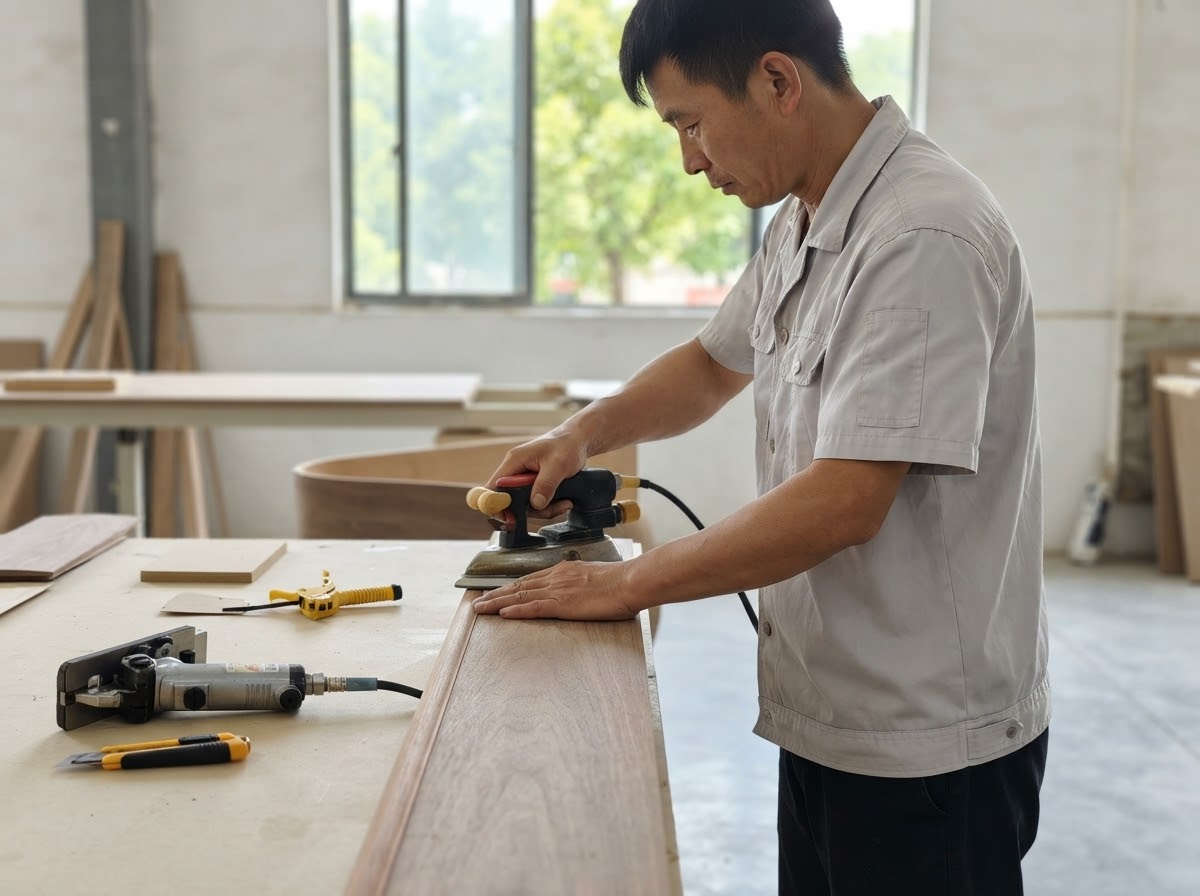
I was sweating in a Zhongshan inspection bay last August when a $12,000 problem made itself painfully obvious. A Vegas hospitality procurement director—let’s call him Mike—was staring dead-eyed at a row of ten-foot-tall architectural doors meant for a high-roller suite.
They looked incredible from the front. We’re talking matched quarter-sawn walnut veneer under a flawless 30-sheen PU finish. A real portfolio piece. But when I laid my straightedge across the concealed backside? You could slide a half-empty pack of cigarettes under the middle.
The doors had warped. Nearly an inch of bow on a composite structure that the factory owner had sworn on his ancestors would stay dead flat.
“Aluminum honeycomb core,” he’d pitched us months prior. “Never bends.”
Right.
If you’ve spent any time on the ground trying to source oversized moving walls or high-end cabinetry in Guangdong, you’ve heard the aluminum honeycomb pitch. It’s sold as the ultimate weight-reduction strategy. But here’s the brutal reality nobody hands you with their glossy catalog at CIFF: mastering the aluminum honeycomb core isn’t about buying the right metal grid. The raw material is cheap.
No, getting this right is entirely about mastering the sandwich. And that’s exactly where the nightmare begins for overseas buyers.
The Brutal Truth About the “Perfect” Core
Let’s get the uncomfortable reality out of the way. Most factories in China can buy a decent sheet of expanded aluminum honeycomb. Maybe one in twenty actually understands the physics of balancing it inside a wood composite structure.
The standard operating procedure? They treat the aluminum grid exactly like a piece of MDF. Just roll some glue onto it, slap a decorative skin over it, throw it in a cold press, and call it a day.
But a honeycomb core is mostly air. It has entirely different thermal and moisture expansion properties than the high-density fiberboard (HDF) or natural wood skins you’re laminating to it. When you ignore that differential, the door doesn’t just warp. It twists. It torques until the weakest glue line pops.
Here is my absolute golden rule for these composites: if the factory’s technical team cannot sit down and show you the basic math on their skin tension, they are guessing. And you are paying for their education.
Key Takeaway: The Honeycomb Core Reality
- It’s not the core, it’s the skin: Warping rarely comes from a failed aluminum grid; it comes from unbalanced tension in the outer wood laminations.
- Adhesive dictates lifespan: Using standard water-based glues on non-porous aluminum is a guaranteed recipe for delamination.
- The container bake is the real test: A massive door that measures flat in humid Foshan will often bow like a banana after 40 days in a shipping container.
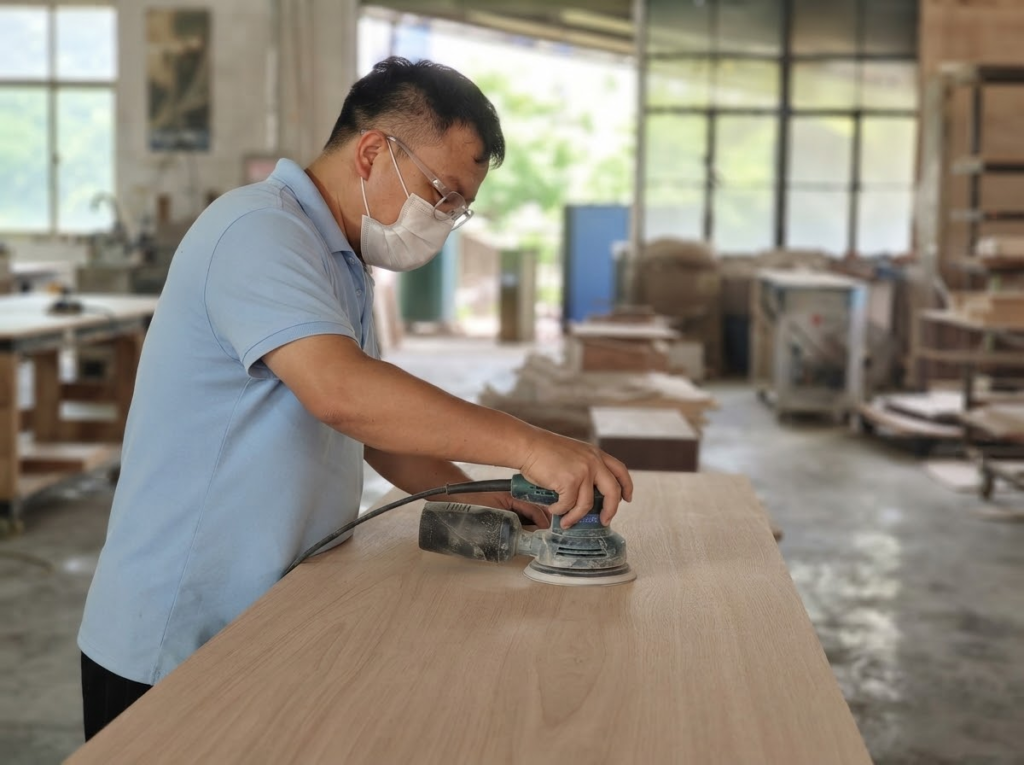
Anatomy of a Warp: Where Chinese Factory Engineering Falls Down
Think of a honeycomb composite door like a brutal, slow-motion tug-of-war.
The aluminum core is the rope. The front decorative skin and the back concealed skin are the two teams pulling on it. If the team on the front pulls harder than the team on the back, the rope moves. The door bows.
It’s that simple. Yet this basic principle of physics is screwed up constantly on the factory floor.
The Lopsided Sandwich
I see this exact scenario play out constantly when aggressive buyers push for cost-downs on China custom doors. The quoting phase always looks great. The factory provides a beautifully spec’d cross-section for the front skin: 3mm of natural oak over 5mm of moisture-resistant HDF.
But a factory purchasing manager’s job is to shave fractions of a cent off the BOM. So, they quietly swap the unseen back skin. Instead of matching the front, they throw on a 3mm standard MDF with a cheap melamine face. Who cares, right? It’s facing a closet.
(And yes, this happens more than anyone likes to admit. Unless you cut a cross-section out of your production run, you won’t catch it until installation.)
Those two asymmetrical materials react completely differently to ambient moisture. The oak-faced front absorbs humidity and expands. The melamine-faced back doesn’t breathe at all. The rigid aluminum core eventually yields to that uneven tension.
A true production engineer knows you have to build a perfectly symmetrical sandwich. If you put 6mm HDF on the front, you put 6mm HDF on the back. You aren’t finishing the back to make it look pretty. You’re finishing it to balance the moisture barrier.
The Glue Line Crisis
Here’s an insider detail that usually separates the real players from the pretenders in Dongguan. Don’t look at their CNC machines. Watch how they apply their adhesive.
Most mid-tier woodworking factories use standard PVA or UF glues because they are dirt cheap and workers can clean the rollers with water.
But aluminum doesn’t breathe. When you use water-based glues, the moisture has nowhere to go. It cures terribly when trapped between metal and wood.
The only reliable, long-term bond for aluminum honeycomb composites is a high-grade Polyurethane Reactive (PUR) hot melt system. PUR glue reacts with moisture in the air to chemically cure, forming a flexible, waterproof bond that won’t shear when the wood moves.
But a proper PUR lamination line costs serious money. We’re talking climate-controlled clean rooms and heated roller arrays. The factory boss who points to his battered cold-press machine and tells you his glue is “just as good for metal” is lying to you.
The Edge-Banding Illusion
Let’s dig into another mechanical failure point. The perimeter frame.
An aluminum honeycomb core is hollow. You can’t screw a heavy-duty concealed hinge into a hollow hex grid. The core has to be framed out internally with solid material before the skins are pressed on.
Cheap factories will frame the perimeter with standard MDF or scrap wood. They pin-nail it around the grid, smear some glue, and press the skins over the assembly.
If that internal frame is weak, or if the transition joint between the solid wood and the hollow core isn’t perfectly flush, you get “telegraphing.” A visible line appears on the face of the door. Furthermore, when the installer drives a heavy hinge screw into a cheap MDF frame, it crumbles. The door sags. The factory stops answering WeChat messages.
Ecosystem Reality: Navigating the Supply Base
You can’t just throw a dart at a sourcing platform and expect to find a factory capable of precision composite work. The manufacturing landscape in China is ruthlessly stratified.
At the bottom tier, you have the “me-too” workshops knocking together lightweight doors for budget apartments. At the top tier, you have massive, heavily automated operations in Foshan or Zhejiang with PUR lines and engineering teams. But they are geared for massive scale. If you are outfitting a 40-room boutique property, your order is a nuisance to them.
But for most savvy project buyers, the sweet spot is in the middle-upper tier. You’re looking for operations that have the technical chops without the crushing minimum order quantities.
Take a Guangzhou-based operation like Interi Furniture, for instance. A mid-sized player heavily focused on hospitality projects and soft furnishings operates differently than a retail volume factory. They usually have enough export experience to understand why a pivot door for a Maldives beach resort requires an entirely different internal substrate than a sliding partition for a dry corporate office in Frankfurt. Manufacturers in this tier have usually invested in the necessary PUR technology specifically to capture complex bids.
You need a partner who genuinely understands that Chinese factory engineering isn’t just about matching the CAD drawing visually. It’s about engineering the hidden layers to survive the specific micro-climate it’s going to live in.
The Subcontracting Shell Game
Here is another layer of the sourcing nightmare. Let’s say you audit a mid-sized factory, verify their PUR line, and sign the contract.
What you don’t realize is your door design requires a specialized CNC routing process this factory doesn’t actually own. Instead of declining, they quietly subcontract the raw door slabs to a smaller workshop three towns over.
This shadow workshop doesn’t have a PUR line. They use cheap cold-press glue, route the channels, and ship the slabs back to your primary factory for the final veneer. When you inspect them, they look perfect. Six months later, they delaminate.
If you buy complex composites, you must explicitly write into your PO that unauthorized subcontracting of core structural components is a breach of contract resulting in total rejection.
The Pacific Bake: The Invisible Enemy
A 40-foot shipping container sitting on a cargo ship in the middle of the Pacific Ocean in August is essentially a solar oven. Internal temperatures easily exceed 140°F (60°C).
If your factory built an unbalanced honeycomb door using standard water-based glue, this 30-day journey is where the product quietly destroys itself. Trapped moisture vaporizes, the wood skins expand rapidly, and the cheap glue shears. When you open those container doors in California, the veneer has literally blown off the substrate like a blister. This is why accelerated climate testing is a mandatory part of the vetting process.
The Hardcore Actionable Framework
So, how do you protect your capital before wiring that 30% deposit? You interrogate the process.
- Demand the Symmetry Spec: Require a millimeter-accurate cross-section callout. Every layer on the front must have a corresponding, identically performing layer on the back. No exceptions.
- Audit the Adhesive System: Ask directly: “What specific brand and chemical type of adhesive is used to bond the wood to the aluminum, and what is the curing process?” Anything other than PUR hot melt or structural epoxy means you walk away.
- The “Moisture Oven” Red Flag: Ask the factory boss how they test for climate stability. If he proudly holds up a handheld wood moisture meter, he failed. A real composite manufacturer puts a cross-section sample in a chamber that rapidly cycles extreme heat and humidity.
- Require a “Destructive Sample”: Don’t just ask for a finished sample. Require a raw, un-edge-banded cut-off straight from the lamination press. Take a chisel and physically try to pry the skin off the aluminum. The wood fibers should tear before the glue line fails.

Frequently Asked Questions from the Trenches
Q: Can you actually fix a warped aluminum honeycomb door once it arrives on site?
A: No. Once the skins have pulled a honeycomb core out of true, it is a permanent structural failure. Actually, that’s not quite right—you can try to fix it with heavy-duty pivot hinges, but you are just fighting physics. The door will twist again and pull the hardware straight out of the jamb. You have to manufacture a replacement.
Q: Why do Chinese factories keep pushing honeycomb if it’s this difficult?
A: Because when executed correctly, it’s absolutely brilliant. It allows designers to specify massive architectural doors that can still be pushed open with a single finger. It saves money on shipping weight and reduces wear on expensive hardware. The concept is sound; the execution is just unforgiving.
Q: Does a thicker aluminum core mean a flatter, stronger door?
A: No, that’s a common misconception. A thicker core increases overall panel rigidity, but if the skin tension is severely unbalanced, even a massive 40mm thick aluminum core will eventually bow. The symmetrical balance of the sandwich matters far more than the raw thickness of the metal inside.
Q: How do I practically verify they are using PUR glue if I can’t visit the factory?
A: Force transparency through video. Ask them to shoot an unedited video of the lamination process for your specific batch. PUR lines are visually distinctive—they involve large heated roller assemblies and fume hoods. You can also mandate they DHL a raw off-cut from your actual production run so you can inspect the cured adhesive yourself.
The Bottom Line
At the end of the day, successfully sourcing large-format composite products in China requires a fundamental shift in mindset. You cannot act merely as a buyer; you have to step into the role of a highly skeptical remote quality engineer.
The factories that can build a perfectly balanced, dead-flat oversized custom door exist, and their work is genuinely world-class. But they do not achieve those results by accident. They do it through paranoid attention to material science and chemical adhesion.
If your main factory contact spends more time on WeChat talking about the beautiful grain of the walnut veneer than explaining the structural symmetry of the hidden substrate, you are in the danger zone. You aren’t buying a luxury door. You’re about to buy a very expensive, very heavy boomerang.
Trust the math. Interrogate the hidden layers. And never, ever trust a cold-pressed core.