

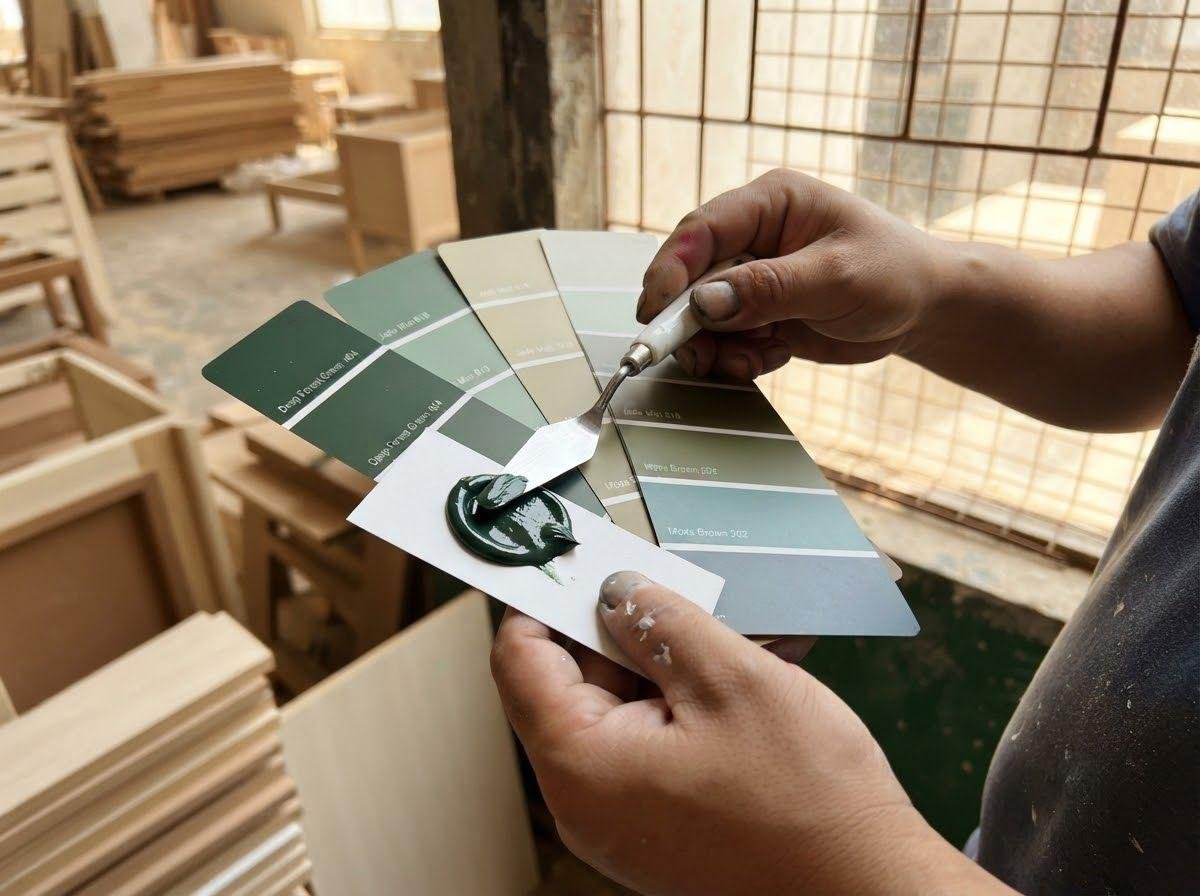
The chairs arrived on a Tuesday. Seventy-two of them, stacked three-high in a 40-foot container that had spent nineteen days crossing the Pacific to reach a boutique hotel project in downtown Austin. The procurement director — let’s call her Mara, because that’s close enough — had approved the navy velvet swatch back in March. Pantone 19-4024, if you want to get technical about it. She’d flown to Foshan herself, walked the factory floor in Longjiang, watched the dye bath with her own eyes. The sample was perfect. Deep. Consistent. Exactly the moody, institutional blue the interior designer had pitched to the ownership group.
And then the container doors opened.
The first twelve chairs were the navy she’d signed off on. The next batch? A shade lighter. Not dramatically. Just enough that, under the lobby’s LED pendants, they looked like they’d been ordered from two different suppliers. The final row? Slightly purple. Not obviously. But put them next to the first twelve and the difference screamed. Mara called me that afternoon. She didn’t yell. She just sounded tired. “I checked the box,” she said. “It said ‘within tolerance.’ What does that even mean?”
It means someone, somewhere along the line, applied the 3% rule. And Mara’s $340,000 furniture package — the one she’d sold to her client as turnkey and bulletproof — was now a case study in why China furniture orders keep procurement directors awake at night.
The Brutal Truth: Tolerance Is a Euphemism
Here’s what nobody tells you in the glossy showroom. Color variance isn’t an accident. It’s a feature of the system, built into pricing structures and production schedules that most buyers never see.
Chinese quality control, as it’s practiced on the factory floor, operates on thresholds. Not absolutes. A 3% variance in dye lots, in veneer staining, in leather finishing — that’s considered acceptable. Standard, even. The factory isn’t trying to deceive you. They’re trying to hit a number that keeps the line moving and the margin intact.
And here’s the kicker. That 3%? It compounds. One batch of fabric arrives 2% off from the lab dip. The finishing department adjusts. Then the lighting in the QC room is fluorescent instead of natural. Then the shipping wrap traps humidity. By the time you unbox in Austin, you’re not looking at 3% variance. You’re looking at three distinct colors pretending to be one.
Key Takeaway
- China furniture sourcing is the process of procuring manufactured goods from Chinese suppliers, where color consistency remains one of the most commonly underestimated risks in project-based buying.
- The “3% rule” refers to the industry-accepted tolerance for color variation between production batches — a threshold that sounds minor on paper but becomes visually catastrophic in finished interiors.
- Color variance ruins projects not because factories are careless, but because buyer expectations and factory tolerances are rarely calibrated to the same standard.
- Effective Chinese quality control requires specifying color standards beyond generic Pantone references and validating them under destination lighting conditions.
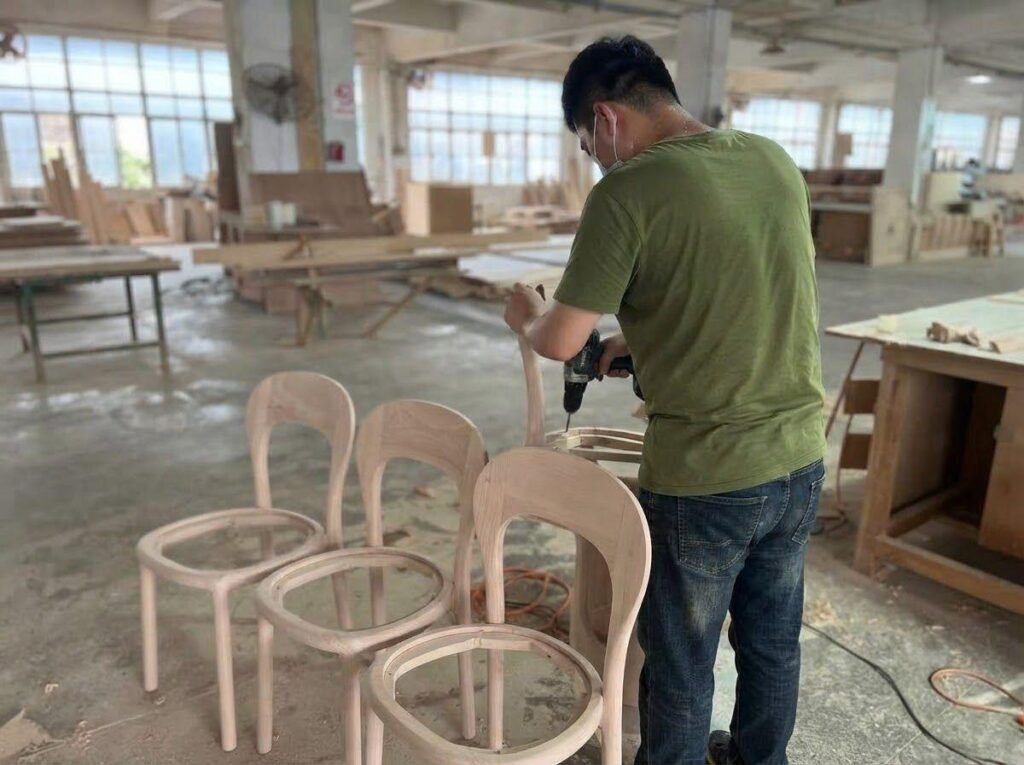
Why the Factory Floor Doesn’t Care About Your Mood Board
Is It the Dye, or Is It the Dying Art of Batch Control?
Walking through a textile mill in Keqiao at 7 a.m. feels less like a manufacturing facility and more like a kitchen during dinner rush. Vats steaming. Workers moving on instinct. A foreman with a clipboard who looks like he hasn’t slept since the Canton Fair. The dye master — and there’s always a dye master, usually a guy in his fifties who’s been mixing pigments since before the factory got ISO certified — works by eye as much as by formula. He’ll dip a swatch, hold it to the light, nod. Close enough.
And honestly? For domestic Chinese market orders, it is close enough. The tolerance culture evolved serving a market where absolute color matching matters less than price and speed. Export buyers, especially those in hospitality and high-end residential, imported their own expectations without importing the context.
Think of it like this. Ordering furniture color from a factory using only a Pantone number is like ordering a steak by saying “cooked.” Medium-rare means one thing at a steakhouse in Dallas and something else entirely at a grill in Qingdao. The words are the same. The reference points aren’t.
What tends to happen is that factories manage color at the batch level, not the project level. Batch A matches the standard. Batch B matches the standard. But Batch A and Batch B don’t match each other. The general pattern suggests that smaller factories — the ones with six dye vats instead of sixty — actually have more inconsistency lot-to-lot because they’re running shorter production cycles with less buffer inventory.
But the real problem isn’t the equipment. It’s the specification. Or rather, the problem isn’t the factory, it’s the expectation that a digital color file and a physical sample viewed under showroom track lighting will translate identically across twelve hundred miles of supply chain and three seasons of humidity variation.
The Lighting Lie
I learned this the hard way in Dongguan. Approved a beautiful charcoal bouclé under the factory’s warm-white LEDs. Looked rich. Deep. Expensive. When the shipment hit our client’s Manhattan showroom, the same fabric looked greenish under their cooler architectural lighting. Same dye lot. Same mill. Two completely different personalities.
The color you approve is never the color you receive — it’s the color you approved under specific conditions that will never be replicated.
Factories in Guangdong and Zhejiang typically evaluate color under D65 daylight simulation or standard cool-white fluorescents. Your project site? Probably a mix of 2700K residential LEDs, north-facing window light, and whatever the electrician spec’d for the corridor. The factory isn’t wrong. You’re not wrong. You’re just speaking two different visual languages without a translator.
And here’s where it gets expensive. A color mismatch in a residential living room is annoying. A color mismatch in a 200-room hotel rollout is a brand identity crisis. I’ve seen projects where the headboard upholstery arrived in three distinct shades of greige. The designer had specified a warm taupe. The factory delivered warm taupe, slightly-warm taupe, and “we-ran-out-of-that-dye taupe.” The client rejected the entire floor. Six weeks of delay. $80,000 in replacement fabric costs. Not because anyone was incompetent. Because the 3% rule met a zero-tolerance design brief.

The Hidden Economics of “Close Enough”
Who Actually Pays for the Rework?
There’s a mythology in sourcing that goes like this: if the factory ships the wrong color, they’ll fix it for free. Sometimes true. Usually partial. Almost never painless.
Factories calculate replacement costs against relationship value and order volume. If you’re moving two containers a month, you might get a sympathetic hearing. If you’re a one-off project buyer, you’re negotiating from weakness. The factory’s standard response to color disputes — and I’ve heard this verbatim in Longjiang — is “it’s within AATCC/ISO tolerance.” Which is technically defensible. And practically useless when your client is standing in an unfinished suite wondering why the accent chairs look like they came from a clearance sale.
While some buyers gravitate toward large-scale manufacturers in Foshan with vertical dye houses and automated color matching, others find that mid-sized specialists — operations like Interi Furniture, which focuses on custom hospitality and project-grade upholstery — offer a different risk-reward equation. They’re often more willing to hold fabric stock across extended production windows and run pre-production dip approvals batch-by-batch rather than lot-by-lot. That flexibility matters when you’re staging a phased hotel opening and need consistency across six months of manufacturing.
The cost of color variance isn’t just the replacement goods. It’s the storage fees for the wrong shipment. The air freight for the emergency replacement. The installer sitting idle. The photographer rescheduling the marketing shoot. The general contractor charging delay penalties. The real damage spreads like a stain.
Industry observers estimate that color-related disputes account for roughly 15-20% of all quality claims in China-to-US furniture orders. I can’t verify that figure against a published study — it’s a composite from conversations with three freight forwarders and two third-party inspection companies over the past four years. But anecdotally? It tracks. Walk into any QC firm’s office in Shenzhen and ask what triggers the most client complaints. Color won’t always be first. But it’s never outside the top three.
What to Actually Do About It
The Pre-Production Checklist That Factories Hate (But Buyers Need)
You can’t eliminate color variance. You can only manage the probability that it destroys your project. Here’s the framework I use. It’s not elegant. It works.
Specify the viewing conditions — not just the color.
Don’t just say “Pantone 19-4024.” Say “Pantone 19-4024, evaluated under D65 daylight, with final approval required under the client’s specified architectural lighting (2700K LED, CRI 90+).” Make the factory sign off on both conditions. If they won’t, that’s information.
Demand a production lot sample, not just a pre-production sample.
The pre-production sample is a love letter. Carefully made. Carefully checked. The production lot sample — pulled from the actual run, mid-batch — is the honest truth. Insist on it. Actually, that’s not quite right — what most buyers miss is that you need both: the pre-pro to set the standard, and the lot sample to confirm the standard is being met when the line is moving at speed.
Set a physical standard, not a digital one.
Send the factory a physical swatch. Have them dye to match the swatch, not the PDF. Then keep that swatch as the sealed master. When inspection happens — and you should be doing pre-shipment inspection, not just trusting the factory’s internal QC — the inspector compares against the master, not a memory.
Schedule production in the smallest viable batches.
This contradicts conventional wisdom. Most buyers think larger orders get better attention. Wrong. Larger orders get split across shifts, across weeks, across dye lots. A 500-chair order placed as one PO often ships as three distinct production batches. Better to place three POs of 170 chairs with explicit batch-to-batch color matching requirements. It costs more in administrative overhead. It saves infinitely in consistency.
Build a color buffer into your timeline — and your budget.
Add three weeks. Minimum. For re-dips. For re-approvals. For the inevitable moment when the factory says “the dye house is backed up.” If you don’t use the buffer, you finish early. If you need it and don’t have it, you’re choosing between a delayed opening and a compromised design.
Inspect under the right light, at the right time.
Pre-shipment inspection should happen with the lights the client will use. If that’s impossible — and it usually is — specify that the inspector photograph the goods under both factory-standard and natural daylight conditions. Side-by-side. Same frame. No filters.

FAQ
Q: My factory says a 3% color variance is “industry standard.” Are they just brushing me off?
A: Sometimes yes, sometimes no. The 3% tolerance is genuinely referenced in textile and finishing standards (AATCC Gray Scale, ISO 105, etc.), but “standard” doesn’t mean “acceptable for your project.” What matters is what’s in your purchase order. If your PO is silent on color tolerance, the factory defaults to their standard. Which is probably looser than your designer’s standard. Get it in writing. Specify the evaluation method. And if you’re doing hospitality or commercial work, consider requiring a Delta E of 1.0 or less — that’s a measurable, defensible threshold instead of a vague percentage.
Q: I approved a physical sample that looked perfect. The bulk shipment was visibly different. How does that happen?
A: Sample-making and bulk production are different processes with different pressures. The sample room has time. The bulk line has quotas. Plus, samples are often made from small-batch dye lots with tighter control. Bulk orders pull from larger dye baths where variance naturally increases. The general pattern suggests that factories with in-house dye operations have better lot-to-lot control than those sourcing dyed fabric from external mills. Ask where the dyeing happens. If it’s outsourced to a third-party textile mill three provinces away, your risk just went up.
Q: Is it worth paying extra for “color consistency guarantees” from the factory?
A: It depends on what they’re actually guaranteeing. If it’s a promise with no inspection protocol, it’s smoke and mirrors. If it includes batch-to-batch lab testing, retained sample comparison, and a written rework policy with financial teeth? Then yes, it’s usually worth 3-5% on the unit price. Think of it as insurance with a deductible you control.
Q: Can I just use a third-party inspection company to catch color issues before shipment?
A: Yes, but only if you’re specific. Telling an inspector “check the color” is useless. Telling them “compare bulk production against sealed master sample XYZ under D65 lighting, photograph side-by-side, and flag any visible variation” is useful. The best third-party inspectors in Shenzhen and Ningbo know exactly how to do this. The mediocre ones will eyeball it and check a box. You’re paying for specificity.
Q: Does the 3% rule mean I should stop sourcing furniture from China?
A: No. It means you should stop sourcing furniture from China the way you order from a domestic catalog. China furniture orders offer unmatched range, customization, and value — but only if you invest in the specification and oversight that those advantages require. The factories aren’t the problem. The handshake-and-hope approach is the problem.
The Hard-Earned Lesson
Color variance in China orders doesn’t ruin projects because factories are sloppy. It ruins projects because buyers treat color as a detail instead of a variable. They specify it like they’re ordering paint at a hardware store — name, number, done — when they’re actually commissioning a biological and chemical process across thousands of miles, multiple climate zones, and human judgment calls made at 7 a.m. by guys who haven’t had enough coffee.
The 3% rule isn’t a conspiracy. It’s a reality of manufacturing at scale. Your job isn’t to eliminate it. Your job is to build a process that makes the 3% irrelevant to your client’s experience.
So here’s the question I’ll leave you with: If your next container opened tomorrow and the first chair was a slightly different shade than the last, would your contract protect you? Or would you be making the same tired phone call, listening to the same tired explanation, wondering why you didn’t fix this before the PO went out?
Fix it before the PO goes out. That’s the only rule that actually matters.