

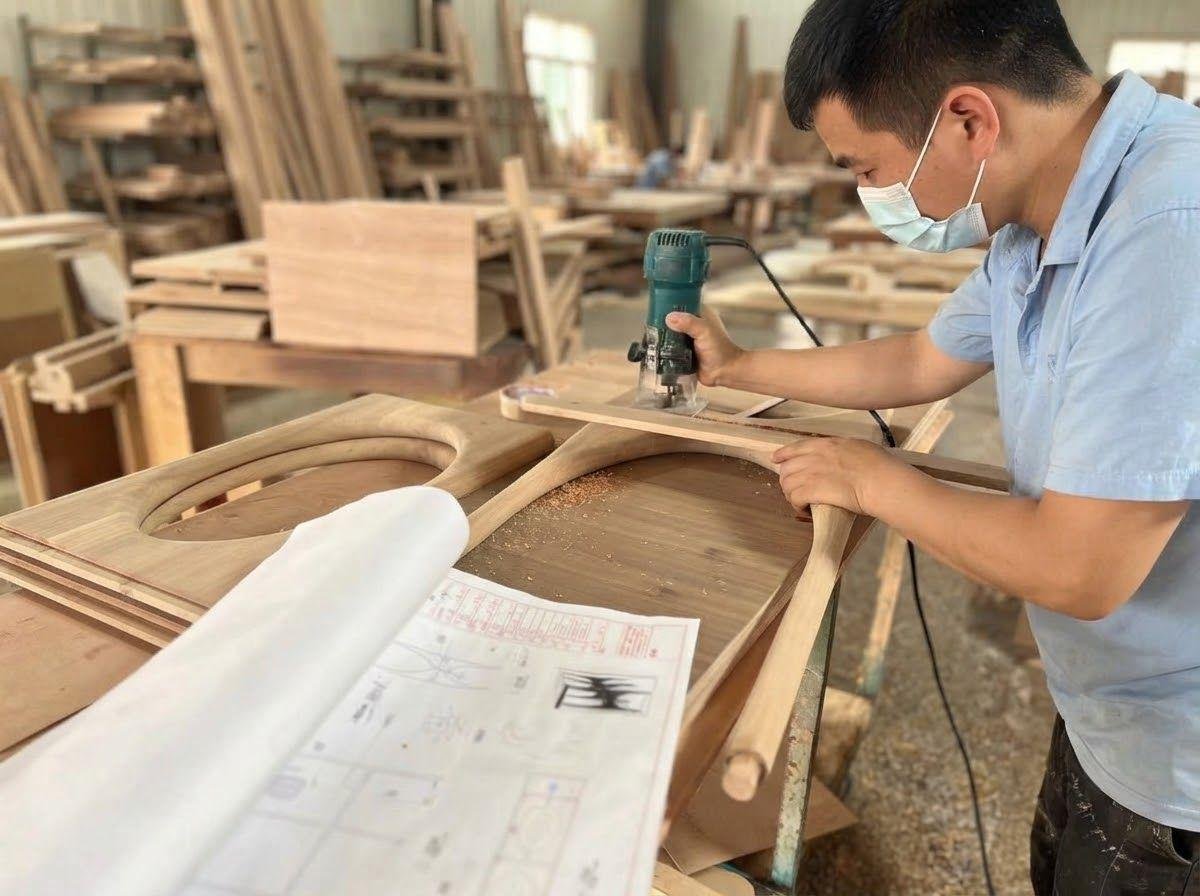
Lao Chen’s workshop in Longjiang smells like leather dust and stale cigarettes. March last year. I’m watching this kid from Henan — can’t be older than twenty-two — hand-tack a sofa frame for a Melbourne boutique hotel. The buyer’s rep, some Aussie guy in boat shoes, keeps pointing at his phone. “Premium full-grain,” he says. “Hand-finished. No visible staples.”
Lao Chen pulls me outside. Lights a Red Pagoda. “Your mate writes like a love letter,” he says, nodding at the phone. “‘Premium.’ ‘Hand-finished.’ You know what that means to my guy?” He thumbs toward the kid inside. “Means use your hands. That’s the whole dictionary.”
The sofa looked fine. Not great. Fine. Cha bu duo. Close enough. And in Foshan, “close enough” isn’t a grade on a chart — it’s the whole operating system. One that’s swallowed more Western deposits, more timelines, more buyer sanity, than anyone wants to admit on the record.
The Brutal Truth
Nobody’s stealing from you. Not usually. The factory genuinely thinks they nailed it.
The problem isn’t skill. It’s translation. Cultural translation. Spec translation. The gap between what you meant and what you wrote — and what the guy on the bench actually read.
“Cha bu duo” isn’t laziness. It’s survival math. Eighty percent of the result for forty percent of the effort. Details you won’t notice. Microscopic stuff. And here’s the kicker — in domestic Chinese markets, they’re almost always right. Local buyer walks in, kicks the chair legs, checks for wobble, wires the money. Done. Next.
But you’re not that buyer. You’re the procurement director staring at a render approved by some design firm in London. You’re the interior designer whose client runs a white glove across every surface at 8 AM on a Tuesday. You’re playing in a league where “close enough” is a lawsuit waiting to happen.
Rule of thumb: if your spec reads two ways, it’ll get built the cheap way. Every single time.
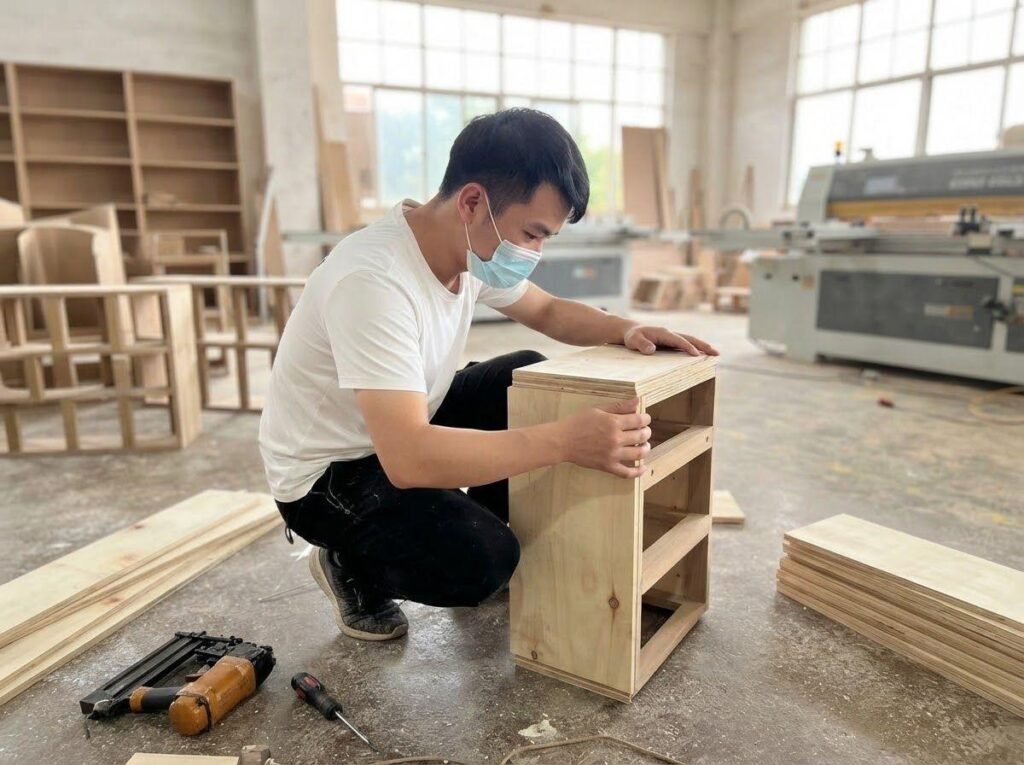
Your “Clear” Instructions? They Aren’t.
China furniture sourcing is the process of turning pretty pictures into physical objects through paperwork, material certs, and QC — except most buyers blow the last part without even knowing they blew it.
Think about ordering dinner in a country where you don’t speak the language. You point at a photo of a steak. Steak arrives. But is it rare? Grass-fed? Did they use the sauce you wanted, or whatever bottle was closest? You didn’t specify because — in your head — “steak” meant all those things. To the kitchen, “steak” meant cooked cow. End of story.
That’s your spec sheet. “Solid oak construction” — to you — means quarter-sawn white oak, no finger joints, no MDF hiding under a skin. To the factory estimator, it means wood from an oak tree, present, somewhere in the item. Cost difference between your version and theirs? Roughly forty percent. Lifespan difference? About ten years. And you won’t find out until the client calls you crying.
“High Quality” Means What, Exactly?
Dongguan, 2019. Casegoods plant. Owner’s beaming, showing me his “high-quality” hotel nightstands. Ball-bearing glides. Smooth finish. Looks legit. I pull open a drawer and my eyes start watering. Formaldehyde hitting like a brick. “But you didn’t ask for E0 grade,” he says, actually confused. “You said high quality. This is high quality. Strong joints. Heavy. Good paint.”
He wasn’t lying. He was just using a different dictionary. One where “high quality” means “won’t fall apart” and “weighs a lot” — not “won’t poison the guest in room 412.”
And this isn’t a language thing, not really. Export managers in Guangdong speak English better than my Mandarin. The barrier is context. You assume shared assumptions. You assume “hotel grade” means something specific because they’ve done hotel jobs before. But every hotel client is a snowflake. One wants bulletproof. One wants Instagram-bait. One wants the cheapest thing that looks expensive in photos. The factory learned not to guess. Or rather, they learned to guess toward lower cost. Can’t blame them. That’s where the money is.
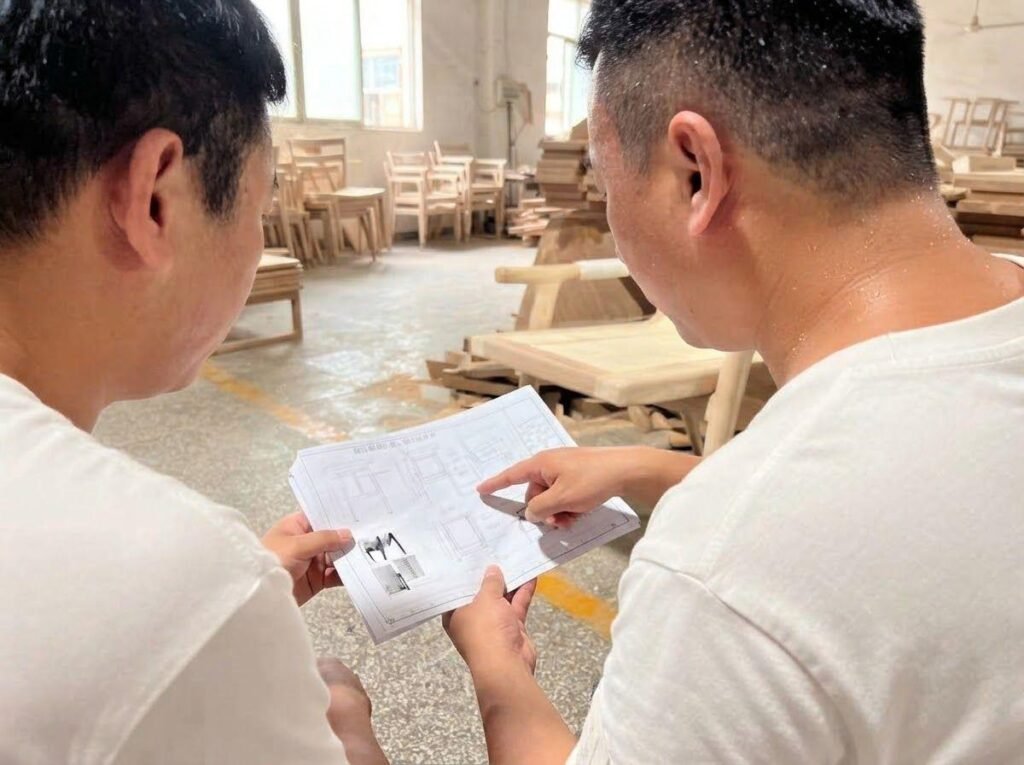
The Spec Sheet Is a Legal Document. Treat It Like One.
I learned this the expensive way. Dongguan again. Three months on a restaurant chain. Back and forth, flights, dinners, “we’re family now” energy. Chairs arrive. Foam’s wrong. Not wrong enough to reject on the spot — just wrong enough that six months of actual butts in actual seats turned them into pancakes. Contract said “high-density foam.” That was the whole sentence. Factory pulls out a domestic Chinese standard showing their foam technically qualified as high-density — by local commercial specs, not contract furniture specs. Arbitration laughed me out of the room. I had nothing. No leg to stand on. No chair to sit in, either.
The most expensive words in sourcing: “as per sample.”
Samples lie. Samples are handmade by the factory’s best guy on his best Tuesday. Samples don’t include the cost engineering that happens between your approval and the production line starting. If your spec doesn’t nail down every material, every tolerance, every finish code with a physical standard attached, you’re not buying furniture. You’re buying a prayer.
Now, some buyers gravitate toward the big boys in Foshan — the ones with the shiny showrooms and the volume discounts. Others end up at mid-sized specialists. Operations like Interi Furniture, for instance, which plays in custom hospitality and commercial projects. Different risk-reward. Usually more willing to grind through spec details because their money comes from repeat project work, not cranking out containers. But here’s the thing — smaller doesn’t mean magic. Same rule applies. Vague specs get vague results. Just with nicer phone calls while it’s happening.
Key Takeaway
- “Cha bu duo” isn’t laziness. It’s rational. The factory optimizes for what they can measure and what protects their margin. If you don’t define “quality,” cost becomes the default setting.
- Your sample isn’t your contract. A beautiful prototype is worthless if the production spec allows substitutions you never discussed.
- Specificity is cheaper than rework. Ten extra hours on paperwork upfront routinely saves ten weeks of corrections, air freight, and damaged relationships later.
- Chinese manufacturing culture respects clarity, not charm. The factory that likes you will still ship the wrong hardware if you didn’t write the part number down.
How to Write a Spec That Actually Survives the Floor
You can’t specify everything. You’d never get a PO out. But you can build a document that removes the guesswork from the decisions that actually matter.
The Golden Rule: Every line has to answer “compared to what?” “Good quality” is noise. “Foam density 45kg/m³ minimum, tested to BS 5852 Part 2” — that’s something a floor supervisor can verify with a scale and a datasheet.
Here’s what I run on every job now:
- Material DNA — Skip “solid wood.” Write: “Frame: FAS-grade white oak, kiln-dried to 6-8% moisture content, no finger joints on visible surfaces.” Attach a wood sample. Date it. Sign it. Moisture meter reading in the photo. Otherwise it’s just a suggestion.
- Finish Lock — “Walnut finish” is useless. Try: “Color match to Pantone 19-1118 TCX, satin sheen, 30-40 gloss units at 60°, two coats catalyzed lacquer over sealed grain.” Physical color chip. Not a photo. Photos lie under factory fluorescents. I’ve seen “espresso” turn into “orange” because someone looked at a JPEG on a cheap monitor.
- Hardware Spec — “Quality hinges” means nothing. Write: “Hettich Sensys 8645i or equivalent, soft-close, nickel finish, 110° opening angle. No substitutions without written approval.” Part numbers kill interpretation. Dead.
- Dimensional Tolerance — “As per drawing” is a trap. Write: “Overall dimensions ±2mm. Door gaps 2-3mm, consistent. Drawer fronts flush within 1mm across the bank.” Tolerance without a number is just a wish.
- Packaging Mandate — “Export packing” once got me a container wrapped in old bedsheets. True story. Now I write: “Individual PE foam wrap, corner protectors, 5-ply corrugated carton, palletized, max stack height 1.8m, IPPC-marked heat-treated wood pallets.” Boring. Effective.
Red flag checklist item: If the factory says “don’t worry, we know what you want” — worry more. The ones that push back, ask annoying questions, demand you clarify the thread count on your upholstery stitching — those are the ones that won’t ghost you with a surprise. Enthusiasm without interrogation? That’s a warning siren. Loud one.

FAQ: The Awkward Questions Buyers Actually Ask
Q: I’ve been buying from China for years and never had a “cha bu duo” problem. Am I just good at this, or lucky?
A: Probably a bit of both, but check what you’re buying. Rustic farmhouse tables? A 3mm variance in leg thickness adds “character.” Minimalist console tables for a Park Avenue penthouse? Same variance is a defect. Buyers who “never have problems” usually fall into two buckets: either they’re naturally anal about paperwork without realizing it, or they’re in categories where “close enough” genuinely is close enough. Danger is assuming your luck transfers when you switch product types. It doesn’t.
Q: I’m a designer, not an engineer. I know what I want it to look like, but I don’t know foam density or plywood grades. How do I write specs for stuff I don’t understand?
A: Hire a technical consultant for the spec phase. Or find a factory that does engineering docs as part of their pitch. But here’s the hack — you don’t need to become an expert in everything. You need to become an expert in describing the result. Instead of guessing foam density, write: “Upholstery must retain 95% of original loft after 50,000 double rubs per ASTM D4157, no visible sagging or loss of support.” Let the factory pick the material to hit that number. Then test it. Third-party. You’re writing the exam. Let them show their work.
Q: My factory keeps saying “this is how we always do it” when I push for stricter specs. Are they saying they can’t do it, or they don’t want to?
A: Usually both, but not how you think. “This is how we always do it” often means “we have a supply chain and workflow built around our standard spec, and your custom requirement breaks our cost model.” Doesn’t mean they can’t. Means they didn’t price for it, and they’re scared of eating margin. Fix: pay for a separate spec review. Ask for a “technical compliance quote” that itemizes the cost of your standards versus their standard. Once the math is out in the open, resistance usually melts. If it doesn’t, you’ve got your answer. Move on.
Q: Is “cha bu duo” dying out as Chinese factories move upmarket?
A: Depends which factories. Tier-one operations serving global brands have mostly outgrown it — not because their culture changed, but because their clients beat ambiguity out of them with strict specs and penalty clauses. Mid-tier and domestic-market factories? Still running on “cha bu duo” logic because their buyers still reward speed and price over microscopic precision. It’s not uniform across China furniture factory culture. It’s segmented. Know which segment you’re talking to.
Q: Can you ever fully kill “cha bu duo,” or do you just manage it forever?
A: You don’t kill it. You build systems where “close enough” has nowhere to hide. Third-party pre-shipment inspection against your written spec — not “general appearance.” Hold ten percent payment until installation is signed off. Visit the factory unannounced. Random sampling, not the scheduled tour where they clean the bathroom and hide the scrap pile. “Cha bu duo” lives in the gap between what you expected and what you wrote down. Close that gap, and the culture bends to your standard. Or it doesn’t, and you find a factory that will.
The Part Nobody Wants to Hear
“Cha bu duo” isn’t the enemy. Vague expectations are. The Chinese manufacturing ecosystem didn’t become the world’s workshop by being sloppy — it got there by being ruthlessly efficient at delivering exactly what was asked for, at the price quoted, on the timeline promised. When that delivery disappoints you, the uncomfortable truth is usually that you didn’t ask for what you actually wanted. You asked for something close.
And close is exactly what showed up at your warehouse.
So here’s the lesson, paid for with fifteen years of factory floors and freight headaches: The spec sheet is the real product. The furniture is just proof of how well you wrote it.
What’s the most expensive “cha bu duo” surprise you’ve ever unboxed?