

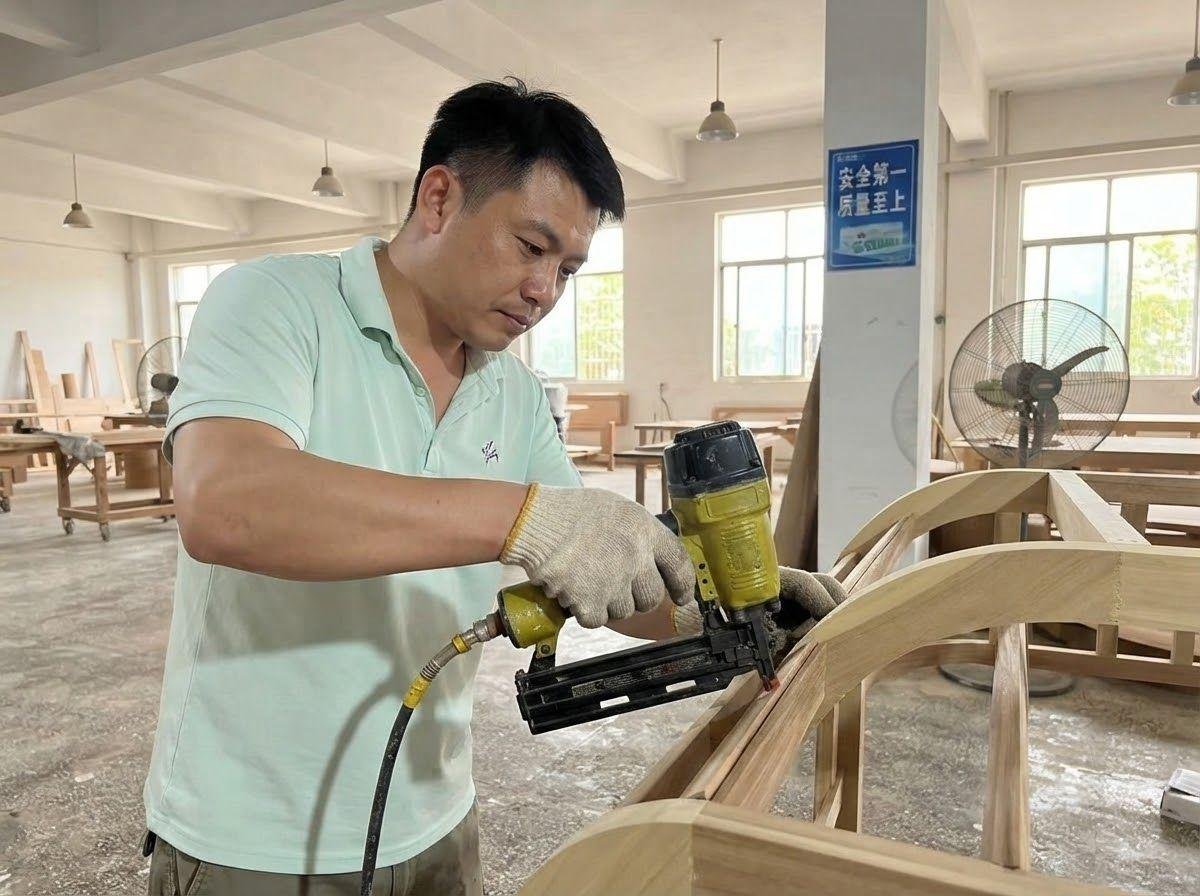
Three years back, I watched a procurement guy from Denver — hospitality group, decent budget, had it all figured out — walk into this massive factory in Longjiang, Foshan. Brought a binder thick with CAD drawings. Eighty-five grand earmarked for tooling. Six hours. That’s all it took. He walked out with a catalog under his arm and a PO for four hundred barstools. Straight ODM. Never touched his CADs.
And you know what? He nailed it.
That story eats at me because it breaks every rule the LinkedIn crowd shouts about. OEM is for the serious players, right? The ones with design chops. ODM is for dabblers who can’t be bothered. Except on the factory floor in Guangdong, that whole framework collapses. The floor doesn’t care about your brand strategy. It cares if your tech pack survives a humid July in the Pearl River Delta. It cares if you’re ready to burn six months chasing a prototype that looked gorgeous on screen and falls apart under a 200-pound load test. Most buyers? They aren’t ready. Most buyers think they want OEM because “control” sounds good in a boardroom. What they can actually execute — that’s a different conversation entirely. One most of them don’t want to have.
The Brutal Truth
Most Western furniture buyers pushing for OEM aren’t ready. Full stop.
They don’t have the engineers. They don’t have the QC setup to catch a three-millimeter frame variance while a container’s getting loaded at 10 PM. They don’t have six months of cash sitting in tooling deposits with zero revenue coming back. What they’ve got is a mood board, a margin target, and this vague notion that “owning the design” keeps competitors away.
It doesn’t. Not here.
Here’s my rule of thumb after fifteen years in this racket: OEM is a manufacturing call, not a branding one. If you can’t explain — in one plain sentence, no MBA jargon — why your custom frame joint outperforms the factory’s existing catalog enough to justify the cost and the delay, you’re not doing OEM. You’re doing expensive vanity shopping. And the factories? They’ll take your tooling money. They’ll build your prototype. They’ll even act excited about your “revolutionary” leg angle. But behind the polite WeChat messages, you’re the pain-in-the-ass job they mark up 30%.
Key Takeaways
- China furniture OEM means commissioning a factory to build your proprietary design to your spec, your tooling, your benchmarks — and it chews up way more operational bandwidth than most buyers ever budget for.
- ODM isn’t the lazy route; it’s a different risk trade. You hand off design control, yeah, but you keep your speed-to-market and your cash.
- The “right” strategy has almost nothing to do with how you position your brand and everything to do with whether your team can manage technical details, timeline slippage, and spec drift across seven thousand miles.
- Factories in Foshan, Dongguan, Longjiang — big ones, small ones, specialists — each play the OEM/ODM game differently, and none of it maps onto what Western buyers assume about size equaling capability.
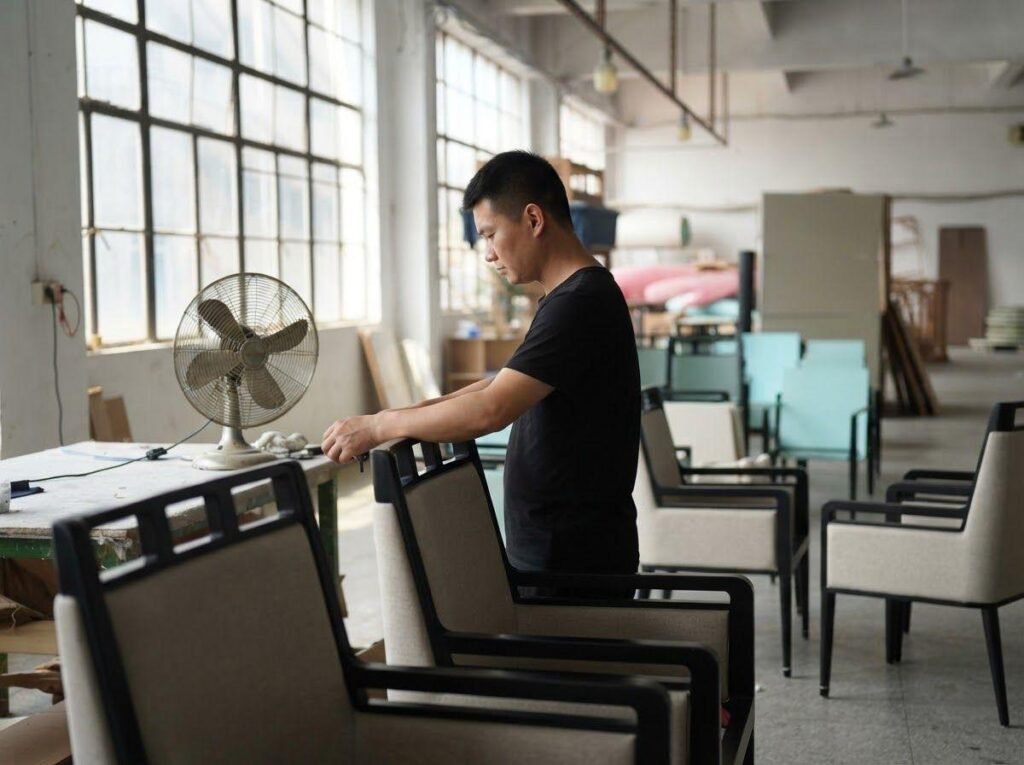
What OEM Actually Looks Like on the Floor
Folks talk about OEM like it’s ordering a bespoke suit. Bring your measurements, pick the fabric, craftsman builds to your body. Cute analogy. Also dead wrong.
Better picture? You’re renovating a house in a country where you don’t speak the language, the codes are different, and the contractor’s never seen your style of architecture. You bring blueprints. Fine. But when the drywall’s up and the electrical’s two inches off-center, you’re the one eating the cost to rip it out. The factory isn’t being sloppy. They’re reading your ambiguous drawing through their own lens — local material stock, existing jig setups, what the foreman considers “close enough.” Your “custom” sofa leg might need a CNC path they’ve never programmed. Your foam density might not exist in their supplier network without a ninety-day import wait. And nobody tells you this until the sample’s three weeks late.
Here’s what most buyers miss, and I mean really miss: the killer cost in OEM isn’t the tooling deposit. It’s the stuff that gets lost in translation.
I learned this the hard way. Dongguan, 2019. Client wanted this very specific mortise-and-tenon joint on a dining chair — something they’d seen in Milan, fell in love with. Factory nodded. Sample looked fine. Production run hits twelve hundred units, and we find out the joint’s been “optimized” with a hidden metal bracket. Same strength. Same look. Completely not what was spec’d. The factory genuinely thought they were doing us a solid. Fixed a weakness we hadn’t spotted. But our client was selling authenticity. That bracket was a lawsuit waiting to happen. We ate the rework. Three weeks down the drain. A factory relationship that never recovered.
That’s OEM in China. It’s not about being creative. It’s about forensic spec management. Can you look at a production sample and know, instantly, whether that walnut veneer grain match is within tolerance or a shortcut? If your answer is “I’d need to hire an inspector,” you’re not saving money with OEM. You’re buying a very expensive lesson.
Why Do Factories Actually Prefer ODM Buyers?
Because ODM buyers know what they don’t know. They sit down and say, “We need three hundred of something like this, in this price band, for this market.” Factory opens their catalog — or more likely, thumbs through their WeChat photo album of recent jobs — and the conversation starts. Lead times shrink. MOQs get flexible. Pricing gets sharp because the factory is building something they’ve already built, with materials already on the shelf, on jigs already dialed in.
But — and this matters — ODM isn’t passive. The sharp ODM buyer isn’t just pointing at a photo and saying “ship it.” They’re negotiating the hell out of modifications: swap the leg, change the fabric, tweak dimensions for American doorways. That’s where the real craft lives. In my experience, maybe seven out of ten “ODM” relationships that actually work are really light-customization deals. You don’t own the base frame, but you own enough of the configuration to stand out in your market. And you get there in half the time, with a fraction of the engineering headache.
The ODM Trap Door
For all its practicality, ODM has a trap door. Swallows brands whole. The trap? You stop being a buyer and start reselling someone else’s design instincts.
Seen it happen to design studios. To boutique hotel chains. To e-commerce operators who built their whole brand on “curated” aesthetics. Start with light ODM tweaks. Two years later, their whole catalog is interchangeable with four other brands pulling from the same three factories in Anji. Their “signature” lounge chair? Sitting in a competitor’s High Point showroom with a different label. Because it’s the same damn chair. The factory sold the frame to everyone. No contract broken — there was never a contract to break. That’s ODM.
While some buyers gravitate toward the big-name manufacturers in Foshan, others end up at mid-sized specialists — outfits like Interi Furniture, which tends to focus on project-based hospitality and commercial seating. These operations usually keep a tighter grip on their design catalog. Less likely to wholesale the same frame across twenty competing brands. The catch? Smaller capacity, and often a slightly higher unit cost. But for buyers running multi-property rollouts who need consistency more than they need the absolute lowest quote, that specificity can be worth the premium.
The general pattern is this: ODM works when your in-house team is strong on styling — when you can take a factory base frame and differentiate it through upholstery, finish, merchandising — but thin on product engineering. That’s not a weakness. That’s a valid model. West Elm isn’t engineering proprietary sofa frames from scratch for every SKU. They curate, modify, brand. The danger is thinking you’re running West Elm’s playbook when you’re actually just dropshipping with a slower boat.
The Cost Nobody Puts on the Spreadsheet
Quality fade. In OEM, you catch it because you’re checking against your own spec. In ODM? You often don’t catch it until your customer does. Factory swaps the internal plywood grade on your bestselling dining chair. Changes foam suppliers without a word. Dimensions drift five millimeters per run — not enough to spot in a photo, enough to make assembly a nightmare for your end user. These aren’t evil moves. They’re entropy. Natural decay in a relationship where you never wrote the original blueprint. You don’t have leverage to demand process docs because you never asked for them at the start.
What tends to happen is that ODM buyers confuse relationship warmth with accountability. They’ve visited the factory twice. They’ve got the sales manager’s WeChat. They think that friendliness equals enforcement. It doesn’t. Warmth costs nothing. Accountability costs money, and it needs contractual teeth.
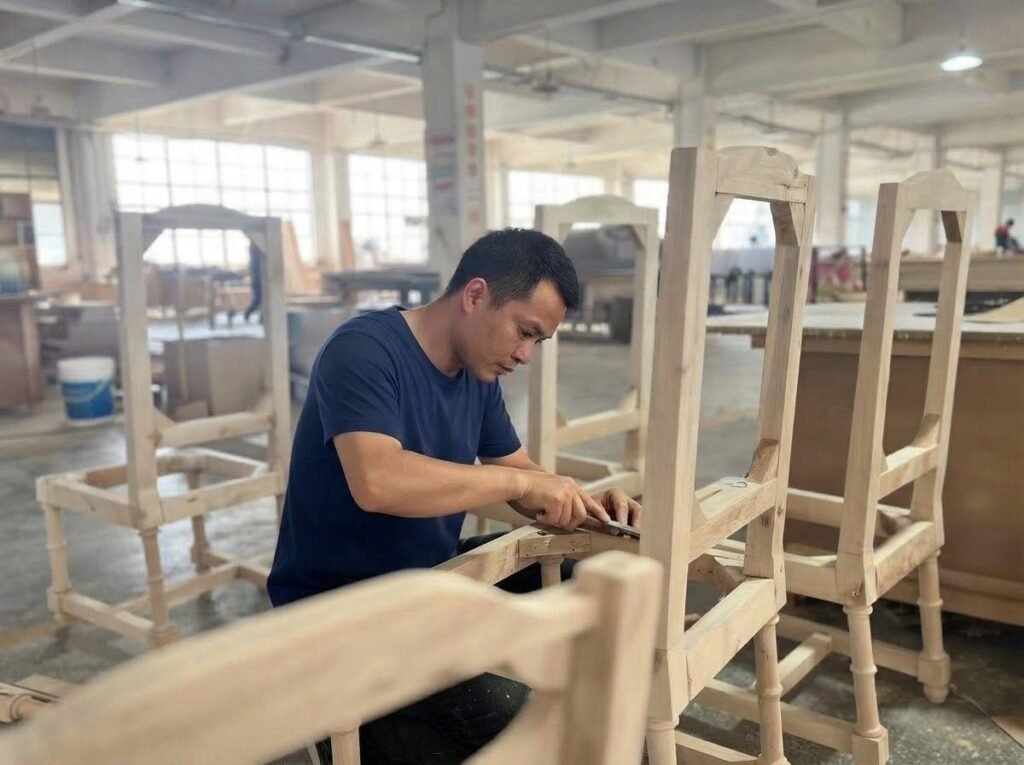
The Question Nobody Wants to Ask Themselves
Most buyers treat this like a personality quiz. “We’re design-led, so OEM.” “We’re lean and agile, so ODM.” Wrong frame entirely. The real question: what’s your organization’s actual tolerance for managing technical ambiguity from seven thousand miles away?
Think of it like driving in a foreign country. OEM is renting a manual transmission on the wrong side of the road. You can do it. Might even love it. But if you can’t drive stick, you’ll stall at every light, and the locals will lay on the horn. ODM is hiring a driver. You lose control of the route. You gain the ability to look out the window and actually think. Neither is better. But one of them will wreck you if you pick it for the wrong reason.
The real kicker? Some of the sharpest buyers I know run a hybrid without ever calling it that. They OEM their hero pieces — the statement items that define the brand — and ODM the workhorses. Side tables. Dining chairs. Storage that just needs to work and hit a price. That takes two supply chains. Two relationship rhythms. Twice the QC overhead. Most small-to-mid operations can’t sustain it. They try. Burn out. Retreat to pure ODM and wonder why their margins keep getting squeezed.
A Framework That Actually Helps
Don’t decide this over Excel. Walk through it honestly. Better yet, have someone on your team who doesn’t give a damn about the “design vision” score you.
OEM — Are You Actually Ready?
- Complete tech pack? Not sketches. Not 3D renders. Dimensioned drawings with tolerances, material callouts, finish specs, assembly logic. If your “spec” is a Pinterest board and a phone call, stop. You’re not ready.
- Someone on your team spent three straight days in a Chinese factory? And can read a production sample against intent without a translator doing the interpreting? (Yeah, this happens more than anyone admits — buyers signing off on samples they don’t actually understand.)
- Cash flow that can carry a 4-to-6-month prototype-to-production cycle with zero revenue from those SKUs? Plus fifteen, twenty percent contingency for rework?
- A real answer to “Why custom?” One sentence. What your proprietary design does that an adapted catalog frame cannot. If that sentence includes “feel” or “aesthetic,” dig deeper. Those are styling calls, not engineering ones.
ODM — Are You Being Smart About It?
- You know exactly which two or three design elements make your brand yours? And they can be achieved through upholstery, finish, minor dimensional tweaks to an existing frame?
- You’ve walked the same halls in Longjiang and recognize the leg profiles your competitors are using? Not espionage. Just knowing the landscape.
- You have a system to catch quality fade? Annual re-sampling. Unannounced inspections. Or at minimum, a written requirement that the factory notify you of any material substitution. Most ODM buyers skip this. Most get burned. Eventually.
The Red Flag
Factory pushes you toward OEM because “your design is so unique” but can’t name a single technical risk in your drawings? They aren’t impressed by your creativity. They’re smelling an amateur who’ll pay tooling fees for a frame they’ll quietly add to their ODM catalog six months later. Walk away.
| What You’re Actually Dealing With | OEM | ODM |
|---|---|---|
| Who owns the design | You. Full stop. | The factory. You license or modify. |
| Cash upfront | Heavy. Tooling, prototyping, spec work. | Light to moderate. Sampling, tweak fees. |
| Time to sellable product | Four to eight months, if you’re lucky. | Six to twelve weeks, typical. |
| Technical burden on your end | Heavy. Engineering, QC, constant vigilance. | Light to moderate. Styling, spec watchfulness. |
| How different you can really be | High, if you know what you’re doing. Low, if your spec is weak. | Moderate. Depends on how deep your modifications go. |
| Who this actually fits | Brands with real engineering, long product lifecycles, regulatory needs. | Brands with strong merchandising, fast refresh cycles, thin technical staff. |
| The thing that’ll bite you | Translation loss, tooling lock-in, factory “improvements” you didn’t ask for. | Quality fade, design commoditization, your “exclusive” frame showing up with someone else’s label. |

What Buyers Actually Ask Me
Q: Can I start ODM and flip to OEM later, once I know what moves?
A: Sure. But plan for it upfront. If you even think you might want to OEM a frame down the road, negotiate a “design evolution” clause in your first ODM deal. Most factories won’t hand over full IP, but you can often lock in first-right-of-refusal on exclusive mods, or a phased tooling buyout. Don’t assume goodwill gets you there. Get it in writing before that first container ships. The pattern I see? Buyers who try to renegotiate IP after a product’s proven out end up paying double or triple what they would have paid if they’d locked it in early.
Q: How do I catch a factory selling my “custom” ODM design to other buyers?
A: You often don’t. Not for sure. But watch for smoke. Six months after launch, search Alibaba and Global Sources in your category. See your exact frame with different branding? Factory either sold it or never stopped selling it. Real protection is contractual — ODM exclusivity with teeth — plus relationship leverage. Big, consistent orders buy more loyalty than a signed piece of paper. Also, don’t chase the absolute cheapest quote. Factories with razor margins have every incentive to spread their design costs across as many customers as possible.
Q: Is OEM always higher quality?
A: No. Quality is about spec clarity and enforcement, not which three letters you’re using. I’ve seen tight ODM runs from disciplined buyers outperform sloppy OEM programs on every metric. Factory builds to the standard you insist on and actually check. Your OEM spec has gaps? Factory fills them with their own judgment. Their judgment is tuned for efficiency, not your brand promise. A sharp ODM buyer who knows exactly which corners can’t be cut — and inspects those points relentlessly — can hit consistent quality without ever opening a CAD file.
Q: My factory’s pushing ODM even though I brought full OEM specs. Are they lazy, or do they know something?
A: Bit of both, usually. Chinese factory owners are pragmatic to a degree Western buyers often misread as dismissive. If they’re pushing back, listen. They might be telling you your design has a failure mode they’ve seen before. Or your specified material doesn’t exist at the grade you think it does. Or your volume doesn’t justify tooling disruption. That said, some factories push ODM because it’s more profitable — same frame, multiple customers, zero hand-holding. The test is specifics. “This is better for you” with no details? Be skeptical. “Your leg angle creates a stress point at joint B that our current jig can’t reinforce without a twelve-grand custom fixture”? That’s intelligence worth paying attention to.
Q: So which wins — OEM or ODM?
A: Depends on whether you’re buying furniture or building a product organization. Building an organization with technical staff, long-term SKU planning, tooling capital? OEM gives you assets that compound over time. Buying furniture to sell — curating, merchandising, moving inventory? ODM is probably the smarter play, if you manage the commoditization risk. Most buyers who think they need OEM actually just need better ODM discipline.
The Lesson That Cost Me
At the end of the day, this whole OEM vs. ODM argument isn’t about strategy. It’s about knowing yourself. The buyers who thrive in China? Not the ones with the fanciest design vision or the leanest operations. The ones who looked hard at their own team, their own cash, their own tolerance for ambiguity — and picked the path that matched their actual capabilities, not the ones they wished they had.
So here’s what I ask every buyer before they book that flight to Guangzhou: Are you trying to build something only you can sell? Or are you trying to sell something someone else can build? No wrong answer. But there’s a very expensive one if you pretend they’re the same thing.