

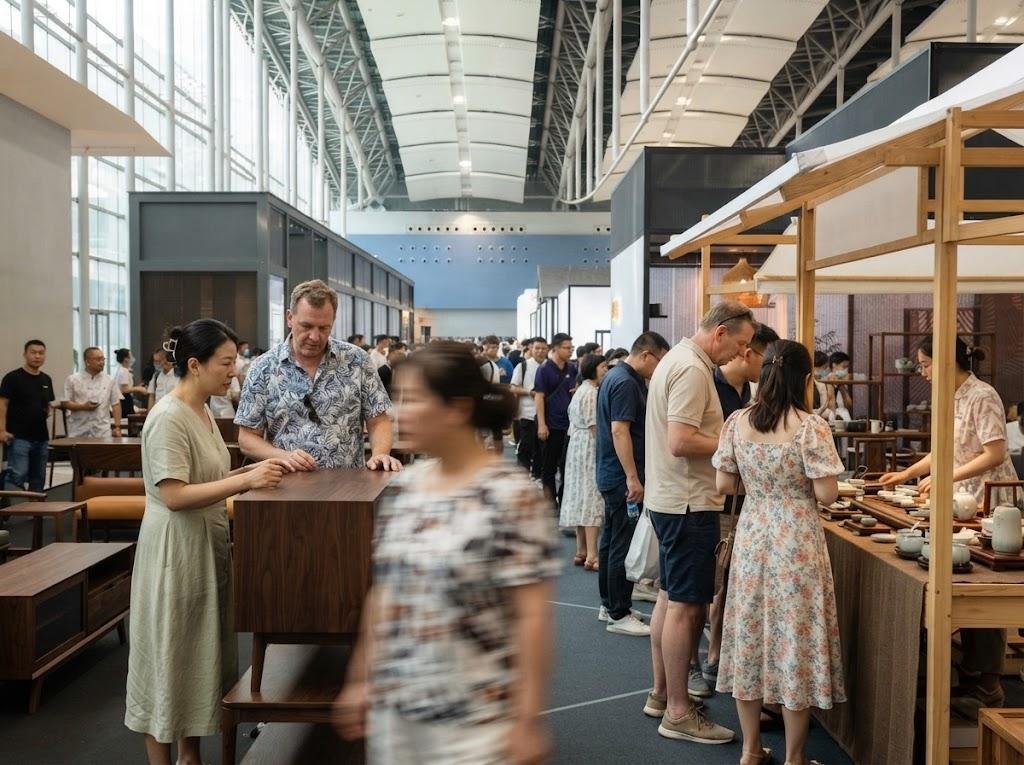
I was nursing an overpriced, genuinely terrible espresso in Hall 9.1 at the Pazhou Complex this past October when I watched a guy from Dallas practically beg a factory rep to take his money. It was the same old scene. The Texan needed 40 velvet accent chairs for a boutique lobby reno. He was pitching his firm’s long-term potential, waving a corporate card, doing everything short of pleading.
The factory rep? Polite, totally unyielding, and barely looking up from his oversized desktop calculator. He just tapped the laminated placard sitting on the glass table: 100 pieces per SKU.
The Texan eventually stormed off, venting to his assistant about how independent buyers are getting squeezed out and how they should just go back to domestic wholesalers.
But he was totally wrong.
What that buyer—and frankly, what most western buyers—completely missed is that the Canton Fair MOQ on that little placard isn’t a brick wall designed to keep you out. It’s a filter. It filters out the tourists. If you want to get past it, you don’t need a half-million-dollar budget to unlock decent volume discount China rates. You just need to stop asking for favors and start structuring your buys like a logistics partner.
The Uncomfortable Economics of “Small” Orders
Nobody likes hearing this, but factories do not hate you. They just passionately despise inefficiency.
When a factory boss sets a minimum order of 100 dining chairs, he isn’t trying to gatekeep the furniture industry. He is looking directly at his production line mechanics and his own supply chain. Buyers forget that Chinese factories also have to buy raw materials in minimums.
Say you want 40 chairs in a very specific rust-colored aniline leather. The factory can’t just run down to a local market and buy exactly 40 chairs’ worth of hides. They have to order a massive 500-yard batch from their tannery. What happens to the leftover leather? It sits in a humid warehouse in Shunde, tying up cash flow, getting in the way, and eventually degrading.
And that’s just materials. Think about the labor. They have to halt an entire line, swap out the wooden jigs on the CNC routers, recalibrate the pneumatic presses, and brief the floor staff on your specific stitching requirements.
Small runs bleed money.
If your order doesn’t keep a continuous assembly line humming for at least half a standard working shift, you are costing them money, not making them money.
THE SURVIVAL PLAYBOOK
- MOQs are filters, not laws. You can bypass them if you offset the factory’s upfront setup costs through legally binding tiered pricing.
- Consolidation is your real currency. Combining shipments from three or four specialized regional workshops into a single 40HQ container completely alters how a factory perceives your value.
- You don’t need huge single-SKU volume. You need a concentrated total factory spend across a curated product family.

The “Annoyance Tax” (And How to Stop Paying It)
Navigating the pricing game inside Guangdong’s industrial clusters is wild, mostly unregulated, and heavily dependent on your factory-floor empathy.
If you force a factory to do a small, custom run, you are going to pay what I call the Annoyance Tax. Think of it like a commercial bakery. If you demand a single slice of a massive, seven-tier wedding cake, they will charge you an insane premium because they still have to mix the batter and clean the entire industrial kitchen afterward.
I was walking the floor of a mid-sized upholstery plant in Longjiang a few years ago. The place smelled strongly of fresh pine frames, sawdust, and volatile adhesives. The line manager—a guy with missing fingertips who had probably been building sofas since the 90s—was visibly losing his mind. They had just halted the main assembly line to run a 20-piece custom sofa order for a naive Australian buyer.
It took his crew nearly an hour to fully retool. That hour of dead time, with 30 workers standing around checking their phones, cost the factory more than the net profit on those 20 specific sofas. They will never accept an order from that Australian guy again.
This is exactly where you use tiered pricing to save your margins.
Instead of demanding the 100-piece price for your 40-piece order—which instantly flags you as a rookie—you negotiate a sliding scale. You look the rep in the eye and agree to pay a 15% premium for the first 40 units. But here is the kicker: you legally lock in the 100-piece price for the next 60 units, provided you reorder within a six-month window.
You are effectively financing their painful setup cost on round one. In exchange, you are aggressively securing your own margins for round two.
The PI is Everything
To actually execute this, you can’t rely on a handshake. You must demand that all pricing tiers are written directly into the initial Proforma Invoice (PI). And it needs to be stamped with the factory’s official red chop. I’ve seen way too many buyers accept a verbal “don’t worry, we’ll take care of you next time” at the fair, only to be hit with a 20% price hike six months later when steel prices shift. A PI without a red chop is basically toilet paper.
Why 40 Pieces is Leverage, Not a Liability
So what if you literally never intend to order those extra 60 pieces? What if your project is a one-and-done deal, and you don’t have the warehouse space back in Dallas to store extra inventory?
This is where the art of local consolidation changes the game.
Canton Fair MOQ requirements look absolutely terrifying if you are trying to fill a 40-foot shipping container with just one single SKU. But honestly, nobody smart does that anymore unless they are a big-box retailer. (And yes, it happens. I’ve personally watched buyers ship half-empty containers, paying $4,000 to ship Guangdong air across the Pacific because they didn’t know how to mix a load).
The Hub-and-Spoke Model
The secret is finding a primary factory willing to act as your unofficial consolidation hub.
Here is how it works in practice. You buy your heavy, space-eating items from them—the massive king-sized bed frames, the solid wood dining tables, the bulky modular sectionals. Then, you source your delicate brass lighting from Zhongshan, your rugs from a different province, and your accent chairs from smaller, specialized workshops.
You arrange for those smaller factories to ship their goods to the primary factory’s warehouse via local Chinese logistics trucks (the infamous wuliu network).
By transforming a scattered, multi-city sourcing nightmare into a single consolidated 40HQ container, your status upgrades instantly from “annoying small buyer” to “logistics partner.”
When you sit down with a factory boss and map out a consolidated container plan, the psychology of the negotiation flips. You aren’t just buying 40 beds anymore. You are utilizing their logistics infrastructure. You are establishing a long-term supply chain foothold. You are proving you actually understand how the export machine works.
| Your Strategy | Upfront Capital Needed | Logistics Headache | How the Factory Sees You |
| Single SKU / Huge Volume | Very High | Low | VIP Client |
| Scattered Small Orders | Medium | Extreme | Total Nuisance |
| Consolidation Hub Model | Medium | Medium | Strategic Partner |

Finding the Right Ecosystem (And the Right Loading Dock)
Here is a hard truth that self-proclaimed sourcing gurus ignore: Not all factories are built for this.
If you try to run a consolidation play with a mega-factory that supplies global giants like Target or IKEA, you will fail. They will politely serve you expensive tea, smile, and completely ignore your requests. They absolutely do not have the warehouse space to spare for your random pallets of side tables. Their loading docks operate on military precision. A delayed local truck ruins their entire daily manifest.
You need the agile mid-market players. You need the Goldilocks factories.
A lot of rookies blindly chase the massive, 100,000-square-meter mega-factories in Foshan because they equate sheer size with safety. But those guys won’t let you consolidate. You need agility over scale. Take operations like Interi Furniture over in Guangzhou, for example. They carve out a solid living doing custom soft furnishings for project buyers. A setup in that specific middle tier is large enough to have actual, functioning QC departments and standardized management, but nimble enough that the floor manager will actually accommodate you if you ask to park three crates of marble tops on his loading dock for a couple of days.
That middle tier is where the magic happens. They inherently understand that the hospitality and project game requires aesthetic variety, not just mind-numbing volume. They know you need the marble, the brass, and the upholstery all in one shipment.
Or rather, the problem usually isn’t the factory itself—it’s the buyer’s wildly misaligned expectation. If you walk into a massive booth demanding supreme flexibility and warehousing favors from a rigid mass-producer, you’re setting your own money on fire. You have to vet for logistical agility just as hard as you vet for weld quality or foam density.
The absolute sweet spot is a factory big enough to handle your volume without cutting corners, but small enough to actually care when your local logistics go wrong.
The Ground Game: Executing at the Fair
The sheer scale of the Pazhou complex is overwhelming. So how do you actually execute this strategy on the ground without getting taken for a ride?
- Nail down your heavy anchor. Don’t try to shop for everything simultaneously. Find the manufacturer that will produce the bulk of your physical volume and eat up the most CBM (Cubic Meters) in your container. They are your hub. Secure them first.
- Pitch the annual spend, not the isolated PO. Stop pointing at the immediate order sitting on the table. Frame your negotiation around your projected 12-month spend. Say something like, “I need 40 pieces for this immediate phase, but this is a pilot for a three-property rollout.” (But seriously, only say this if it’s true. Factory bosses talk to each other over dinner. Liars get blacklisted fast).
- Negotiate the tier into existence. Ask for the price at 40 pieces, 100 pieces, and 250 pieces. Write all three tiers directly into the proforma invoice. This establishes the volume discount China benchmark for future orders and keeps their sales reps honest when material costs inevitably fluctuate.
- Secure the hub explicitly. Ask the anchor factory point-blank during your second meeting: “If I buy my heavy casegoods from you today, can I ship my lobby seating from a smaller factory to your loading dock for consolidation next month?” Watch their reaction. If they hesitate, or say they need to check with five different managers, they aren’t a good hub.
- Define the wuliu boundaries. Who pays for the local truck from the small factory to the big factory? Usually, you do. Negotiate this upfront so there are no surprise cash fees demanded by angry truck drivers when the goods arrive at the dock. Also, clarify who is actually responsible for physically unloading that local truck.
- The Ultimate Red Flag Check: If a factory eagerly agrees to consolidate goods they didn’t produce, but aggressively refuses to let your third-party QC inspector on their premises during the actual container loading—walk away. Immediately. They are either planning to swap out your consolidated goods for cheaper knockoffs behind closed doors, or they are a trading company desperately trying to hide their true location from you.
Your absolute best leverage at the negotiating table isn’t the PO in your briefcase. It’s the mathematically structured, legally documented promise of your future volume.

Navigating the Trenches: What Actually Happens
Q: Wait, do factories actually honor tiered pricing if my second order happens a year later?
A: Generally, no. Most legitimate tiered pricing agreements expire after 6 to 9 months because raw material markets are incredibly volatile. If you wait a full 12 months, expect them to recalculate based on current MDF, leather, and rolled steel costs. Always get the strict expiration date of the pricing tier written in English and Chinese on the stamped invoice.
Q: How do I know if the “volume discount” they quoted me isn’t just the standard price marked up first?
A: You cross-quote mercilessly. Take the exact same specification sheet to three different factory booths in the same hall. Do not tell them who else you are talking to. If Factory A’s “heavily discounted” 100-piece price is virtually identical to Factory B’s baseline 40-piece price, Factory A is playing games with their margins and hoping you are bad at math.
Q: Will factories charge me a storage fee if my consolidated goods arrive at their warehouse early?
A: Usually, yes, if it exceeds two weeks. Factory floor space is premium real estate in Guangdong. If your secondary supplier delivers goods three weeks before your main order is ready to load into the ocean container, the anchor factory will definitely tack on a daily warehousing fee. Time your local deliveries to arrive strictly within 72 hours of the final container loading date. Project manage it aggressively.
Q: Can I beat high MOQs just by hiring a local sourcing agent to argue for me?
A: It depends entirely on the agent’s real leverage on the ground. A phenomenal agent actively bundles your 40 pieces with another buyer’s 60 pieces on the back end to hit the Canton Fair MOQ, genuinely securing a discount for both of you. A bad agent just begs the factory for a favor, gets denied, accepts the high price, and still charges you a 10% commission for their failure. Vet your agents harder than your factories.
Next time you’re standing in a neon-lit booth in Guangzhou, staring down an MOQ that makes your stomach drop and your budget scream, take a breath. Look around the room and ask yourself who is really in control of the transaction. Are you just a desperate tourist asking for a favor? Or are you an educated buyer architecting a resilient, profitable supply chain?
The factories aren’t the enemy. They are highly efficient, fiercely pragmatic machines waiting for you to input the right combination of logistics planning and pricing structures.
Stop fighting the MOQ blindly. Start designing a better deal.
See you in the aisles.