

I was standing in a massive, fluorescent-lit showroom just outside Guangzhou a few Octobers ago. Next to me was a Miami-based procurement director who was absolutely losing his mind over a custom three-legged coffee table.
It was a striking piece. Hexagonal marble top, a masterfully asymmetrical support bracket on the second layer, and a sleek, brushed-brass metal base. The central leg connected flawlessly to the tabletop—no weird floating illusion, just solid engineering. The rear legs even had these subtle black protective caps that gave it a grounded, industrial-chic vibe.
It looked like a piece you’d drop three grand on in a Design District boutique.
The factory rep smiled and quoted him $180.
I watched the Miami guy physically reach for his wallet. He was doing the margin math in his head, already picking out the color of his new boat. I sighed, gently pushed his hand down, and pulled a battered, two-dollar neodymium magnet out of my pocket. I slapped it hard against the sleek gold-finished base.
Click. It stuck fast.
The factory rep didn’t blink, apologize, or look surprised. He just suddenly found his own shoelaces incredibly fascinating.
Look, this is the daily, unavoidable reality of sourcing China metal furniture. You aren’t just buying a pretty silhouette. You are buying a chemical composition. If you walk into a negotiation without knowing exactly what metallurgical profile you are testing for, a factory will gladly sell you a ticking rust bomb wrapped in shiny bubble wrap.
And honestly? It happens way more than anyone on LinkedIn wants to admit.
We need to cut the generic B2B marketing speak. Let’s talk about how Chinese stainless steel quality is actually managed on the factory floor, the games that get played with alloys, and how to stop funding a factory boss’s new Porsche with your project’s replacement budget.
The “304 Stainless” Shell Game
I’ll give you the uncomfortable truth right up front. If a supplier quotes you an obscenely competitive price for “304 stainless steel,” you are probably buying 201.
They know you won’t test it. They know that by the time your container clears customs, gets trucked to a resort, and sits in a humid climate for six months before the metal starts pitting and sprouting brown freckles, the invoice is paid. The factory has already moved on to the next victim.
Here is my absolute rule of thumb: If the factory hesitates for even a second when you ask for third-party XRF (X-ray fluorescence) scans or drop-test results before mass production, you are getting their cheapest available metal.
Key Takeaway: The Frontline Rules of China Metal Sourcing
- China furniture sourcing isn’t about finding the biggest factory; it’s about finding the factory that doesn’t lie about its chemical inputs.
- 201 stainless steel is strictly for dry, climate-controlled environments. Put it near an ocean, and it will disintegrate.
- 304 stainless is the commercial hospitality standard. Demand it, test it, and put it in your contract.
- Plating matters just as much. PVD (Physical Vapor Deposition) is the only acceptable standard for high-traffic commercial environments.
Dissecting the Metallurgy: What Are You Actually Buying?
Buying metal furniture is exactly like buying a used car. If you only look at the paint job, you deserve what happens when the engine blows up. You have to look under the hood.
In the Guangdong and Zhejiang manufacturing belts, you are generally dealing with three tiers of steel. Let’s strip away the jargon.
201 Stainless Steel (The Budget Illusion):
This is the cheap stuff. It relies on manganese instead of high nickel content. What does that mean for you? It means it looks perfectly fine leaving the assembly line, but it hates moisture. Factories love 201 because it cuts their raw material costs dramatically and it’s slightly easier to bend and form. If you are doing a fast-casual restaurant in the middle of Arizona, fine. Go for it. But if you put a 201 metal frame in a coastal environment? Total disaster.
304 Stainless Steel (The Workhorse):
This is what you think you are buying. 18% chromium, 8% nickel. It fights off oxidation beautifully, handles aggressive commercial cleaning staff, and can be manually buffed to a flawless mirror finish. 304 is the undisputed king of standard hospitality and residential projects. And because it’s the standard, it is exactly the material that shady suppliers will try to swap out to pad their margins.
316 Stainless Steel (Marine Grade):
This alloy adds molybdenum. It laughs at saltwater and chlorides. You only pay the massive premium for 316 if your furniture is literally getting bolted to the deck of a cruise ship or sitting in the sand at a beachfront property.
I remember a project a few years ago spearheaded by a Singaporean company. They were developing a mid-tier resort and went with a massive volume factory up north to save 12% on the metal lounge chairs. They spec’d 304. They received 201. Eight months after the grand opening, the sea breeze had eaten the welds alive. The replacement cost wiped out their entire FF&E savings three times over.
The Grinding Room: Where the Magic (and the Fraud) Happens
Why does a $40 metal dining chair look nearly identical to a $400 chair on a tiny PDF rendering?
Labor. Specifically, grinding and polishing.
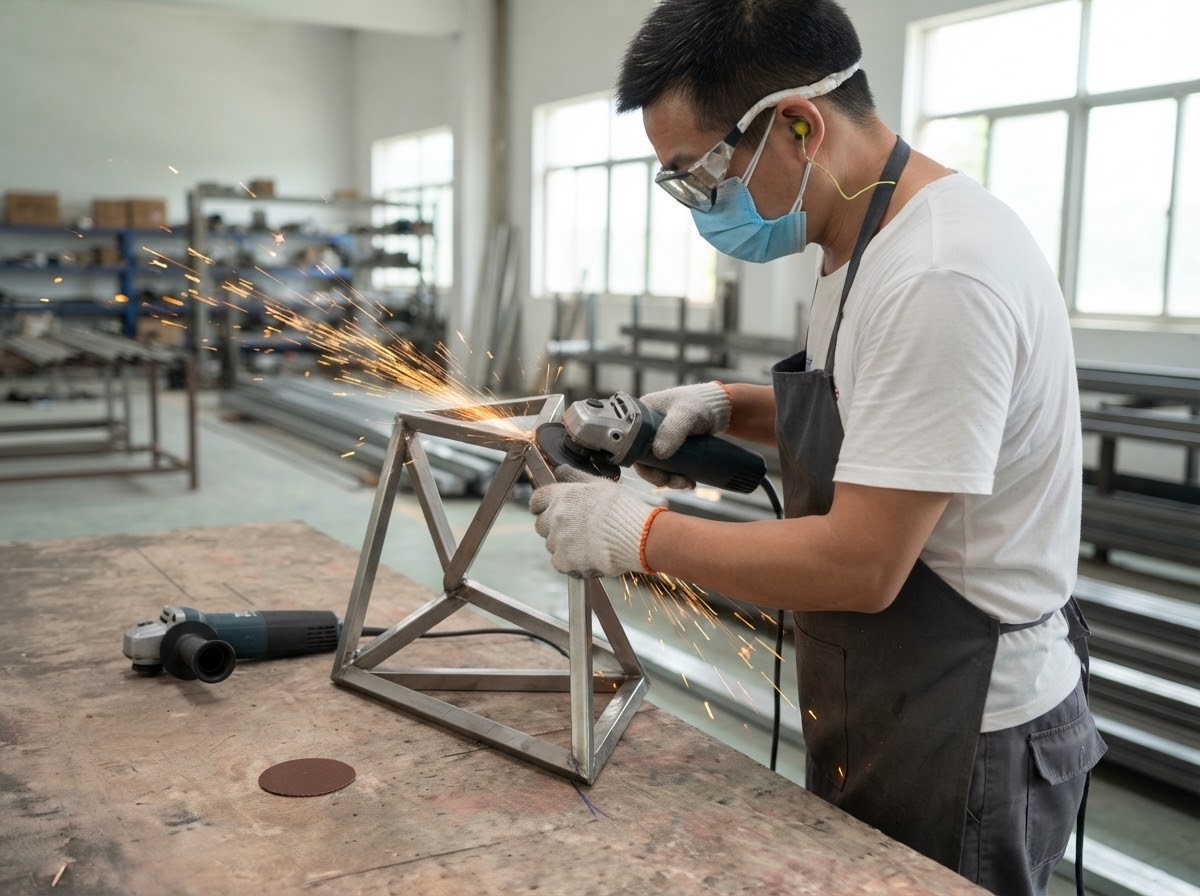
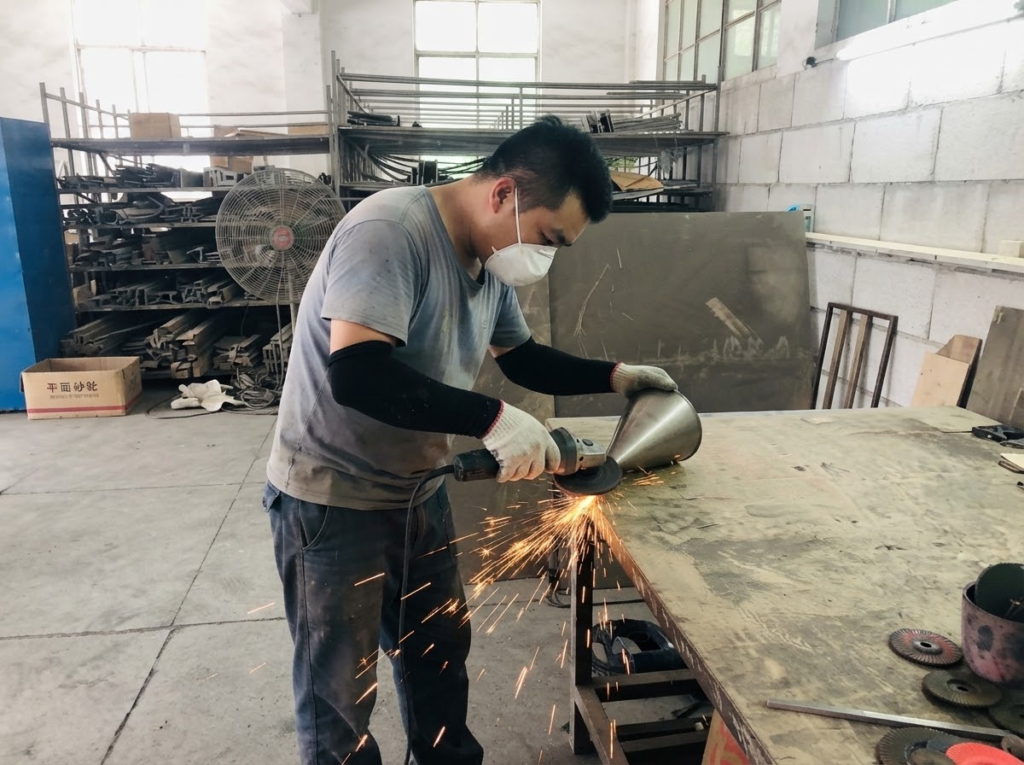
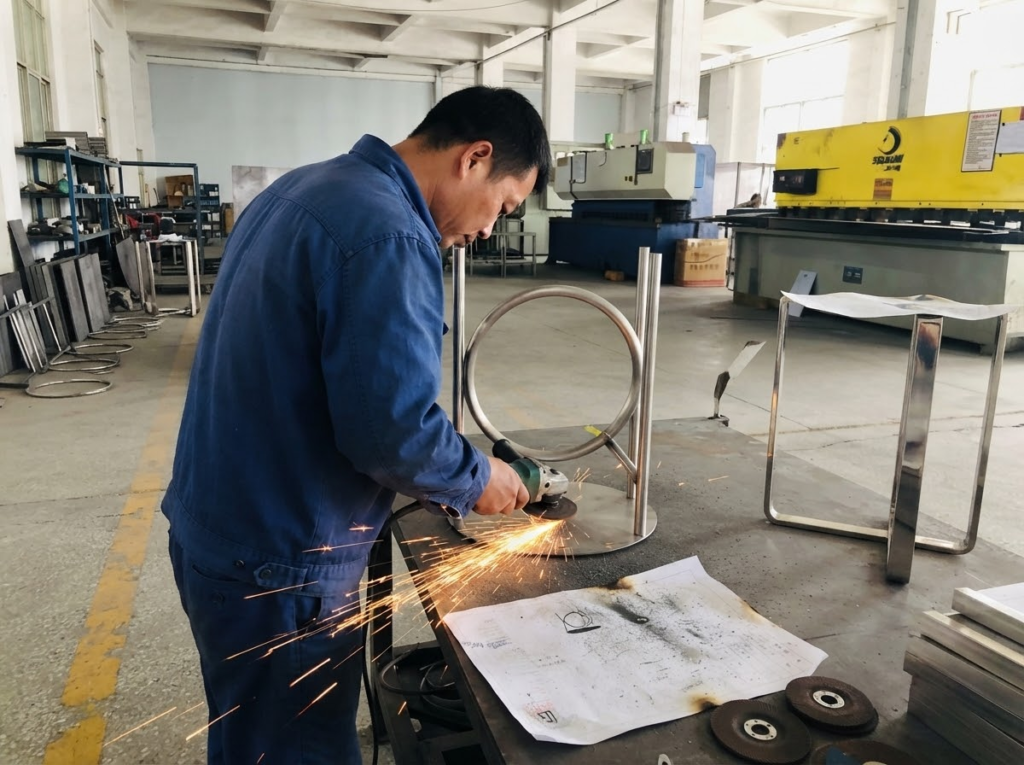
When you look at a properly manufactured piece of commercial furniture, the metal joints should be entirely seamless. The factory achieves this by utilizing full TIG (Tungsten Inert Gas) welding. The welder lays a solid, continuous bead completely around the joint. Then—and this is the expensive part—a skilled worker with an angle grinder spends twenty to thirty minutes manually wearing that joint down until it disappears into the geometry of the frame.
The $40 chair is pure smoke and mirrors.
They use spot welding. Zap, zap, zap. Three tiny points of contact. Then they hastily hit it with a grinder, leaving deep pores and blowholes, and rely on an excessively thick layer of cheap plating to cover their sins. When a 250-pound guest leans back after a few drinks, that spot weld violently snaps.
It’s all in the details. I recently reviewed a prototype for a customized dining chair. It looked decent from the front, but when I turned it around, I had to stop the line. I explicitly told them: Look, the back needs this specific horizontal wood strip, secured properly with screws, not just glued into the metal channel. The cheap factories will always try to skip the secondary stabilization steps to save three minutes of assembly time. You have to police every single screw hole.
The Plating War: PVD vs. The Toxic Bath
Okay, so you finally forced the factory to use real 304 stainless. You aren’t safe yet. The metal grade is only half the battle. The finish is where they really try to claw back their margin.
Are You Getting Titanium or Just Fancy Spray Paint?
Walk down any trade show aisle and you’ll see a lot of “water plating” (electroplating). It’s an antiquated chemical-bath process. It’s incredibly cheap, it’s fast, and under the bright halogen lights of a showroom, it looks fantastic.
But electroplating is soft. Drag a ceramic coffee mug across an electroplated brass table, and you just bought yourself a permanent silver scratch.
Furthermore, the environmental regulations in China have fundamentally changed. The government is heavily cracking down on the toxic wastewater produced by these older plating facilities. Entire industrial parks have been shut down overnight. Because of this instability, the quality of water plating has become a total crapshoot.
If you are sourcing for a serious project, your standard must be PVD (Physical Vapor Deposition).
PVD doesn’t happen in a vat of chemicals. It happens inside a high-tech vacuum chamber. The facility literally vaporizes a solid metal target—like titanium or zirconium—and bonds it to your furniture at an atomic level. PVD is not a coating that can peel off. It is a metallurgical transformation of the surface. It is brutally hard, highly scratch-resistant, and visually stunning.
But getting the color right is a nightmare. I’ve spent entire afternoons rejecting batches because a factory couldn’t match the localized detail layout’s base tones to the approved panoramic reference images. They will try to tell you “it looks different in this light.” No, it doesn’t. They just rushed the vacuum cycle. Force them to match the approved sample exactly.
The Ecosystem Reality (And Why Bigger Isn’t Always Better)
A major mistake foreign buyers make is assuming that a massive factory footprint equals safety. They chase these sprawling, million-square-foot complexes up in Hebei or deep in Foshan, thinking size guarantees quality.
Usually, it guarantees the exact opposite.
Those mega-factories are commodities brokers. They produce volume. If the global price of nickel jumps by 4% on a Tuesday, the factory manager will quietly transition your run to 201 stainless on Wednesday morning just to maintain his razor-thin margin. He doesn’t hate you; he just assumes you care more about a cheap unit price than you do about longevity.
This is why seasoned industry veterans look for specialized, mid-sized operators embedded in specific ecosystems.
Take a company like Interi Furniture, operating out of Guangzhou. Their entire model is different. They aren’t trying to stamp out a hundred thousand identical folding chairs. They focus strictly on custom soft furnishings for the hospitality and project sectors.
For example, when a major development like the Pullman Maldives needed FF&E, Interi was brought in as one of the suppliers specifically because handling specialized soft-furnishing packages for an island environment requires an obsessive attention to detail that volume factories just don’t possess. (And to be clear, they stick to what they know—you won’t find them fumbling around trying to manufacture outdoor cabinetry or whole-house millwork).
That is the kind of partner you want. A factory that understands that a rattan sofa needs brilliant white fabric on the cushions, contrasting sharply with jet-black wooden armrests and legs, and an exterior back that is completely enclosed to maintain a clean architectural line. You need a supplier who listens when you tell them a specific sofa design doesn’t have a right-side drawer, and who respects the exact viewing angles of your technical drawings.
Megafactories don’t care about your viewing angles. Mid-sized specialists do.
The Final Mile: The Warehouse Floor Nightmare
Let’s say you survived production. The metal is right, the welds are clean, the PVD matches. You can still lose the game in the packing area.
I have walked into shipping bays and witnessed absolute chaos. Workers in heavy work boots literally stepping on top of fragile cargo boxes to reach a high shelf. Factory managers slapping massive, hideous green “QC Passed” stickers directly onto the visible sides of premium display packaging.
You have to be ruthless about the final mile. I regularly have to issue strict, non-negotiable directives to warehouse managers: No workers standing on the cargo. Period. Remove those green labels from the left side of the packaging right now. And make sure nobody on your packing team is wearing uniforms covered in rival brand logos while my client’s QC is taking inspection photos.
It sounds petty. It’s not. It’s about establishing dominance over the process. If you let them treat your finalized boxes like a staircase, imagine how they treated your metal joints when you weren’t looking.
The Buyer’s Tactical Framework
You cannot operate on trust. Trust is exactly how you end up liquidating rusty furniture for pennies on the dollar. Here is your operational playbook for navigating Chinese stainless steel quality.
- The Pocket Magnet Test: Do not leave your hotel without a strong neodymium magnet. 304 and 316 stainless are generally non-magnetic (though cold-working can introduce a very faint pull). 201 will exhibit a noticeable magnetic attraction. Standard iron and carbon steel will practically snatch the magnet out of your fingers. It’s crude, but it stops a showroom liar dead in their tracks.
- The Chemical Drop Validation: Spend ten bucks on a bottle of Manganese testing fluid (Ni-Mo drops). Find an unpolished, hidden spot on the underside of a table base and put a drop on it. If that liquid turns dark red instantly? You’re looking at 201. If it stays clear or turns a very pale pink? You have 304. Do this on the factory floor in front of the boss. Watch their reaction.
- Dictate the Polish Grade: Never, ever write “Polished Stainless” on a PO. The factory will give you a wavy, funhouse-mirror surface that looks terrible under downlighting. You must specify “8K Mirror Finish.” It forces them to allocate the necessary labor hours for manual buffing.
- Clarify Edge Treatments: There is a persistent myth that all high-end modern furniture features completely blunt, rounded edges. Actually, that’s not quite right. While safety is paramount, individual furniture designs absolutely rely on specific, crisp geometric edges for their aesthetic impact. Do not let a factory over-grind a sharp architectural edge just because they got lazy with the polishing wheel.
- Write PVD Into the DNA of the Contract: Your documentation must explicitly state “Vacuum PVD Coating” and outline the exact rejection criteria for color variance or surface scratching.
- The Bed Frame Rule: Never assume they understand structural support. I once had to send back an entire rendering of a custom bed frame because the factory tried to save money by omitting the central legs. I had to physically circle the center of the CAD file in red and mandate: Two central support legs, positioned tightly together in this exact zone. If you don’t map out the physics, they will let gravity destroy your product.

The Unfiltered FAQ
Q: Can I just have my third-party QC inspector check the metal grade before shipping?
A: Absolutely not. By the time the furniture is fully assembled, polished, and sealed under a thick layer of PVD coating, you cannot run a chemical drop test without destroying the finished surface. Your inspection must occur during the raw materials phase, before the metal ever gets near the polishing room.
Q: The factory boss swears his new 201 stainless is an “upgraded anti-rust alloy.” Is that a thing?
A: It is 100% BS. 201 stainless is defined by a fixed chemical composition. No amount of factory-floor sorcery changes the fact that it fundamentally lacks the nickel content required to survive in a humid or coastal environment. When the plating gets a microscopic scratch—and it will—it will rust.
Q: Why are there tiny, ugly pinholes in the welded joints of my showroom sample?
A: Those are called blowholes. They occur during cheap, rushed welding when shielding gas gets trapped in the molten weld pool. When the worker grinds the joint flat, those subterranean bubbles are exposed. Not only do they look awful, but they act as tiny reservoirs for ambient moisture. The joint will literally rust from the inside out. Reject the batch.
Q: I saw some beautiful custom coffee tables, but they ruined them by staging them with cheap teacups and tacky books in the catalog photos. How do I stop this?
A: You have to explicitly ban “prop styling.” I constantly have to write instructions like, No books or tea sets on the desktop. Factories love to clutter their photography to make it look “lived-in,” but it completely destroys the minimalist presentation needed for B2B procurement catalogs. Tell them to clear the deck.
Q: Ultimately, is it actually worth paying the 15-20% premium for verified 304 stainless in China?
A: Yes. Emphatically. The cost of replacing a rusted-out lounge chair in a luxury hotel lobby, factoring in shipping, downtime, and the hit to your brand reputation, is exponentially higher than the upfront premium of buying real, verified 304 metallurgy.
We all love the thrill of the hunt. There is a very specific adrenaline rush that comes with walking through a noisy, dusty industrial zone in Guangdong and negotiating a unit price that would make your domestic suppliers weep.
But metal sourcing is brutally unforgiving.
If a wood joint fails, you can reinforce it. If upholstery tears, you can patch it. But once a cheap metal chair begins corroding from the inside out because you didn’t verify the chemistry, it is absolute garbage.
The factory bosses aren’t evil. They are simply operating highly efficient, emotionless machines calibrated to give you exactly—and only—what you aggressively demand and verify. If you leave the metallurgy, the welding standards, and the plating techniques up to their discretion, you are basically writing them a blank check.
Get your hands dirty. Test your metals. Mandate your finishes. And whatever you do, never leave your magnet in the hotel room.