


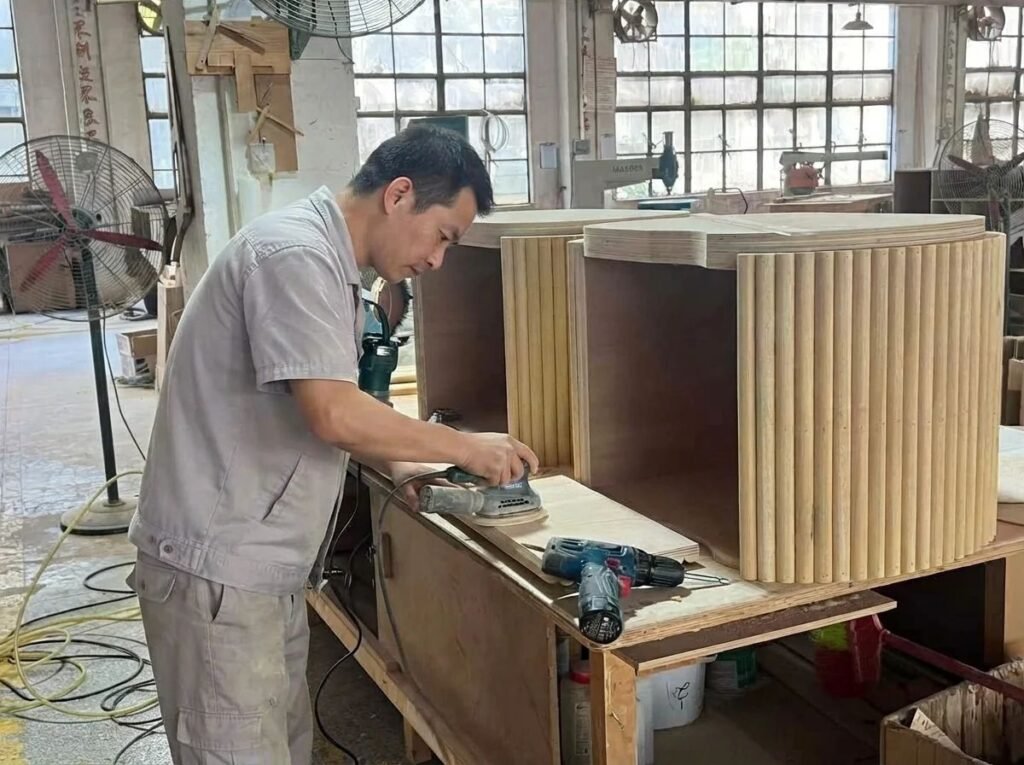
Let me take you to a Tuesday in Dalang, because it explains everything else in this piece. Dalang is a furniture town inside Dongguan — one long industrial road, sawdust in the air, in case you haven’t had the pleasure.
Mid-July. North of 34 degrees on the factory floor, even with the big roller doors open. I’m standing maybe three meters from a panel saw that costs more than my car, watching a crew feed boards toward the blade. The order on the line: minimalist wall panels for a boutique hotel group, $212,000, every corner a 45-degree miter, and the design allows exactly zero trim to hide behind. Not a bead. Not a shadow molding. Nothing.
The factory manager is proud. Genuinely proud — new CNC line, German blades, the whole showcase. And the boards stacked at the infeed table? Came off a truck that morning, still holding the heat of the road.
Nobody in that building thought anything was wrong. That’s the part that stayed with me. Four months later, in a climate-controlled lobby in Riyadh, every one of those corners opened up. Hairline gaps, one after another. The client sent photos and asked the only question that matters: what happened?
Nothing happened. There was no villain, no lazy crew, no con. Wood did what wood does. A truck, a schedule, and a saw — that’s the whole tragedy.
China furniture sourcing is the process of specifying, prototyping, inspecting, and shipping furniture and millwork from Chinese manufacturers. And when the product is custom furniture from China in the minimalist category, one rule overrides everything else: delete the ornament and you delete the forgiveness.
The Brutal Truth
Your QC report measures what the factory decided to measure. Full stop.
Look at what a standard pre-shipment inspection actually covers. Quantity. Cartons. Obvious damage. Dimensions against the spec sheet. All useful — genuinely. And not one of those checks will catch a miter that’s half a degree off, because half a degree lives comfortably inside every tolerance ever written onto a QC form. The caliper says pass. The lobby lighting says otherwise.
The uncomfortable math of this category: defects are invisible in the factory and permanent in the building.
The brutal truth: with custom furniture from China, the paperwork describes the factory’s intentions — the light describes its hands.
My rule of thumb, given freely and ignored regularly: the machine is innocent until proven guilty, and the schedule is guilty until proven innocent. A five-axis router doesn’t get tired. Doesn’t rush. Doesn’t care about the piece-count bonus. The Tuesday production schedule cares about exactly one thing — and it isn’t your corner.
Wait. I should be fair. It isn’t really the schedule’s fault either. It’s the missing 72 hours. The acclimation time nobody billed anyone for.
KEY TAKEAWAY
- Miter gaps hide inside “passing” tolerances. No angled light, no inspection.
- From Chinese OEMs, the golden sample shows you the ceiling. Production shows you the average.
- Moisture beats machinery. Every time.
- The cheapest quality control happens before the deposit, not before the ship date.
Why the Corners Fail
Think of a minimalist corner like a white dress shirt. Wear a patterned shirt to a messy lunch and nobody notices a thing. Wear white, and every drop of soup announces itself. Traditional casework is the patterned shirt — beads, cornices, stepped reveals, all busy enough to swallow small sins. Minimalism is the white shirt. One half-degree of error, under a designer’s cove light, reads like a stain on the chest.
So where does the gap actually come from?
Four places, roughly in the order they strike.
First: the boards arrive wet. A container or flatbed crosses a humid province, the lumber picks up moisture on the way, and the boards hit the saw at 14 or 16 percent moisture content when the target for export work is closer to 8. Ask to see the MC logs — real factories keep them, serious buyers photograph them. If the numbers don’t exist, the acclimation didn’t either.
Second: the wood keeps moving after the cut. Machining releases stress. Fibers relax, panels cup by fractions of a millimeter, and your perfect 45 becomes a perfect 44.6. Nobody did anything wrong. Physics doesn’t need permission.
Third: the container itself. Cargo crossing from a humid port can “rain” inside — condensation collects on the ceiling and drips onto the top cartons for weeks. If your panels ride the top of the load with no desiccant plan, they arrive pre-stressed.
Fourth — and this is the one that keeps me up at night — the handoffs. Dock to saw. Layup to press. Factory to port. Port to installer. Every transfer is a place where boards get re-stacked, sequence numbers get lost, orientation gets flipped. The paperwork at each step still says fine.
Hold on — isn’t most of this stuff MDF anyway?
Fair catch. A lot of minimalist panel work is veneered MDF or plywood core, precisely because the core is stable and flat. Good instinct. But the corner is where the trick falls apart: the miter-folded edge. The veneer wraps around a 45-degree fold, the glue line sits under permanent tension, and months later a hairline crack opens right at the fold — exactly where the eye goes first. Sharp, crisp, doomed.
Solid wood lipping has the opposite problem: it moves, and it takes the finish with it. Pick your poison. Actually, no — with the right factory, neither poison is fatal. But somebody has to raise the question before production, not after installation. In my experience, roughly eight out of ten “mystery corner” failures trace back to moisture or fold tension, not tooling. The general pattern suggests buyers rarely ask about either one.
What about the CNC? Doesn’t it just… cut straight?
Half the time it’s the hero. The other half, it’s an accomplice with a clean alibi.
A CNC cut is only as honest as that morning’s calibration, the blade’s edge, and the vacuum hold-down under the board. Let one composite panel shift two-tenths of a millimeter under vacuum — the operator sees nothing — and the joint’s fate is sealed before the spindle spins up.
Here’s the detail the spec sheet won’t tell you: plenty of mid-tier shops around Foshan and Shunde run saw blades weeks past their prime, because blade changes eat piece-count bonuses. Cuts stay “within tolerance” on paper. Under raking light, they confess. Want a factory’s real standards? Skip the certificate on the wall. Ask for the sharpening log.

Who’s Actually in the Game
Buyers love sorting Chinese OEMs into good and bad. Rookie move. The useful sort is scale versus specialization, because the two fail in completely different directions.
| Dimension | Large-scale manufacturers | Mid-sized specialists |
|---|---|---|
| Floor space | 50,000–200,000+ m² campuses | 8,000–30,000 m² shops |
| Natural habitat | Volume hospitality casegoods, repeatable room packages | Complex joinery, mixed-material custom work |
| How they break | Production drift across huge batches — you’re order #400 | Capacity crunches — you’re hostage to their queue |
| MOQ flexibility | Rigid | Often negotiable |
| Engineering style | Strong process discipline, thin design dialogue | Real DFM pushback, thin margin for error |
| Best suited for | Flagship chains, standardized rollouts | Boutique hotels, high-end residential, statement pieces |
Some buyers default to the big campuses around Shunde. Others trade scale for attention and end up at mid-sized export houses — Interi Furniture is the kind of name that surfaces in this tier, a Guangdong-based operation working the custom and project segment. You give up batch consistency and get engineering attention in return, plus management access — the kind where a miter question gets answered on WhatsApp at 9 p.m. your time. When one shadow gap can trigger a six-figure claim, that access is cheap at the price.
Communication rhythm matters more than buyers expect, too. The usual pattern on big-campus deals: your emails pass through a sales layer that translates you into production-speak, and something always gets lost in the translation. On specialist deals you often talk to the engineering lead directly. Messier conversations. Better outcomes. A factory that asks three clarifying questions before confirming your deposit is doing you a favor. A factory that confirms in four minutes hasn’t read the drawing yet.
This ecosystem isn’t a ladder from bad to good. It’s a menu of trade-offs — and the skill is matching a factory’s DNA to the exact way your project can fail.
The Playbook: Run This Before the Deposit Moves
Forget “do a factory audit.” Everyone does a factory audit. Audits get scheduled, cleaned up for, passed. This sequence catches what audits miss. Run it before the money leaves your account, not after.
- Get the acclimation protocol in writing. Then ask what happens when production slips a week. The distance between those two answers is the real audit.
- Light your samples properly. Raking LED, about 15 degrees, panels oriented the way they’ll actually hang. Almost nobody does this. Almost everybody should.
- Check the boring parts. Drawer grooves. Shelf pin bores. Back panels. Factories polish whatever buyers photograph — so photograph the back.
- Red flag: the factory that says yes to everything. The agreeable factory is not your friend. One that pushes back — flags a risky grain direction, questions an impossible reveal — is protecting your margin. The yes-factory is protecting its own.
- Show up unannounced in week three. Not golden-sample week. Week three, when schedules squeeze and shortcuts get invented. Bring someone who knows what a dull blade sounds like.
- Write “flawless” into the contract. Maximum gap width under raking light, in millimeters, measured at site climate. Never accept “industry standard” — those words mean whatever the factory needs them to mean that week.
One more, because it gets skipped constantly: hire an inspector who knows millwork, not containers. A cargo inspector counts cartons. A millwork inspector reads geometry. Different professions, different eyes, different outcomes.

FAQ
Q: Be honest — can Chinese OEMs actually deliver invisible 45s, or is “flawless” just a marketing word?
A: Yes, it’s real — with conditions. Flawless minimalist joinery ships out of China every week. What it takes is a factory with genuine acclimation discipline, a buyer who specs light-based inspection, and one mid-production visit that wasn’t scheduled three months in advance. Pull out any leg of that triangle and you’re gambling.
Q: My golden sample was literally perfect. Why do you keep implying that means nothing?
A: Because it means everything about your factory’s best day and nothing about its average one. The golden sample gets the A-team, the best boards, the front of the queue. Production gets the Tuesday crew, Tuesday boards, and position 200 in line. The gap between the two is, in my experience, the single most reliable predictor of how your project ends.
Q: Big factory or small factory? I get opposite advice from everyone.
A: It depends what you’re afraid of. Big factories fail through drift and deprioritization. Small ones fail through capacity shocks. Five hundred matching hotel rooms? Go big. Forty-eight museum-grade panels where every corner faces a spotlight? Give me the obsessive mid-sized specialist with the owner walking the floor, every time.
Q: What does joinery-focused QC actually cost me?
A: Based on what I see across export projects, serious millwork inspection runs about 2–4% of order value — and pays back multiples in avoided claims. Cheapest inspection: before production. Most expensive: your client’s guests, doing it for free, under permanent lighting, for the next fifteen years.
Q: Fine. Is it a nightmare or not?
A: It depends on exactly one thing: whether you treat joinery as a specification problem or a process problem. Specification buyers live the nightmare. Process buyers get corners a Swiss cabinetmaker would photograph.
The Part Nobody Writes Into the Spec
The Riyadh lobby got fixed, by the way. A local crew pulled the panels, re-machined the corners, and re-hung everything across six nights. Hotel opened on schedule. And the buyer? She still sources from China — but she flies in during week three, keeps a raking light in her luggage, and won’t release a deposit to any factory that won’t argue with her drawings.
Fifteen years of factory floors teaches one lesson that stings: the joinery was never the nightmare. The expectation was. You can’t buy perfection with a purchase order. You can only build a process where perfection is the path of least resistance for a factory ten thousand kilometers away.
So here’s my question for you. Next time a sales rep promises invisible corners, are you going to smile and nod — or are you going to ask to see the acclimation room and watch his face?
His face will tell you everything. It always does.