


I was sweating through a cheap polo shirt in a dusty Longjiang assembly plant back in late 2019, staring down a $45,000 batch of brushed brass lounge chairs. These were meant for a boutique hotel down in Miami.
Downstairs in the boss’s air-conditioned showroom? Pure magic. We drank over-steeped Tieguanyin tea while admiring what looked like a million bucks.
Up here on the third floor, though, under those buzzing, headache-inducing fluorescent tubes? Absolute garbage. I dragged my bare thumb across the underside of the armrest joint and winced. It felt exactly like a piece of jagged, chewed-up coral. The TIG weld was a porous mess. Hastily ground flat. Slapped with a PVD coating that was already starting to pit right there in the humid factory air.
The floor manager—a guy missing half his left index finger—just lit a Double Happiness cigarette. He shrugged. “Acceptable for this price.”
Actually, that’s not quite right. What he really meant was that foreign buyers wouldn’t notice until the chairs hit the Florida humidity and started bleeding rust onto the carpets. Spotting defective welds in Chinese steel furniture isn’t about staring at the shiny bits. It’s knowing exactly where the factory shaved off thirty minutes of miserable manual labor to pad their margins.
The Brutal Truth About Metal Fabrication
Let’s rip the band-aid off right now. When you buy metal seating or tables from overseas, you aren’t really paying for the steel.
You’re paying for grinding time.
Buying standard 304 or 201 grade stainless steel tubes from a local Guangdong material market is easy. The raw material is just a commodity. You buy it by the ton. The real bottleneck on the production line is the guy in the respirator mask holding the angle grinder.
Taking a burnt, welded joint up to a seamless mirror finish requires a massive amount of back-breaking, lung-destroying manual labor. Going from a rough 40-grit sanding belt, stepping down to 80, then 120, then 400, and finally hitting it with the cotton polishing wheel. It takes time. A lot of time. And here’s the dirty open secret nobody mentions at the Guangzhou trade shows: young workers in China do not want to breathe metal dust for twelve hours a day anymore. Labor for this specific job is getting incredibly scarce. Which means it’s getting expensive.
If a supplier quotes a price that looks absurdly good on your spreadsheet, they didn’t magically find cheaper steel. They just told their welders to hurry the hell up. They skipped three grit levels on the sanding belt.
Here is my unbreakable rule of thumb: If the underside of the chair will tear a pair of nylon pantyhose, you overpaid.
Key Takeaways: Inspecting Chinese Steel Furniture
- Defects hide in the dark: Always inspect the underside, inside joints, and unpolished seams where floor workers are explicitly instructed to move fast.
- Coatings are camouflage: Electroplating and PVD are frequently used to put lipstick on a pig—masking porous, incomplete TIG welds that will eventually fail under stress.
- Time is the true cost: Roughly 70% of the cost difference between high-end and low-end metal furniture is tied directly to manual grinding time.
- Agents matter: Hiring a specialized China inspection agent is non-negotiable for high-ticket metal orders. Factory-supplied photos are useless.

The Anatomy of a Botched Joint
Think of a welded joint like cheap autobody repair. A shady mechanic slaps a thick layer of Bondo over a massive dent, paints it, and it looks totally fine from twenty feet away. But tap it with your knuckles. Wait for a cold snap. The facade cracks right down the middle.
Stainless steel fabrication works exactly the same way.
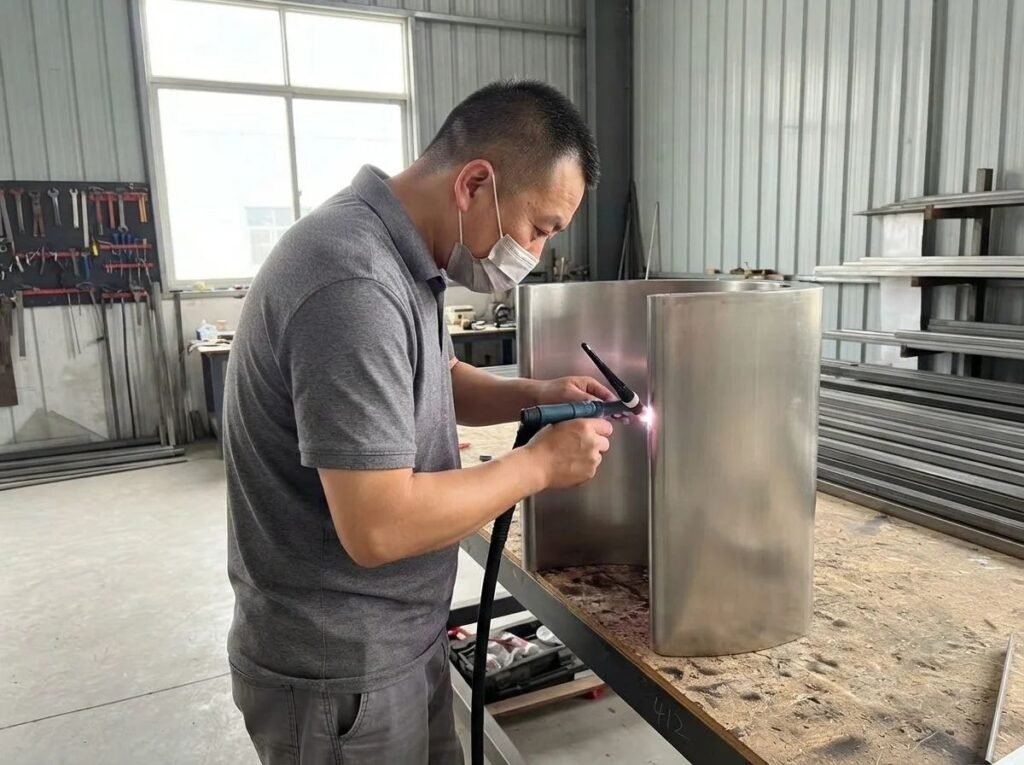
I used to think bad welding was born of malice. Actually, scratch that—it’s just math. Argon gas isn’t free. To save a few RMB per day, factory managers will quietly dial back the gas flow rate on the welding machines. What happens then? Oxygen gets into the molten metal pool. You get porosity. Little microscopic bubbles inside the weld that completely destroy the internal structure of the joint.
Then, the workers slap thick filler wire over the huge gaps where the metal wasn’t cut straight to begin with. They grind it flat, wipe it down, and call it a day. Looks seamless from a distance.
Structurally? A ticking time bomb.
I remember walking through a massive workshop out in Dongguan. The air tasted heavy, like burning pennies and metal dust. You could instantly tell which line was for export just by watching the welders’ hands. The budget guys were flying.
Zip. Zip. Done.
Barely any gas shielding. Because time is money, and they get paid by the piece. (And yes, this happens way more than anyone admits in those glossy, highly edited Alibaba company profiles).
Why does the underside always look like a war zone?
Flip a standard dining table over sometime. You’ll usually find what I affectionately call the splatter zone.
Spatter everywhere. Heavy black burn marks. Incomplete penetration. Factories know hotel guests don’t flip tables over. So they explicitly instruct the polishers to only finish the “A-faces”—the parts you can easily see when standing up.
But leaving a weld unpolished and un-passivated invites immediate corrosion. The moisture from daily floor mopping, or just ambient room humidity near a coastline, eventually causes ugly brown rust streaks to bleed down the legs of the furniture.
Is “full welding” actually full?
Suppliers absolutely love to promise “full welding” instead of spot welding. A continuous bead sounds great in an email negotiation, right?
Here’s the kicker, though. They’ll full-weld the top half of the joint where you look, and spot-weld the bottom where you can’t see it. It saves them a fraction of a cent in gas and wire per chair. I once had a client who bought fifty dining tables with heavy sintered stone tops. The factory spot-welded the crossbars to save maybe twenty minutes of labor per table. Three months later in a Texas warehouse, the temperature shifted drastically, the metal contracted, and those welds popped like gunshots.
When a 250-pound guy leans back in a badly welded chair? Snap.
The Plating Deception
Plating is a procurement director’s worst nightmare.
Applying a PVD (Physical Vapor Deposition) coating over a porous weld means the coating simply won’t adhere properly. It’s literally like trying to paint over wet sand. It’s going to flake.
Electroplating is even worse. The acid bath used to chemically clean the metal gets trapped inside the microscopic pinholes of a bad weld. A month later, while sitting inside a dark, humid shipping container baking on the Pacific Ocean, that acid bleeds out.
The industry calls this “weeping welds.” It ruins the finish completely, leaving nasty brown streaks right down the polished gold leg. (You try telling a Miami procurement director his custom chairs are rusting before the hotel even opens. I promise you, it is not a fun phone call).
Factory Ecosystems: Volume vs. Vision
This is exactly why understanding the broader factory ecosystem matters so much. Some buyers automatically run to the massive, multi-category Foshan mega-factories to squeeze out every last penny on unit price. And sure, if you’re buying disposable banquet chairs for a cheap rental company, go for it. Roll the dice.
That calculus changes drastically when you look outside the mega-factories. Mid-sized operations—such as Interi Furniture, built around the positioning of a high end custom furniture solution provider—operate under a completely different set of pressures. Their stated mission is to “make design more achievable,” which sounds great on a brochure, but practically speaking? Their core claim to “Never let clients down” forces them into much tighter quality control loops. Because if a factory playing in the B2B high-end space ships weeping welds to a VIP hospitality project, their entire business model collapses overnight.
The sheer size of a factory doesn’t guarantee a perfect weld, but their target market usually dictates their baseline polishing standards.
Mid-sized guys relying on repeat custom project business simply can’t afford weeping welds. They often pay their welders by the day, not by the piece. That one detail changes the entire incentive structure on the floor.
The Actionable Inspection Playbook
Listen to me on this one. You cannot trust an internal QC report. Period. It’s asking the fox to audit the henhouse.
Here is how you actually evaluate metal on the factory floor before you wire that final 70% balance:
- The bare fingernail test. Run your nail across the polished seam where two tubes meet. Catch or snag? Incomplete grinding. A premium weld should feel like one continuous piece of extruded plastic. No dips. No valleys.
- Hunt for the blue halo. A faint bluish or brownish tint around an unplated joint means the metal was severely overheated during welding. The chromium burned out. It will absolutely rust, regardless of the steel grade.
- The heavy fixture check. Ask to see the welding jig. If they are welding a complicated geometric base without a heavy steel fixture holding the pieces perfectly in place, the heat will warp the metal. They’ll just bend it back into shape with a rubber mallet later, secretly weakening the whole structure.
- The weight discrepancy. Weigh three identical chairs on a digital scale. If one is way lighter, they secretly mixed thinner gauge steel (like 1.0mm instead of the specified 1.5mm) into the run to pad their margins.
- The magnetic truth. 304 stainless should be mostly non-magnetic. If a magnet sticks hard to the frame, they quietly swapped it for 201 series steel.
- The Ultimate Red Flag:The factory insists you don’t need your China inspection agent because they generously hired an “independent” third party for you.
Never, ever accept that arrangement. You choose the agent. You pay the agent. They work exclusively for you.
And whatever you do, don’t send a standard soft-goods inspector to check intricate metalwork. A guy who spends his days checking the stitching tension on fabric sofas usually doesn’t know what TIG weld undercut looks like. You need a hard-goods engineer who actually knows metal.
The Table of Truth: 304 vs. 201 Stainless
Industry observers estimate over 60% of disputes regarding rusted Chinese steel furniture stem from unauthorized grade swapping. Once polished and plated, 304 and 201 look exactly the same to the naked eye.
Here is the reality of what happens on the floor when you turn your back.
| Feature | 304 Stainless Steel | 201 Stainless Steel | The Factory’s Motivation |
| Material Cost | High | 30-40% cheaper | Massive margin padding on volume orders. |
| Corrosion Defense | Excellent (marine viable) | Poor (rusts in high humidity) | Buyer won’t notice until 6 months later. |
| Welding Behavior | Smooth, easier to polish | Harder metal, sloppy finish | 201 eats up grinding belts faster, leading to skipped steps. |
| Magnetic Test | Non-magnetic | Slightly magnetic | They gamble that you won’t ever bother to check. |

FAQ: Sourcing and Inspecting Metal Furniture
Q: How much should I actually pay a China inspection agent for this kind of specialized quality check?
A: In my experience, a standard man-day for a qualified hard-goods inspector runs between $250 and $350. Don’t cheap out here. Spending $300 to ensure a $30,000 container of tables won’t collapse on your customers is the best insurance policy on earth. If someone quotes you $100 a day, they are likely taking kickbacks from the factory boss to look the other way.
Q: The factory manager insists the black spots on the joints are just leftover polishing wax. True?
A: No. It’s almost always weld porosity. Microbubbles trapped deep in the metal because they skimped on shielding gas. Wax washes off with a simple solvent. Porosity is structural. It causes plating to flake off later, and you can’t just wipe it away with a rag.
Q: Can I just have bad welds repaired once the container arrives in my country?
A: Practically speaking, no. Paying western labor rates to re-weld, re-grind, and re-plate a finished chair costs vastly more than the chair itself. Plus, the intense heat from re-welding will destroy the surrounding upholstery or finish. It has to be caught in China before it gets packed into the carton.
Q: Does buying from a famous furniture city like Foshan guarantee better metalwork?
A: It depends entirely on the specific factory. Foshan has some of the most advanced fabricators in the world. It also has the absolute worst back-alley sweatshops hiding behind incredibly nice Alibaba storefronts. Location gives you access to the supply chain, but only independent QC gives you a good product.
Q: Will asking for videos during production solve the problem?
A: Rarely. Factories are absolute masters of camera angles. They will show you the one perfectly welded prototype, not the fifty flawed units sitting in the dark corner of the workshop. A video can’t feel a snagged weld or test a magnetic field. Yes, you need a physical agent on site.
The Final Word
You can engineer a beautiful chair on paper. You can spec the absolute finest 304 stainless steel, and you can negotiate a killer unit price over WeChat at two in the morning.
But if you aren’t paying close attention to what actually happens at the welding station, you are basically just buying expensive scrap metal.
I’ve seen veteran procurement directors fired because fifty dining chairs snapped during a busy Friday dinner service. It is a brutal, expensive lesson to learn. The steel tube almost never fails. The joint does.
So the next time a supplier sends a highly edited video of a gold chair spinning on a pedestal, under perfect studio lighting, ask yourself a simple question. What exactly are they keeping out of the frame?
Don’t buy the shine. Buy the weld.


