

I still have the taste of stale Zhongnanhai cigarettes and instant Nescafé burned into my memory from that afternoon.
It was late November. Freezing cold inside a cavernous Lecong showroom because, frankly, nobody in Guangdong bothers running the heat. Sitting right across the glass table from me was a boutique hotel buyer from Miami. The guy was practically vibrating with adrenaline, scribbling out a $120,000 deposit check like he’d just won the lottery.
In his head, he had just hacked the entire global supply chain. Bypassed the US distributors. Scored Italian-grade luxury sectionals for a 40-room hospitality gig. Based on the spreadsheet glowing on his iPad, he was saving a massive 60%.
Except he wasn’t. Four months later, on a muggy afternoon at the Port of Miami, his container doors swung open.
What was inside? Not the kiln-dried European oak and high-resilience foam he poked and prodded in the showroom. Nope. It was weeping, poorly fumigated rubberwood. Wrapped up in a chemical-smelling bonded leather that literally began peeling apart before his install crew even managed to rip the plastic shrink-wrap off. Total, unmitigated disaster.
He didn’t cut out the middleman. He just funded a much more dangerous one.
Look, when you endure a 15-hour flight to Guangzhou armed with a fat FF&E budget, the illusion of wholesale access is intoxicating. Everyone wants to be the insider. But surviving this manufacturing belt? That is a completely different blood sport.
The Ugly Reality of “Factory Direct”
Let’s kill the romance of international sourcing right now. Most foreign buyers stepping off the bullet train in Foshan aren’t dealing with factories at all.
You’re dealing with slick trading companies playing dress-up. Or worse, domestic retail showrooms that hike up local wholesale prices, slap an English PDF catalog on a flash drive, and call it a day.
If a quote seems absurdly cheap, you aren’t somehow magically getting a discount on luxury. You’re just paying top dollar for garbage.
Here is the absolute golden rule of this industry: You pay for exactly what you inspect, not what you expect.
This market operates on mathematical precision. A factory boss in Dongguan knows the exact, down-to-the-cent cost of a cubic meter of FAS-grade American Walnut. If a vendor quotes you a dining table for half the going raw material cost, they aren’t taking a hit to “build a long-term relationship.” They’re using vastly inferior materials. End of story.
Key Takeaway: China furniture scam prevention
- The Phantom Factory: Roughly 60% of English-facing Alibaba vendors are just trading desks. They don’t own a single bandsaw.
- Samples Lie: That perfect golden sample sitting under the halogen spotlights? Yeah, that’s rarely the mass-production standard you’ll actually get.
- Contracts are Toilet Paper: A Chinese contract won’t save you in a Western court. Your only actual leverage is the unpaid 70% balance.
- Inspection is Everything: Never, ever wire the final balance without a third-party inspector tearing open a box on the floor.
Scam 1: The Phantom Factory Tour
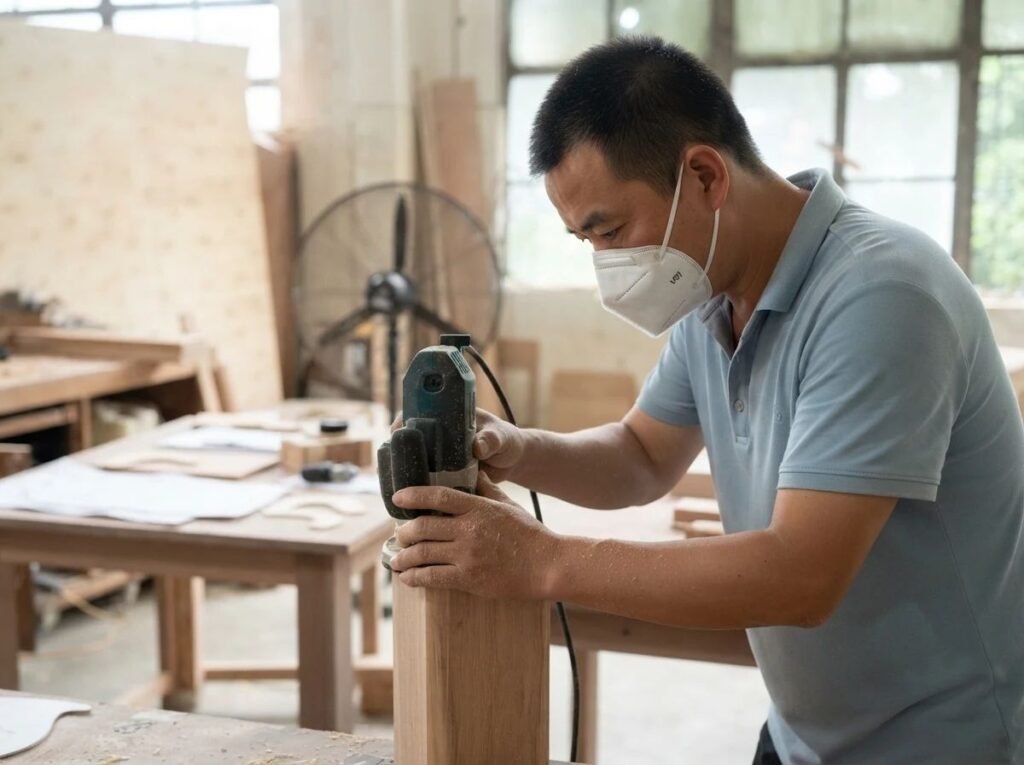
Doing business here sometimes feels like a terrible Tinder date. Their online profile shows a pristine, glass-front facility spanning 50,000 square meters. But the person you’re actually messaging? Some guy named Kevin sitting in a smoky, windowless office above a noodle shop.
I learned this the hard way back in 2012. A “supplier” picked me up from my hotel in a black Mercedes. We drove an hour deep into an industrial park, and he confidently walked me through a massive, dusty assembly line. Sparks were flying. Edge-banding machines were screaming.
Wait, let me tell you what I missed. The body language.
The guy leading my tour didn’t know a single worker on that floor. He didn’t nod at the line manager. He didn’t know where the breaker box was when a CNC router suddenly jammed. It was a trading company renting a tour of a real factory. Pure theater.
When you place an order with these phantom operators, they don’t build your goods in that gorgeous facility. They sub-contract your luxury order to a dirt-floor, tin-roof workshop three towns over in Longjiang. The primary tool is a rusty pneumatic staple gun. The deadliest mistake in sourcing is blindly believing the guy holding the clipboard actually owns the machines.
Scam 2: The Golden Sample Bait-and-Switch
Next up is the showroom trap. You sit on a sofa. It feels amazing. The stitching is dead straight. The sales rep pours you a cup of Tieguanyin tea, you sign the Proforma Invoice, and wire the 30% deposit.
But Chinese furniture traps are built invisibly into the timeline.
Once mass production kicks off, the factory quietly switches the hidden materials to protect their shrinking margins. You paid for a high-density, 45kg/m³ foam core. They casually swap it for a cheap 25kg/m³ foam. Why? Because you can’t see it. That foam will flatten into a hard pancake after six months of heavy lobby use. But right now, sitting in a cardboard box, it looks absolutely identical.
Scam 3: The Upholstery Core Swap
If you aren’t physically standing on the assembly line with a box cutter, slicing open a piece of upholstery to check the guts, you are flying blind.
In the luxury segment, the real money isn’t just in the visible Italian leather or the Carrara marble. It’s in the skeleton. The “Core Swap” happens when a factory promises solid, kiln-dried hardwood frames. Properly drying wood takes serious time and expensive kilns. So, they quietly substitute it with cheap MDF (Medium Density Fiberboard) or “green” wood that hasn’t been dried at all.
Think about a metal box baking on the deck of a shipping vessel in the Pacific for 30 days. That wet wood basically cooks. The moisture has nowhere to go. Result? It warps. It cracks. Sometimes you crack open the container doors in Florida and a cloud of toxic white mold punches you in the face.
| Feature | What You Paid For | What Actually Ships (The Swap) | Real-World Impact |
| Wood Frame | Kiln-dried Ash (8-12% moisture max) | Unfinished Pine or raw MDF | Warping, cracking, massive termite risk |
| Cushion Core | Multi-layer HR (High Resilience) Foam | Recycled scrap foam glued together | Sags completely flat within 6-12 months |
| Metal Base | PVD Electroplated Stainless Steel | Spray-painted cheap iron tubing | Rusts rapidly, especially in coastal climates |
| Wood Veneer | 0.6mm natural American walnut | Printed melamine paper (fake wood) | Peels right off at the edges, impossible to repair |
Scam 4: The “Weight and See” Dimension Shrink
Here’s the kicker. Almost nobody catches this until the installation crew is already on site pushing furniture into hotel rooms. I call it the dimension shrink.
Shipping containers are just high-stakes Tetris. A 40HQ container holds roughly 76 cubic meters. Let’s say you order 200 custom lounge chairs for a resort. The factory logistics guy realizes that if they shave just two inches off the depth and one inch off the height of every single chair, they can cram an extra 30 units into that box.
Do they call and ask your permission? Absolutely not. They quietly alter the CAD drawings, build the shrunken chairs, and ship them.
You unbox them six weeks later. Suddenly your grand, imposing luxury lounge chairs look like they belong in a pediatric dental clinic. Unless your purchase order strictly defines an engineering tolerance of +/- 5mm and penalizes deviations, a factory will legally shrink your furniture to optimize their own shipping volume.
Scam 5: The “Too Big to Care” Trap
Southern China’s manufacturing belt isn’t one big happy family. It’s a messy, tiered food chain. Up top, you have mega-conglomerates in Foshan pushing out 500 containers a month for massive US big-box retailers. Down at the bottom, unregulated back-alley chop shops.
A lot of foreign buyers assume bigger is always better. They chase the massive factories, assuming massive scale equals safety.
The problem isn’t the factory itself. It’s the mismatch of expectations. If you are a boutique buyer ordering a single, highly-customized $80,000 container of mixed pieces, a mega-factory does not care about you. You are a massive headache to their streamlined assembly line. They’ll push your tiny order to the back of the queue, assign their greenest junior salesperson to your account, and cut corners just to get your annoying project off their floor.
Veterans know that mid-sized specialists offer a vastly better risk-reward equation. Take an operation like Interi Furniture, for example. Because they focus heavily on export-grade custom furnishings—without carrying the bloated corporate overhead of the mega-factories—they actually value a $100,000 hospitality project. A mid-sized factory will assign a senior project manager. They’ll let your QC inspector tear apart a prototype on the “white-wood” stage. And most importantly, they won’t sub-contract your complex upholstery work to a sweatshop because your volume is actually meaningful to their bottom line. Finding the right-sized factory for your specific volume is literally half the battle.
The Frankenstein Container
Don’t get cocky and try to buy lighting, hand-tufted carpets, leather sofas, and aluminum patio chairs from a single supplier. Do that, and you fall straight into the Frankenstein Container scam.
No single factory on earth makes all those things. If a supplier claims they do, they are a trading company. Period. They’ll source your lighting from Zhongshan, carpets from Tianjin, and sofas from Longjiang. They throw all this unchecked quality into one container. You have zero control over those sub-suppliers. The resulting container is a stitched-together monster. When the lamps arrive with shattered glass, the “factory” will just shrug and blame the shipping line.
The Sourcing Survival Playbook
You want to survive out here? Get paranoid. If you want to successfully import high-end FF&E without losing your shirt, you need this exact framework.
- Check the License, Not the Catalog: Stop drooling over glossy PDFs. Demand their official Chinese business license. The paper with the red star stamp. Get it translated. If the business scope says “Wholesale and Trade” instead of explicitly stating “Manufacturing and Production,” grab your bag and walk.
- Specify the Unseen: Your purchase order must read like a localized legal threat. Don’t write something lazy like “Grey Sofa.” Write: “Grey Sofa. Internal Frame: Kiln-dried Ash (maximum 10% moisture content, verified by moisture meter). Foam: 45kg/m3 HR foam. Fabric: 100,000 double-rub commercial grade. Dimension Tolerance: +/- 5mm max.”
- Hold the Sample Hostage: The second you approve a physical sample, grab a Sharpie. Physically sign the raw wood frame underneath. Take a macro photo of your signature. Tell the factory boss directly that mass production will be measured strictly against that specific signed sample. Watch how fast their attitude changes.
- Hire a QC (And warn them early): Tell the supplier, before you even pay a dime of the deposit, that an independent inspector will conduct a DUPRO (During Production) check and a Pre-Shipment Inspection. Bad factories will suddenly get “too busy” to take your order. Good factories won’t even flinch.
- The Ultimate Red Flag:Avoid the factory with flawless English that replies within 5 minutes at 2 AM your local time.
Wait, doesn’t everyone want great communication? Sure. But think about it. A gritty factory floor boss producing top-tier hardwood furniture isn’t sitting on WhatsApp speaking perfect, idiomatic English at two in the morning. That smooth-talking rep is a commission-hungry broker sitting in a high-rise in Shenzhen, three hours away from where your wood is actually being cut. Real factory reps are busy. Their English is often broken. They care way more about accurate CAD drawings than asking about your weekend plans.

Real Questions from the Trenches
Q: Can I trust the factory’s ISO9001 or SGS material certifications?
A: You can trust the piece of paper to physically exist. You absolutely cannot trust that it applies to your specific order. It’s incredibly common for a factory to pay for an SGS test on one perfectly engineered prototype five years ago. Then they boldly use that exact same certificate to sell you completely different, inferior materials today. A certification belongs to a specific test date and a specific batch. It is not a lifetime guarantee.
Q: What is the standard payment structure to protect myself?
A: Never pay 100% upfront. Ever. And never do a 50/50 split. The hard industry standard for reputable factories is a 30% T/T (Telegraphic Transfer) deposit to kick off production. The remaining 70% balance is paid only after your third-party inspector has issued a passing QC report and you hold a copy of the official Bill of Lading. The second that final wire transfer leaves your bank account, your leverage drops to zero.
Q: Is it cheaper to just fly to the Canton Fair and buy directly off the floor?
A: Trade shows are phenomenal for networking. But you have to realize they are staged realities. The booths are meticulously designed to dazzle you. You’ll meet great, legitimate suppliers there, sure. But you must still visit their actual physical factory before paying a deposit. Never buy straight off a trade show floor unless you are fully prepared to gamble your entire project budget on a handshake.
Q: What happens if a factory completely screws up my order? Can I sue them?
A: Short answer? No. Long answer? You can try, but cross-border litigation for a $50,000 container order will easily cost you $150,000 in upfront legal fees. And there is absolutely no guarantee of collection in mainland China. This is exactly why pre-shipment inspection is your only real shield. Once that container is loaded onto the boat, the goods are yours. Flaws, mold, and all.
The Hard Lesson
Importing luxury furniture direct from Chinese manufacturers is hands-down one of the most profitable procurement strategies on earth. But only if you actually know how to play the game.
The factories aren’t evil. They aren’t sitting around rubbing their hands together plotting your downfall. They are simply operating in a hyper-capitalist, razor-margin landscape. Foreign buyers constantly squeeze them on price. If you push a factory boss for a 20% discount on an already bottom-barrel quote, he will smile. He will nod. He will say yes. And then he will quietly take 30% out of the product’s internal quality to survive.
So ask yourself before you hit “send” on that international wire transfer: Are you actively managing a complex manufacturing process? Or are you just closing your eyes and praying for a good outcome?
The most expensive furniture in the world is the cheap, defective container you have to throw directly into a landfill. Stop blindly buying the price tag. Start rigorously inspecting the process.


