

You don’t know real, miserable heat until you’ve stood on the cracked asphalt off Highway 325 in Foshan. Late August out here? It literally cooks the rubber right onto the soles of your boots.
But shove your shoulder against the heavy double glass doors into the Louvre Furniture Mall in Lecong, and bam. Meat locker. The air conditioning is always set to absolute zero. Spotless marble floors reflecting millions of dollars of high-end inventory.
I was nursing a burnt Americano near the main atrium last month. Leaning against a pillar, just watching a property developer from Dubai make an $85,000 mistake in real-time. Unforced error.
He was signing off on a massive master bedroom suite for a Palm Jumeirah villa. The guy was completely obsessed with his interior aesthetic. He had his iPad out, aggressively tapping on these hyper-specific 3D renders. He kept explaining to the sales rep how the furniture needed to pop against his beige latex paint walls. It had to be bathed in this very specific, soft 4:30 PM spring light.
He was ordering a customized ‘Spring’ model bed from a clever new seasonal collection—a strict R&D design sequence of Spring, Summer, Autumn, and Winter. He wanted the main headboard fabric in an off-white bouclé. Or maybe a breathable pure linen, he kept going back and forth. Dark wood framing. Sleek metal accents.
“Absolutely no genuine leather,” he told the rep, pointing a finger. “And listen to me—no cheap, warm white LED backlighting stuffed inside the headboard slats. Keep it clean. Pure.”
The sales rep in the sharp navy blazer just smiled. Nodded enthusiastically. Scribbled on his clipboard and promised a 45-day lead time without even blinking.
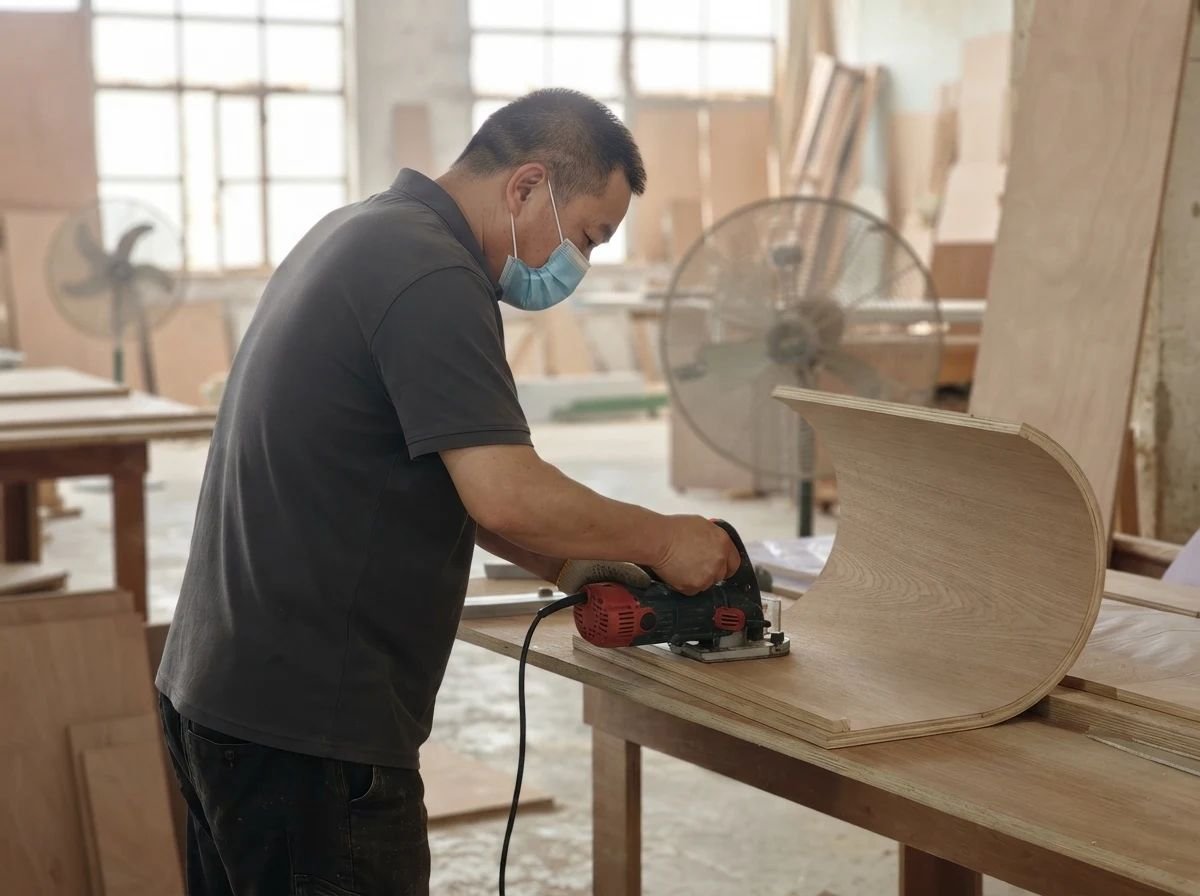
Here’s the punchline. I audited the factory backing that exact showroom three years ago. Their real production line isn’t a well-lit, pristine laboratory. It’s a deafening, dust-choked metal shed three miles down a pitted dirt road in Longjiang. It smells like toluene glue, cheap cigarettes, and raw sawdust.
That buyer wasn’t getting the exquisite bed he was touching in the showroom. Not a chance in hell. He was buying a localized, gutted ghost of it. When that shipping container cracks open in the UAE six months later, it’s going to reek of industrial formaldehyde.
When you decide to buy furniture from China as a private homeowner, you aren’t going on a fun luxury vacation. You’re walking onto a ruthless assembly line built for massive commercial volume. Don’t know the unwritten rules of the factory floor? You’re the mark.
The Brutal Truth About Showroom “Bait”
Nobody wants to hear this stuff. Especially not after sitting in a cramped economy seat for 15 hours straight to Guangzhou. But I’m going to lay it out anyway.
Those breathtaking pieces sitting under the gallery spotlights? Bait. Total smoke and mirrors.
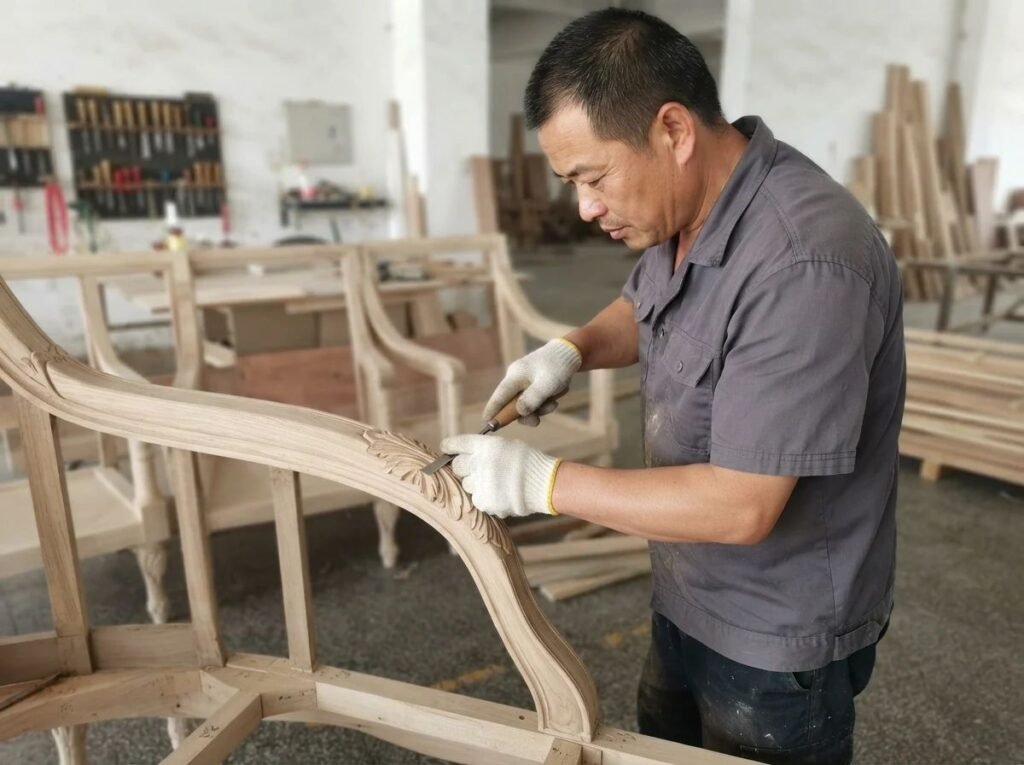
Factory bosses aren’t stupid. They absolutely do not run their showroom samples down the main piece-rate lines. That’s margin suicide. Display models are basically automotive concept cars. They get painstakingly hand-crafted by veteran, salaried sample-makers hiding out in a quiet back room. Top-tier imported materials. Flawless edge-banding. Perfect stitching that would make a seasoned Italian tailor weep.
Their only job? Dazzle you enough to wire a 30% deposit.
Once your multi-room order actually hits the system, it gets dumped onto the high-speed floor. Up there, margins are razor-thin. Floor workers get paid by the piece, not by the hour. Faster equals more cash for them to take home to their kids. Quality control? That’s just whatever they can sneak past an overworked floor manager before the lunch bell rings.
Here is your rule of thumb for surviving Guangdong: If you don’t have a trusted guy physically standing on the line holding a tape measure and a moisture meter while your specific sofa frame gets nailed together, assume they’re cutting corners.
Key Takeaway: Surviving the Sourcing Game
- Showrooms are theater: A three-million-dollar display space guarantees absolutely nothing about the rusted-out metal shed actually welding your chairs.
- Specs mutate in the dark: That “imported off-white bouclé” you agreed on in March has a very funny habit of becoming a “premium domestic synthetic blend” by mid-April.
- Blind trust is wildly expensive: Never wire that final FOB balance without an independent inspector pulling random cartons off the loading dock.
Peeling Back the Curtain on the Factory Floor
Sourcing a massive project overseas is exactly like ordering a bespoke suit via email. You pick the swatches. You send your measurements. But if you aren’t standing in the room for the fitting, the tailor guesses.
And they usually guess whichever way saves them a yard of expensive silk.
Bypassing retail markups by going straight to the source looks brilliant on a spreadsheet. But that bypass creates a massive blind spot. Let’s talk about how the trick actually works on the ground.
China furniture sourcing is the process of navigating a fragmented, multi-tiered manufacturing ecosystem to procure goods directly from the source, bypassing traditional retail markups.
That’s the textbook definition, anyway. The reality is a whole lot messier.
The Infamous Two-Rack System
I spent a week last November bouncing between upholstered bed suppliers in Dongguan. One thing always burns itself into my brain during these trips. How raw materials get physically segregated on the floor.
Walked past two distinct wood racks at this one frankly brazen facility. One was marked “Export/Showroom” and held perfectly kiln-dried, beautiful ash. The other just said “Standard.” Stacked to the ceiling with heavy, wet, cheap rubberwood.
The boss decides which rack your order pulls from. That decision is based 100% on how hard you squeezed them on the unit price over tea.
People jump on Reddit forums screaming about a Chinese factories scam when their stuff falls apart a year later. They totally miss the context. The factory owner doesn’t think it’s a scam. To him, it’s just flexible engineering. You demanded a 30% discount to hit your budget? Okay, friend. Done.
But do the math. A supplier absorbs a 30% price cut by quietly removing 30% of the product’s unseen value.
Take our Dubai buyer. Dark wood, metal joints, off-white bouclé, no LED lights. Boss nods. Writes it on the proforma invoice.
Then production starts. They swap the kiln-dried wood for wet local pine slathered in dark stain. They swap real bouclé for a cheap synthetic tweed that pills in a month. Hollow zinc instead of solid metal. And half the time, they staple those LED light strips in anyway because the floor manager thinks it looks “premium” and completely hides the sloppy joinery at the corners.
On shipping day, it looks fine in a blurry WeChat photo. Six months later, the frame screeches every time you sit down.
The Nankang Walnut Illusion
Let’s talk solid wood for a second. Take a trip up to Nankang. It’s a massive hub for solid wood. Walk the dusty alleys there and you’ll see factories churning out thousands of “American Walnut” dining tables.
Except, a terrifying amount of it isn’t walnut.
It’s local elm. Or rubberwood. Heavily bleached. Chemically treated to kill the natural grain, then expertly stained to mimic the deep, rich tone of premium walnut.
Actually, wait, that’s not totally fair—sometimes they do use a millimeter-thin veneer of real walnut over cheap MDF. But a trained QC guy spots the fake in ten seconds by checking the end-grain or lifting the piece to gauge density. But a villa owner reviewing a quick 15-second video from 6,000 miles away? Zero chance. Factory charges for walnut, ships stained rubberwood, and pockets a massive margin. Pure profit.
Why the Villa Market is the Perfect Target
Private buyers outfitting 15,000-square-foot homes always think they hold all the cards. Dropping $150k in one wire transfer. They expect a parade.
Reality check. In the Guangdong supply chain, a $150,000 order is a rounding error. A decent Foshan factory pushes out forty-foot high-cube containers of identical hotel chairs to Europe every single week.
Truthfully? Factories secretly love private villa owners. Highly lucrative, deeply uneducated buyers bringing zero structural oversight to the table. A corporate procurement director demands moisture content readings below 12%, Martindale rub-test certs, and load-bearing data. A residential buyer just wants to know if the brass inlays match their dining room chandelier.
The landscape here is insanely polarized. Massive, sprawling conglomerates have reliable quality. But they will flat-out ignore your custom dimensions because a one-off villa isn’t worth retooling their line. They literally won’t pick up the phone for a residential guy.
On the flip side, you’ve got tiny, unverified alleyway workshops. Eagerly say “yes” to everything, take your deposit, then secretly outsource your job to three unlicensed garages. (I learned this the hard way years ago, chasing down a client’s missing nightstands in a residential neighborhood at midnight. Don’t recommend it).
The guys who actually survive find the middle ground. Mid-sized specialists.
Look at operations structured like Interi Furniture, for example. They act as a high end custom furniture solution provider, heavily focused on export and hospitality. They offer a much saner risk-reward equation. Their whole mission is to “make design more achievable,” backed by a serious core brand claim to “Never let clients down.” Mid-tier players like this are big enough to maintain actual in-house QC protocols, but small enough that a two-container villa project actually matters to their monthly quota.
Finding that sweet spot is 80% of the battle. Go too big, you’re a nuisance. Go too small, you’re funding a nightmare. The safest factory for high-end residential sourcing is one where your order is treated as a respected milestone.
The Frontline Survival Framework
So, how do you pull this off without getting hosed? You need a paranoid, rigid system. You cannot rely on a friendly sales girl or a glossy PDF.
Here is my battle-tested framework.
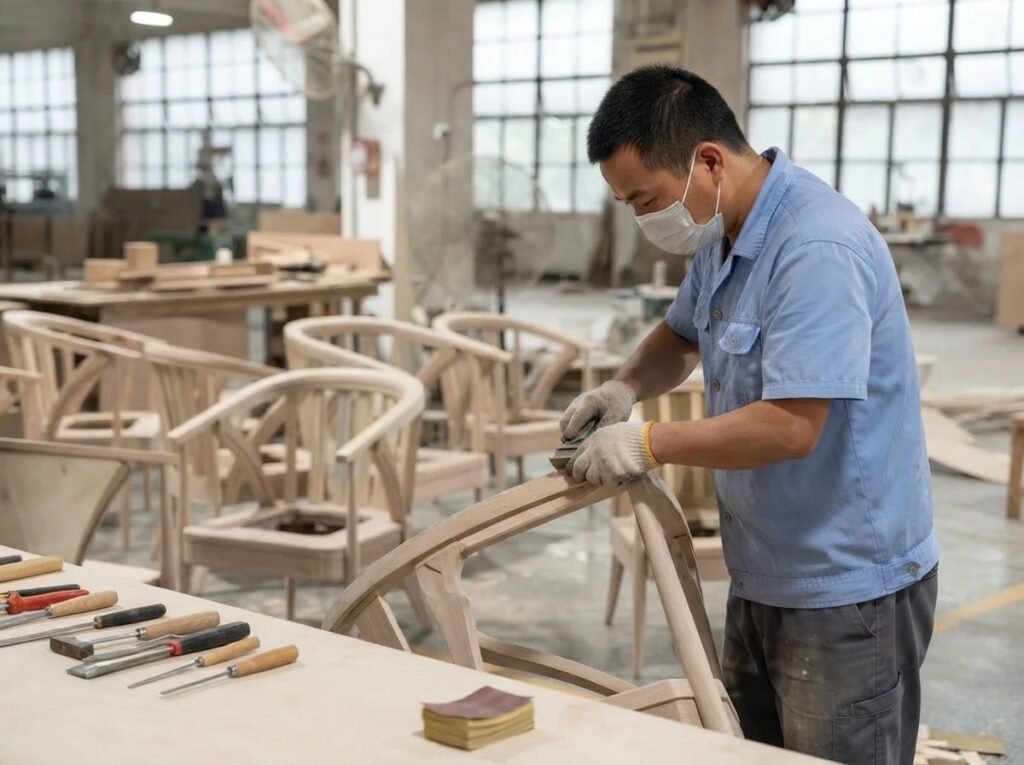
- The “Golden Sample” Lockdown: Never approve a critical sample via photos. Hire a local, third-party inspector. Have them visit the factory, sign the physical sample with a permanent marker, take macro photos of the exact stitching, and slap a tamper-proof seal on the frame. That piece is the undisputed legal benchmark. If the final product deviates, the factory eats the cost.
- Demand the X-Ray: Factory refuses to provide a detailed structural CAD drawing of the inside of the furniture? Walk away. Do not pass go. If they won’t list foam densities, spring gauges, and exact wood species in writing, they are absolutely planning to downgrade them.
- Payment Leverage: Never pay 50% upfront and 50% before shipping. You lose all leverage the millisecond that final wire clears. Push for 30% upfront, 40% after a successful “white-wood” (mid-line) inspection, and the final 30% only after cartons are loaded into the container. Cash-starved factories fight this. Let them.
- The Ultimate Red Flag:Beware the supplier who agrees to major material changes without adjusting the price. Everyone thinks a flexible factory is a great partner. Nonsense. You ask to upgrade from standard synthetic fabric to a heavy, breathable pure linen. The boss smiles and says “No problem, same price.” He is lying to your face. He just mentally downgraded your internal framing to subsidize the fabric cost.
Let’s look at this dynamic in raw, factory-floor terms. If you don’t enforce your specs, here is exactly what happens on the line:
| Component | The Showroom “Bait” Spec | The Actual “Switch” Delivery | The Frontline Consequence |
| Internal Frame | Kiln-dried imported Ash | Green (wet) mixed local scrap wood | Warps, cracks, and audible squeaks pop up within 8 months. |
| Seat Core | 45kg/m3 High-Resilience Foam | 25kg/m3 standard foam + glued offcuts | Cushions sink and permanently lose shape almost immediately. |
| Upholstery | Pure linen or off-white bouclé | Cheap synthetic tweed or poly-blend | Peels, flakes, and cracks quickly in climate-controlled AC; fabrics pill in weeks. |
| Hardware | Solid brass, soft-close | Zinc-alloy, standard lightweight steel | Heavy wardrobe doors sag, metallic finishes pit and rust. |

FAQ From the Factory Trenches
Q: Is this whole Chinese factories scam a real, organized syndicate thing, or did I just get unlucky with my supplier?
A: Stop thinking like that. It’s not an organized criminal syndicate. It is a systemic issue driven entirely by misaligned incentives. When you grind a supplier down on price, they don’t magically agree to operate at a loss. They quietly re-engineer the materials to preserve their margin. You didn’t get unlucky. You just played a highly complex procurement game without knowing the local rules.
Q: Can’t I just hire a cheap Alibaba sourcing agent to babysit the order and prevent the bait and switch?
A: Most of those cheap sourcing agents double-dip. They charge you a 5% fee, then take a hidden 10% kickback directly from the factory behind your back. If the factory swaps your premium materials for garbage, your agent isn’t blowing up the deal. They want their kickback to clear. You need an independent, flat-fee QC company with zero financial stake in the transaction.
Q: Will US/EU customs catch it if the factory lies about the wood species on the invoice?
A: Not a chance. Customs officials hunt for contraband, invasive bugs, and tariff fraud. They don’t care if your dining table is genuine American Walnut or chemically stained Rubberwood. The burden of material verification falls 100% on your shoulders before those container doors swing shut in Shenzhen.
Q: I’m outfitting a massive 6-bedroom estate. Should I even try to do this directly if the risk is this high?
A: Depends entirely on your risk tolerance and willingness to micromanage. Yes, the financial arbitrage is massive. You can literally save hundreds of thousands of dollars. But if you think you can manage a 400-piece cross-border logistics project using Google Translate and WhatsApp, you will get slaughtered. You only capture those savings by enforcing brutal, uncompromising oversight.
The Final Audit
At the end of the day, look in the mirror and ask yourself a question. Are you acting like a professional commercial buyer, or a wealthy tourist with a checkbook?
The manufacturing machine in Guangdong doesn’t care about your wealth, your status, or your Instagram aesthetic. It only respects your vigilance. These factories aren’t inherently evil. They are highly efficient, profit-seeking engines designed to give you exactly what you managed to enforce. Nothing more.
Next time you sink into a flawless velvet armchair in a showroom and marvel at the shockingly cheap price tag, remind yourself that you aren’t actually buying that physical chair. You’re buying a promise.
And in this specific industry? Promises require a very strict audit trail. Keep your eyes open, keep your contracts ruthlessly tight, and never skip the white-wood inspection. Safe sourcing out there.


