

11:37 PM. My phone vibrates violently against the nightstand wood.
I’m half-asleep, but I already know it’s a WeChat notification. It’s “Kevin”—the very Western English name adopted by a 24-year-old junior account manager at a Houjie upholstery plant. Right now, Kevin’s boss is sitting on my client’s $120,000 deposit for a boutique resort project down in Miami. The beds, chairs, and lobby fixtures? They were supposed to hit the water out of Yantian port next Thursday.
Instead, Kevin sends me a heavily compressed JPEG. It’s a photo of a crumpled piece of A4 paper, stamped with a smudged red star seal.
“So sorry brother. Local environmental bureau inspection. Power rationing. Force Majeure. Need 45 more days.”
I just stare at the ceiling for a minute. Is the document real? Maybe. The local Huanbao Ju (environmental protection bureau) does actually run sweeps. But does the authenticity of the paper actually matter? Absolutely not. Try explaining “provincial power rationing” to a Miami developer who is opening his doors on September 1st and absolutely will not accept paying guests sleeping on bare concrete floors.
Look, I’ve watched this exact nightmare play out hundreds of times over my 15 years walking factory floors from the dust-choked industrial parks of Guangdong up to the massive sheds in Zhejiang. What most overseas buyers—especially the C-suite guys analyzing spreadsheets in Chicago—simply refuse to grasp is that sudden “environmental inspections” or “mandatory power cuts” have evolved. They are now the ultimate get-out-of-jail-free card.
This isn’t a streak of bad luck. It’s a calculated, deliberate strategy to manage factory capacity hoarding.
And you, the foreign buyer, are the one footing the bill.
The Reality Check Nobody Wants to Cash
Let’s rip the band-aid off regarding those standard international purchase agreements your expensive legal team drafted. They are practically toilet paper on the ground in a provincial Chinese manufacturing hub.
When a factory falls behind schedule—maybe they mismanaged their CNC routing line, a foam supplier stiffed them, or their polishers went home for the Qingming festival and just never came back—they almost never admit fault. Admitting fault means losing face. But far more dangerously, admitting fault means triggering the liquidated damages and late-penalty clauses hiding in your PO.
So, they don’t confess. Instead, they trigger a massive China contract loophole disguised as an unavoidable Act of God.
You can threaten international lawsuits until you are blue in the face. You can fire off angry emails with the subject line in all caps. But trying to enforce a foreign contract in a local district court over a 30-to-45-day delay? It’s a fool’s errand. Half the time, the local judge went to middle school with the factory boss’s brother.
Here is my golden rule of thumb, written in blood and lost margins after years of sourcing: A contract penalty clause only works if the factory genuinely believes you have the leverage to unilaterally deduct it from their final balance before the goods get loaded onto the vessel.
If you don’t control the cash flow, you don’t control the timeline. Period.
Key Takeaway: The “Force Majeure” Illusion
- China furniture sourcing is the process of aggressively managing a volatile web of local relationships, cash-flow bottlenecks, and shifting factory priorities—it is not just picking pretty chairs from a glossy PDF catalog.
- A Chinese suppliers delay is rarely about actual government intervention stopping the machines. It is almost always a symptom of the factory prioritizing a larger, more lucrative domestic order over your export container.
- Local notices (like emissions testing or rolling blackouts) are often real events, but factory bosses weaponize them selectively to shield themselves from contractual financial penalties.
- Your only real defense? Heavily staged payment terms tied directly to independent, unannounced quality control inspections on the ground.
How to Manufacture an “Act of God”
It is terrifyingly easy to blame the local government for a blown shipping window. And to be completely fair to the suppliers, local municipalities in massive furniture hubs like Longjiang, Dalingshan, or Anji do issue sudden edicts. The air quality index spikes, Beijing yells at the provincial governor, and suddenly the local environmental bureau shuts down the spray booths in an entire industrial zone for five days.
But how those edicts are applied by the factory bosses? That’s where the sleight of hand happens.
Think of it like a tenant telling you they can’t pay this month’s rent because there’s a city-wide plumbing crisis. Sure, the city might be digging up a water main three blocks away. But that doesn’t explain why your tenant just bought a brand new jet ski and parked it in the driveway. The excuse is conveniently adjacent to the truth.
The most common China contract loophole relies entirely on exploiting real local policies to cover up terrible internal production planning.
I remember rolling up to a massive casegoods facility in Foshan a few years back. My client had been told their production was completely halted. The excuse? “Strict provincial emissions testing” on the spray booths. The factory owner had even FedExed us a very official-looking document with the requisite prominent red chop.
But I happened to be in Guangzhou that week on other business, so I rented a car and showed up unannounced on a Tuesday afternoon.
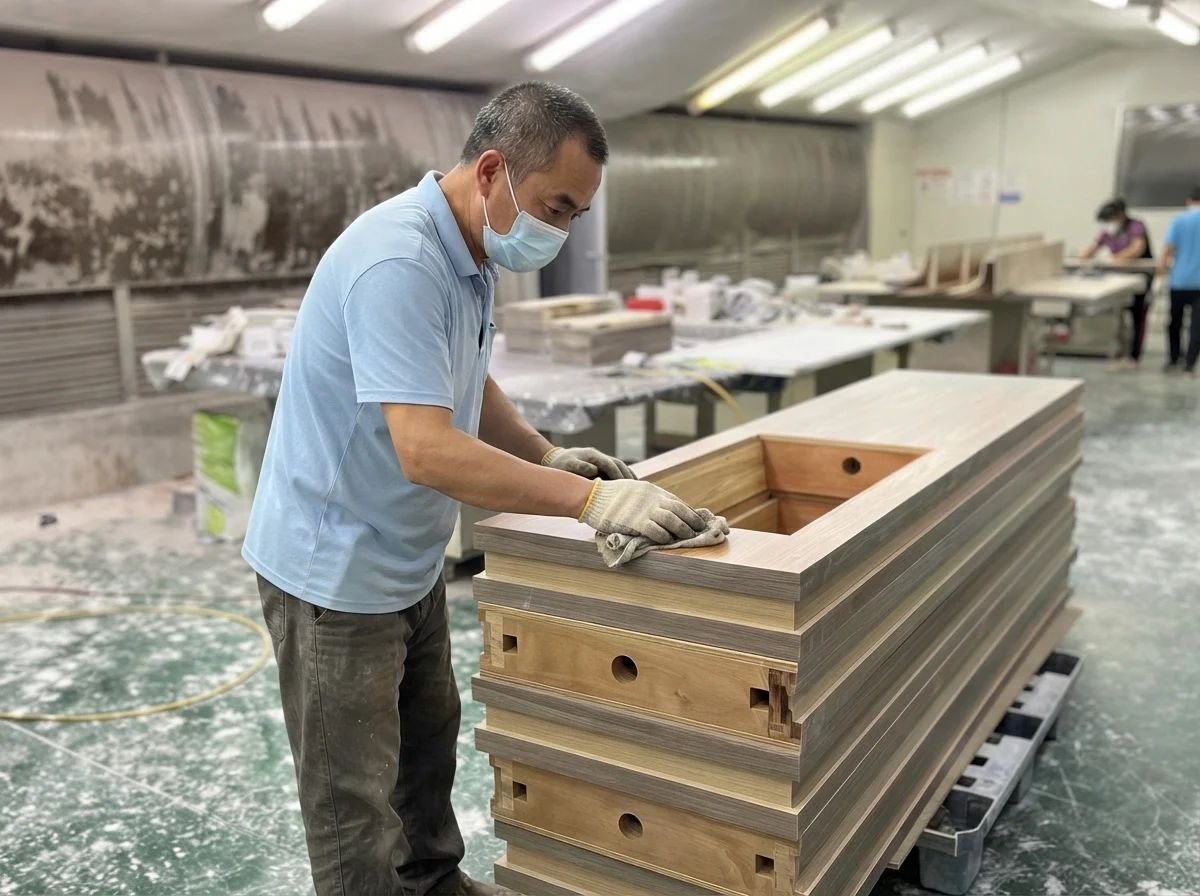
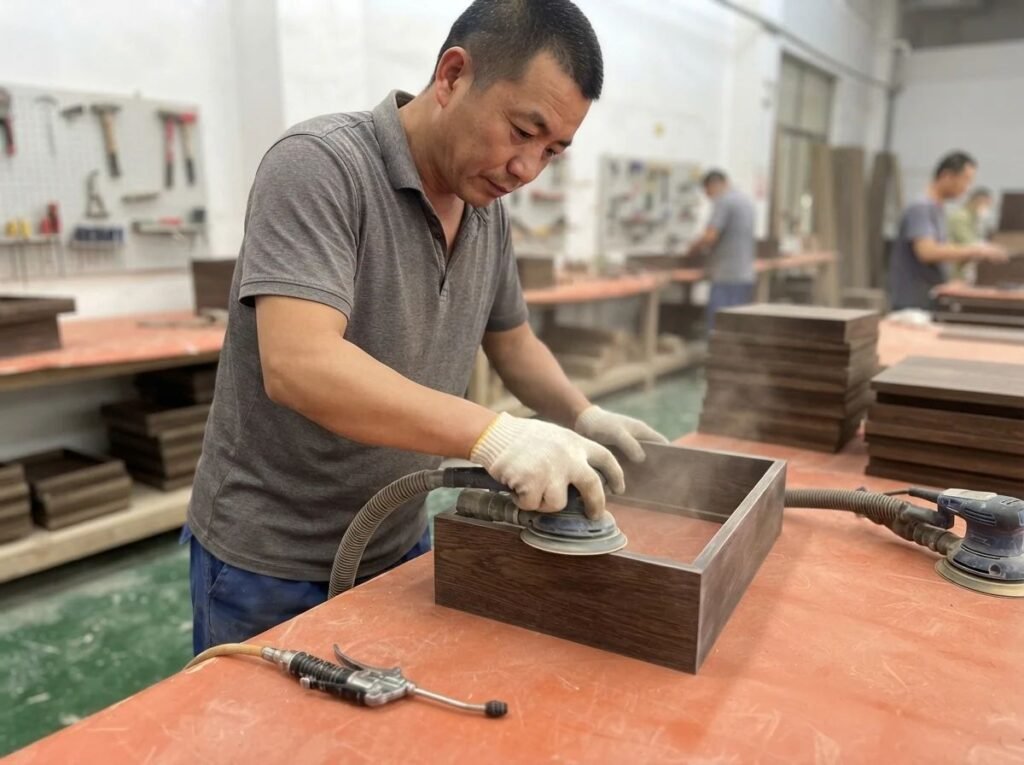
The spray booths weren’t shut down. They were running at absolute maximum capacity. The smell of toxic lacquer and MDF dust was so thick it burned my throat. They were churning out hundreds of heavy, gaudy dining tables for a massive domestic real estate developer.
Where was our stuff? I found my client’s hospitality furniture sitting unassembled in a dark corner of warehouse number three. It was shoved behind a forklift and covered in a half-inch of sawdust.
Classic smoke and mirrors.
Actually, wait, that’s not quite right. What most novice buyers completely miss is that the government notices themselves aren’t usually forged. They are often real documents issued to the district. The factory just uses that blanket municipal notice to deliberately pause lower-margin export orders, while secretly shifting all their covert night-shift resources to their VIP domestic clients. You know, the local buyers who pay in hard RMB cash, on 15-day cycles, and don’t care about CARB Phase 2 compliance.
The Hidden Math Behind the Delay
To understand the delay, you have to look past the showroom and understand the cash flow velocity of a Chinese manufacturer.
Most furniture factories operate on incredibly thin margins—we’re talking 5% to 8% net profit on a good day. They survive on sheer volume and keeping the cash moving. If a massive domestic buyer shows up with cash in hand and demands a rush order for a new 500-unit apartment complex, the factory boss will absolutely pause your production line to accommodate them. Why wouldn’t they? Your 30% deposit is already spent anyway. They used it to buy wood, fabric, and foam three weeks ago to float another client’s order.
But they can’t tell you they bumped you. If they sit down at the tea table and admit they pushed your hotel project aside for a better customer, they breach the contract and owe you thousands in late fees.
If they blame the local environmental bureau? Well, that’s force majeure. It’s an Act of God. “Nothing we can do, boss. Please understand.”

The “Goldilocks” Supplier: Why Scale is Your Best Defense
You can’t completely eliminate this risk. If a sourcing agent tells you they have a “foolproof” system in China, check your wallet, because they are actively lying to you.
But you can drastically reduce the risk by choosing the exact right manufacturing partner from day one. The frequency of these fake force majeure claims is directly tied to the scale and business model of the factory you decide to wire money to.
If you buy from the sprawling, 10,000-worker mega-manufacturers in Foshan—the massive campuses where you need an electric golf cart just to get from the main showroom to the metal fabrication shop—your $150k order is a rounding error. You are a mosquito on their windshield. You will be the very first order to get bumped off the line when a bigger fish swims by.
Conversely, if you try to save a buck by going to a tiny, unverified five-man workshop in the back alleys of Nankang, they often lack the working capital to even buy raw materials if a single client pays late. One minor cash flow hiccup from another buyer, and your production stops cold.
This is why scale matters. While some buyers gravitate toward those massive facilities for perceived safety, seasoned pros often find that mid-sized, export-focused specialists offer a totally different, much safer risk-reward equation.
Take an operation like Interi Furniture, for example. They focus heavily on the mid-to-high-end project and hospitality space. When you deal with factories at this specific mid-tier scale—big enough to have real in-house engineering and drafting teams, but small enough that your container actually matters to their monthly bottom line—they generally can’t afford the reputational hit of weaponizing force majeure. Their timelines usually reflect actual production realities on the floor, rather than strategic corporate delays.
When a factory’s core survival depends on repeat export business from professional Western buyers, they stop playing games with local government excuses.
They know that hospitality procurement directors talk to each other. One blown hotel opening in Vegas or Miami is enough to blacklist a supplier across an entire whisper-network of designers and purchasing agents. They won’t risk it.
Bulletproofing the PO Before You Wire a Dime
You cannot wait until the goods are 14 days late to fix a Chinese suppliers delay. By the time Kevin sends you that sad WeChat message at midnight, you have already lost the game.
The battle is won or lost during the Purchase Order negotiation. Down in the mud, before the proforma invoice is stamped.
Here is exactly how I structure deals to neutralize the “Act of God” loophole before a single dollar wire transfer clears the bank.
- Fracture the payments based on physical reality on the floor. Never, ever agree to a simple “30% deposit, 70% before shipment” structure for a new supplier. It gives them too much rope. Break it down. I prefer: 30% deposit, 20% upon completion of raw material sourcing (verified by date-stamped photos of the specific wood/fabric sitting in their warehouse), and the final 50% only after passing a third-party final inspection.
- Rewrite the Force Majeure clause entirely. Standard contracts just say “Acts of God, government intervention, natural disasters.” Trash that language. I add a clause stating: Any claim of government-mandated shutdown must be accompanied by a verifiable municipal notice explicitly naming the factory’s registered address. Furthermore, the buyer reserves the right to send a local representative to visually verify the shutdown within 48 hours.
- Kill the “Dedicated Line” premium. Don’t let a slick sales rep charge you a 5% premium for a “dedicated production line.” It rarely exists. Instead, write in a clause that allows unannounced QC (Quality Control) visits at any point during the 45-day production cycle. If they refuse? Walk away.
And here is the ultimate red flag that contradicts everything you’ll ever read in a Harvard Business Review case study on supply chain management.
Watch out for the supplier who eagerly signs a brutal late-penalty clause without arguing. (I learned this the hard way in Dongguan about ten years ago, and it cost me my bonus).
If you demand a $5,000-per-day penalty for late shipments, and the factory boss just smiles, pours you more tea, nods, and stamps the contract? Run away. Do not wire the deposit. He agreed to it so easily because he already knows he’s going to use the force majeure loophole to invalidate your penalty entirely. Honest factories will fight you tooth and nail over penalty clauses. They will sweat, argue, call their partners, and threaten to walk away—because they actually intend to honor the contract and fear the financial hit.

Field Guide: Fighting Back When Production Stalls
Buyers email me the same panicked questions every single time a shipment stalls. It’s like groundhog day in this industry. Here is exactly how you should handle the chaos on the ground when the factory drops a delay in your lap.
Q: My supplier just sent me a government notice saying power is cut to their district for three weeks. How do I know if they are bluffing?
A: Hire a local third-party QC inspector to do a “drive-by” the very next morning. Use a firm like V-Trust or Asia Quality Focus. It costs about $150 to $200. Have the guy literally stand across the street and take a video. If the factory lights are on, the CNC machines are whining, and trucks are leaving the loading dock, you have your answer. Catching a factory boss in a flat-out lie instantly shifts the power dynamic back to you. They lose face immediately, and suddenly, your container becomes their absolute top priority just to get you out of their hair.
Q: If I catch them faking a delay, should I threaten to cancel the order?
A: Only if you don’t actually need the goods. Empty threats destroy your credibility faster than anything else in China. If your 30% deposit is already spent on raw materials, they know you won’t walk away. Instead of threatening cancellation, threaten their remaining cash flow: calmly tell them the final payment will be held in escrow until the goods clear US customs and are inspected on-site. Watch how fast they find a way to finish your chairs.
Q: Can I actually enforce the late penalty I put in my purchase order?
A: Usually, no. Let’s be real here. Unless you are unilaterally deducting the penalty from the final balance payment before the goods are loaded onto the vessel, collecting a penalty from overseas is virtually impossible. If you try to short-pay them at the very end, the factory will simply withhold the Telex Release or the original Bill of Lading. Your goods will sit at the port of Long Beach racking up insane demurrage fees while you play a game of chicken over a $3,000 penalty. They will win that game every time.
Q: So is there any real legal way to close the China contract loophole?
A: No, not entirely. You cannot out-lawyer a factory in their own backyard. You win through relationship leverage, meticulously staged cash flow, and relentless, annoying, ground-level verification.
The True Cost of Grinding Factories Down
At the end of the day, you have to sit down in your office and ask yourself a really hard question: Who is actually paying for this delay?
When a factory bumps your order, blames the provincial government, and forces your client to delay a grand hotel opening by three weeks, the financial damage on your end always eclipses whatever minor savings you gained by grinding the factory down on unit price.
(And yes, this happens constantly. Buyers relentlessly squeeze factories for an extra 50 cents a chair, and then act completely shocked when the factory cuts corners on time and materials).
You get exactly what you pay for in global manufacturing. If you force a supplier into an EXW profit margin so thin they can barely breathe, you shouldn’t be outraged when they suddenly discover a “provincial environmental mandate” the precise moment a better-paying order crosses their desk.
Stop relying on PDF contracts to manage physical, messy realities. Get on a plane. Go smell the sawdust and the toluene. Hire local eyes to watch your production line, control the cash disbursements like a hawk, and stop accepting blurry red-stamped excuses from guys named Kevin.
Good luck out there. Keep your deposits tight and your QC inspectors closer.


