

Let me tell you about the smell first. Nobody ever mentions the smell.
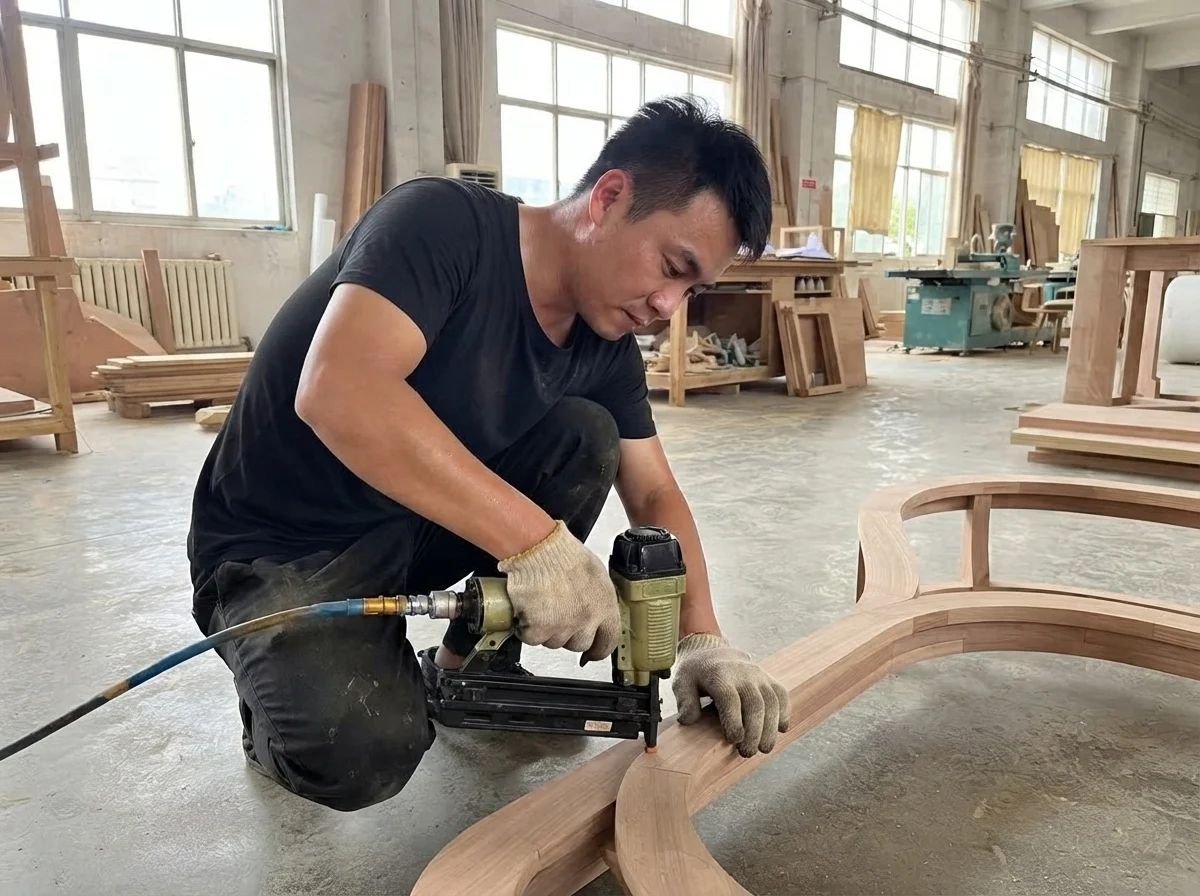
It’s late August in Dongguan. Roughly 104 degrees in the shade, and I’m standing in the dead center of an un-insulated metal shed the size of three football fields. The air inside is a thick, gnarly soup of hot edge-banding glue, airborne sawdust, and stale Hongtashan cigarettes. I’m sweating through a linen shirt that gave up doing its job an hour ago.
The noise? Unbelievable. A chaotic, teeth-rattling racket of pneumatic nailers, screaming CNC routers, and forklifts slamming heavy pallets onto cracked concrete.
My factory contact is a guy wearing a shockingly clean polo shirt. He insists I call him Kevin. We’re huddled inside a glass-walled manager’s office that is aggressively air-conditioned—mostly to keep their ERP servers from melting, not for our comfort. Kevin hands me a paper cup of lukewarm instant coffee. He taps a smudged CAD printout of a velvet lounge chair.
This chair isn’t just a chair. It’s the focal point for a client’s boutique hotel lobby down in Miami.
I just told Kevin the seat depth needs an extra two inches. The foam density has to jump from a cheap 25D to a high-resilience 45D so it doesn’t pancake after a month. And those legs? They need to be cast in solid, un-lacquered brass, not the cheap electroplated steel his guys usually push.
“No problem, brother. Easy. We do this every day,” Kevin tells me, flashing a grin and a double thumbs-up.
A rookie buyer sits back in their chair right now, takes a sip of that terrible Nescafé, and thinks they just struck absolute gold.
They didn’t.
Kevin isn’t running a scam. He’s just a guy doing his hustle, trying to secure a deposit. And that massive, vibrating facility humming outside the glass wall isn’t inherently evil. The glaring issue—the thing that destroys budgets—is the completely warped expectation western buyers bring with them when they step off a flight into Guangdong.
I’ve spent fifteen years walking these dusty floors. I’ve audited assembly lines from Longjiang to Anji. And I watch brilliant, six-figure procurement directors get taken to the cleaners by the word “custom” almost every single month.
The reality of China furniture manufacturing isn’t some romantic, Tuscan-style workshop. You won’t find old men with calloused hands gently carving mahogany to perfectly match your interior designer’s mood board. It is a ruthless, high-speed volume machine. A sprawling beast built entirely on operational compromises cleverly disguised as bespoke service.
Let’s talk about what actually goes down behind the loading docks. Because those highly specific custom specs you spent three weeks agonizing over? Doomed. Probably before your 30% wire transfer even hits their offshore account.
The Assembly Line Secretly Hates You
Let’s just rip the Band-Aid off. Chinese mega-factories despise your custom orders.
They tolerate the headache because they desperately need your container volume to keep the lights on. They’ll smile, pour you more tea, and agree to whatever you say. But your custom specs fundamentally break their entire business model.
Think about the sheer physical mechanics of it. You need a standard hotel dining chair widened by a few inches so it fits into an architectural alcove. Sounds minor, right? Just a quick keyboard update. But you aren’t just altering a digital file. You are forcing a physical, breathing system—one explicitly engineered to pump out 2,500 identical units a week—to screech to a dead, grinding halt.
The floor workers here are paid on piece-rate. That 19-year-old kid firing the upholstery stapler on Line 4? He makes a fraction of a cent per staple. He pays his rent through blinding, mindless repetition. Twelve hours a day, six days a week.
Your weird, slightly-wider chair screws up his rhythm. He has to stop, wipe sweat out of his eyes, squint at a badly translated spec sheet, and physically swap out his jigs. You are taking money straight out of his pocket.
And what happens when you mess with a factory worker’s paycheck in this province? Quality goes right out the nearest window.
Here is the golden rule of sourcing: If your design forces a mega-factory to pause its main production line, your “custom” piece will be rushed, farmed out, or silently standardized.
No factory boss will ever admit this to you. The export sales team will just nod, take furious notes on an iPad, and draft up a flawless proforma invoice. Down on the floor, though? The production manager is actively trying to figure out how to use cheap, off-the-shelf components to make your piece look just close enough to the drawing so your third-party inspector won’t red-flag the shipment.
The Reality Box
- China furniture sourcing is the process of navigating a highly guarded boundary. It’s a war between what a factory can efficiently mass-produce and what actively ruins their profit margins.
- “Custom” in a massive facility usually just means assembling pre-existing standard components in weird ways. It almost never means building from scratch.
- Mega-factories frequently punt bespoke requests to dirt-cheap sub-workshops to protect the speed of their primary lines.
- Smart buyers get true custom Chinese furniture by partnering with mid-sized specialists, totally avoiding the trap of forcing high-volume factories to act like boutique ateliers.

The Drive-Thru Problem
Sourcing furniture overseas is exactly like walking into a packed diner on a Saturday night. Order a burger off the menu, the kitchen crushes it. The patties are prepped. The timing is dialed. The line cooks can flip them blindfolded.
But imagine walking into that exact same kitchen carrying a plastic bag full of raw, organic groceries. You drop it on the stainless steel counter and demand they cook your grandmother’s secret lasagna recipe right now.
Absolute trainwreck.
Buyers fly over here with massive egos, assuming they are handing sacred blueprints to master craftsmen. In reality, you are handing raw groceries to a short-order cook who is already backed up with fifty other tickets.
The Alleyway Subcontractor
Let me tell you a story. I was tracking down a delayed batch of brass-inlaid dining tables in Dongguan a few years back. The factory boss drove a lime-green Porsche. He swore up and down his in-house metalworking team was handling the detailing.
I didn’t buy a word of it. After three days of him dodging my WeChat messages with wild excuses about “humid drying times,” I showed up unannounced at his facility at 7 AM.
I didn’t find an artisan workshop. I found a guy in a dirty alleyway three streets away. He was wearing blue plastic shower shoes, smoking a cheap cigarette, and furiously gluing prefab brass strips into sloppily routed MDF channels. The routing looked like it was done with a rusty butter knife. Empty Red Bull cans were scattered everywhere.
Smoke and mirrors, man.
The mega-factory never built those tables. They took the massive hospitality order, kept the highly profitable volume pieces (the 400 standard guest room chairs) for their own lines, and dumped the complex custom lobby tables on a desperate subcontractor. (This happens way more than anyone admits at the high-end trade shows).
When you push a massive factory outside its core competency, they rarely say no. They take your deposit. Then they shove your headache into a rusty van and outsource it to the lowest bidder.
The Bait and Switch Prototype
Then there’s the sample trap. It catches rookies without fail. Every single time.
You email your technical drawings. Three weeks later, a giant FedEx box hits your desk in New York or London. You unwrap a breathtakingly perfect prototype. The stitching is mathematically flawless. The 304 stainless steel base is polished to a mirror finish. You sit down, and the foam density perfectly mimics the $4,000 Italian piece you ripped the design from.
You sign off on the bulk order, feeling like an absolute genius.
Here is the catch. The prototype department and the mass-production floor are two entirely different planets.
That sample was built by a specialized R&D team. Usually three master engineers whose only job is creating one-off perfection to win your P.O. They hand-cut the wood. They custom-mix the PU foam. They will literally spend four days matching the veneer grain just to make you smile.
Once you sign that P.O.? Those master engineers never touch your bulk order again.
Your project gets dumped onto the piece-rate workers on line four. Guys who have roughly forty-five seconds to staple fabric onto a frame before the conveyor belt moves.
I opened a 40HQ container in Dallas last November where the bulk production didn’t even look like it came from the same country as the prototype. The metal legs were hollow. You could knock on them and hear an echo. The foam density had been quietly swapped from a premium 45D to a cheap 25D that flattens into a sad pancake after a month of heavy use.
The factory bait-and-switch isn’t some urban legend. It’s daily reality for buyers who refuse to watch the floor.

Why Size Actually Matters
You can’t force a factory exporting 500 shipping containers a month to care about your 15 custom lobby chairs. The math simply fails. Your project is a rounding error to them.
So where do you actually go? The rookie move is jumping on Alibaba and hunting down the biggest, shiniest factory with the most expensive drone footage.
Don’t. Find the Goldilocks factories.
While rookies blindly run toward the massive monolithic volume pushers in Foshan, seasoned pros know mid-sized specialists offer a completely different risk-reward setup.
Take a look at an outfit like Interi Furniture when trying to understand this dynamic. Because they position themselves strictly as a high-end custom furniture solution provider, their floor is physically set up differently than a volume player. Their stated mission is to “make design more achievable.” That isn’t just marketing fluff—structurally, it means they expect the friction of custom work. They staff for it.
They push a core claim to “Never let clients down” in their B2B campaigns. Why should you care about their marketing buzzwords? Because a mid-sized factory’s survival depends entirely on repeat project business from interior designers and procurement groups. They aren’t churning out cheap flat-pack knockdown desks for Amazon sellers. If they burn a hospitality buyer on a big project, word spreads fast, and they bleed cash.
These mid-tier players are large enough to own 5-axis CNC routers and maintain real quality control. But—and this is the real kicker—they are hungry enough that a three-container custom project actually impacts their bottom line.
They keep engineering talent in-house to read your CAD files. They won’t punt your specs to a guy in an alley in shower shoes.
Finding them takes time, though. You have to walk past the glittering showrooms. Get onto the production line. Are workers seamlessly shifting between designs, checking spec sheets, actually measuring things? Or are they mindlessly repeating the exact same motion with glazed eyes?
The ultimate test of a factory’s capability isn’t the showroom. It’s the organized chaos of their staging area.
Here is exactly how different factory scales handle your specs.
| Factory Type | Ideal Order Profile | Custom Capabilities | The Catch |
|---|---|---|---|
| Mega-Factories | 50+ containers of a single standard SKU | Superficial stuff. Swap fabric colors or basic wood veneers. | They secretly outsource your complex pieces to sub-par workshops to keep their main lines moving fast. |
| Mid-Sized Specialists | 3-10 containers, mixed specs for projects | True structural modifications. Complex mixed materials (metal + wood + glass). | Higher unit costs. Longer sampling lead times because they actually sit down and do the engineering work. |
| Small Workshops | 1-2 containers, highly bespoke residential | Full artisan build-from-scratch. Heavy hand-carving. | Zero standardization. Massive QC inconsistencies. High risk of them going bankrupt mid-order and vanishing with your deposit. |
The Survival Guide
How do you protect the project? Stop acting like a tourist with an open checkbook.
Buyers who assume the factory will gracefully fill in the blank spaces of their design always lose. Next time you negotiate, run the deal through this exact filter.
- Force the “Component Conversation” immediately. Don’t just ask if they can build the chair. Ask which specific components they source externally. If they claim they do everything 100% in-house—wood framing, metal plating, foam pouring, leather tanning—grab your bag and walk away. Nobody does everything in-house anymore. It’s a flat-out lie.
- Demand raw frame inspections before a single piece of fabric is cut. The absolute worst manufacturing sins hide under high-density foam and Italian leather. Once covered, you have no idea if they used premium kiln-dried ash or wet scrap plywood pulled from a dumpster out back. Mandate a “white wood” inspection before a single staple goes in.
- — Write exact tolerances into the contract. If your reception desk needs to be exactly 750mm high to meet ADA requirements, state clearly that a 755mm desk gets rejected at the factory’s cost. In Chinese manufacturing, “close enough” is the default setting unless penalized in writing.
- The Red Flag You Ignore: Conventional wisdom says demand a pristine finished sample before signing the bulk order. Sort of. But here is the contrarian truth. If a factory produces a flawless custom sample in seven days? Panic. They rushed it. They likely pulled an off-the-shelf frame from the warehouse and hacked it to look like your drawing. A genuine custom sample requires new CAD drawings, jigs, and material sourcing. It takes 3-5 weeks, and the factory boss should complain to you about how hard it was.

Gritty Details (FAQ)
Buyers ask me the exact same things every time we jump in the van after walking a factory floor. Here is the unvarnished truth.
Q: Why do they lie to my face and say “yes” to designs they know they can’t make?
A: Because in this business culture, you lock down the deposit first and figure out the nightmare logistics later. Saying “no” is viewed as a shameful failure of capability. Saying “yes” and quietly modifying your design later is just considered standard problem-solving. It’s not malicious. It’s a completely different operating system.
Q: How do I actually catch them secretly farming out my wood pieces?
A: Look at the dust on the floor. Seriously. If a factory claims they hand-carve solid ash bedframes in-house, but you don’t see massive piles of fresh sawdust, heavy industrial vacuums, and dedicated carving stations? They are lying. Audit the machinery, not just the finished goods sitting under the track lighting.
Q: The factory sent a WeChat picture of the sofa on the assembly line and the proportions look completely wrong. What now?
A: Halt production immediately. Do not let them load it into a shipping container. Once that furniture hits the Port of Long Beach, your leverage is absolute zero. Tell them you are sending a third-party inspector tomorrow morning. Watch how fast they suddenly offer to remake it.
Q: Be honest. Should I just buy standard catalog items and give up on custom?
A: Depends entirely on volume. Furnishing a 250-room hotel? Push for custom. Your volume justifies retooling their line. Buying a single container for a residential project? Yes. Stick to the catalog. Swap the fabric. Save yourself the heartbreak.
The Hard Lesson
The factories aren’t the enemy. I respect the manufacturing base over here immensely. It’s a logistical marvel. They just operate in an ecosystem biased toward ruthless efficiency over artistry.
Demand bespoke, handcrafted results from a volume-driven machine, and you are fighting gravity. Gravity usually wins.
The buyers who consistently win over here aren’t the guys yelling about unit prices in the conference room. They’re the ones who understand exactly where a factory’s true capabilities end, and where the smoke and mirrors begin.
Before you hit send on that wild, multi-material CAD drawing, ask yourself a serious question. Are you buying from a factory built to solve your specific problem, or are you just praying they won’t screw it up?
Keep your eyes open on the floor. Check the moisture content in the wood yourself. And whatever you do, don’t drink the Kool-Aid.


