


If you head down to Hall 3.1 on the opening day of CIFF Guangzhou this March, you will quickly come to believe that every 20m along this aisle is producing a copy of: a white boucle curved sofa, sintered-stone (travertine style) round dining table, and a sales person keen to get you to PO 2x 40’containers by Friday in exchange for an attractive $380FOB.
It will be hot, crowded and you will regret having flown out.
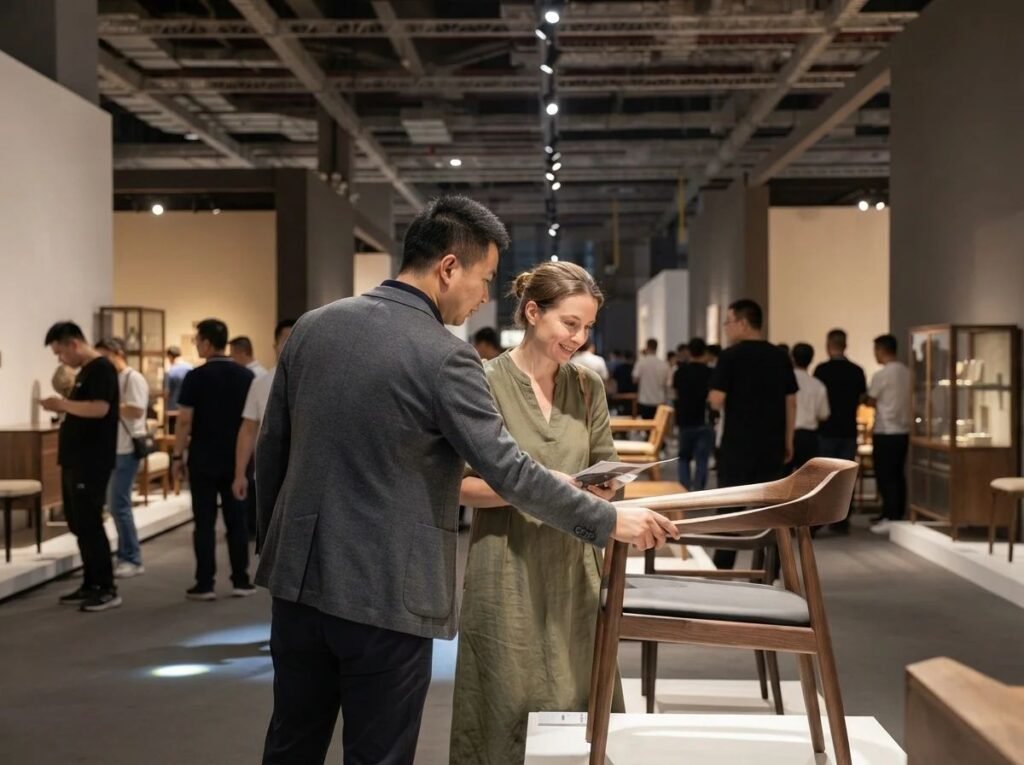
However, if you continue 10mins further East (beyond the coffee stands, vying for free WiFi), and make your way through some of the Design Halls, you will begin to notice a change in the quality of the carpet and light levels. You may come across a ~60 strong business from either Dongguan or Hangzhou, displaying perhaps 3 products, no advertising banners and a business owner who takes little notice of you upon entering. A beautiful all-black walnut feature console may be tucked away somewhere in the background, costing you ~$1,100FOB, but will be sold at ~$5,800+ to your 5* residential accounts in London, NY etc. Unfortunately, most customers won’t bother to seek these items out as they will be too distracted hunting for $15 savings in the “Red Sea”.
Main-Hall Reality Check
There is an unwritten rule among those enjoying a drink back at the conference center: once a stall has attracted a 20min+ queue AND is providing complimentary drinks, you cannot hope to achieve any meaningful margin.
As soon as you are actively seeking out and purchasing from the key, highly-publicized showrooms based around Foshan, Shanghai etc., you should stop thinking that you will gain any sort of competitive edge. The likelihood is that your competitors will have secured the same range of products, and by the time your goods reach your warehouse, an emerging DTC brand will be advertising the product on social media at ~15% less than your final landed price.
My personal rule is: if you can identify the same product in 3 consecutive bays within 1-2 hours of your fair visit, you’re likely to enter a race to the bottom with your pricing. Over my 15-year career, this has always held true.
Consequently, the real secret to sourcing high margin furniture today lies in identifying products that have NO obvious “look-alike” alternative available online.
Key Takeaway
- Main-hall trends destroy margins: High-traffic booths at major Chinese fairs sell commoditized silhouettes that trigger immediate retail price wars.
- Modern Eastern aesthetics offer price insulation: Blending Song-dynasty minimalism, real wood joinery, and Western ergonomics creates products that resist reverse-image price shopping.
- Niche furniture sourcing requires a different vetting lens: Smaller workshops in the quiet zones offer lower MOQs and higher retail markups, provided you know how to inspect kiln-drying and joinery.
- Mid-sized specialists bridge the gap: Pairing design-forward aesthetics with export-ready reliability means avoiding both mega-OEMs and unscalable artisan studios.

Defining Modern Eastern in a commercial context
Broadly speaking, “Modern Eastern” describes a fusion of classic Eastern techniques and materials (primarily East-Asian) with the requirements of Western residential and commercial applications. Of course, the ornate, over-scaled, dark-stained wooden features adorning many Chinese restaurants since the early 2000’s will be instantly rejected by your target market.
In the quieter sections of the fairs in Guangzhou, Shenzhen and Shanghai, however, you will find a very pared-down interpretation of this style. Often taking inspiration from the Song Dynasty period, these designs pair extremely well with, for example, fine Belgian weaves and stone.
Imagine that you are seated at a 12-topping Omakase restaurant vs. a large-scale US-style buffet. The former offers a level of subtlety, precision and exclusivity that the latter simply cannot replicate. Nor would you expect to receive a 10% discount on your plate of Otoro if you knew that another stall further down the restaurant served a lower-cost fish!
So, am I really paying for joinery?
The temptation (or assumption) when considering the above styles of product is that, given the apparent simplicity, the level of skill and input required to manufacture such goods must be modest. This is somewhat misleading.
Buyers may underestimate the complexity, but rarely understand the criteria against which they should assess these businesses. It is very possible to produce a deceptively understated, modern-looking piece using a high-quality ash-veneer applied to an MDF substrate, concealed fixings, etc. Under the subdued lighting conditions prevalent at the majority of Chinese fairs, this will be difficult to distinguish from a genuinely crafted piece using e.g. Black Walnut.
On your next fair trip, take a dining chair and invert it. (You may alarm the member of staff on duty!) Inspect the junction between the leg and seat frame, running your finger under the seat. Provided that you have sourced a competent, smaller business in the Dongguan, Zhejiang or Jiangsu area, you should be able to appreciate a tightly-executed, neat joinery solution, devoid of visible adhesives, fillers, or (worst case) steel fixings!
It’s almost comical the level of effort that some of the larger exhibitors will go to in order to convince the passing public that their offering is “bespoke” and therefore deserving of a significant premium. The most valuable aspects of their product are invariably concealed from the customer.
By travelling directly to these manufacturers (typically located ~1hr drive from the motorway network, e.g. Shunde, Anji), you will see that their process differs markedly. Rather than seeing 20+ operatives rapidly applying a thick, high-gloss coat of paint to a pre-cut component, you may witness 3 seasoned individuals meticulously sanding a single piece of Ash to 600 grit, prior to applying a low-sheen oil finish. The resulting product will emit a distinct, pleasant aroma, and provide a subtle (but perceptible) sense of richness to the customer when they sit down to enjoy a meal.
Why consider niche?
“Niche” is a term that frequently appears when discussing the Chinese supply chain, but what does it actually mean for a furniture buyer? Typically, this will refer to businesses that do not offer the broad portfolio of products that characterize the bulk of Chinese manufacturers, and are therefore able to operate at smaller volumes. As a result, the unit cost will typically appear considerably higher than the equivalent product supplied by a large-scale OEM.
Why would a buyer elect to source from these companies, if a comparable (in terms of visual impact) product could be obtained at ~3x lower cost?
The answer lies in the subsequent ability to apply a markup to the final sale. As shown in the table below:
| Sourcing Dimension | Main-Hall “Red Sea” Sourcing | Quiet-Zone Modern Eastern Sourcing |
|---|---|---|
| Typical MOQ | 30–50 units per SKU (often full container) | 5–15 units per SKU (mixed containers common) |
| Retail / Project Markup | 2.2x – 3.0x landed cost (heavily compressed) | 4.5x – 6.5x landed cost |
| Design Lifespan | 12–18 months before trend saturation | 5–8+ years (timeless architectural appeal) |
| Price Comparison Risk | Extreme (instant Google Lens matches) | Low (bespoke finishes and proportions) |
| Customization Flexibility | Rigid (fabric swaps only, high fees) | High (custom dimensions, stain matching) |
A further point worth highlighting is that a significant proportion of the current “Quiet Luxury” schemes being deployed in hotels across the Western world are sourcing from similar (European-based) operations, and incurring a correspondingly elevated cost to do so.
I have had several instances of hotel buyers reluctant to commit to a ~$4,200 dining chair from a respected, small-scale Italian business, despite the geometry and construction being broadly similar to a product available from a 3rd gen family-run factory in southern China for ~$550 ex-works. Analogously, if you wanted to purchase a bottle of wine at your local supermarket, you would likely pay 3-5x the cost of sourcing directly from a small vineyard in an under-the-radar area of Tuscany, Rioja or Bordeaux. Of course, the grape varietals and growing conditions may vary slightly, but it’s unlikely to be a significant factor in determining the end quality of the finished product!
In short, the cost premium incurred when sourcing from the ‘Quiet’ areas of the Fair is predominantly related to the raw material and labor input, rather than a large overhead associated with the business’s commercial presence.
Likewise, it can be advantageous to request minor alterations to a base product to suit a particular specification. Should you approach one of the large-scale export houses with a request to reduce a product’s width by 4cm (to fit through a tighter lobby or public area), you will probably be met with a lengthy (and costly) query process. Contrastingly, at a 50-person scale operation, the business owner may be happy to discuss the change with their Lead Carpenter, advise a marginal uplift to the ex-works price (+$35pc) and extend the delivery schedule by ~4 days.
Identifying suitable Manufacturers
Of course, if you choose to eschew the principal Show Halls, you will encounter a variety of different types of manufacturer. These can be broadly categorized as follows:
- The “Mega” Exporters – these businesses occupy vast sites in the greater Foshan/Dongguan/Anji area and specialize in supplying the global mass-market. They will be ISO-accredited and have dedicated, fluent English-speaking sales teams, but will largely be unable or unwilling to accommodate a modest order for your next hotel development.
- Pure Artisans – you will also find many highly-skilled, innovative designers working from small workshops around China (e.g. Hangzhou, Jingdezhen). Their output may rival that of any leading international house, but they are often unable (or unwilling) to meet the administrative requirements needed to support a substantial overseas order (ISPM15 compliance, lead times, etc.) and may even take an extended leave of absence each year! (A lesson I discovered when traveling in the Zhejiang province in 2018).
As noted previously, it is in the space between these two extremes that a number of excellent companies have emerged. Some customers will continue to look to the largest OEMs to fulfill their container(s) for a given program, but others will find that a mid-scale specialist (such as Interi Furniture for example, whose core offering comprises Contemporary and 5* Residential) presents a more attractive compromise. Such businesses will typically have the facilities and expertise to deliver the requisite surface treatments, combinations of material and tighter QC, whilst retaining the flexibility to manage a customer’s specific timeline (subject to careful planning around the Spring Fair period).
Ultimately, your ideal supplier will be one that allows you to place a sufficiently material order to justify their allocation of resources, but not one that forces them to dedicate an excessive proportion of their production line.
Over the past 2-3 years, it is these mid-tier businesses that have come to dominate the high-value 5* hotel contracts awarded throughout SE Asia, MENA and Europe.
How to identify these businesses
To maximize your chances of locating these suppliers, you will need to modify your approach to exploring the Fair, and subsequently evaluating a candidate:
- Avoid the principal Fair Show Halls on Day 1. Make your way to the Design Halls, Free Standing Designer Stands and upper levels of the Quiet Area before your attention begins to waver from the sea of cream-colored 3+2s.
- Enquire about the timber MC. Before committing to a sample, ask the relevant contact what moisture content they target when drying the hardwood for despatch to your country. For destinations such as Colorado, Saudi Arabia, Canada etc., a figure of ~8-10% should be expected. Failure to receive a clear response (or one that simply refers to the ‘export standard’) should act as a warning.
- View the pre-finished product. Request access to the product prior to final coating (i.e. prior to painting, staining etc.). Whilst these colors can mask a degree of sub-standard stock (i.e. higher sapwood content, patches of glue-in, poor color-matching of stave components), you will be able to readily assess the underlying material if shown a bare frame.
- Beware a pristine “factory”. Although many buyers will instinctively seek to view the cleanest and most orderly production facility possible, in the context of hardwood-focused niche manufacturers, a facility that is entirely devoid of sawdust, off-cuts etc. should raise some suspicion. It is probable that you are being shown a storage and packing location, with the actual work outsourced to a series of sub-contractors.
- Focus on improving the shipping package. Once you have identified a suitable manufacturer, it is rarely productive to push to reduce their ex-works rate, as this will inevitably lead to compromises elsewhere (e.g. thickness of lacquer, drying time…). You should instead seek to improve the robustness of the outbound parcel, e.g. requiring higher grade carton board, additional internal protection, dense corner pieces etc. The loss of revenue due to a single compromised item will far outweigh any potential savings achieved by reducing the base cost.
Therefore, avoid driving the price down too aggressively with these suppliers…

FAQ
Will my (Western) hotel and residential accounts accept Modern Eastern styled product?
Generally, yes. As mentioned above, the most successful businesses will ensure that their offering does not appear overtly “Chinese-inspired”, but will resonate strongly with the Japandi, Natural, Organic and similar design movements currently popular in the West, and complement their existing fabric and fixture selection. Crucially, this will allow them to command a significantly higher price than if they sourced the same effect from Italy.
What safeguards are in place to prevent warping and movement of the hardwood upon arrival in a low-humidity location?
This will be a key consideration when evaluating a potential supplier. You should ensure that they are able to confirm (preferably in writing) that the product has been dried and stored to the appropriate MC (<10%) immediately prior to commencing the final finish. Additionally, you will want to ascertain whether sufficient allowance has been made for the wood to expand and contract, particularly if ordering large surfaces (e.g. extending the use of “floating” tenon or elongated cam-brass connectors).
Are we still looking at high MOQs to benefit from this type of business?
For the majority of the ‘Quiet’ businesses, the answer will be no. You should be able to secure 10-15 pieces (or even fewer) per product, although you may incur a small premium to cover the setup associated with matching a bespoke color.
Why haven’t these businesses listed themselves on Alibaba, enabling me to source directly from home?
As indicated above, the majority of these firms will currently be operating close to (or exceeding) 80% utilization to fulfill the bulk of their (predominantly) domestic order book. They have little incentive to expend the time and resources required to manage and respond to a high volume of inbound leads on Alibaba, typically enquiring about low-cost, high-volume products.
Is it worth foregoing the opportunity to source from the prominent Show Halls at CIFF / FurnitureChina to pursue high-margin opportunities in the Quiet Areas?
Provided your business is not dependent on achieving ultra-low prices to compete with platforms such as Amazon or Wayfair, then absolutely. There is still considerable opportunity to source attractive, differentiated and profitable product from the Fair’s quieter locations.
So, as you stand outside the CIFF or #FurnitureChina venue on the first day, observing the masses funneling towards the principal Show Halls, consider doubling back.
Anyone with access to a bank account and an agent can procure the latest “trending” product and resell at an appropriate premium. They require minimal creativity to execute this, and the industry is happy to reward them for it. But if you want to consistently generate 60%+ margins, you will be found sipping tea in a remote corner of the exhibition, and examining the joinery of a walnut dining chair.
Where will you start your search this time?


