

In October, I shared a small Cantonese restaurant in Lecong, Foshan, with a Procurement Director from a large US hotel group. We had just completed the signing of a ~$420k FF&E order for the fit-out of a 140-room boutique hotel. His plan was to fly direct to China and tour the various malls in Foshan (including the ‘Louvre’ furniture mall) to eliminate intermediaries and secure his furniture.
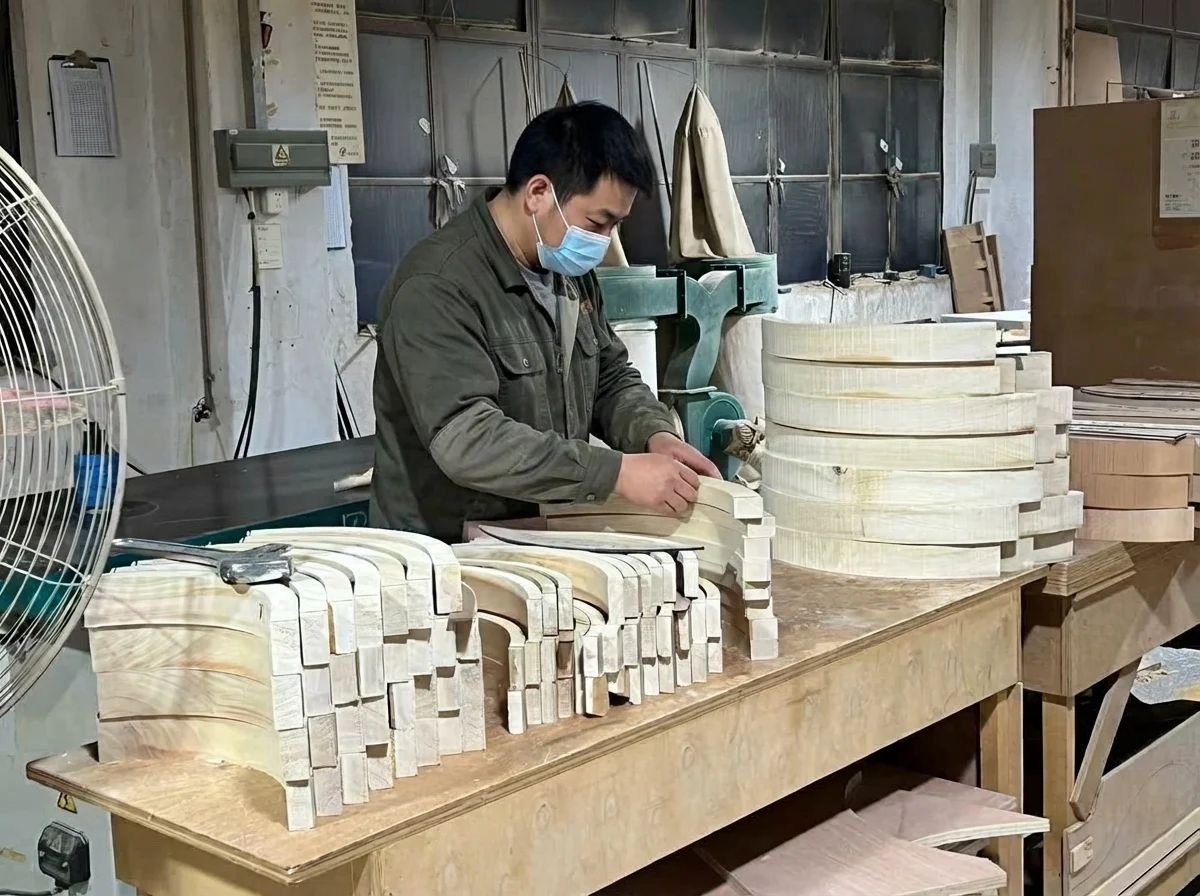
I couldn’t bring myself to spoil his meal and so held my tongue through his first round of dim sum, before informing him that the heavy, oaken beds he’d specified would be manufactured ~450km away, in the town of Nankang. Similarly, his stainless steel table tops and bases would be cut and welded in Bazhou, Northern Hebei. All that remained in Foshan was a 4,000m2 showroom.
Many readers will recognize the above scenario, having recently traveled to China for the purpose of China furniture sourcing. For the better part of the last 20 years, Foshan and Dongguan (both in Guangdong province) were synonymous with Chinese furniture manufacturing. However, in 2026, assuming Foshan will fulfill all your requirements is akin to assuming that Silicon Valley can be fully explored via a trip to a BestBuy.
Foshan: What’s Left?
It’s fair to say that Foshan still exists and continues to operate. However, due to increasing cost of doing business (labor, land, environmental regulation) within the Greater Foshan area, it has largely retreated from producing many key furniture categories. As such, a significant proportion of the firms and ‘showroom-factories’ encountered at the Canton Fair and CIFF in Guangzhou will be sourcing a material or sub-assemblies from further afield, and reselling under their own brand.
My advice to all my clients traveling to China for furniture is therefore simple: once a showroom begins selling you Italian coffee and Italian marble, assume that your furniture has passed through 2+ intermediaries.
That said, there may well be benefits to working with a consolidator. Whether you choose to work directly with manufacturers in other cities or use a consolidator, you should avoid falling prey to the latter’s premium for their service and then falsely assume you have visibility into the factory.
Some initial observations about the current state of play in China’s furniture sector include:
Initial Observations on China’s Furniture Industry in 2026
- There are now distinct “cities” in China that specialize in certain aspects of the furniture value chain. Due to increased labor and environmental regulation, much of the basic production of raw timber, metal and upholstered products has moved away from the PRRD.
- As a result, it can be advantageous to engage suppliers in these other towns (e.g. Nankang, Anji, Bazhou…) who have greater depth of skill and experience in their niche and can drive unit price down.
- To assemble a typical hotel furniture specification, you will need to work with at least 3 separate cities in China, regardless of whether you source directly or via a consolidator.
- Be aware of reduced capacity to fulfill overseas orders from these inland locations. Unit cost may be significantly lower, but you will need to deploy additional resources to QC the production.

Moving Away from Foshan: Nankang and Chengdu
So what is China furniture sourcing exactly? The term broadly refers to the identification and management of a range of manufacturers, each specializing in a discrete stage of the furniture supply chain, in order to deliver a complete range of commercial and domestic furniture products. Up until very recently, this activity could be conducted entirely from a series of factories and malls straddling the border of Foshan and Dongguan.
To identify where furniture is currently produced in China, hop on the HSR from Guangzhou towards Ganzhou in Jiangxi Province, and alight at Nankang.
Can Nankang compete with Foshan?
Without any hesitation: yes, and by an enormous margin. Through targeted investment from the municipal authorities, coupled with the ability to receive huge volumes of raw timber, Nankang has developed into a powerhouse of solid timber furniture production in China. Trying to equate Foshan to Nankang today is akin to comparing a Michelin-star restaurant in central Paris with the local butchery in Lyon. Both will sell you fine meat, but one provides a level of control over the starting product that the former cannot hope to achieve.
On any given day, if you drive through the factory estates surrounding Nankang, you will be greeted by an intoxicating smell of freshly seasoned timber and (usually) low-VOC coatings. The streets are clogged with lorries carrying US-species ash, and the towns stretch out endlessly without a hint of an English language presence. (I discovered this when my local contact took me to a timber supplier that was closed, and I was forced to hail a taxi and explain my predicament with minimal verbal communication!)
Unadulterated, no-frills manufacturing.
According to several industry contacts, a disproportionate volume of China’s solid wood furniture is now produced in Nankang, and the majority of its residents have taken steps to accommodate the requirements of international customers. By failing to source from Nankang, you are likely incurring a substantial uplift in your final landed cost compared to what could be achieved by engaging one of its many factories.
In a comparable position to Nankang is Chengdu, located in the southwestern province of Sichuan. Historically, Chengdu’s manufacturers supplied primarily the internal Chinese market, but recent advances in the efficiency and frequency of freight movements to overseas markets have allowed them to begin competing globally. Their willingness to accept and fulfill orders from abroad is limited however, as the majority will insist on receiving detailed engineering information and will not be able to interpret vague design guidance.
Other Specialized Centers of Production
As noted above, the furniture industry in China relies on a specialized Chinese supplier network, where distinct regional hubs handle individual stages of the production chain.Familiarizing yourself with this distribution of suppliers and their respective strengths is critical to the success of your orders.
Don’t fall for the “all-in-one” factory!
One of the attractions of engaging a Chinese manufacturer to supply a hotel is the opportunity to consolidate a wide variety of furniture types and finishes under a single source. From the perspective of an ID, it offers an obvious administrative and commercial benefit to instruct one firm for the provision of the hotel’s suite of upholstered, stone, metal and office furniture.
Of course, it does not mean that the factory will actually be able to produce (or, crucially, profitably produce) all of these items. If you instruct a Foshan-based firm with a primary focus on upholstery and joinery to manufacture, e.g., a bespoke series of bent metal dining tables and swivel office chairs, you are unlikely to receive a favorable quote. At which point, they will almost certainly engage one or more 3rd party manufacturers to undertake those works and add a margin.
Two locations stand out as the main source of these types of hidden sub-contracted production in China: Anji and Bazhou.
The town of Anji, in eastern Zhejiang Province, is home to an incredible concentration of chair manufacturers. Whatever type of chair you require – be it office, gaming, fabric-upholstered, metal-framed, etc., it is highly probable that it originated in Anji. When I visited a number of manufacturers there earlier this year, I recall being shown a client’s reference chair that featured a rotating base. Upon inspection, the base was found to rotate unevenly. The site manager immediately drove around the back of the estate to a local metal-stamping operation, sourced 3 alternative parts, and returned to my group with a rectified version in time for us to collect some refreshment.
No down-time incurred.
Bazhou is located approx. 2hr driving distance from Beijing. Its manufacturers predominantly produce metal and glass furniture (e.g. dining and bar-height) and will typically be happy to undertake any quantity of works required. The downside to traveling to Bazhou is the climate – in particular during the winter months. Nevertheless, their extensive production lines and finishing facilities ensure that they are well-placed to meet any demand placed upon them.
Overall, my view is that in 2026, you should be looking to engage multiple manufacturers to fulfill different elements of your specification, rather than attempting to find a single provider that can meet your entire requirement. The table below summarizes some of the main centers of production identified thus far:
| Manufacturing Hub | Primary Specialty | Typical MOQ Flexibility | Export & English Readiness | Best Buyer Fit |
|---|---|---|---|---|
| Foshan / Dongguan (Guangdong) | Custom upholstery, luxury casegoods, project consolidation | High (often accepts low MOQs for hospitality) | High — mature export teams and showrooms | Boutique hotels, high-end residential designers, multi-SKU packages |
| Nankang (Jiangxi) | Solid wood (oak, ash, rubberwood) dining & bedroom | Medium to High (prefers container-level runs) | Low to Medium — improving, but needs local QC | Importers, wholesale brands, large solid-wood rollouts |
| Anji (Zhejiang) | Swivel chairs, office seating, molded-foam lounge seating | Medium (flexible on fabrics, strict on molds) | High — very experienced with US/EU compliance | Commercial office, hospitality seating, e-commerce brands |
| Bazhou (Hebei) | Metal frames, bent steel, glass-top dining, barstools | High (built for volume runs) | Low to Medium — transactional, price-driven | Volume retailers, restaurant chains, OEM metal components |
Filling the Gaps: The Next Level Down
At this point, buyers may start to feel overwhelmed. They don’t want to place their order with a large, opaque Foshan-based firm, but they probably don’t have the manpower (or Chinese-language skills) to oversee a spread of raw-material providers in Jiangxi, Hebei and Zhejiang.
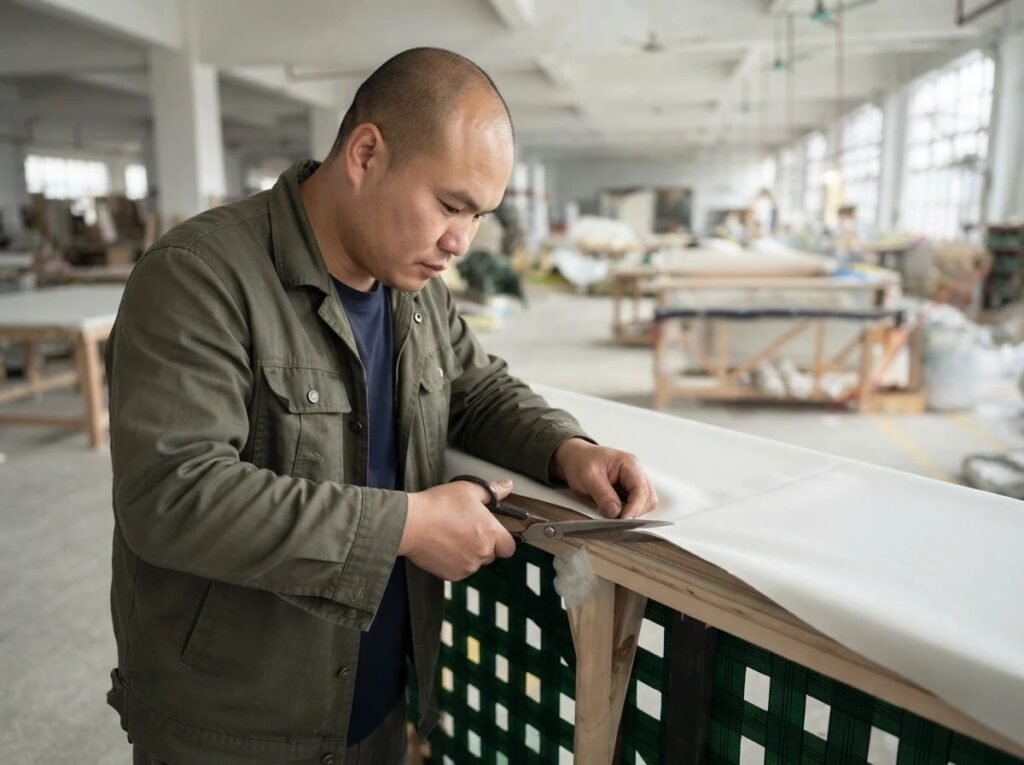
Fortunately, the Chinese market also hosts a tier of smaller but established manufacturers that are increasingly focused on fulfilling orders from overseas—operations like Interi Furniture. These companies have generally emerged from the current downturn having identified a product niche that they can service efficiently. Some will be based in Guangdong or other coastal provinces and will therefore retain many of the commercial features that allow them to successfully engage international clients (i.e. appropriate level of technical and commercial reporting, robust packing protocols, responsive communications). Although you should not expect the lowest possible ex-factory price available, you can be confident that your order will leave China without incurring delays from a failure to supply suitable desiccants, bracing, or other protective measures.
Furthermore, by approaching a company of this size, you stand a much greater chance of being viewed as a valued customer. Should you instruct a large-scale factory to supply $150k-worth of furniture, you will likely rank poorly compared to their existing client base. By targeting a similarly-sized operator, you are more likely to drive meaningful engagement with your account team.
Considerations when evaluating manufacturers beyond Foshan
Should you elect to explore the options available beyond Guangdong this year, you should bear the following points in mind:
- Confirm the company’s registration details and ensure that these correspond to their stated premises. All businesses operating legally in China will have a USSC code associated with them, and you should request this as part of your due diligence. Additionally, you should confirm that their business activities include ‘production’ (生产) and are not solely engaged in ‘sales’ (销售). This exercise is quick and straightforward, but will help guard against fraudulent operators.
- Request a video of their coating and finishing department. Again, avoid the showroom, office and any promotional content that may be hosted online. Ideally, you should be able to view open paint lines, curing areas and operatives applying treatment to products.
- Avoid any site that appears immaculate. While it is natural to associate a clean, orderly factory environment with best practice, you should exercise caution if you are presented with a pristine and (typically) deserted production facility. It could indicate that you have been directed to a decoy site, and that your furniture is in fact being manufactured in a less-desirable location. Alternatively, the site may simply have no incoming order book and is depleting its working capital reserves! A typical, busy factory will have a combination of raw materials, in-process and completed stock on site.
- Agree the requirements for the outbound packaging of your shipment. Many of the manufacturers located in the inland provinces discussed above will not have optimized their packaging to suit the rigors of overseas transport, and may strip back the specification of cartons and end-pieces accordingly.
- Engage a separate party to inspect your goods prior to the release of the outstanding payment. Clearly, this is undesirable from the perspective of your sales representative, but you should never rely on an individual who has a financial interest in the factory to perform this function.

FAQs
I’m planning a relatively small hotel scheme, will I gain sufficient benefit from traveling to these alternative locations?
Probably not. If your specification comprises a large number of disparate SKUs and modest quantities of each, the inland sites may be unwilling to entertain your order, or impose significant additional charges. In these cases, it may prove most cost-effective to continue engaging a supplier based in the PRRD, provided they can demonstrate an appropriate level of transparency regarding the origin of the relevant sub-components.
What level of cost saving can I expect from engaging manufacturers outside of Foshan?
Typically around 15-25% vs. equivalent items supplied from Foshan, subject to your order meeting the factory’s minimum requirements. That being said, once you factor in the cost of moving the goods to a suitable export port and arranging (potentially multiple) inspections, the net saving may be materially diminished (particularly in the event of a failed container).
Will the staff at these alternative locations be able to communicate in English?
In Anji at least, many of the larger firms will have dedicated personnel who can conduct business in English and are well-versed in the principal testing regimes applicable to overseas markets (BIFMA, BS5852…). In the other towns, you may encounter an English-speaking point of contact, but you should expect the bulk of the relevant decision-makers to require translation support. It is advisable that you engage a specialist translator with knowledge of the furniture sector.
Should I cease engaging suppliers based in Foshan altogether in 2026?
Not necessarily. There will continue to be significant value in retaining a footprint in the PRRD, particularly where you require a higher degree of customization, a broader mix of product and / or lower order sizes. Provided you are willing to invest the necessary effort into overseeing the production of your order, however, the opportunity to reduce your overall landed cost will be significant.
The Hard Lesson
In summary, the geography of China’s furniture manufacturing has undergone minimal change over the past 5 years, but the nature of the supply chain has evolved. It is likely that most western clients will continue to pursue their orders via the prominent firms based in Guangdong, unaware of the alternative providers that exist and the resultant reduction in their competitiveness. The challenge is to discover these manufacturers, and make the requisite journey to reach them. Will you make it, or will you settle for a showroom with a superior espresso machine? Remember: good luck finding one in the true factories of China!


