

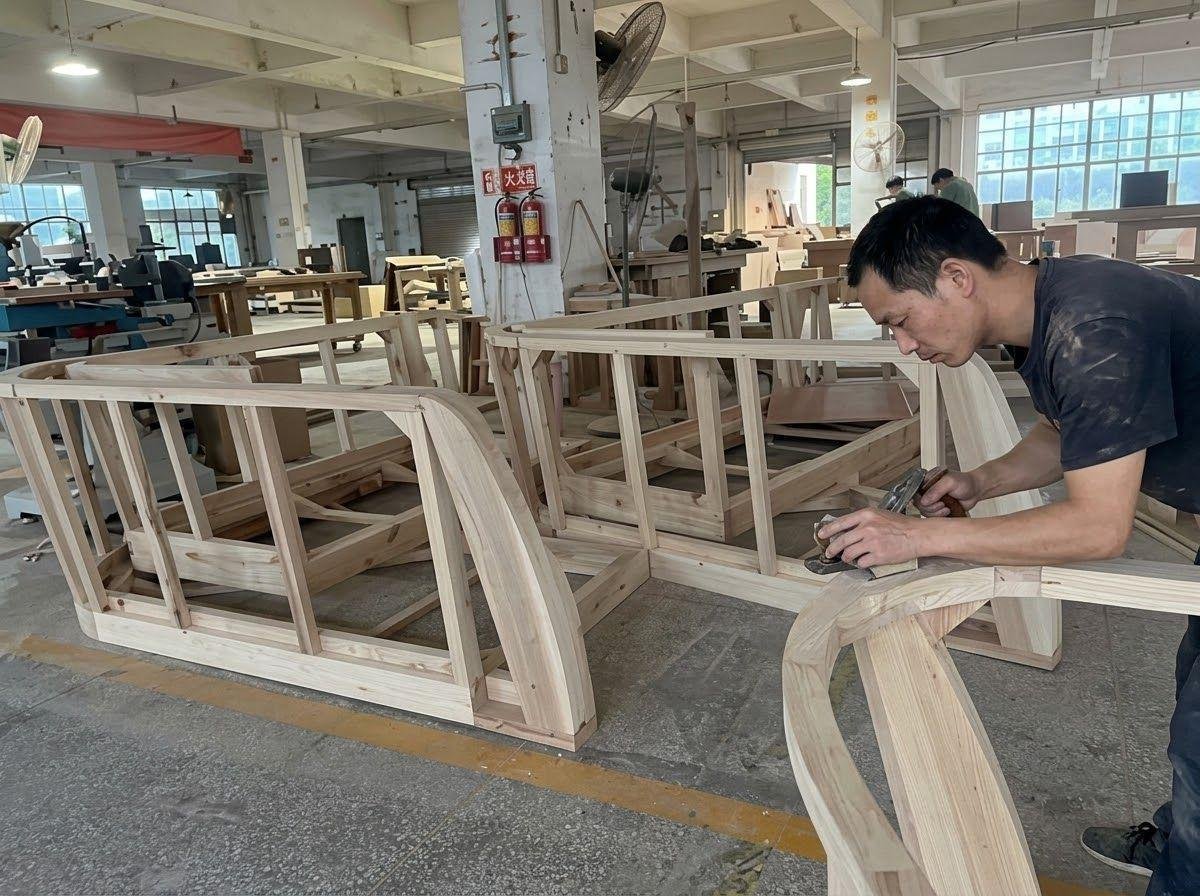
I was standing in a 40,000-square-meter factory in Longjiang, just outside Foshan, watching a production line crank out what the sales manager called “heavy-duty contract seating for assisted living.” The chairs looked the part. Thick vinyl. Steel frames. Weight-rated tags dangling from every seat. The buyer — a procurement director from a Midwest senior living chain who’d flown in for a final inspection — nodded approvingly. Then I lifted one chair. It weighed maybe eleven pounds. The “steel frame” was aluminum tubing with a brushed finish. The vinyl? Standard PU, not the medical-grade Crypton or Ultraleather the PO specified. The weight rating tag? Printed in-house. No third-party testing. The PO was for 1,200 units at $187 per chair. At that price, in 2024, with ocean freight still volatile? Something had to give. And it did. The buyer didn’t catch it. He was too busy checking finish colors against a swatch book.
That trip stuck with me. Not because the factory was uniquely dishonest. They weren’t. They were responding to a market signal: American senior living operators want “contract-grade” Chinese seating at residential-grade prices. And the industry has built an elaborate vocabulary of misdirection to bridge that gap.
The Brutal Truth: “Contract Grade” Is Mostly a Marketing Layer in China
Here’s what nobody tells you at the trade show booth. In China, “contract seating” is not a regulated product category. It’s a sales tier. A factory can slap that label on a chair because the frame has an extra cross-brace, or because the foam density is 35 kg/m³ instead of 30. There’s no governing body checking. No customs inspector verifying. The term means whatever the factory needs it to mean to close the deal.
The uncomfortable reality? Most senior living buyers are sourcing what I call “contract theater.” It looks right. The samples pass the sit-test. The catalog photography is indistinguishable from Steelcase or KI. But the production run? Different animal entirely.
Rule of thumb: If the factory’s “contract” line costs less than 60% of what you’d pay for an equivalent domestic North American or European contract chair, you’re not getting contract-grade. You’re getting contract-styled. And in a senior living environment — where a chair absorbs 16 hours of daily use, incontinence episodes, aggressive cleaning protocols, and the occasional 300-pound resident — that distinction isn’t academic. It’s financial. And legal.
Key Takeaway
- Chinese contract seating is the process of procuring bulk, specification-driven furniture from Chinese manufacturers for commercial environments — but the term “contract grade” carries no enforceable standard across the industry.
- The gap between sample quality and production-run quality is the single largest source of buyer regret in senior living furniture sourcing.
- Price compression in the senior living sector has created a secondary market of “contract-styled” products that fail under real institutional use.
- Your strongest protection isn’t a better contract. It’s a sourcing process that treats the factory as a partner to be audited, not a vendor to be negotiated down.
Trap 1: The Certification Shell Game
Why That CAL 133 Tag Might Be Worthless
Sourcing China senior living furniture often starts with a compliance checklist. CAL 133. BIFMA. TB 133. NFPA 701. The buyer sends the checklist. The factory sends back certificates. Everyone relaxes. Here’s the problem: those certificates frequently describe a sample, not the production specification. Or they were issued for a different SKU entirely. Or — and this is more common than you’d think — the testing lab itself operates on a “send us what passes, we’ll certify it” model.
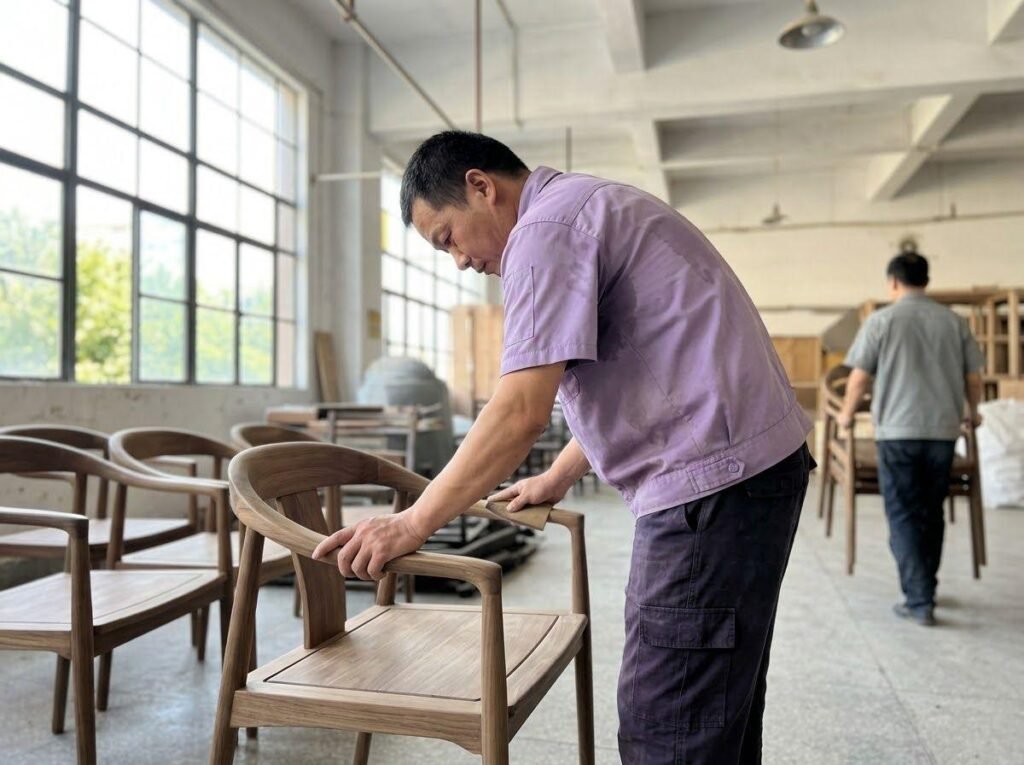
I learned this the hard way in Dongguan. (I learned a lot of things the hard way in Dongguan.) We received beautiful CAL 133 test reports for a lounge chair. Full flame-test documentation. Impressive. Then I asked to see the actual test specimen. The factory manager blinked. “The specimen was destroyed in testing,” he said. Fair enough. But I asked for photos of the pre-test specimen. Silence. Then: “We don’t keep those.” In seven years of factory audits, I’ve never encountered a legitimate lab that doesn’t photograph the specimen before ignition. Never.
The real kicker? Even when the certificate is genuine, it often covers the foam and fabric only. Not the finished chair. Not the way the frame conducts heat. Not the interaction between components under flame. A senior living facility in California doesn’t need a foam certificate. It needs a system certificate. The whole chair, as assembled, as shipped, as installed. Most buyers don’t know to ask for that distinction. Most factories don’t volunteer it.
Think of it like buying a car based on the crash-test rating of the steel alloy alone. Not the welded frame. Not the airbag deployment. Just the raw material. That’s essentially what a fabric-only CAL 133 certificate gives you. Useful information. Insufficient protection.
Trap 2: The Ergonomic Mirage
Who Actually Sat in This Chair Before You Did?
Senior living seating has a dirty secret: it’s designed for buyers, not for residents. The buyer is the procurement director, the interior designer, the administrator walking the showroom floor. The resident is 84 years old, has reduced mobility, maybe some dementia, and needs a chair they can get out of without using their arms as leverage. Those are different users. And Chinese factory showrooms are optimized for the former.
I’ve watched buyers sink into a “senior lounge chair” in a Foshan showroom and declare it comfortable. Of course it is. They’re 45 years old, fully mobile, and they’ve been walking factory floors for three days. That chair’s 22-inch seat depth and 18-inch seat height might feel plush to them. To an elderly resident with hip replacements and reduced quadriceps strength? It’s a trap. Too deep to sit back against the support. Too low to stand up from without assistance. The “comfortable” chair becomes a fall risk.
And here’s the insider observation that doesn’t make it into trade magazines: most Chinese contract seating factories don’t employ gerontologists. They don’t run sit-stand testing with octogenarians. They copy dimensions from successful North American SKUs, adjust for foam cost, and call it “senior living optimized.” The dimensions look right on paper. The physics of aging? Not their department.
While some buyers gravitate toward large-scale manufacturers in Foshan with enormous catalog breadth, others find that mid-sized specialists — operations like Interi Furniture, which focuses on project-driven hospitality and care-environment seating — offer a different risk-reward equation. They’re not trying to be everything to everyone, which means their senior living lines often reflect more focused R&D input. Not a guarantee. Just a different pattern.
The uncomfortable truth. Comfort in a showroom is not comfort in a memory care wing.
Trap 3: The Invisible Cost of “Good Enough” Engineering
When the Frame Fails at Month 14
Senior living furniture operates in what engineers call a “high-cycle, high-load, abusive environment.” That’s not an insult to residents. It’s a description of reality. Chairs get dragged across vinyl flooring by maintenance staff. They get wiped down with quaternary ammonium compounds daily. They support residents who use them as leverage points to stand. They absorb impacts from walkers and wheelchairs. A residential chair — even a sturdy one — dies quickly in this environment.
Chinese contract seating factories know this. So they engineer to a price point that survives the warranty period. Not thrives. Survives. If the warranty is 12 months, the chair is engineered for 14. If the warranty is 24 months, maybe 26. It’s rational economic behavior. It’s also why I see so many senior living operators replacing Chinese-sourced lounge seating at the 18-month mark. The frames don’t catastrophically fail. They just… sag. The foam compresses unevenly. The mechanism loosens. The vinyl cracks at the seams. Death by a thousand micro-failures.
Plus, there’s the replacement math that nobody runs. A $187 chair replaced every 18 months costs more over five years than a $340 chair that lasts 60 months. But the $187 chair fits this year’s CapEx budget. The $340 chair doesn’t. So the trap closes. Buyers optimize for purchase price. The facility optimizes for replacement cycles. And the residents? They sit in progressively deteriorating furniture that signals, subconsciously, that this environment is temporary. Disposable.
The frame doesn’t have to break to fail. It just has to make a resident feel less supported than they did last month.
The Ecosystem Reality: Who’s Actually Building What
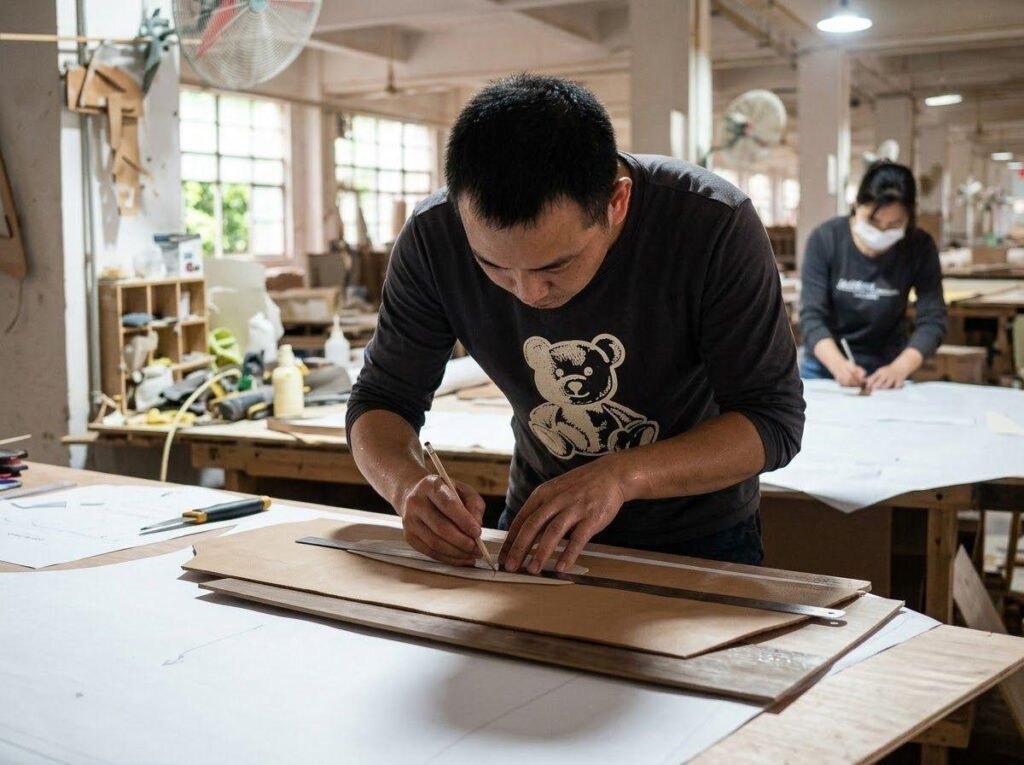
Let’s step back from individual traps and look at the landscape. The China senior living furniture export market isn’t monolithic. It fractures into three rough tiers, and understanding where your factory sits is more important than any single specification.
| Tier | Typical Profile | Price Range (FOB) | Risk Level | Best For |
|---|---|---|---|---|
| Catalog Resellers | Alibaba/1688 traders, no factory ownership, source from multiple OEMs | $80–$150/chair | Very High | Budget-constrained independent facilities with high replacement tolerance |
| Mid-Scale OEMs | Own factory 15,000–50,000 m², direct export experience, limited custom R&D | $150–$280/chair | Moderate | Regional chains, standard room packages, predictable specs |
| Project Specialists | Engineering-focused, custom capabilities, active compliance management, higher MOQs | $280–$500+/chair | Lower (but not zero) | Large-scale operators, branded environments, complex regulatory requirements |
Most senior living buyers end up in Tier 2. That’s not bad. But it requires a different level of oversight than Tier 3. The factory in Tier 2 wants to help. Their intentions are generally good. Their systems are just… incomplete. They’ll pass your flame-test requirement to a subcontractor and trust the certificate. They’ll adjust foam density to hit your price target without flagging the durability trade-off. They’ll say “yes” to custom dimensions because they don’t want to lose the order, even when those dimensions compromise structural integrity.
And here’s what tends to happen when things go wrong: the factory’s response is proportional to your ongoing business value, not your contract’s warranty clause. A $50,000 order from a one-time buyer gets slow-walked. A $500,000 annual program gets escalated to the owner. The contract matters less than the relationship. This isn’t corruption. It’s queueing theory. But most Western buyers source like the contract is the protection. It isn’t.
Your Pre-Purchase Framework: A Decision Tree That Actually Works
Don’t treat this as a checklist to delegate to a junior buyer. Use it as a decision gate you personally walk through.
Phase 1: Factory Vetting (Before You Request Samples)
- Request video of the actual production line — not the showroom, not the lobby, the line where your chairs will be built. If they refuse or send a three-year-old video, pause.
- Ask for three reference buyers in your specific segment — not “hospitality,” not “healthcare,” senior living. If they can’t name three, they haven’t solved the problems you’re about to face.
- Verify the testing lab’s accreditation — CAL 133 certificates from labs you’ve never heard of? Search the lab name plus “accreditation” before you proceed. Takes two minutes. Saves two years of headaches.
Phase 2: Sample Evaluation (When the Box Arrives)
- Disassemble one chair. Seriously. Remove the seat deck. Check if the frame is fully welded or bolted at joints. Bolted frames in contract seating are a red flag — they loosen under cyclic loading. This contradicts conventional wisdom, which says bolted frames are easier to repair. In senior living, repairability matters less than structural integrity. Welded wins.
- Weigh it. Compare to the factory’s stated weight. A significant discrepancy (more than 10%) suggests material substitution between sample and spec.
- Perform the “cleaning test.” Wipe the fabric with the actual disinfectant your facility uses. Wait 48 hours. Check for discoloration, stiffness, or odor retention. Most buyers skip this. Most buyers regret skipping this.
Phase 3: Production Oversight (After PO, Before Shipment)
- Insist on pre-shipment inspection by a third party — not the factory’s QC team, not your freight forwarder’s buddy. SGS, Bureau Veritas, or equivalent. Budget $800–$1,200. It’s the cheapest insurance you’ll buy.
- Request production samples from the middle of the run — not the first ten units off the line when the factory is being careful. Unit #347 tells you more than unit #003.
- Photograph the cartons and pallets before loading — damage claims are easier when you have baseline images. Sounds obvious. Rarely done.
Phase 4: The Red Flag That Defies Conventional Wisdom
- Be suspicious of factories that say “yes” to everything. The best Chinese contract seating manufacturers push back. They’ll tell you why your seat height request is problematic for egress. They’ll refuse to substitute a cheaper foam because they know it’ll fail. A factory that accommodates every custom request without qualification is either desperate for the order or doesn’t understand the application. Neither is good.

FAQ: What Buyers Actually Ask (After They’ve Already Made Mistakes)
Q: I ordered 800 chairs and the production run feels lighter than the sample. Can I reject the shipment?
A: You can try. But unless your PO specified exact weight per unit with tolerance language, you’re in a negotiation, not a legal position. This is why pre-shipment inspection matters more than contract language. The time to catch substitution is before the container leaves the port. After that, you’re paying to ship defective goods back to China or accepting a partial credit. Neither feels like winning.
Q: My factory says their vinyl is “medical grade.” Is that a real standard?
A: Not in any enforceable sense. “Medical grade” in China senior living furniture marketing usually means the vinyl has an antimicrobial additive or a higher rub count. It does not mean it meets CDC cleaning guidelines, CA Prop 65 standards, or specific flammability requirements. Ask for the actual test standard: ASTM D4157 for abrasion, AATCC 147 for antimicrobial efficacy, or the specific chemical resistance profile. If they can’t produce it, “medical grade” is just a label.
Q: Should I be sourcing from Foshan, or are there better regions for contract seating?
A: Foshan dominates for volume and variety. Longjiang specializes in upholstered seating. Anji in Zhejiang has grown significantly in mid-scale contract furniture over the past decade. Dongguan offers more engineering-heavy, OEM-focused operations. The region matters less than the factory’s specific track record in your product category. A great Foshan factory beats a mediocre Anji factory every time. Geography is a filter, not a guarantee.
Q: Is it worth paying 40% more for a domestic North American manufacturer instead of sourcing Chinese contract seating?
A: It depends on your time horizon and your internal capabilities. If you have zero factory-audit experience, no Mandarin-speaking staff, and no tolerance for quality variation, domestic sourcing is probably cheaper in total cost of ownership. If you have the expertise to manage Chinese production — or you hire a third-party sourcing agent with senior living-specific experience — the savings are real and sustainable. The trap isn’t Chinese manufacturing. The trap is undermanaged Chinese manufacturing. Most buyers think they’re buying furniture. They’re actually buying a relationship that requires ongoing management. If you can’t provide that management, pay the premium for domestic.
Q: Can I trust a factory that supplies major hotel chains to also handle my senior living project?
A: Sometimes. But hotel furniture and senior living furniture face different abuse profiles. Hotels cycle guests every 48 hours. Senior living residents use the same chair 12 hours a day, 365 days a year. A factory that optimizes for hotel durability may underspec for senior living without realizing it. Ask specifically about their senior living or long-term care references. “Hospitality experience” is not automatically transferable.
The Question That Should Keep You Up at Night
I’ve seen too many procurement directors treat senior living furniture as a solved problem. The specs exist. The factories exist. The price points are established. What else is there to figure out?
Actually, that’s not quite right. What most buyers miss is that the furniture in a senior living facility isn’t background noise. It’s the physical environment where vulnerable people spend the final years of their lives. A chair that sags prematurely doesn’t just represent a replacement cost. It represents a resident who stops sitting in common areas because the furniture feels unstable. A fabric that cracks isn’t just a warranty issue. It’s a surface that harbors bacteria and signals neglect. The sourcing decision ripples outward in ways that never appear on a spreadsheet.
So here’s my question: When you negotiate that factory down to $165 per chair, who exactly are you saving money for? The CFO? The residents? Or just the version of yourself who wants to close the RFP and move on to the next project?
The best buyers I’ve worked with — the ones who sleep well — aren’t the ones who paid the most. They’re the ones who understood that Chinese contract seating isn’t a transaction. It’s a partnership with a factory 7,000 miles away that doesn’t wake up thinking about your residents. Making them care — through inspection, through relationship, through the implied threat of lost future business — that’s the job. The furniture is just the output.