

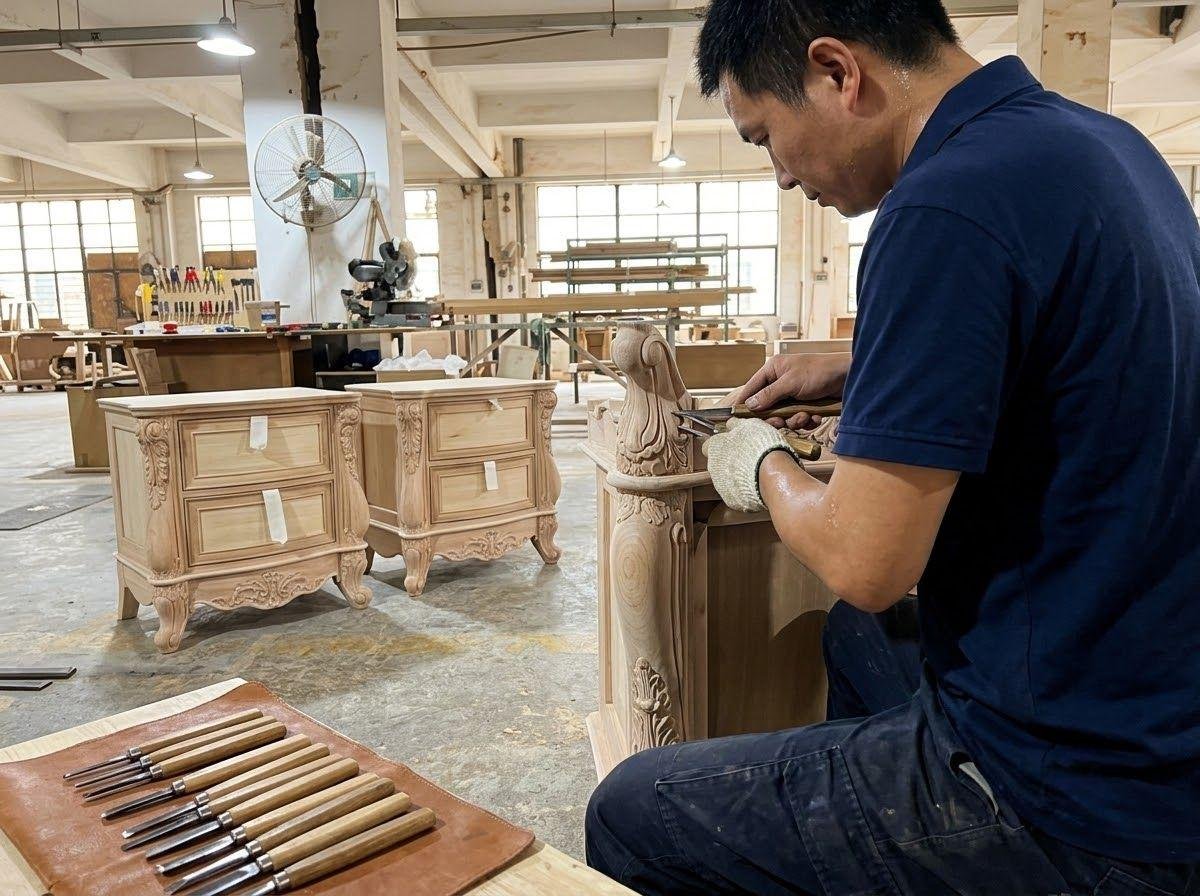
March 2019. Longjiang, Shunde. Twelve-thousand square meter plant. I’m watching this old guy hand-stitch a wingback chair — the kind that ends up in a Miami boutique hotel lobby. Leather’s flawless. Pitch is tight. I throw my full weight on it. Frame doesn’t make a sound.
Mr. Chen — let’s just call him that — grins. “Your container. Exactly this.”
Six months later. Florida. Stitching’s crooked. Foam’s dying after three weeks. “Solid oak”? Knock on it. Hollow.
Here’s what happened. That chair I sat on in Longjiang? Not a preview. A performance. They’d pulled their best craftsman, sourced premium leather from a different pile, spent three days on one piece. The actual line? Different workers. Different leather. Different everything.
Guangdong. Zhejiang. I’ve watched this movie maybe twenty times. Still pisses me off.
The Brutal Truth
Buyers love to think the golden sample scam is about dishonesty. Wrong. It’s math.
A factory in Foshan or Dongguan — margins are paper-thin. In my experience, maybe sixty percent of these Chinese furniture plants are break-even or worse during slow season. You walk in with a two-hundred-grand order. The owner does the math. Spend an extra eight hundred on labor and materials to build a perfect sample, or lose the deal. He picks the eight hundred. Every single time.
Uncomfortable rule of thumb: if that sample took more than two days to make, your production run won’t match it.
Not cynicism. Factory economics.
And here’s what nobody tells you. The guys who built your golden sample? They might not even work the main floor. Some mid-sized plants keep a “sample room team” — three, four veteran craftsmen who never touch mass production. Their job? Build museum-quality pieces for showroom visits. Meanwhile the actual line runs on piece-rate workers who get paid per chair, not per perfect chair.
Does this mean every plant is running a con? No. But “what you see is what you get” is a dangerous assumption here. The general pattern? Factories with dedicated sample teams deliver inconsistent quality way more often than plants where the same hands handle both samples and production.
Key Takeaways
- China furniture sourcing is the process of identifying, vetting, and managing production partners across China’s fragmented manufacturing landscape — and the golden sample is often the first trap.
- The golden sample scam isn’t always intentional China factory fraud; it’s frequently a structural outcome of how Chinese furniture plants separate sample production from mass manufacturing.
- Buyers who rely on a single sample visit without production-floor verification face disproportionately higher defect rates.
- Geographic clustering matters: plants in Foshan’s Longjiang district, Dongguan’s Dalang area, and Anji’s bamboo-furniture zone each carry distinct risk profiles.
How the Scam Actually Works
Think online dating. (Yeah, I know how that sounds.) Factory puts up their best photos, tells you what you want to hear, shows up looking incredible. Six months in? You’re living with a stranger.
The way they pull it off? Almost elegant.
Why Does the Sample Look Perfect While the Container Looks Wrong?
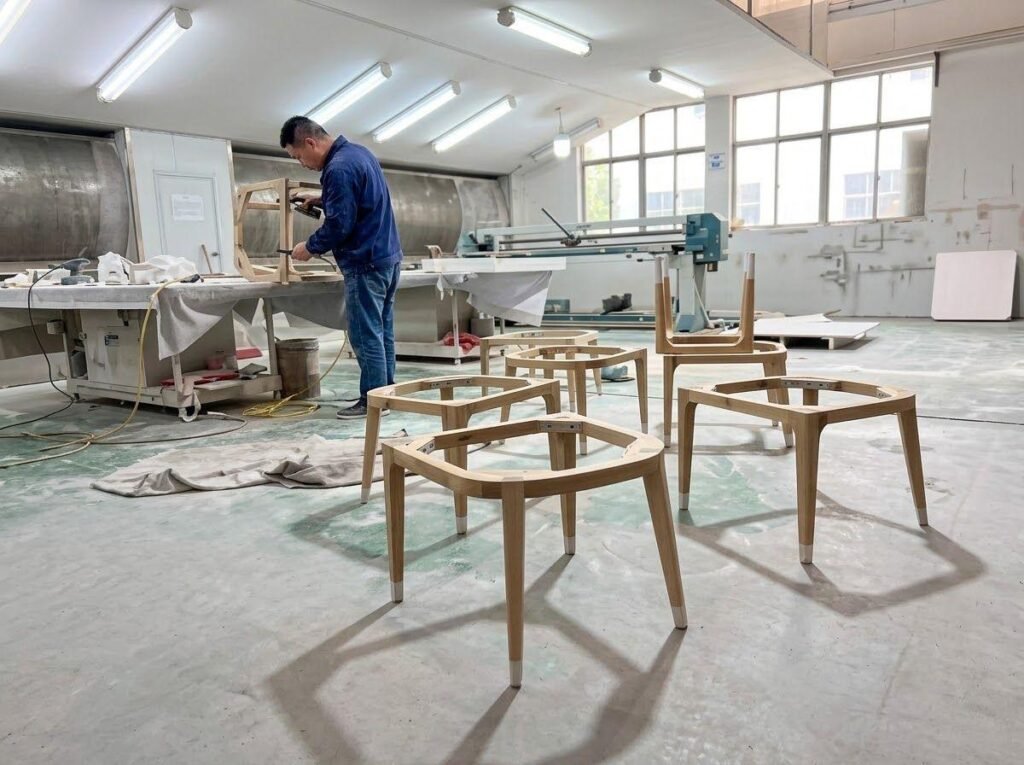
Factory gets your specs. Quotes a price — competitive, not suspicious. Assigns the sample to their A-team. Ten-plus years experience. Knows how to hide a seam, level a leg, pick veneer without knots.
Sample ships. You approve. Deposit hits.
Then production starts. And here’s the real kicker.
That A-team? Already working on the next buyer’s sample. Your order goes to the B-team. Or worse — subcontractors the factory quietly farms out to. (I learned this the hard way in Dongguan, 2017. “Factory” I was auditing? Trading company renting space in three facilities. Sample came from Facility A. My client’s $340K order got split between B — decent equipment — and C, which looked like a high school woodshop.)
Wood switches from FAS-grade white oak to rubberwood with thick veneer. Foam drops from 45kg/m³ to 28. Stitching goes from double-needle to single because the double-needle machine is “being repaired.”
Actually, that’s not quite right. What most buyers miss? The factory often doesn’t see this as deception. In their head, the sample shows what they’re capable of. Not a binding promise for every unit. “We can make it this way. But at this price, why would we?”
What most buyers miss is that the factory often doesn’t even see this as deception — they see the sample as proof of capability, not a binding promise.
Who’s Really Running the Line?
This separates experienced buyers from rookies. When you visit a Chinese furniture plant, you meet the owner or sales director. Charming. Knowledgeable. Wants your business. Might not step onto the production floor more than once a week.
The person actually running your order? Floor supervisor you’ve never met. Bonus based on output volume, not quality scores. His incentive? Push pieces through. Fast. Corner needs cutting to hit daily quota? Cut.
And here’s what keeps me up at night. Some of the worst quality drops happen at factories that pass third-party inspections. Why? Inspector shows up Tuesday, checks ten random pieces, leaves. Factory knows the schedule. They prep those ten units. Smoke and mirrors.
The Geography of Deception
China’s furniture manufacturing isn’t one industry. It’s a dozen regional ecosystems sharing a country code.
Foshan vs. Dongguan — Does It Matter?
Foshan — Shunde District, Longjiang at the center — biggest furniture cluster on earth. Walk through Louvre Furniture Mall on a weekday. Buyers from Dubai, Lagos, São Paulo, Sydney. All hunting factory-direct pricing. Mass-market sofas to hand-carved reproduction antiques.
Brutal reality? Foshan’s scale is both superpower and weakness. A plant here might have four hundred workers, five lines, but subcontract thirty percent of orders to smaller workshops you’ve never heard of. Golden sample from the main facility. Your container? Maybe from a converted warehouse three kilometers away. Smells like glue and desperation.
Dongguan — built its name on electronics precision. But its furniture sector, particularly Dalang and Houjie, evolved toward higher-end hospitality and office. Plants here tend smaller, more specialized, more transparent about capabilities. Cost fifteen to twenty percent more. Worth it? Sometimes.
Anji, up in Zhejiang. Bamboo and rattan capital. Nankang, Jiangxi. Chair capital. Millions of dining chairs annually. Each cluster has its own culture, its own quality norms, its own version of the golden sample problem.
Your factory’s address predicts risk better than its ISO certificate.
What Happens When Nobody’s Watching?
Can’t “date” a factory and hope trust grows. Trust here is a verb. Show up unannounced. Pull random cartons from the loading dock. Know enough woodworking to spot substituted substrate before it ships.
I once watched a Nankang factory swap specified hardwood frame for pine on a hotel headboard order. Buyer approved the sample six months back. Factory assumed — correctly, for most buyers — nobody disassembles a finished headboard to check internal frame. I only caught it because I walked past a stack of raw pine boards that didn’t match the spec sheet. The smell was wrong. Pine smells different. Sweet. Softer.
General pattern? Quality degradation accelerates after the third production run. By then, factory assumes you’re not paying close attention. Sample was perfect. First two shipments acceptable. Run three? That’s when real corner-cutting starts. The trust is gone. You just don’t know it yet.
The Factory You Don’t See
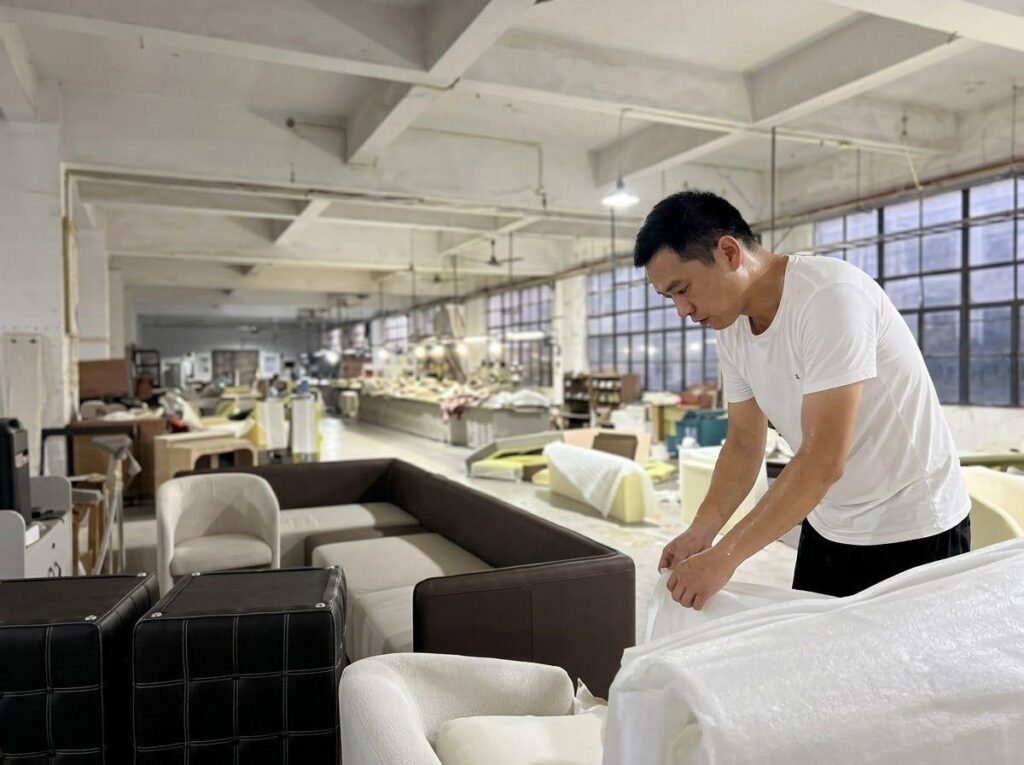
Here’s something that doesn’t get talked about enough. The factory with the shiny showroom and English-speaking sales team? Might not manufacture a single piece of your order.
China’s furniture industry runs on a hidden subcontracting network that would make a supply chain professor cry. A “manufacturer” you meet at CIFF Guangzhou might be a trading company with a beautiful booth and zero production capacity. Or they own one facility but outsource everything beyond their specialty.
While some buyers gravitate toward large-scale manufacturers in Foshan, others find that mid-sized specialists — operations like Interi Furniture, which focuses on bespoke contract furniture for hospitality and high-end residential projects out of Guangzhou — offer a different risk-reward equation. Their model, built around custom orders with no minimum quantities, forces tighter sample-to-production consistency because every order is essentially a sample run. Doesn’t make them immune to the golden sample problem, but it changes the math. When your business is built on one-off hotel projects rather than container-load repetitions, there’s less incentive to maintain a separate A-team and B-team.
Size isn’t safety. A forty-thousand-square-meter plant with five hundred workers can hide more dysfunction than a five-thousand-square-meter specialist where the owner still walks the floor daily. I’ve seen both.
A Framework for Catching the Scam Before It Catches You
You don’t need a forensic accounting degree. You need a system annoying enough to work.
Phase 1: Before You Even Request a Sample
- Demand production-floor photos with timestamps — not showroom glamour shots. Ask for video of the specific machines that’ll build your order. If they hesitate, you already know.
- Check the factory’s export license against claimed capacity. Plant says they ship five million annually but only registered for domestic trade? That’s not a red flag. That’s a siren.
- Ask who built the last sample they showed you. “Our sample team”? Not reassuring. You want “the same workers who’ll run your order.” Period.
Phase 2: Sample Evaluation
- Order two samples. Not one. Send the second to a different address, two weeks later. Compare side by side. Variation between them tells you everything about production consistency. One perfect, one sloppy? You’re looking at a scam in progress.
- Label one sample “DESTROY” and ask them to cut it in half. Check internal frame, foam density, substrate. (Yeah, they’ll think you’re nuts. Good. Crazy buyers get better product.)
- Document every material spec with supplier names. Not “solid wood.” “FAS-grade American white oak, sourced from [specific supplier].” Vague specs are where substitutions hide.
Phase 3: Production Monitoring
- Require pre-production samples pulled from the actual line. Not a golden sample. A real unit, built at production speed, by production workers, using production materials. If it looks worse than the showroom piece, that’s honesty. If it looks identical, they’re still performing.
- Show up unannounced. Or hire someone who will. Scheduled inspections are theater. Unannounced visits are reality. The factory that panics when you arrive unannounced? That’s your answer.
- Inspect the loading dock, not just the warehouse. I’ve seen factories swap approved goods for rejected inventory during final truck-loading. Happens fast. Happens often. Usually around 4 PM on a Friday.
Phase 4: The Red Flag That Breaks Conventional Wisdom
Be suspicious of factories that agree to everything immediately. The plant that says “no problem” to every customization, every timeline, every quality standard? That’s not flexibility. That’s either desperation or deception. The best factories I’ve worked with — Foshan, Dongguan, doesn’t matter — push back. They tell you why your timeline’s unrealistic, why your foam spec won’t work for that frame, why your veneer choice will blister in humidity. That friction is a feature. Means they actually understand their own capabilities. A factory that fights you a little? Keep them. A factory that rolls over? Run.
| What They Say | What It Actually Means | Your Move |
|---|---|---|
| “This is our standard quality” | Could be literally anything | Demand material specs with supplier names |
| “Our sample team will handle it” | A-team builds sample, B-team builds yours | Insist on production-line samples |
| “No problem, we can do everything” | Either desperate or deceptive | Run. Fast. |
| “We have 20 years of experience” | Might be 20 years of cutting corners | Check export license and recent project references |
| “Inspection already passed” | We knew the inspector was coming | Schedule unannounced visits |

FAQ: What Buyers Actually Ask
Q: If the sample is perfect, does that mean the factory is capable of good work, and I just need to pay more to get it?
A: Sometimes. But roughly half the time the issue isn’t price — it’s structural. The factory literally can’t replicate the sample at volume. Not enough skilled workers. Or the sample used materials their regular suppliers don’t stock. Paying twenty percent more won’t fix capacity. What tends to happen? Extra money gets absorbed as margin. Production line stays the same. You’re just paying more for the same scam.
Q: Can I trust third-party inspection companies like SGS or Bureau Veritas to catch this?
A: They help. Not a cure. Inspectors check a statistical sample against specs. They don’t disassemble furniture. Don’t know if the internal frame got swapped after their visit. And if the factory knows the inspection date — which they usually do, since you have to coordinate access — they can prep the units being checked. Use inspections. Don’t treat them as proof of innocence. I’ve seen factories pass SGS with flying colors while shipping garbage.
Q: I’ve been sourcing from the same factory for three years with no issues. Am I safe?
A: No. Complacency is the golden sample scam’s best friend. Quality degradation often accelerates after long-term relationships stabilize. Factories assume you’re no longer scrutinizing every shipment. Rotate inspection schedules. Change unannounced visit dates. Keep them guessing. The moment they think you’re asleep, they start cutting.
Q: Are smaller factories less likely to pull this scam than big ones?
A: Depends on owner involvement, not square footage. A three-thousand-square-meter plant where the owner still approves every material purchase is often safer than a thirty-thousand-square-meter operation run by middle managers incentivized on volume. That said, tiny workshops lack quality control infrastructure to catch their own mistakes. No universal rule. You have to look at the specific plant, the specific owner, the specific floor.
Q: Is the golden sample scam at Chinese furniture plants actually fraud, or just a communication gap?
A: Depends on intent, but from a buyer’s perspective the distinction barely matters. You approved a sample. You got materially different goods. Your hotel lobby has wobbly chairs. Whether the factory calls it “normal variation” or you call it China factory fraud, you’ve been harmed. The only answer that matters: Yes, it is a scam when delivered goods systematically and knowingly deviate from the approved sample. And it’s one of the most persistent forms of China factory fraud in the furniture sector. It happens more than anyone admits. Way more.
The Hard Lesson
Fifteen years walking factory floors in Guangdong and Zhejiang. I’ve stopped believing in trust. I believe in verification. Random carton pulls. The sound a solid wood frame makes when you knock on it. The smell of real leather versus bonded garbage.
The golden sample scam persists because it’s profitable. Because most buyers are too busy to fight it. Because factories know a two-hundred-thousand-dollar order rarely justifies a fifty-thousand-dollar lawsuit. They bank on your inertia. They count on you being tired, being busy, being hopeful that “this time will be different.”
So here’s my question. What’s the real cost of that “perfect” sample sitting in your showroom? The price tag? Or the false confidence it sold you?
Stay skeptical. Stay annoying. And for God’s sake — cut open the next sample they send you.