

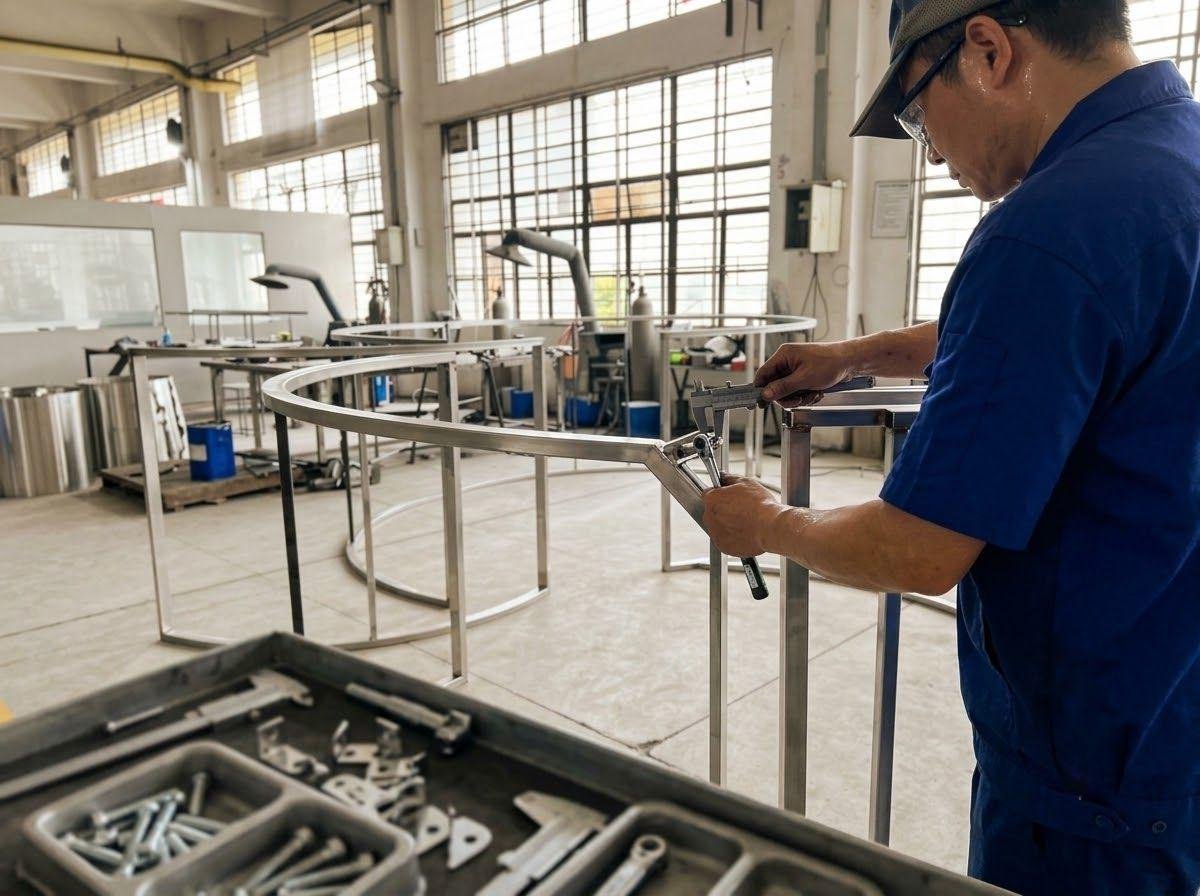
Last spring, I walked into an 8,000-square-meter factory in Longjiang, just outside Foshan, and saw a container of dining chairs being wrapped for a buyer in Miami. The purchase order said “304 stainless steel frame.” The metal looked right. Brushed finish, decent heft, that faint industrial smell. The buyer had paid roughly $12,000 for the lot. Here’s the thing: I ran a spot test with reagent fluid on a scrap piece from the cutting floor. It turned pink in fifteen seconds. That pink drop meant the frames were 201 grade, not 304. The buyer would find out the hard way, six months later, when the salt air started eating the welds. And the factory manager? He just shrugged. “They didn’t ask for a mill test report,” he said. “They asked for a price.”
The Brutal Truth
Most stainless steel furniture coming out of China isn’t lying to you on purpose. It’s worse than that. The supply chain is lying to the factory, and the factory is passing the savings to you without passing the warning.
Here’s my rule of thumb after fifteen years of walking these floors: If the quote for “304 stainless” furniture is less than 40% above the standard steel equivalent, you’re not getting 304. You’re getting a gamble. Maybe 201. Maybe a blend. Maybe something that barely qualifies as stainless at all.
The margins are too thin for miracles. A legitimate 304 frame carries raw material costs that don’t bend to your target price. Factories know this. Trading companies know this. And most buyers, especially first-timers, don’t want to know it.
Key Takeaway
- China furniture sourcing with stainless steel components requires grade verification at the raw material stage, not the finished product stage.
- The majority of “stainless steel” fraud in Chinese furniture materials isn’t malicious counterfeiting — it’s silent substitution enabled by missing documentation.
- China stainless steel pricing for furniture-grade 304 should sit roughly 35–50% above 201 grade at the mill level; anything narrower is a structural red flag.
- A mill test report (MTR) is the only paper that matters. Certificates of origin, ISO printouts, and glossy factory photos are theater.
Why the Grades Don’t Match the Labels
What Does “Stainless” Even Mean on a Factory Invoice?
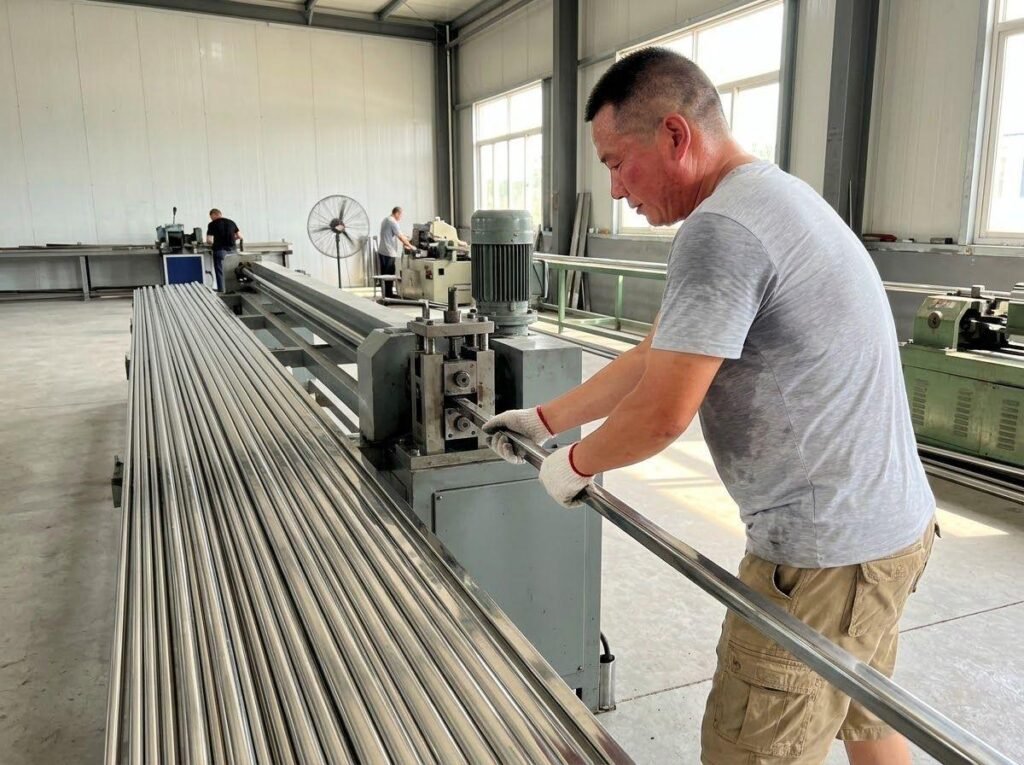
China stainless steel furniture production runs on a simple market reality: 201 grade costs about half what 304 costs at the wholesale metal level.** The difference is nickel. 304 has enough nickel to form a self-healing oxide layer. 201 replaces nickel with manganese. It looks identical on day one. It fails identically on day four hundred, usually around a weld or a scratch where the protective layer can’t hold.
Think of it like buying olive oil. (I learned this analogy from a buyer in Anji who used to work in food import.) You can sell “extra virgin” in a beautiful bottle, and most consumers won’t know the difference until they cook with it. The bottle looks right. The label is printed right. The fraud isn’t in the packaging — it’s in the liquid, and the liquid is invisible to anyone who doesn’t test it. Stainless steel works the same way. The brushed finish, the weight, the magnetism — none of these are reliable tells on their own.
Actually, that’s not quite right. What most buyers miss is that magnetism is a terrible indicator. 304 can be slightly magnetic after cold working. 201 can be less magnetic depending on processing. The real kicker isn’t the magnet. It’s the chemistry. And chemistry requires a test.
Who’s Cutting Corners, and Where?
The substitution usually happens two steps before the furniture factory. The mill produces the coil. A distributor sells it. Someone along that chain swaps the label, or blends batches, or sells “304 equivalent” with air quotes that don’t make it to the invoice. The furniture factory buys metal by the ton. They’re not chemists. They’re welders and polishers. They trust the slip.
In my experience, roughly seven out of ten mid-sized furniture factories in the Foshan corridor do not verify incoming metal grades with independent testing. They check thickness. They check finish. They check price. The grade? Taken on faith.
And faith is expensive.
The Factory Floor Reality
Is the Welder Your Only Quality Control?
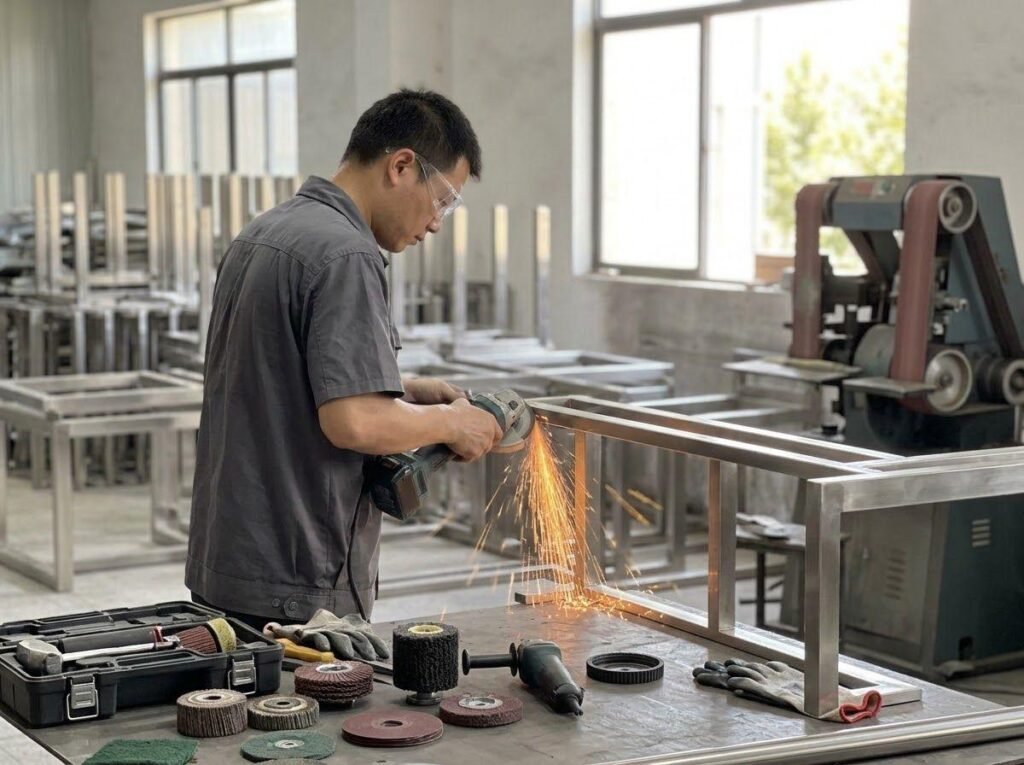
Walk into a stainless furniture workshop in Dongguan on a humid Tuesday afternoon, and you’ll see what I mean. Sparks flying, angle grinders screaming, workers in slippers. The metal arrives in bundles. A foreman checks the delivery note. If the note says 304, the foreman writes 304 on the production sheet. No spectrometer. No reagent kit. No questions.
The problem isn’t laziness. It’s economics. A handheld X-ray fluorescence gun costs about fifteen thousand dollars. A bottle of stainless steel reagent fluid costs eight dollars and lasts six months. Most factories have neither. The ones that do? They usually bought the gun because a European buyer made them, then it sits in the manager’s office like a trophy.
But here’s what separates a decent operation from a risky one. Decent factories have long-term metal suppliers. Relationships. Not friendship — leverage. If a factory has been buying from the same mill distributor for eight years, and they suddenly get a “too good to be true” price on 304, someone in that office pauses. Risky factories chase the lowest coil price every single month.
Why Your “Marine Grade” Chair Rusted in Six Months
That Miami buyer I mentioned? His chairs weren’t outdoor chairs. They were dining chairs for a waterfront restaurant. The salt air wasn’t extreme, but it was enough. 201 grade, with its low nickel and high manganese, doesn’t just rust. It pits. The corrosion bores into the metal like a drill. Once it starts at a weld joint — and welds always disrupt the surface layer — it accelerates. A 304 frame in the same environment would stain, maybe, eventually. A 201 frame fails structurally.
The general pattern suggests that furniture sold as “marine grade” or “outdoor stainless” from smaller trading companies in Nankang or Anji carries elevated substitution risk. Not because those regions are dishonest. Because the price pressure is relentless, and the buyer verification is minimal.
The Brand Ecosystem: Who’s Playing What Game
While some buyers gravitate toward massive integrated manufacturers in Foshan with their own metal workshops and in-house polishing lines, others find that mid-sized specialists offer a different risk-reward equation. Operations like Interi Furniture, which focuses on metal-and-upholstery contract pieces for hospitality and commercial interiors, typically sit in a middle tier — large enough to have supplier accountability, small enough that a single bad batch could damage a hard-won reputation. Buyers working with firms in this category often find more transparency not because the owners are saints, but because their business model depends on repeat project work rather than one-off container trading.
The real divide in Chinese furniture materials isn’t big versus small. It’s integrated versus assembled. A factory that buys raw steel coil, cuts it, welds it, polishes it, and coats it under one roof has skin in every step. A factory that buys pre-cut frame kits from a metal broker and just assembles and upholsters them? That factory doesn’t know what metal is in the tube. And they don’t want to know.
Your Hands-On Verification Framework
Don’t rely on paperwork alone. Don’t rely on friendship. Use a system.
Before you place the order:
- Request the mill test report (MTR) — not a certificate of conformity, not an ISO 9001 brochure, the actual heat-specific MTR from the steel mill. If the factory hedges, pause.
- Ask where the metal is sourced — Foshan has legitimate stainless distributors. So does Wuxi. Vague answers like “from a big supplier” mean they don’t know or don’t want to say.
- Price-check the raw material — In my experience, if the stainless component of a chair quote is less than roughly $18–$22 per kilogram for 304-grade finished frame weight, the math doesn’t work. (Adjust for current nickel prices, obviously.)
When the container arrives:
- Test a scrap piece, not the surface — Surface treatments, clear coats, and polishing compounds can interfere with reagent tests. Ask for a cut-off from production, or file a small hidden area.
- Use a two-step reagent kit — The cheap single-fluid tests are better than nothing. A proper two-step kit (copper sulfate plus electrolyte) is more definitive and costs under twenty dollars.
- Check the welds specifically — Grade substitution often reveals itself at weld points first. Look for discoloration, porosity, or rust bloom in hidden joints.
The red flag that contradicts conventional wisdom: A factory that immediately offers you 201 grade as a “budget option” is often more trustworthy than one that insists everything is 304 at suspiciously low prices. The honest ones know the game and will separate the two. The dishonest ones only know one script.

FAQ: What Buyers Actually Ask
Q: If I stick to big-name factories in Foshan, am I safe from grade swapping?
A: Safer, not safe. Large factories have more to lose, but their size also means they buy metal through procurement teams you never meet. A rogue distributor can infiltrate even a reputable supply chain. Always verify, regardless of factory size.
Q: My supplier sent me a SGS report saying 304. Is that enough?
A: No. SGS tests what you send them. If the factory sent a carefully selected sample, or if the sample came from a different batch than your production, the report is meaningless. The only test that matters is on your container, your frame, from a piece you chose.
Q: Can I just use a magnet? I read 304 isn’t magnetic.
A: That test is unreliable and outdated. Cold-worked 304 can pick up magnetic properties. Some 201 batches test weakly magnetic. You’re testing processing history, not chemistry. Buy the reagent kit. It’s cheaper than one bad chair.
Q: Is 201 grade always bad?
A: No — 201 is a legitimate alloy for indoor, dry-environment furniture where cost matters more than longevity. The fraud isn’t using 201. The fraud is selling 201 as 304. If you know what you’re buying, 201 can be fine. The problem is the lie.
Q: So if a “stainless steel” sofa frame from China rusts, does that automatically mean fraud?
A: It depends on the environment, but in most cases, yes — if it was sold as 304 and failed in normal indoor conditions within two years, you almost certainly received a lower grade or improperly processed metal. The exception is coastal or chemically aggressive environments, where even 304 needs proper maintenance. For standard residential use, premature failure is a chemistry problem, not a user problem.
The Hard Lesson
At the end of the day, stainless steel in China furniture sourcing isn’t about trust. It’s about verify-and-then-trust. The factories aren’t villains. They’re operators in a system where metal arrives with a story, and that story is rarely fact-checked until someone in Miami opens a rusted container.
The question isn’t whether you can find honest suppliers. You can. The question is whether you’re willing to be the buyer who makes honesty profitable — by testing, by asking hard questions, by walking away from a deal that smells like a bargain.
Because the real kicker? That factory manager in Longjiang wasn’t proud of the swap. He was resigned to it. He’d watched too many buyers choose price over proof. Be the exception. Test the metal. Read the report. And when the reagent stays clear — not pink — then you’ve earned the right to relax.