

The email landed in my inbox at 11:47 PM, Shanghai time. A procurement director I’d met two years prior at a trade show in Guangzhou was in full panic mode. His co-working chain — fourteen locations across Southeast Asia, all kitted out with what he’d been assured was “direct-from-factory” seating — had just watched three hundred task chairs develop the exact same wobble. Same joint. Same failure point. Same week. The factory in Foshan that had sworn they used “high-grade nylon” for the base? They’d switched to a recycled blend six months into the contract. Never mentioned it. Never adjusted the price. And now this director, who thought he’d locked in a three-year supply agreement at $38 per unit, was staring at a $14,000 replacement bill for chairs that hadn’t seen their first birthday. He’d done what every playbook tells you to do: visited the factory, shook hands with the owner, inspected the sample room. The real kicker? He wasn’t even angry at the factory. He was angry at himself. Because in the co-working space race — where you’re opening three locations a quarter, burning through furniture like it’s disposable — the margin for error isn’t slim. It’s nonexistent. And Chinese wholesale suppliers, for all their horsepower, don’t operate on the same timeline your lease agreement does.
The Brutal Truth: You’re Not Buying Furniture. You’re Buying a Guessing Game.
Here’s what nobody puts in the sourcing guides. Most buyers who think they’re working directly with Chinese wholesale suppliers are actually working with the second or third layer of markup. The factory with the slick Alibaba page and the English-speaking sales rep? That’s rarely the factory. That’s a trading company with a rented office in the same building.
The rule of thumb I give every co-working operator who asks: if your contact sends you a quote within four hours of your first email, you’re not talking to the workshop. You’re talking to a middleman who knows exactly how much margin to add before you flinch.
And here’s the thing that stings. Sometimes the middleman is worth it. Sometimes. But you need to know you’re paying for translation, logistics bundling, and quality buffering — not some mythical “factory-direct” discount that doesn’t exist at your volume. Co-working fit-outs live and die by unit economics. A $12 per-chair spread across 800 seats is real money. But a $12 saving that turns into a 23% defect rate six months in? That’s a cash flow hemorrhage dressed up as procurement efficiency.
Key Takeaway
- China office fit-out sourcing works best when you treat the supplier relationship as a manufacturing partnership, not a product purchase.
- The lowest quoted price is almost never the actual cost; hidden expenses show up in defects, delays, and replacement cycles.
- Co-working spaces need furniture built for high-turnover commercial abuse, not residential aesthetics scaled up.
- Your real risk isn’t overpaying. It’s finding out, too late, that the factory’s “standard” changed between your sample and your container.
Why Your “Factory Direct” Quote Isn’t Actually From the Factory
China furniture sourcing is the process of identifying, vetting, and purchasing commercial-grade furniture from manufacturing clusters across mainland China — primarily Guangdong, Zhejiang, and Jiangsu provinces — for use in office, hospitality, or residential environments. Simple enough on paper. But the paper is never where the story lives.
Think of the Foshan furniture market like a fish market at 5:00 AM. The guys shouting the loudest aren’t the fishermen. They’re the stall owners who got there first, laid out the catch, and marked up the price before the sun rose. Your job as a buyer isn’t to find the loudest voice. It’s to find the boat. And in China’s office furniture corridor — that stretch from Longjiang to Lecong that supplies a measurable chunk of the world’s commercial seating — the boats don’t have websites.
I learned this the hard way in Dongguan. Walked into what I thought was a 40,000-square-meter metalworking plant. Impressive stamping machines. ISO certificates laminated and hung like family portraits. The owner, a man in his sixties who smoked through the entire facility tour, offered me tea and a price sheet that made my eyes water — in the good way. $31 for a task chair frame that I’d been quoted $67 for in Shenzhen. I was ready to sign.
But. (And this is a “but” that has saved me more money than any contract clause.)
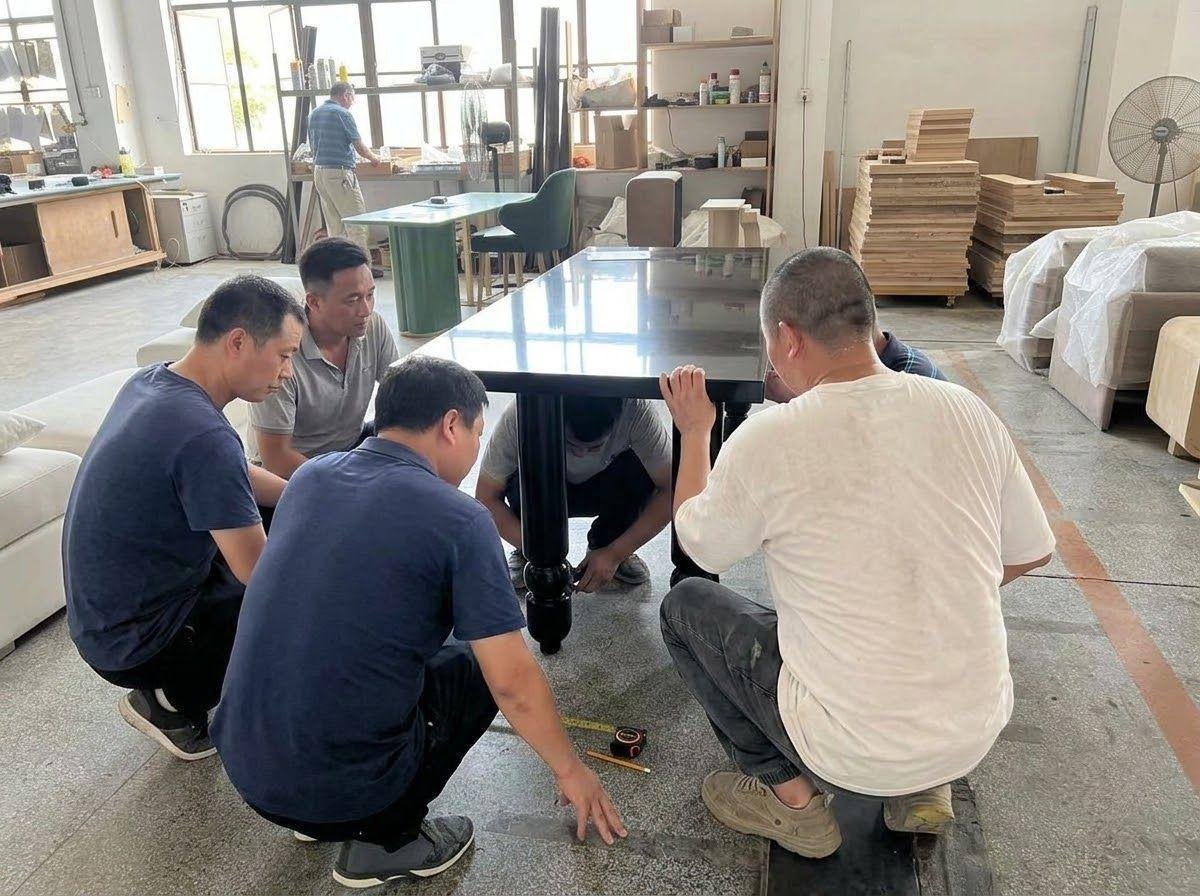
The sample he handed me had a weld joint that was clean. Almost too clean. When I asked to see the batch running that day — not the demo line, the actual line — the mood shifted. What I saw was a subcontractor operation: twenty workers in a rented bay, assembling frames from stamped parts that arrived on a flatbed that morning. The “factory” I was visiting? They were the project manager. The middle layer. The markup I thought I was eliminating was still there; it was just wearing a hard hat and calling itself manufacturing.
What’s the Real Difference Between a Trading Company and a Manufacturer?
A trading company will tell you they can do anything. Custom upholstery? Yes. OEM branding? Absolutely. A chair that floats? They’ll check with the engineer. A real manufacturer will tell you no. No, we don’t do leather. No, our MOQ is 300 pieces per color. No, that design won’t work with our current mold. The “no” is the greenest flag you’ll see.
Trading companies serve a purpose. For co-working operators doing their first China office fit-out, buying through a trading company isn’t stupid — it’s training wheels. They handle the QC, the consolidation, the shipping docs. But once you’re scaling past a single location, once you’re ordering 400 workstations and need them to match across three cities, the training wheels become a tax. And not a small one. Industry observers estimate that trading companies add 18% to 35% on top of the factory price for commercial furniture, with the spread widening on lower-volume orders.
Why Do Factories Hide Their Real Prices?
Because they can. Because the export market runs on asymmetry. Because a factory in Anji that makes exactly one thing — say, molded plywood chair shells — has no incentive to learn your language, your payment terms, or your panic when a container shows up in Jakarta with 12% of the goods damaged.
What tends to happen is this: the factory quotes a “FOB” price that assumes you’re buying the way they want to sell. Full container load. Their standard finish. Their standard packaging. The moment you ask for white-glove delivery, custom labeling, or — heaven forbid — a payment plan, the price morphs. The real factory-direct game isn’t about the per-unit cost on the first quote. It’s about what the per-unit cost becomes after you’ve invested six months in the relationship, visited twice, and proven you can reorder without being a nightmare.
The Spec Sheet Lie: What Breaks First in a Co-Working Space
If I had a dollar for every time a buyer showed me a spec sheet and said, “This says commercial grade,” I’d have enough to buy an actual commercial-grade chair. Which, incidentally, wouldn’t be the one on the spec sheet.
Here’s the analogy that lands. Buying office furniture for co-working spaces based on a PDF spec is like buying running shoes based on the box weight. The numbers are real. They’re just not relevant. A co-working chair doesn’t fail because the gas lift is under-spec’d. It fails because the plastic back flexes 400 times a day, and the factory used regrind nylon in July because virgin material prices spiked. The spec sheet said “nylon backrest.” It didn’t say “virgin nylon.” It never does.
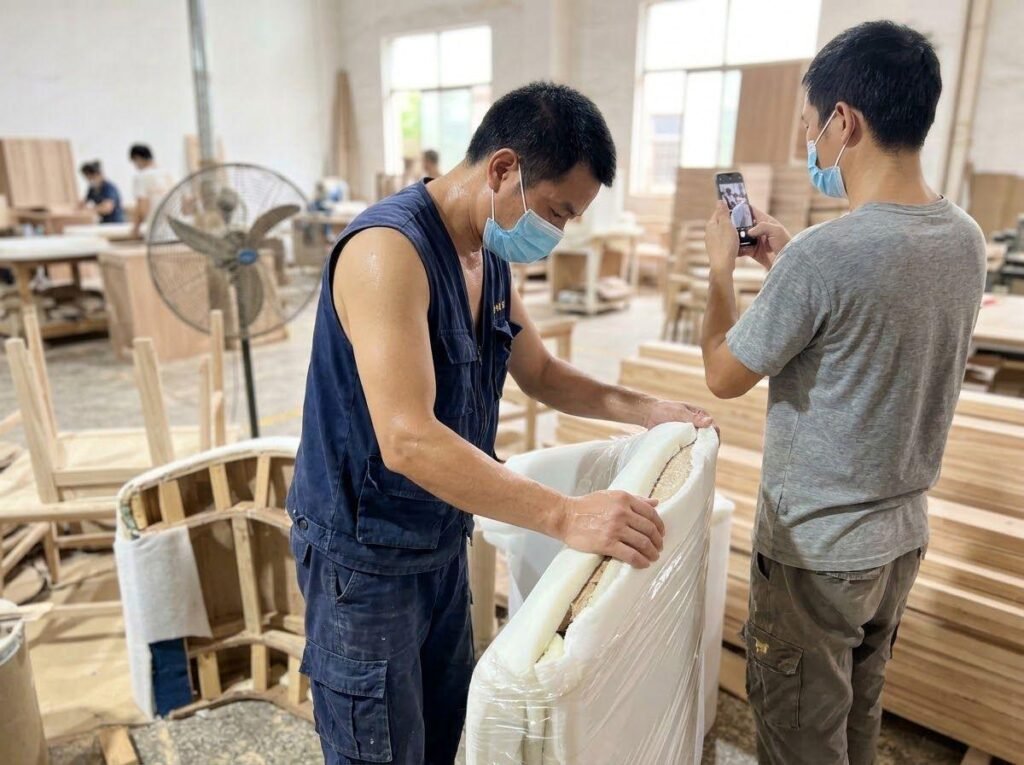
The insider observation? In Longjiang, where a significant portion of the world’s mid-range office seating is born, there’s a quiet seasonal rhythm that buyers never see. Factories buy foam in January when prices are low. They buy mesh in March. If you place an order in May, and the factory is rushing to clear backlog before the summer slowdown, your “high-density foam” might be the batch they blended to stretch inventory. Not illegal. Not even technically out of spec, if the spec just says “foam.” Just a reality of manufacturing at scale that no brochure captures.
What Does “Commercial Grade” Actually Mean in Longjiang?
Honestly? Less every year. The term has been diluted by exporters who know that Western buyers search for it. In my experience, roughly 60% of chairs labeled “commercial grade” by mid-tier Chinese wholesale suppliers would fail a proper BIFMA-style cycle test if tested blind. Not because the factories can’t build to standard — they can. Because the buyer didn’t specify the standard, didn’t pay for the certification, and the factory defaulted to “good enough for the price point.”
Good enough for a home office. Not good enough for a hot-desking environment where a single chair sees six different users, five days a week, fifty weeks a year.
The Foam Density Scam Nobody Talks About
Actually, that’s not quite right — what most buyers miss is that foam density isn’t the scam. The scam is the testing report. A factory will send you a beautifully laminated sheet showing 45kg/m³ density, 40% compression set, the works. What they don’t show you is the date stamp. That report? From 2019. From a different supplier. From a batch they made for a Japanese client who actually paid for the good stuff. Your batch? Your batch is 38kg/m³, and it’ll start bottoming out around month nine.
Or rather, the problem isn’t the factory, it’s the expectation. You expected a certificate to guarantee behavior. In China office fit-out procurement, a certificate guarantees someone once paid for a certificate. The behavior is guaranteed by your QC process, your relationship, and your willingness to reject a container that doesn’t match the sealed sample.
The Middle Layer Most Buyers Miss
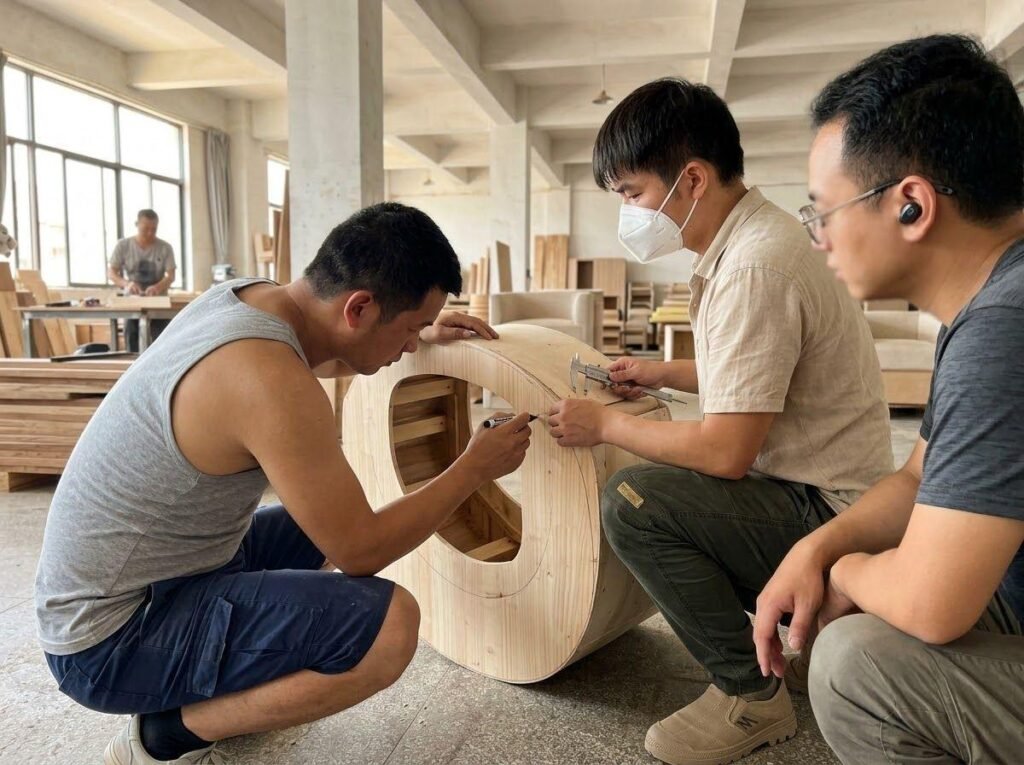
While some buyers gravitate toward large-scale manufacturers in Foshan — the ones with showroom floors the size of aircraft hangars and MOQs that start at 500 units — others find that mid-sized specialists offer a different risk-reward equation. Operations like Interi Furniture, which focuses on commercial soft seating and project-based hospitality furniture, sit in that awkward middle ground: too big to be a garage workshop, too small to ignore orders under a hundred pieces. For co-working operators who need lounge areas, phone booths, or breakout seating that doesn’t look like it came from a catalog, these mid-tier players can be surprisingly agile. They’ll modify arm heights. They’ll run a custom fabric. They’ll answer an email at 10 PM because the owner still checks the export inbox personally.
The catch? They don’t have the logistics infrastructure of the giants. You might save 15% on the product and spend 20% more on shipping consolidation. The general pattern suggests that buyers who succeed with these specialists treat them as product partners, not vendor lines in a spreadsheet. You don’t squeeze them on payment terms; you negotiate on exclusivity for a regional colorway. You don’t demand 30-day delivery; you lock in a production slot three months out. It’s a different game. And for co-working brands trying to build visual identity across multiple locations — not just filling space with beige conformity — it’s often the better game.
The Co-Working Fit-Out Decision Tree: A Framework That Actually Works
After fifteen years of watching buyers succeed and crater, here’s what I tell co-working operators before they book their first flight to Guangzhou. This isn’t theory. This is the checklist I use myself.
Phase One: Before You Touch Alibaba
- Define your failure metric first. Is it defect rate? Delivery window? Color consistency across batches? If you don’t know what “unacceptable” looks like, the factory will define it for you — and their definition is generous.
- Budget for the sample, the flight, and the rejected container. Not “maybe.” As a line item. In my experience, roughly 20% of first-time buyers face a partial rejection or rework on their initial large order. If that cost would kill your project, you’re not ready to scale.
Phase Two: Vetting the Supplier
- Ask for a video call from the factory floor. Not the showroom. The floor. If they refuse, or if the “factory” is mysteriously “under renovation” during your call, that’s not a red flag. That’s a stop sign.
- Request the name of their worst client. Not the best. The worst. Every factory has one. A supplier who can’t name a difficult relationship is a supplier who hasn’t been tested. Or worse, they’re so new they don’t have relationships.
- Check if they export to Japan or Germany. Not because those markets are magical, but because the compliance documentation required for Japanese import tends to weed out the sloppiest actors. It’s a proxy for systems.
Phase Three: The Order Itself
- Lock your sample in a box. Physically. Seal it. Sign across the seal. That sample is your contract more than the contract is. When the container arrives, you open that box first. If the production unit doesn’t match the sealed sample, you don’t negotiate. You reject.
- Pay 30% deposit, 70% against copy of B/L — and only if your QC agent (not theirs) signs off on the pre-shipment inspection. If a factory demands 100% upfront, walk. But here’s the red flag that contradicts conventional wisdom: if a factory offers you net-30 or open-account terms on your first order, walk faster. That’s not confidence. That’s desperation, or a trading company floating credit they can’t back.
Phase Four: Post-Delivery
- Track failures by SKU, by month, by location. Not “some chairs broke.” Which chair? Which joint? Which batch date? The factories that earn repeat business are the ones who see your data and adjust. The ones who disappear? They were never factories. They were transactions.
| Sourcing Approach | Best For | Hidden Cost | Risk Level |
|---|---|---|---|
| Large Foshan Manufacturer | 500+ unit orders, standard SKUs | Rigidity, high MOQ, slow customization | Low (if you meet MOQ) |
| Mid-Sized Specialist (e.g., Interi Furniture model) | Custom lounge/breakout, 100-300 units | Logistics fragmentation, longer lead times | Medium (high reward if vetted) |
| Trading Company | First-time buyers, small mixed orders | 18-35% markup, opacity on origin | Medium-High (varies wildly) |
| Direct Subcontractor/Garage Workshop | Cash-strapped startups, experimental pieces | Inconsistent quality, no recourse | Very High |

FAQ: What Co-Working Operators Actually Ask
Q: How do I know if I’m talking to a real factory or just a guy with a laptop and a rented office?
A: Ask for their environmental compliance license. Not because you care about green certification — though maybe you should — but because every legitimate factory in Guangdong has to file one, and it’s a document that can’t be faked in an afternoon. A trading company will send you product photos. A factory will send you a 12-megapixel photo of their dust collection system. That’s your tell.
Q: What’s the real difference between a $45 task chair and a $120 task chair from the same province?
A: Usually? The plastic. And the weld. And whether the factory owns the mold or rents it. At $45, you’re getting a commodity copy with recycled content, spot-welded joints, and a gas lift that meets minimum export standard. At $120, you’re getting virgin nylon, robotic welding, and a component supply chain that doesn’t change based on quarterly resin prices. For a co-working space, the $45 chair is a bet that your members won’t notice. The $120 chair is a bet that they will. Over a three-year lease, the $120 chair is almost always cheaper.
Q: Can I just use Alibaba and skip the flight to China?
A: You can. You can also cook steak in a microwave. The question isn’t whether it’s possible; it’s whether the result justifies the input. For a single location, maybe. For scaling across multiple co-working spaces? No. You need to smell the solvent in the finishing room. You need to see whether the “factory” has one assembly line or six. You need to know if the owner drives a Mercedes or a moped — because that tells you something about cash flow and stability that no Gold Supplier badge will.
Q: How long from order to delivery if I’m shipping to, say, Singapore or Sydney?
A: Production: 35 to 55 days for standard commercial seating. Shipping: 14 to 21 days to most APAC ports. Customs and last-mile: 7 to 14 days. Total realistic window: 60 to 90 days. Anyone promising 30 days door-to-door is either lying or air-freighting your furniture, which means you’re paying luxury logistics prices for commodity goods. Budget 90 days. Push for 75. Celebrate if you hit 60.
Q: Is scaling a co-working fit-out through Chinese wholesale suppliers actually worth the hassle?
A: It depends on whether you need furniture, or whether you need a furniture strategy. If you’re opening one location and want it to look nice, buy local and sleep well. If you’re opening six locations in eighteen months and need unit economics that don’t implode when chair number 217 breaks? Yes. The hassle is the point. The hassle is where the margin lives. But only if you do it with eyes open, samples sealed, and a QC agent who works for you, not the factory.
The Hard-Earned Lesson
After fifteen years of walking factory floors, the principle I keep returning to is this: the cheapest factory will always find you. The honest factory — the one that tells you when a design won’t work, when a material switch is coming, when your timeline is unrealistic — you have to find them. And once you do, you don’t negotiate them into a corner. You pay them on time, you visit once a year, and you treat them like the manufacturing extension of your own brand. Because in the co-working space business, where every dollar per square foot matters and every broken chair is a member complaint waiting to happen, your supplier isn’t your cost center. They’re your insurance policy.
So here’s the question I leave with every operator who asks me about China office fit-out sourcing: are you looking for furniture you can afford today, or furniture you can afford to still own a year from now? The answer to that — honest, unflinching — determines everything that follows.
Safe sourcing out there. And remember: if the sample chair has a scratch on it, check the other nine in the box. The scratch is data. Use it.