

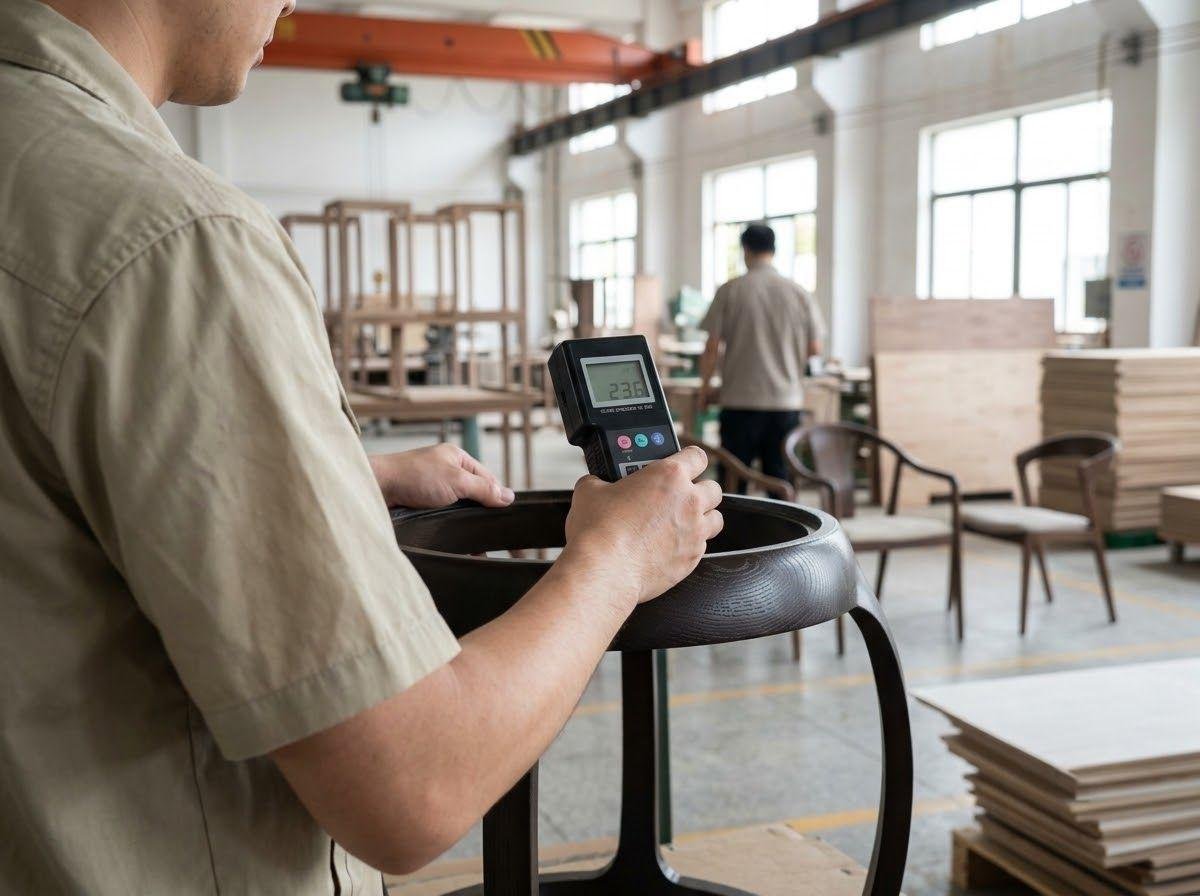
I was standing in a 300-worker factory in Dongguan last March, watching a QC inspector tap a dining chair leg with a small brass hammer. The leg looked fine. Perfect, actually. Fresh lacquer, smooth grain, no visible cracks. The inspector — a local guy named Lao Chen who’d been doing this for 22 years — didn’t even look at the surface. He tapped the underside. Hollow. The sound was wrong. He pulled out a pocket knife and scraped away a thin layer of wood-colored filler. Underneath, the leg had snapped clean through during a stress test two days earlier. Someone had glued it, filled it, painted it, and called it “repaired.” The factory manager smiled and said, “It’s strong now. Same as new.” It wasn’t. And that $47,000 order? We rejected the whole lot. But here’s what keeps me up at night: that chair would’ve passed a surface inspection. It would’ve shipped. It would’ve ended up in a hotel lobby in Dallas or a restaurant in Melbourne, and six months later, some guest would’ve hit the floor when the leg gave out. That’s not a quality control failure. That’s a quality control illusion. And in my 15 years walking factory floors in Guangdong, I’ve learned that the fake repair is the dirtiest trick in the book. Because it looks like diligence. It looks like the problem got fixed. It didn’t.
The Brutal Truth
Most buyers think China furniture QC is the process of verifying that manufactured goods meet specified standards before shipment. It’s not. It’s about catching the hiding of defects. And factories in China — not all, but enough — have gotten frighteningly good at the second part.
The uncomfortable reality? A fake repair often costs less than a real one. A real repair means pulling the piece from the line, disassembling, replacing the part, re-finishing, and re-testing. That’s labor, materials, and time. A fake repair means five minutes with a putty knife and a spray gun. The math is brutal. And most buyers never know the difference until it’s too late.
Here’s my rule of thumb: If you can’t see the repair, that’s not a repair. That’s a cover-up. A proper fix leaves a trace — a slightly different grain pattern, a minor color shift, a seam where the new wood meets the old. Perfection is the red flag. Because real wood doesn’t heal seamlessly.
Key Takeaways
• China furniture QC is only as good as your ability to see what the factory hides. Surface-level checks are worthless against cosmetic fixes.
• Fake repairs are an economic decision, not a random accident. They spike when factories are behind schedule or over budget.
• The most dangerous defects aren’t the ones you miss — they’re the ones that look like they were never there.
• Your best tool isn’t a checklist. It’s the willingness to flip furniture over, tap joints, and ask uncomfortable questions.
How the Game Is Played
Why Do Factories Fake It?
Think of it like a restaurant kitchen during the dinner rush. The chef drops a steak on the floor. The “right” thing is to throw it out and fire a new one. But the ticket’s already late, the customer’s waiting, and the manager’s watching. So he rinses it, sears it hard, plates it beautifully, and hopes nobody notices. That’s the psychology of the fake repair. Pressure, not malice.
In a typical Foshan furniture factory, the production schedule is relentless. A dining table fails a load test at 3 PM on a Tuesday. The container ships Friday. The real fix means missing the boat. The fake fix means making the boat. And the factory owner? He’s not thinking about your customer’s safety in six months. He’s thinking about cash flow this month. (And honestly, would you think any differently if you were sitting on $2 million in unpaid invoices?)
The general pattern suggests that mid-sized factories — the ones doing $5 to $15 million in annual export volume — are the worst offenders. Too big to hand-craft everything, too small to absorb the cost of real rework. They live in the danger zone.
The Anatomy of a Cosmetic Fix
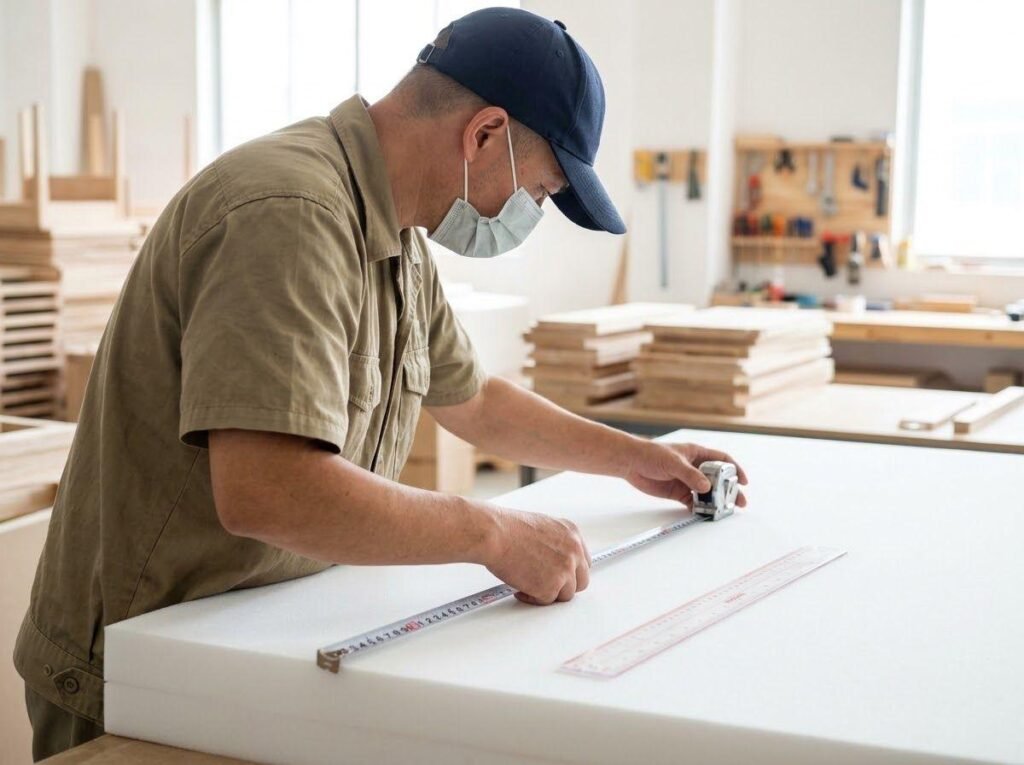
Let me walk you through what I found in Longjiang last year. A sofa frame had cracked at a joint. The proper repair? Remove the upholstery, replace the broken rail, re-web and re-foam. Two days of work. The actual repair? A carpenter injected wood glue into the crack, clamped it for 20 minutes, then stapled a fresh layer of non-woven fabric over the damage. From the outside — even with the cushions off — it looked factory-fresh. The real kicker? They’d even re-stamped the internal QC pass mark.
But here’s what most buyers miss. The glue they used was PVA. Standard white glue. It bonds well in dry conditions. But inside a sofa, where body heat and humidity cycle daily? It crystallizes. It turns brittle. In 8 to 14 months, that joint fails again. And by then, the warranty period is over. The buyer blames “normal wear and tear.” The factory blames “improper use.” Everyone points fingers. Nobody fixes it.
A proper repair uses epoxy or a hardwood spline. It takes time. It looks slightly imperfect. And it costs four times as much.
| What You See | Real Repair | Fake Repair |
|---|---|---|
| Surface appearance | Slight color or grain variation | Flawless, invisible match |
| Underside inspection | Clean joinery, visible spline or dowel | Filler, overspray, or fabric cover |
| Weight and balance | Consistent with original specs | Often lighter or off-balance |
| Documentation | Repair log with photos | Marked “passed” — no record |
| Long-term performance | Structural integrity maintained | Fails within 6–18 months under stress |
The Inspection Mirage
What Are You Actually Looking At?
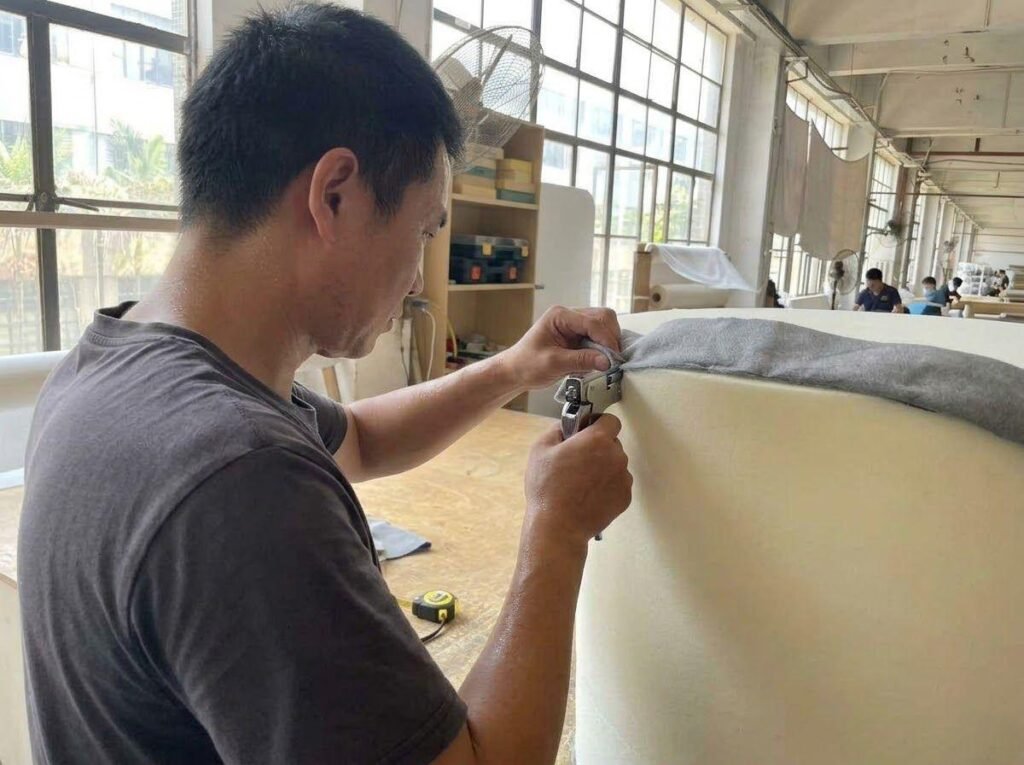
Walking into a Chinese factory as a buyer is like walking into a house that’s been staged for sale. Everything looks right. The floors are clean. The workers are wearing gloves. The lighting is bright. And every piece of furniture on the inspection line looks flawless. Because it was hand-picked for your visit.
I learned this the hard way in Anji. Showed up unannounced at a chair factory I’d been working with for three years. The line was running a completely different product than what I’d ordered. They’d pulled my actual order — which had a 23% defect rate that week — into a side warehouse. What I saw on the floor was a decoy. A Potemkin village of perfect chairs. Took me two hours to find the real stuff.
And here’s the thing about fake repairs: they’re designed for exactly this moment. The inspector arrives. The piece looks good. It passes. It ships. The repair fails later. It’s a time bomb with a six-month fuse.
The Tools They Hope You Don’t Bring
Most buyers show up with a flashlight and a checklist. That’s not enough. You need a moisture meter. (Wood that’s been patched and re-finished often has uneven moisture content — 8% on the original surface, 14% in the filler.) You need a small brass hammer. (Tap a solid joint, you get a crisp ring. Tap a glued-and-filled joint, you get a dull thud.) You need a 10x loupe. (Fresh lacquer over old wood has a different refractive index. It looks almost oily under magnification.)
Actually, that’s not quite right — what most buyers miss isn’t the tool. It’s the spot. They inspect the visible surfaces. The top of the table. The front of the cabinet. The seat of the chair. Nobody flips the piece over. Nobody checks the underside of a drawer front. Nobody runs a hand along the back rail of a sofa frame. The fakes hide where you’re not looking. That’s the whole point.
Not All Factories Play the Game
Let’s be clear: the fake repair isn’t universal. It’s concentrated. You see it most in high-volume, low-margin operations where the factory’s making 8% net and one container rejection wipes out the quarter’s profit. In those environments, the pressure to “make it work” is overwhelming.
But the landscape has tiers. While some buyers gravitate toward large-scale manufacturers in Foshan — the 1,000-worker plants pumping out container loads for big-box retailers — others find that mid-sized specialists offer a different risk-reward equation. Operations like Interi Furniture, which focuses on custom hospitality and project-based residential work out of Guangdong, tend to run tighter QC because their volumes are lower and their client relationships are stickier. They can’t afford a hotel chain blacklisting them over a failed headboard. That doesn’t mean they’re immune. But the economics are different. The incentive to fake a repair drops when your next order depends on the last one performing.
Your Pre-Shipment Detection Protocol
Don’t rely on the factory’s own QC team. Ever. Here’s what actually works:
- Bring a “stupid” question. Ask the production manager, “Show me a piece that failed and was repaired.” If they can’t produce one, they’re either lying about their defect rate or they’re hiding the repairs. A real factory has a repair bay. It has a pile of “comebacks.” No pile means no honesty.
- Flip everything. — Tables get turned upside down. Chairs get inverted. Drawers get removed and inspected from the back. The underside tells the truth. The top is theater.
- Feel the weight. A properly repaired solid wood chair weighs what the original weighs. A fake repair — filler, putty, spray — often changes the balance. Pick it up. Wobble it. Your hands know more than your eyes.
- The smell test. Fresh lacquer over a rushed repair has a sharper, more chemical odor. It hasn’t cured properly because there wasn’t time. If a “finished” piece smells like a paint shop, it was finished yesterday. Ask why.
- Red flag: If the repair looks better than the original — smoother, more uniform, no grain variation — be suspicious. Perfection is the enemy. A real repair is slightly imperfect. A fake repair is flawless.
- Document the serial numbers. Photograph the internal markings on every piece you approve. Factories sometimes swap approved units for rejected ones between inspection and loading. It happens. (I caught a Dongguan plant doing this in 2019. They’d photographed the good pieces for my report, then loaded the bad ones at 2 AM.)

FAQ: What Buyers Actually Ask
Q: Can I trust third-party inspection companies in China to catch fake repairs?
A: It depends on who you hire and what you pay them. A $150 flat-rate inspection from a generic agency? They’re checking quantity, color, and obvious scratches. They’re not tapping joints with a hammer or flipping sofas upside down. A specialized furniture inspector — someone who charges $400+ per day and knows wood joinery — will catch most cosmetic fixes. But even the best inspector only sees what’s on the line that day. If the factory hides the bad batch, nobody catches it. My advice: hire the inspector, but also do your own unannounced spot checks. Trust is not a strategy.
Q: How common are fake repairs, really? Should I be paranoid about every order?
A: Based on export data patterns and what I’ve seen across roughly 200 factory visits, I’d estimate that 15% to 25% of mid-tier Chinese furniture factories use cosmetic fixes as a standard practice — not an exception — when they’re behind schedule or over budget. That doesn’t mean 15% to 25% of your furniture is fake-repaired. It means the risk is concentrated in certain factories, certain seasons (pre-Chinese New Year rush is the worst), and certain product categories (anything with hidden internal frames — sofas, upholstered beds, casegoods with back panels). Paranoia isn’t the answer. Process is.
Q: What’s the most expensive fake repair you’ve ever seen a factory try to pull off?
A: A $12,000 custom conference table for a law firm in Singapore. The tabletop had developed a crack during curing — a long, hairline split running 18 inches through the walnut veneer. The factory didn’t replace the top. They routed out the crack, filled it with colored epoxy, and re-veneered a 3-inch strip. From above, invisible. From the side, under raking light, you could see the seam. We caught it. But if we’d only done a top-down photo inspection — which is what most buyers do — it would’ve shipped. The client would’ve paid $12,000 for a tabletop with a structural compromise. That crack would’ve opened up again within two years. That’s not a repair. That’s fraud with better lighting.
Q: Is a factory that does fake repairs always a factory I should walk away from?
A: No. And here’s why that matters. A factory under extreme deadline pressure might fake a repair once and have a stellar track record otherwise. The question isn’t whether they’ve ever done it. The question is whether their system allows it. Do they have a documented repair protocol? Do they photograph repairs? Do they show you the repair bay? Do they get angry when you ask? A factory that gets defensive about transparency is a factory that’s hiding something. A factory that says, “Yes, we had three repairs this week, here’s what we did” — that’s a partner. The red flag isn’t the repair. It’s the secrecy.
The Hard Question
So here’s my question for you: Are you inspecting furniture, or are you inspecting the idea of furniture? Because the factories that survive in this market — the ones that make money year after year — they’re not stupid. They know what you want to see. They know you want clean lines, on-time delivery, and a price that keeps your margins healthy. They’ll give you all three. And sometimes, buried inside that beautiful package, there’s a joint held together with hope and wood filler.
The hard-earned lesson? Never trust a surface. Not in a factory in Foshan, not in a showroom in Nankang, not anywhere. The truth is underneath. You just have to be willing to flip the piece over.