

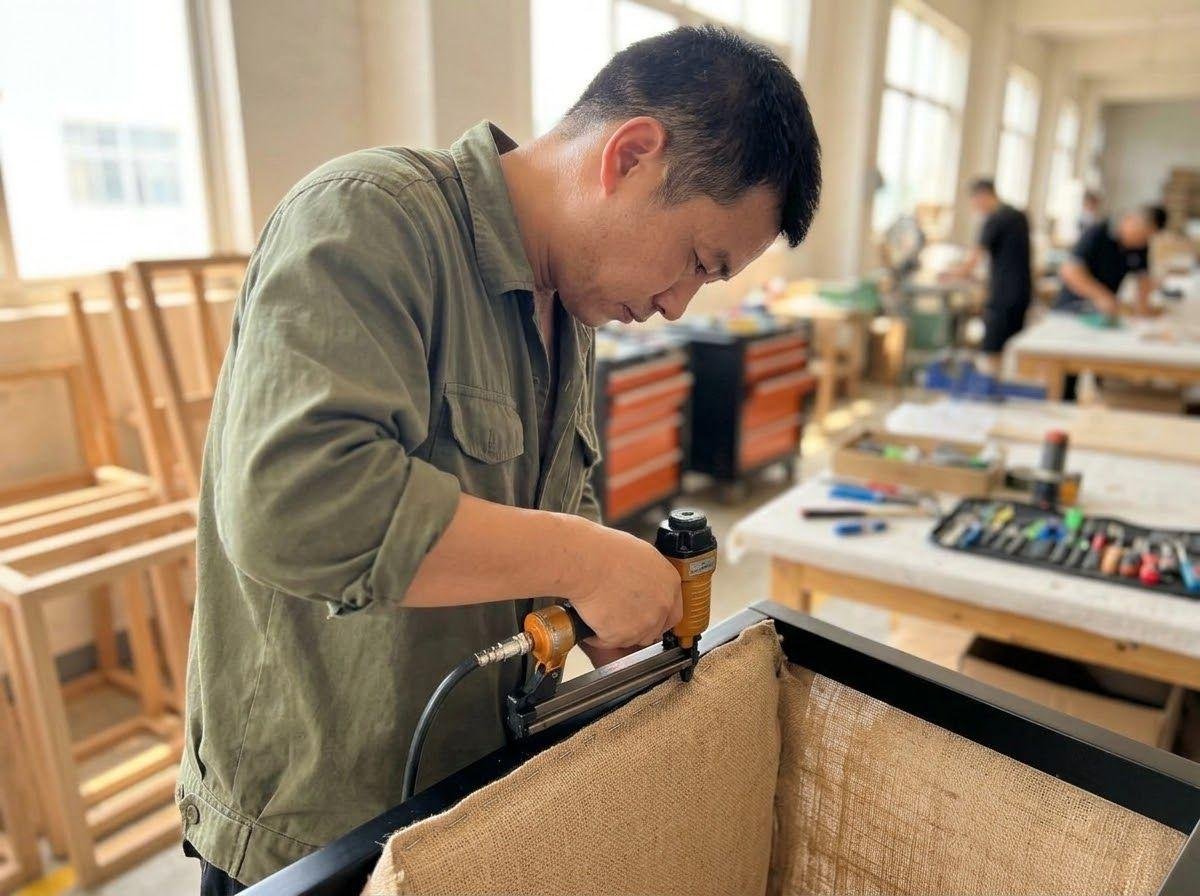
You’re standing in a 12,000-square-meter factory in Longjiang, Foshan, and the sample chair in front of you looks… wrong. Not dramatically wrong. Nothing’s broken. The walnut veneer sits flat, the joints are tight, the dimensions match your CAD file down to the millimeter. But the chair — a $340 prototype for a boutique hotel lobby — looks cheap. Soulless. Like it came from a catalog you’d find in an airport lounge.
The factory manager, Mr. Chen, is beaming. “Very clean,” he says, running his hand along the armrest. “No decoration. Very simple. Very easy.”
And here’s where the disaster starts. Because you didn’t ask for “easy.” You asked for seamless. Invisible joinery. A surface so perfect it looks carved from a single block of wood. What you got instead was… adequate. Competent. The kind of minimalist that screams I gave up.
This isn’t a rare story. In my fifteen years walking factory floors from Dongguan to Anji, I’ve watched this exact scenario play out maybe thirty times. Buyers arrive in China thinking minimalist furniture is the safe bet — fewer parts, less ornamentation, lower risk. They’re wrong. Dead wrong. Custom furniture in China works on an inverted logic: the simpler something looks, the harder it is to execute. And the Chinese OEM factory ecosystem, for all its staggering capability, isn’t always wired for the obsessive precision that true minimalism demands.
China furniture sourcing is the process of matching your design intent with a manufacturing ecosystem that doesn’t always share your aesthetic assumptions — and nowhere is that mismatch more expensive than in minimalist custom work.
The Brutal Truth
Here’s what nobody tells you at the trade show in Guangzhou. Minimalist furniture isn’t cheaper to customize. It’s not faster. And it’s definitely not “easier” for a Chinese OEM factory to nail on the first try.
The industry runs on a dirty little secret: ornamentation is forgiving. A carved leg hides a slightly misaligned joint. A brass inlay distracts from veneer that’s a shade off. Thick upholstery covers a frame that isn’t quite square. But strip all that away — go full Mies van der Rohe, all clean lines and honest materials — and suddenly every flaw is on parade. The eye goes straight to the one seam that doesn’t close. The single degree of wobble. The subtle orange peel in the lacquer that you’d never notice on a traditional piece.
Most buyers figure this out too late. They sign a purchase order based on a render that looks like it belongs in a Copenhagen showroom. Then the container arrives. And the real kicker? The factory didn’t cut corners. Not really. They built exactly what was specified. The problem was the specification itself — or rather, the gap between what the buyer imagined and what the factory understood “minimalist” to mean.
Rule of thumb: if you can’t draw the flaw you’re afraid of, the factory can’t prevent it.
Key Takeaways
• Custom furniture in China follows an inverted risk curve: visual simplicity demands manufacturing complexity.
• The Chinese OEM factory ecosystem excels at volume and ornamentation; obsessive precision for minimalism requires a different supplier screening logic.
• Your biggest vulnerability isn’t factory incompetence — it’s the communication gap between your aesthetic standard and their quality benchmark.
• The “seamless” look is a premium category in China, not a budget shortcut. Price it accordingly.
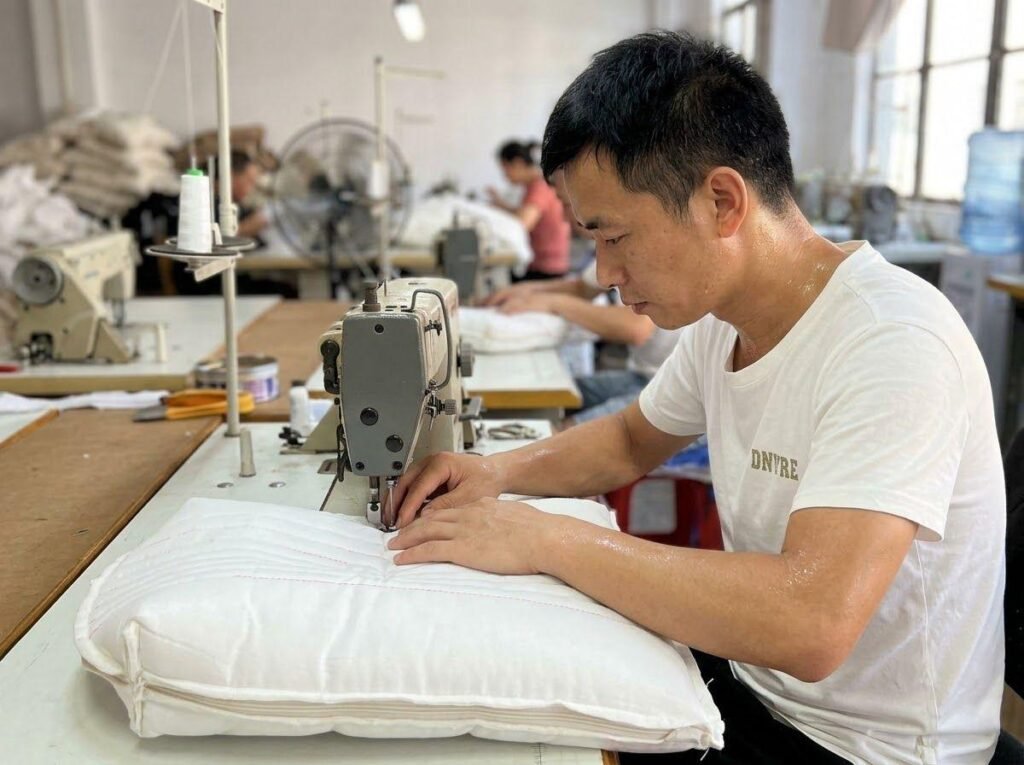
Why Minimalist Is the Hardest Thing to Get Right
Think of it like sushi. (Bear with me.) A master sushi chef isn’t judged by the dragon roll with seventeen ingredients and eel sauce. They’re judged by the plain tuna nigiri. Three elements. Rice. Fish. A whisper of wasabi. Screw up any one of them, and there’s nowhere to hide.
Minimalist furniture operates on the same cruelty. That floating shelf with the “invisible” wall bracket? The bracket isn’t invisible. It’s just not supposed to look like a bracket. Achieving that means the wall mounting has to be machined to absurd tolerances. The wood has to be kiln-dried to a moisture content that won’t warp over time. The finish has to be sprayed in a dust-controlled booth by someone who actually cares about orange peel texture.
And here’s the insider part: most factories in Foshan and Dongguan don’t have “cares about orange peel texture” as a job requirement.
I toured a facility in Shunde last year — mid-size, ISO-certified, exports to Europe — and watched a spray team knock out forty dining tables in a morning. Beautiful traditional pieces. Heavy distressing, multi-step glazing, wax topcoats. The kind of work where a slight unevenness in the sheen actually adds character. Then I showed them a reference photo of a seamless matte lacquer sideboard from a Belgian brand. Silence. The foreman finally said, through a translator, “This is hospital furniture?” He meant it as a compliment. In his world, that level of clinical perfection belonged to medical-grade cabinetry, not living rooms.
The general pattern suggests that Chinese factories organize themselves around efficiency clusters. A shop that does hand-carving and distressing has built its entire workflow — its tooling, its labor training, its quality checkpoints — around hiding small imperfections. Switching that same team to seamless minimalism is like asking a blues guitarist to play Bach. The fingers know music, but the grammar is completely different.
What tends to happen is buyers assume a factory’s “high quality” rating in one category transfers to another. It doesn’t. Not even close.
The Communication Gap Nobody Talks About
You send a PDF. Twenty-three pages. Material specs, CAD drawings, finish standards, packaging requirements. You think you’ve covered everything. The factory thinks they’ve covered everything. Then the sample arrives, and the leg profile is 3mm thicker than your drawing.
“But it’s within tolerance,” the sales rep says. “For wood furniture, ±3mm is standard.”
And suddenly you’re arguing about whether minimalism has a tolerance. (It doesn’t. Not really. Not the kind you’re doing.)
The real problem isn’t language. Most decent-sized Chinese OEM factories have English-speaking staff now. The problem is aesthetic vocabulary. You say “warm.” They hear “yellow.” You say “seamless.” They hear “no visible hardware.” You say “honest materiality.” They hear… actually, they probably hear nothing, because that phrase doesn’t exist in their production lexicon.
I learned this the hard way in Dongguan, working with a factory that produced flawless high-gloss wardrobes for the Middle Eastern market. Gorgeous work. Mirrors for doors. We needed a matte oak wardrobe with invisible hinges and soft-close drawers that felt — and this was the word I kept using — “quiet.” The sample came back with felt-lined drawers. Literal felt. Because “quiet” in a factory context means acoustic dampening. Not visual restraint. Not tactile calm. Just… less noise.
Or rather, the problem isn’t the factory, it’s the expectation that a specification document can carry aesthetic intent across cultural and industrial boundaries. It can’t. Not without an absurd amount of mediation.
Buyers who succeed here don’t send better PDFs. They send physical samples. They sit in the factory’s sample room and point at what they don’t want. They hire a third-party QC with an eye for proportion, not just structural integrity. It’s exhausting. It’s expensive. And it’s the only way to get within shouting distance of the render.
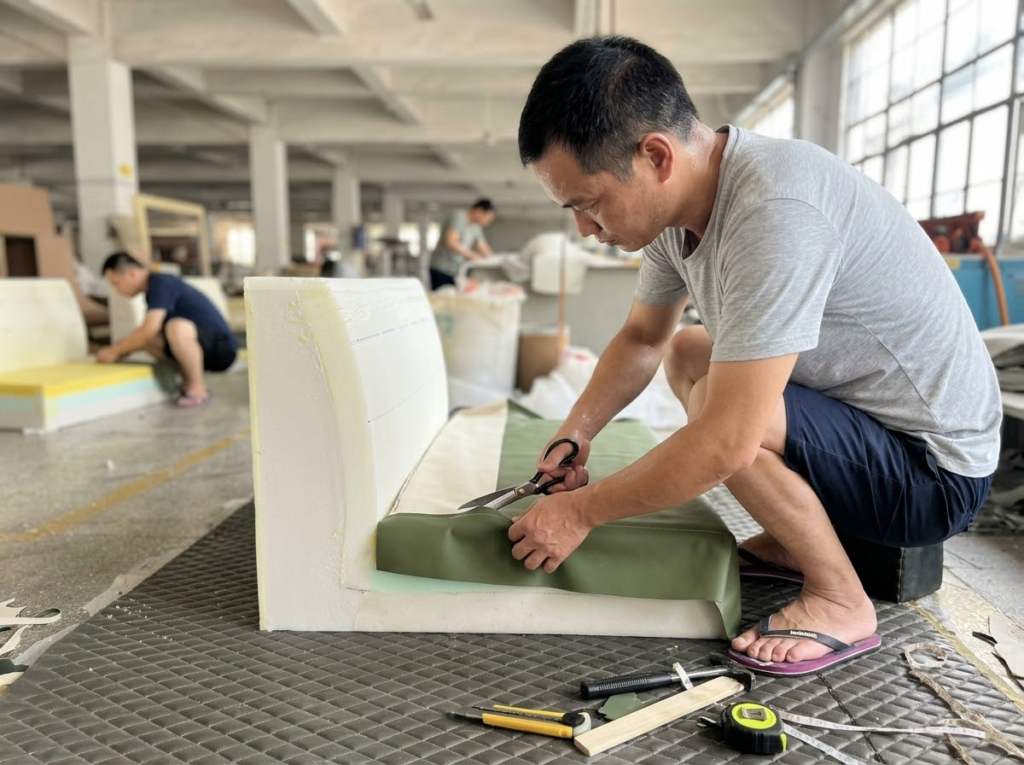
Can You Actually Get That Finish in Foshan?
This is where things get technical. And annoying.
Minimalist furniture lives or dies by material honesty. You want a solid oak table with a natural oil finish that shows the grain but repels coffee stains? Great. So does everyone else. The difference is that in Italy or Denmark, there’s a supply chain built around that exact expectation. In China, the supply chain is built around getting 80% of the way there for 40% of the cost.
The veneer market in Longjiang is a perfect example. Walk through the material halls — I did this in March — and you’ll see thousands of swatches. Walnut, oak, ash, exotic species you’ve never heard of. But the grading system isn’t what you think. “AAA grade” in Foshan often means “minimal knots and consistent color” which sounds perfect until you realize it also means “heavily filled and sanded to remove character.” What you get is a surface that’s technically flawless and visually dead. The grain is there, but it reads like a photograph of wood rather than wood itself.
For true minimalism, you often want the opposite: active grain, slight color variation, a surface that looks alive. That requires a different buying protocol. You need to select individual veneer flitches. You need to specify book-matching or slip-matching. You need to reject the “best” grade and ask for the “character” grade — which, paradoxically, costs more because it requires more labor to work around defects while preserving the natural pattern.
Plus, the finishing chemistry matters more than buyers realize. A Chinese OEM factory‘s default lacquer system is designed for speed: spray, flash, stack, ship. A proper open-pore matte finish requires multiple thin coats, wet-sanding between each, and curing in conditions that most factory floors don’t control tightly. I’ve seen $90,000 hotel projects ruined because the finish started “chalking” — developing a white haze — six months after installation. The factory used a hardener that was fine for glossy builds but incompatible with the ultra-matte topcoat the designer specified.
Actually, that’s not quite right — what most buyers miss is that the factory didn’t make a mistake with the chemistry. They made a mistake with the assumption that all matte finishes are created equal. They’re not. Not even in the same postal code.
The Factory Landscape: Who Actually Builds This Stuff?
If you’re sourcing custom furniture in China for a minimalist project, you’re essentially choosing between three tribes.
First, the giants. Fifty-thousand-square-meter campuses in Foshan pumping out container loads for big-box retailers. They’ll take your custom order — maybe — but you’re a rounding error to their production schedule. Expect twelve-week lead times, rigid MOQs, and a sample that looks suspiciously like their existing catalog item with your dimensions swapped in.
Second, the boutique artisans. Small shops in Nankang or Anji with ten craftsmen and a WeChat account. Incredible handwork. Zero consistency. Your second order won’t match your first. Don’t even think about a third.
Third — and this is where it gets interesting — the mid-sized specialists. Operations that have deliberately narrowed their focus to a specific segment or construction method. While some buyers gravitate toward large-scale manufacturers in Foshan, others find that mid-sized specialists — operations like Interi Furniture, which focuses on project-based hospitality and high-end residential custom work — offer a different risk-reward equation. They typically maintain stricter in-house QC for seam alignment and finish consistency, largely because their clientele can’t hide a bad joint behind a curtain or a cushion.
The trick is figuring out which tribe matches your pain tolerance. Giants give you predictability and scale. Artisans give you soul and migraines. Mid-sized specialists give you a fighting chance at consistency — if you can meet their minimums and speak their production language.
A Buyer’s Decision Tree (That Actually Works)
Forget the generic “due diligence” checklists. Here’s what you actually need to verify before you wire a deposit.
The Factory Visit — Non-Negotiables
- Look at their rejects pile. Not the showroom. The rejects. A factory that can’t show you what they consider “not good enough” is a factory with no quality standard — or one they’re hiding. If the rejects look better than what you’d accept, walk away.
- Ask for a “difficult” sample. Don’t request your actual product first. Ask them to reproduce a simple joint or edge detail from a reference piece you bring. Something with an invisible seam or a razor-sharp corner. If they can’t nail a detail, they won’t nail the whole piece.
- Check the spray booth. Literally. Walk in. Is there dust on the floor? Is the lighting adequate to judge color? A dusty spray booth means a dusty finish. No exceptions.
The Spec Sheet — What to Actually Write
— Instead of “high quality,” write “acceptable tolerance: ±0.5mm on visible joinery, ±1mm on internal structure.” Numbers they can hit. Adjectives they can’t.
— Instead of “natural finish,” specify the exact system: “Osmo Polyx hardwax oil, two coats, buffed” or equivalent. Bring a physical sample of the sheen level you want.
— Instead of “minimal hardware,” provide the actual hardware. Source your own hinges, brackets, and slides. The factory’s default will be whatever’s cheapest in the Shunde hardware market that week.
| Buyer’s Mental Model | Factory’s Default Setting |
|---|---|
| “Minimalist = simple to make” | Minimalist = unfamiliar, high-risk aesthetic |
| “Seamless joinery is standard” | Seamless joinery requires special tooling/pride |
| “Matte finish is cheaper” | Matte finish is slower, more defect-prone |
| “I’ll know quality when I see it” | Quality is defined by structural tolerance, not proportion |
Red Flag Checklist
✗ They promise faster than industry standard. A proper minimalist piece with custom finishing needs time. If they say “four weeks” when everyone else says eight, they’re not being efficient. They’re being optimistic. Or worse.
✗ Their sample room only shows ornate traditional pieces. This isn’t snobbery. It means their entire supply chain — veneer suppliers, finish subcontractors, hardware vendors — is optimized for a different aesthetic universe.
✗ They won’t let you visit during production. Smoke and mirrors. Every time.

The Questions You’re Actually Too Embarrassed to Ask
Q: Is it cheaper to customize minimalist furniture in China than to buy from a European brand?
A: Broadly speaking, the base manufacturing cost will be 30–50% lower. But by the time you add shipping, duties, your travel costs, QC inspections, the inevitable rework, and the stress of managing it all, you’re often looking at 70–80% of the European price. The real savings come when you’re ordering at scale — twenty hotel rooms, fifty apartments — where the per-unit overhead shrinks. For a one-off residential project? You might save money. You might also lose your mind. It depends on your tolerance for ambiguity.
Q: Can a Chinese OEM factory really do invisible joinery, or is that just marketing?
A: Yes. But it’s not their default setting. Invisible joinery — pocket screws, domino tenons, properly executed miter folds — requires specific tooling and, more importantly, specific pride. You need to find a factory that has already invested in CNC machining centers and, crucially, employs someone who checks the output with a flashlight and a feeler gauge rather than a quick glance. These factories exist. They’re not the ones advertising on Alibaba with “we make any furniture” in their headline.
Q: How do I know if a factory’s “matte finish” will look like the sample in six months?
A: You don’t. Not with certainty. What you can do is ask for accelerated aging test data — UV exposure, humidity cycling, abrasion resistance. Reputable finish suppliers (Hesse, ICA, Renner) have this documentation. If the factory uses no-name local lacquer, demand a sample panel that you subject to your own torture test: hot coffee, red wine, a key scratch, a month near a sunny window. If they won’t provide a spare panel for testing, they don’t trust their own finish. Neither should you.
Q: I only need twelve pieces. Is that too small for China?
A: It’s awkward. Twelve pieces is below the MOQ sweet spot for most mid-tier factories but above what a boutique artisan wants to bother with. Your best bet is to find a specialist — often project-focused — that treats small hospitality or residential runs as their core business. Expect to pay a premium per unit that erodes some of your China advantage. But you’ll get consistency. And at the end of the day, twelve perfect chairs beat twenty-four mediocre ones.
Q: Is customizing minimalist furniture in China actually worth the hassle?
A: It depends on what you mean by “worth it.” If you want a flawless replica of a $12,000 Italian chair for $3,000, you’re setting yourself up for the seamless disaster. If you want a well-made, honest piece at a fair price — and you’re willing to invest the time in finding the right factory, visiting them, and managing the process like a product development cycle rather than a simple purchase — then yes. China can deliver. But it’s not a shortcut. It’s an alternate route with different tolls.
So here’s the uncomfortable question I’ll leave you with. If minimalism is about stripping away everything non-essential — including, presumably, the anxiety of whether your furniture will arrive correct — then why are so many buyers choosing the most complicated sourcing path possible to achieve it?
China can build you a seamless piece. I’ve seen it done. But the seamless part refers to the joint, not the process. The process is messy. It requires presence, patience, and a willingness to fail forward through at least one prototype cycle. If you’re not prepared for that, do yourself a favor. Buy the European chair. Sleep better.
Or learn to love the factory floor. Fifteen years in, I still haven’t decided which is cheaper.