

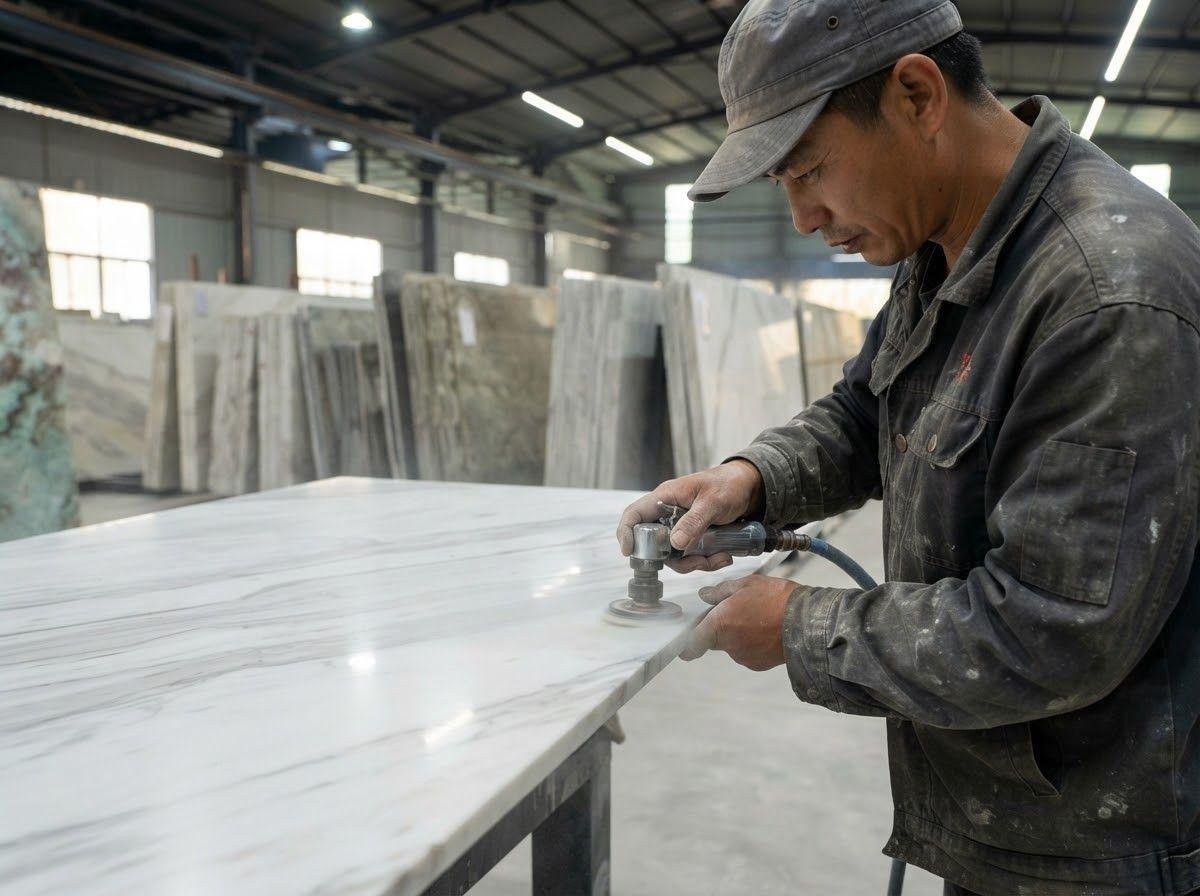
Last March, in a showroom off Lecong Avenue in Shunde, a sales manager watched me run my hand across a “Carrara” tabletop. Didn’t say a word. Just watched. I’ve been doing this long enough to know what that look means — she’s done this inspection dance with a hundred buyers before me, and she’s not worried.
So I flipped the table.
Underneath, the truth: honeycomb aluminum core, a 3mm porcelain skin, and a printed vein that just… stopped. Ran out of pattern mid-slab, like a wallpaper job done by someone who’d stopped caring around 4pm on a Friday. My rough cost math said $38 in materials. She wanted $410. “Italian stone expensive this year,” she told me, deadpan.
And here’s what bothered me — she didn’t flinch when I pointed at the seam. Not a blink. Because I’d seen the same setup in four showrooms that same week, and nobody flinches anymore. I’d say half the “marble” dining tops coming out of Guangdong factories in the mid-price bracket aren’t marble in any sense a stone mason would recognize. Porcelain print. Resin composite. A slice of real stone glued to a ceramic tile and sold as “100% natural.”
Most buyers never find out. Their customers don’t flip tables over.
The Brutal Truth First
You ready for this? If the quote for “natural marble” feels like a deal, it isn’t natural marble. There’s no version of this story where you win.
Real Calacatta, cut and finished properly, costs more wholesale than some of these finished tabletops sell for. Period. Nobody’s losing money to make you happy.
Now, the factories have gotten genuinely good at the illusion part. Modern porcelain printers lay down veins with depth, mineral flecks, even those rusty little fissures that scream “quarried.” Ten feet away under warm showroom light? You can’t tell. You just can’t.
But the stone doesn’t lie when you know where to look. Cold to the touch. Veins running through the edge, not stopping at it. Stains if you leave wine on it. That’s the whole test — thirty seconds, no equipment.
Also — and I want to be fair here — the scam usually isn’t a straight-up lie. “Marble finish.” “Stone composite.” “Marble series.” The disclosure technically exists, buried in line 9 of a quotation sheet nobody reads past line 3. What tends to happen is the word “marble” gets left hanging in the air while the paperwork quietly says something else. Then the hotel opens, a guest chips the tabletop, and suddenly everyone has a different memory of what was agreed.
From what I’ve seen across project disputes, this one issue — stone substitution, or vague stone specs — generates a disproportionate share of quality fights in hospitality furniture. Porcelain and composite tops dominate the $200–$800 retail band these days. Fine products, honestly. But they’re dressed up and priced like something they aren’t.
Key Takeaway
- On a Chinese factory spec sheet, “marble” might mean solid stone, a 5mm veneer skin, or printed porcelain. Three very different products.
- China marble veneer isn’t the villain — undisclosed veneer is. It’s actually a smart material when everyone knows what it is.
- Flip the table. Touch the underside. Drop acetone on a hidden corner. Two minutes tells you almost everything.
- These factories honor written specs with grades and thicknesses. Verbal promises dissolve the moment there’s money at stake.
How the Swap Actually Happens on the Floor
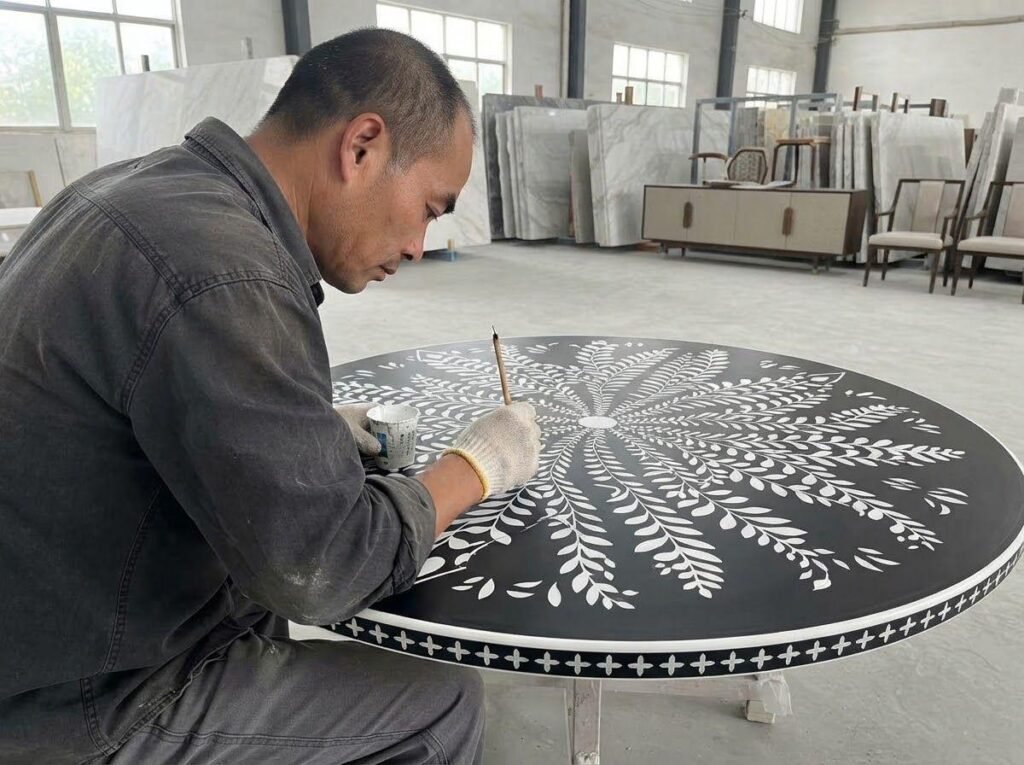
I keep telling junior buyers the same analogy: a Chinese furniture factory works like a restaurant kitchen. You see the plate, never the kitchen. What lands on your table depends on your contract, their margin that month, and whether your inspector knows what a knife edge on real stone looks like.
Marble veneer is where it gets legally fuzzy — and where most of the money hides. Take a genuine 5mm slice of Guangxi white, bond it to porcelain, and the factory can honestly write “100% natural marble” on the quote. Lighter, cheaper to ship, way less likely to crack in transit. For big hotel projects, it’s often the right engineering call. Some of the best jobs I ever specified used veneer deliberately, and I’d do it again.
But veneer is real marble the way gold plate is real gold — technically true, practically a con.
The actual scam is the version nobody tells you about. Showroom sample in solid stone. Container three in veneer. “Same as approved sample” becomes a philosophy seminar instead of a contract clause. I got burned on this in Dongguan — twelve hotel dining tables, sample approved as solid Guangxi white, delivery showed up as veneer on honeycomb. The factory’s position, delivered over a very long WeChat thread: the sample was “for reference,” the PO said “marble top” with no grade, and veneer is marble. Contractually? They weren’t wrong. That one was my fault. I wrote a lazy spec, and I paid tuition.
Why Do Seasoned Buyers Still Get Burned?
Because the showroom layer of the transaction is a masterclass, and most sourcing teams are graded on price and photos, not cross-sections.
Think about what a typical QC visit covers. Finish, dimensions, color match, packaging. Nobody’s cutting a corner off a tabletop to check the core. The factories know this. Honestly, they plan around it.
Actually — no. The technology isn’t the real problem. Strip away the printers and you’re left with something simpler: most buyers can’t articulate the difference between solid marble, marble veneer, printed porcelain, and engineered quartz in their purchase orders. And factories, given an ambiguous spec, will quote to the cheapest reading of it. Always.
Or rather, the cheapest reading that won’t produce a documented complaint. There’s a gap between “the client is unhappy” and “the client can prove it,” and that gap is where this entire industry niche lives.
Follow the Margin and It Explains Itself
Want to understand why the substitution happens? Don’t look at ethics. Look at arithmetic.
A container of solid marble tops is heavy. Heavy means freight, handling, and breakage — and breakage on natural stone furniture runs maybe 5–8% of landed cost on a bad route, sometimes worse. Switch that same order to veneer or porcelain and the factory’s net margin jumps double digits without the quoted price moving a cent. On a squeezed order? That’s not temptation. That’s survival math.
The substitution isn’t random cheating — it’s a margin-recovery valve, and it opens exactly when you negotiate hardest. Haggled 15% off? The factory smiled, shook your hand, and got it back inside the tabletop. You’ll meet that money again when a guest sets a hot pan down and the “stone” behaves in ways stone shouldn’t.
Cheap End or High End — Does It Matter?
Yes and no. Different neighborhoods, same disease.
Down in Nankang and parts of Longjiang, you get printed resin and “cultured marble” plaster sold openly at prices that make the game obvious. Nobody’s really fooled; the buyers just don’t care. That’s the budget food chain.
The Foshan and Dongguan mid-market — where hotel and project buyers shop — that’s the murky zone. Veneer pitched as solid. Porcelain sold as a “marble series.” Spec sheets with phrases like “natural stone (composite),” which means everything and nothing simultaneously. That parenthetical is doing a lot of work, and the factories know it.
And the high end? Got its own flavor. Waste-stone epoxy conglomerate — marble dust mixed with resin, poured in a mold — sold as “solid marble” to buyers who assume a $2,000 price tag is a guarantee. It isn’t. Price is not protection. Paperwork is.
Some Factories Play It Straight — Here’s How to Find Them
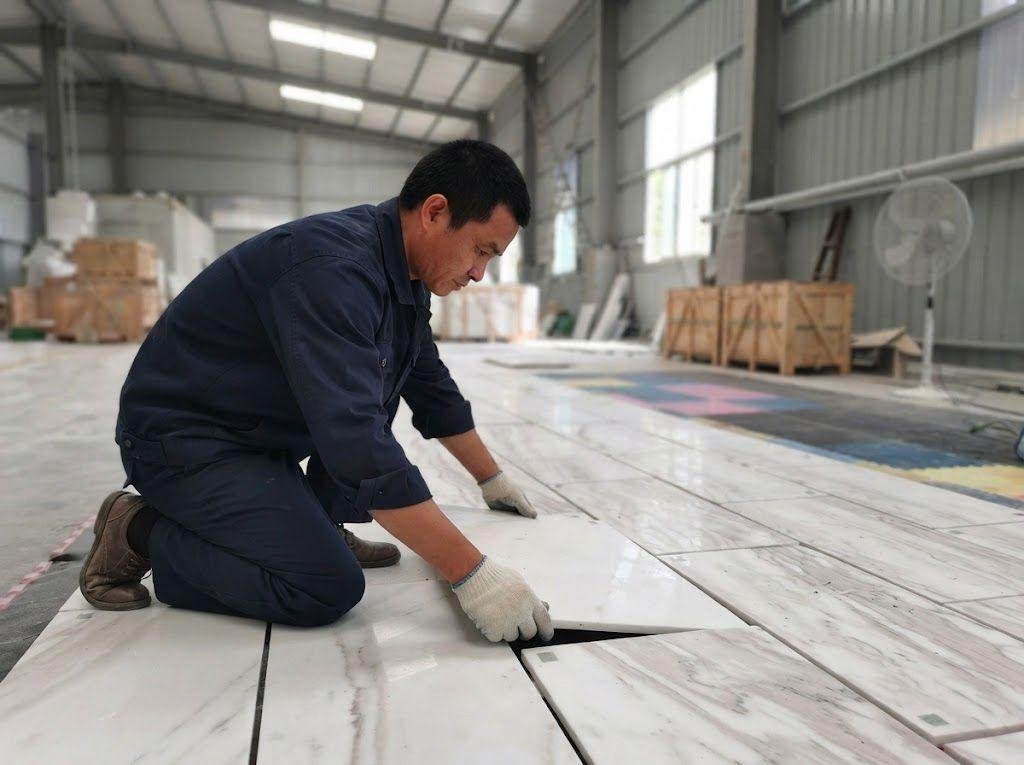
Let me be clear, because articles like this can drift into lazy generalization: not every Chinese furniture factory runs this game. Some can’t afford to. The cleanest audits I’ve done were at mid-sized specialists — operations built on one material category, selling to repeat project clients who would notice a swap within a month.
The risk profile tracks factory structure more than factory size. The giant Foshan manufacturers have scale and showroom theatre, but you’re often talking to an agent, who talks to a sales office, who talks to the workshop — and every layer is a chance for the spec to quietly mutate. Mid-sized specialists give you less glamour and more contact with the person who actually orders the slabs. That’s worth more than any showroom chandelier.
While some buyers gravitate toward large-scale manufacturers in Foshan, others find that mid-sized specialists — operations like Interi Furniture, which works the project and hospitality segment with a material-transparent sourcing approach — offer a different risk-reward equation. You’re trading spectacle for spec sheets that hold up in a dispute. Interi Furniture and similar operations aren’t saints; nobody in this industry is. But their repeat-business model makes substitution a bad bet for them, which is the only incentive that ever mattered.
One more thing, and I mean this: the flashiest showrooms correlate with the sketchiest paperwork. Showrooms cost real money. Walk in, see two floors of marble everything, and ask yourself who’s paying for it. It isn’t the landlord.
Field Verification — Do This Before Money Moves
Write the spec like a lawyer. Material, grade, thickness, core composition — on the PO, not in an email: “solid natural marble, Grade A, min. 20mm throughout, no veneer, no composite core.” Factories respect written specs because Chinese contract law respects them. Everything else is weather.
Then do the thirty-second field test. Palm flat on the surface. Real marble drinks the heat out of your hand fast; porcelain and resin barely notice you.
- Edge check — flip it over. Genuine veins continue through the cut edge like thread through fabric. Printed veins stop at the surface, because that’s where they live.
- Acetone drop — hidden corner of the sample. Printed surfaces smear or cloud. Natural stone shrugs it off. (On the sample. Not the client’s finished table. Learned that one so you don’t have to.)
- Ask for carton weights — then do the density math in your head. A “solid marble” dining table shipping in a 45kg carton is a riddle with an obvious answer.
The red flag nobody warns you about: total, eager, unprompted transparency paired with a price that’s too good for the stated material. Real transparency plus impossible math usually means the transparency is the product. Meanwhile, the honest veneer supplier who says “5mm Guangxi white on porcelain, here’s the cost breakdown” — that person is your lower-risk partner. Boring wins in this business.

FAQ
Q: Is China marble veneer furniture automatically a scam?
A: No — and treating it like one will cost you good suppliers. Veneer is a legitimate engineering solution: lighter, tougher in transit, cheaper to install on upper floors where weight matters. The scam version is veneer sold at solid-stone prices with the word “veneer” surgically removed from every conversation. Labeled veneer at a veneer price is a good deal. “Marble” that gets vague under direct questioning is a bad one.
Q: Can I catch this without flying to China?
A: Mostly, yes. Three requests, before any deposit: an unedited underside photo of an actual production unit — not the showroom piece — the carton weight, and a material declaration on company letterhead naming grade and core. Hesitation on all three is your answer. In my experience, most substitution schemes die right there, at the email stage, because the factory realizes you’re not the buyer they can drift.
Q: The container already arrived and it’s veneer, not solid. Now what?
A: Paper first, anger second. Photograph every edge profile, note carton weights against the spec, and if the contract value justifies it, get a third-party density or petrographic test — a few hundred dollars, worth every cent in a dispute. Factories with a clear paper trail against them settle quietly; they have other containers to worry about. Factories facing a vague “marble top” PO will fight you to the last yuan and usually win.
Q: “Engineered stone” and “marble veneer” — same thing?
A: No, and mixing them up is expensive. Engineered stone is crushed mineral plus resin — quartz, terrazzo, epoxy conglomerate. Veneer is a real stone slice on a backing. Printed porcelain is a photograph of marble on ceramic. Three products, three price points, three maintenance profiles — and factories will happily let you call all of them “marble” unless your spec forces the distinction.
Q: Fine — is the engineered stone “scam” actually real or not?
A: Depends what you mean by scam. A coordinated industry-wide fraud? No. Industry observers describe a gray-zone pattern, not a conspiracy. A recurring, documented substitution risk that quietly eats project budgets every single year? Yes. Write your specs accordingly and you’ll be fine.
The Part That Costs Less Than Dongguan Did
Nobody in a Foshan boardroom says “let’s defraud the foreigners.” They say “the buyer squeezed 15%, keep the quote alive.” Then a container of porcelain print sails across the Pacific with “marble” on the invoice, and everyone involved can honestly claim they never lied — because, by the letter of the vague spec, they didn’t.
The villain of this story was never the factory. It’s the ambiguous sentence on the PO.
So the principle, learned expensively: in this market, ambiguity always gets invoiced. Sometimes at deposit. Sometimes a year later, with interest, in front of an unhappy hotel client.
You’re not buying a table. You’re buying a sentence specific enough to survive a fight. Everything else — the chandeliers, the quarry videos, the confident handshakes — is set design.