

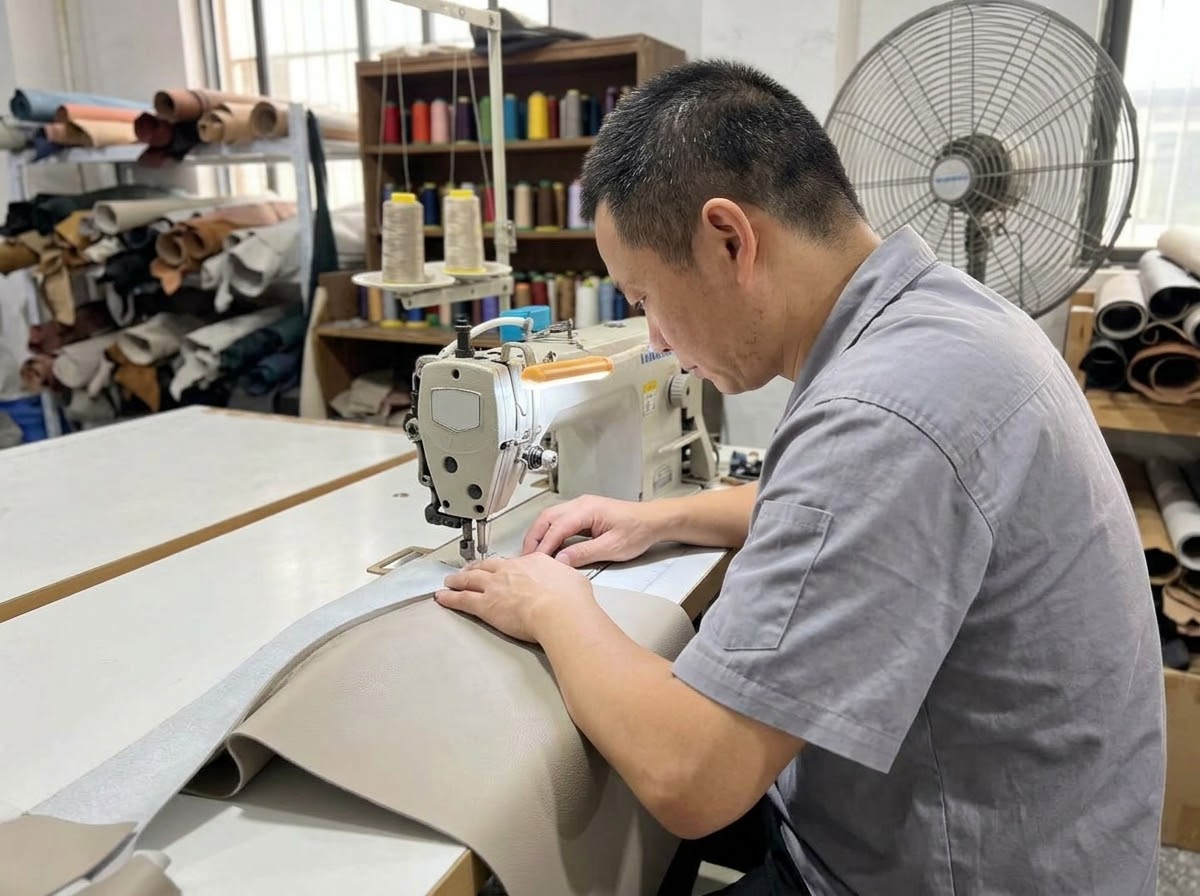
Your client wants a villa in Aspen. Italian marble, French linen, and a dining table that costs more than your first car. You fly eleven hours to Guangzhou, rent a car, and drive an hour north to Foshan. The factory floor is 40,000 square meters of controlled chaos. Dust, noise, the smell of curing lacquer, and then — there it is. The same table. Same white oak. Same hand-rubbed oil finish. The owner’s nephew, who speaks better English than your project manager, quotes you $2,800. Back home, your Milanese supplier charges $18,000. You don’t know whether to laugh or throw up. That’s the first hour. By hour three, you’ve realized the $2,800 table has a tenon joint where the original uses dovetail. The leather’s from Hebei, not Tuscany. The “sustainable” claim means the forester planted three trees last year. And nobody in this building can produce a chain-of-custody certificate that would survive your client’s lawyer. Welcome to China FF&E procurement. It’s not a discount bin. It’s a parallel universe with its own physics. And most architects arrive here without a map — especially when the job involves sourcing Chinese villa furniture that doesn’t look like it came from a trade show floor.
The Brutal Truth: You’re Not Buying Furniture. You’re Buying Risk Management.
Here’s what nobody puts on the brochure. The factory that makes the best sofa in China probably has a website from 2012 and replies to emails on WeChat at midnight. They’re not waiting for your RFP. They’ve got a backlog of Dubai hotel projects and couldn’t care less about your six-piece villa order.
Most buyers think China is cheap. It’s not. It’s efficient at scale. There’s a difference. A single custom armchair from Dongguan costs nearly what you’d pay in North Carolina once you factor in shipping, duties, and the three rounds of samples that went wrong. The savings don’t live in the unit price. They live in the bundle.
Actually, that’s not quite right — what most buyers miss is that the real cost isn’t the factory invoice. It’s the invisible tax of miscommunication. You specified “brushed brass.” They heard “yellow metal.” You drew a detail. They interpreted the spirit. (And yes, this happens more than anyone admits.)
Rule of thumb: If you can’t explain why a piece costs what it costs in three plain sentences — material, labor, complexity — then you’re not sourcing, you’re gambling. And the house always wins when you don’t speak the language.
Key Takeaways
- China FF&E procurement — including the manufacturing of Chinese villa furniture — is the process of specifying, sampling, and producing FF&E through Chinese suppliers, where the gap between design intent and factory execution is the single largest risk factor.
- The best value isn’t in mega-factories with glossy showrooms; it’s in mid-sized specialists who’ve done your exact product category before.
- Geographic clustering matters: Foshan for upholstery and casegoods, Longjiang for metal and glass, Anji for rattan and outdoor, Nankang for hardware.
- Your timeline will triple. Plan for it. Sampling alone eats four to six weeks before production even starts.
The “Made in China” Misunderstanding
Sourcing FF&E from China is like ordering at a dim sum restaurant where half the menu has no pictures and the waiter refuses to tell you prices. You point at something that looks right. You eat. You pray. Sometimes it’s transcendent. Sometimes it’s chicken feet when you wanted shrimp dumplings. And you don’t get to send it back.
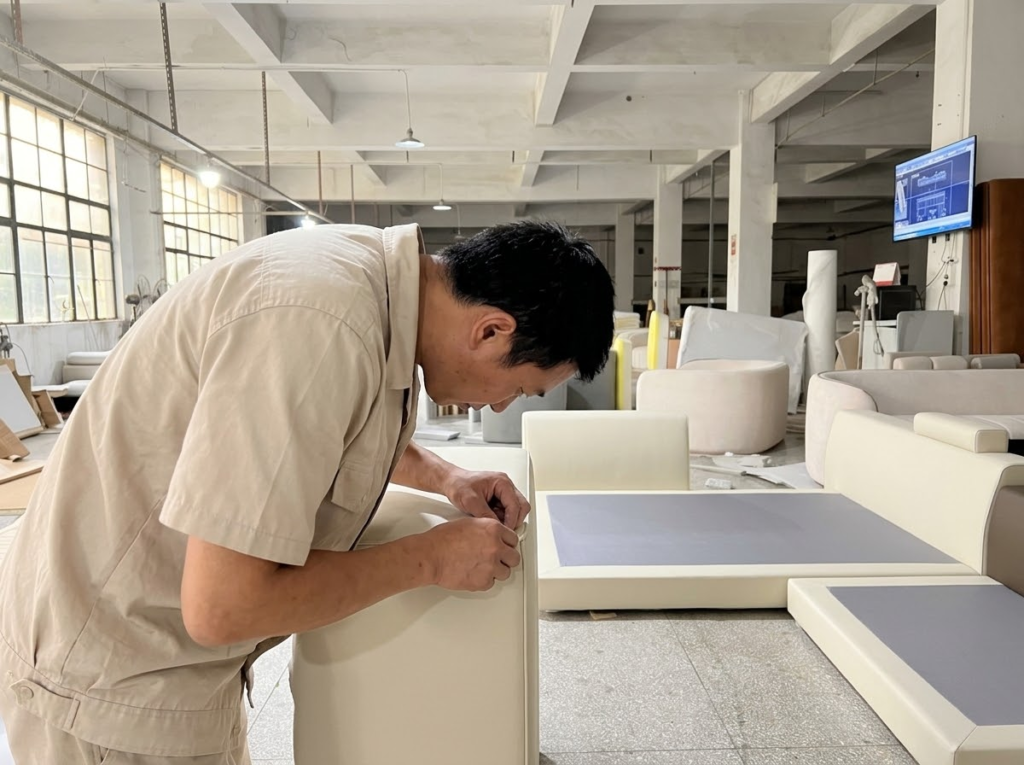
The analogy breaks down in one place, though. At dim sum, the chef isn’t simultaneously cooking for twelve other tables while guessing what you meant by “a little spicy.” In a Foshan upholstery factory, your villa’s sectional is one of forty projects running parallel. The foreman has seen a thousand sectionals. He’s also never heard of your designer, doesn’t know what “Bauhaus-adjacent” means, and thinks “relaxed luxury” is a contradiction in terms.
Why Your Mood Board Is a Foreign Language
What tends to happen is this: You send a beautiful mood board. They send back a sample that hits every technical spec and misses the soul by a mile. The proportions are right. The foam density is right. The fabric’s even the correct weave. But it looks like furniture for an airport lounge. Because that’s what the factory’s muscle memory knows. And muscle memory is stronger than your PDF.
But here’s the thing most architects never clock until it’s too late. The factory isn’t being difficult. They’re being efficient. They defaulted to what they know works at volume. Your job isn’t to find a “better” factory. It’s to find a factory that’s already bored by your product category. A place where your villa dining chair is the simplest thing they’ve built this month. That’s when the magic happens.
The Muscle Memory Problem
In my experience, roughly seven out of ten “quality problems” aren’t quality problems at all. They’re category mismatches. You took a hotel casegoods factory and asked for residential finesse. Or you found a rattan specialist in Anji and tried to pivot them into leather club chairs. The general pattern suggests that factories have a radius of competence. Stray outside it, and even good intentions turn expensive. Simple as that.
Where the Real Value Lives
Buying China FF&E is less like shopping and more like buying vinyl records. The pressing plant matters, sure. But the mastering engineer matters more. You can have the same lacquer, the same timber species, the same Italian leather. The difference is in who spec’d the build and who checked it.
I learned this the hard way in Dongguan. Walked into a factory that looked like a set from a science fiction film. Robots, clean rooms, the works. Hired them for a client’s master bedroom set. Disaster. The joints were perfect. The tolerances were surgical. And every piece felt like it was designed by an algorithm. Zero warmth. Because the factory’s strength was precision engineering for tech offices. They’d never built anything someone was supposed to actually live with.
The Robot vs. Lao Wang
The real kicker? Three miles down the road, a 15,000-square-meter workshop with paint peeling off the walls was turning out the best beds I’d seen in fifteen years. Family-run. Third generation. The owner’s daughter handled exports and had a degree from Melbourne. They didn’t have a robot. They had a guy named Lao Wang who’d been sanding oak for thirty years and could feel a half-millimeter bump blindfolded.
And here’s what cuts against conventional wisdom. You don’t want the biggest factory. You want the factory that treats your order like a reputation bet. Mid-sized operations — the ones doing, based on export data patterns, roughly $8 to $20 million in annual volume — are hungry enough to care and experienced enough not to rook you. The giants will take your villa order, but you’re a rounding error. The tiny shops will care, but they might disappear next quarter.
The Timeline Nobody Talks About
Sourcing FF&E from China is like renovating a kitchen where the contractor speaks a different dialect and all your materials come by boat. The demolition — the sampling, the spec’ing, the miscommunication — takes longer than the actual install. And you can’t live in the house until both are done.
Your client asks when the furniture will arrive. You say fourteen weeks. You’re lying. Not intentionally. You just forgot the invisible weeks. The ones where you’re waiting for a WeChat reply at 2 AM. The week where the sample arrives, looks wrong, and you realize you need to explain “patina” using only photographs.
The “Warm” Incident
I once watched a perfectly specified bedside table go through four sample rounds because the architect kept describing the finish as “warm.” Warm. Not a color. Not a sheen. A feeling. The factory sent four technically perfect samples. Each one was rejected for being “too cold.” The project lost six weeks to a word that doesn’t translate.
What most buyers miss: The factory’s production capacity isn’t your bottleneck. Your own decisiveness is. China can build anything. But “anything” requires decisions, locked. Every change order in week three of production doesn’t just delay. It introduces error. Because now your job is interrupting four other jobs. And the foreman’s solving a puzzle you keep re-shuffling.
If there’s one principle I’ve taken from fifteen years of this, it’s that clarity is cheaper than money. A drawing with six dimensions beats a mood board with six hundred pins. Every time.
The Factory Map Nobody Prints
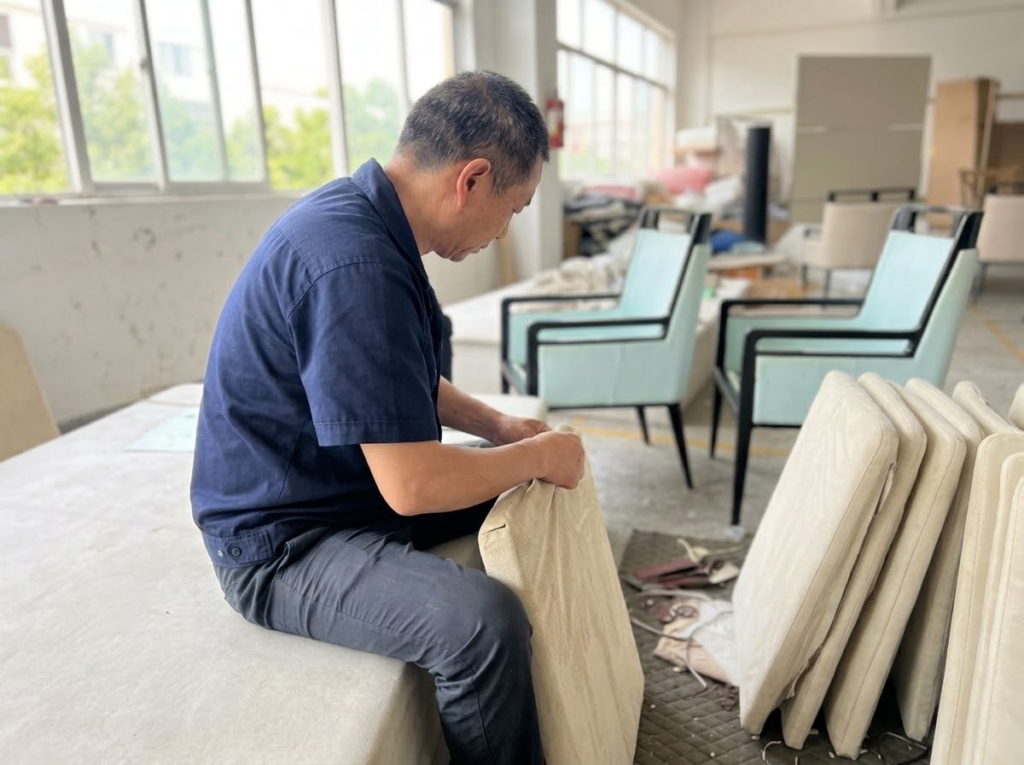
China’s furniture landscape isn’t one market. It’s a dozen microclimates. Foshan owns upholstery and solid wood casegoods. Longjiang, a district within Foshan’s orbit, pumps out metal frames and glass components so efficiently that European lighting brands quietly source there. Anji, up in Zhejiang province, is rattan and outdoor — a completely different supply chain, different skills, different seasonal rhythms. Nankang, near the Zhejiang-Jiangxi border, is where your hardware probably comes from even if your “Italian” handle was finished in Milan.
While some buyers gravitate toward large-scale manufacturers in Foshan with showrooms the size of aircraft hangars, others find that mid-sized specialists — operations like Interi Furniture, which focuses on high-end residential and hospitality FF&E from the Pearl River Delta region — offer a different risk-reward equation. They’re large enough to handle complex villa projects and small enough that your order won’t get lost in a hotel backlog.
表格
| Factory Type | Best For | Hidden Cost | Red Flag |
|---|---|---|---|
| Mega-factory (50,000+ sqm) | Hotels, large developments | You’re a small fish; slow to pivot | Sales team outshines production team |
| Mid-sized specialist | Luxury villas, boutique hotels | Higher unit cost; limited slots | Won’t show live production |
| Family workshop (<50 staff) | Custom one-offs, artisan detail | Inconsistent; thin compliance | No export license; cash only |
The trick isn’t finding “the best” factory. It’s finding the factory whose best work looks like your project.
The Pre-Flight Checkist
Don’t get on the plane until you’ve done this. Seriously. I’ve seen too many architects burn five-figure travel budgets wandering showrooms with no strategy.
Phase One: Homework (Before You Land)
- Lock your spec to 90% final. China isn’t the place to “see what’s possible.” The factory will build exactly what you show them. Vagueness is expensive.
- Prepare three reference images minimum for every single piece. Not one hero shot. One showing the front. One showing the side profile. One showing the detail zoom. Sounds like overkill. Isn’t.
- Get your client’s sign-off on material allowances. “Oak” isn’t a spec. “White oak, plain sawn, 8% moisture content, FSC-certified if available” is closer. The general pattern suggests that factories will default to the cheapest acceptable option unless you nail this down.
Phase Two: On the Ground
- Visit the production floor, not just the showroom. If they won’t take you there, leave. No exceptions.
- Ask to see a piece in progress that’s similar to yours. Not finished — in progress. You want to see how they handle the messy middle.
- Meet the project manager, not just the sales director. The PM is who you’ll actually talk to for the next four months.
Phase Three: The Deal
- Never pay 50% upfront. Industry standard is 30% deposit, 70% against shipping docs. If they demand half, they’re either cash-strapped or testing your naivety.
- Get penalty clauses for delay. Most Chinese contracts are light on this. Add it. Even if it’s never enforced, it signals you’re not a tourist.
The Red Flag That Breaks the Rules
Conventional wisdom says “go with the factory that has the best samples.” Wrong. Go with the factory that sent you a sample with one honest flaw and a WeChat voice memo explaining how they’d fix it. Perfect samples from a showroom are often smoke and mirrors. The factory willing to show you process over polish is the one that’ll survive a twelve-week production cycle.

FAQ: The Awkward Questions
Q: My client specifically said “no Chinese furniture.” Can I source there without telling them?
A: No. And more importantly, you shouldn’t want to. China FF&E procurement isn’t about tricking anyone. It’s about accessing manufacturing capability that doesn’t exist at scale elsewhere. If your client’s objection is political, that’s one conversation. If it’s based on 1990s quality stereotypes, show them a sample. The general pattern suggests that prejudice evaporates when someone sits on a $4,000 sofa that feels like $14,000. But the label on the crate? That’s your ethics. Disclose it.
Q: How do I handle the 30% deposit without getting burned?
A: You verify before you wire. Not just the factory’s existence — their current export license, their bank account name match, and whether they’ve done projects in your client’s tax bracket before. Based on export data patterns, the majority of scams target buyers who skipped this step because “the website looked professional.” Use an escrow if you’re under $50,000. Use a sourcing agent with skin in the game if you’re over. There is no substitute for someone in Dongguan who answers their phone at 10 PM local time.
Q: Is Foshan still the place to go, or has everyone moved to Vietnam?
A: Foshan is still the center of gravity for luxury residential FF&E. Vietnam has grown fast in upholstery and mid-range casegoods, but for complex mixed-material villa pieces — stone inlay, metal integration, custom lacquer — the supplier ecosystem around Foshan and Dongguan remains denser. What tends to happen is that Vietnam becomes part of a multi-country strategy, not a replacement. Yet.
Q: The wood cracked six months after installation. Who’s responsible?
A: Depends on where it cracked. Seam splits in dry climates? Usually a moisture-content mismatch — your spec, or the factory’s prep. Structural failure at a joint? That’s build quality. Here’s the hard part: most China factory warranties are twelve months and paper-thin. Your real protection isn’t the warranty. It’s the relationship you built during production. A factory that likes you will fix things. One that doesn’t, won’t. So be nice to Lao Wang. He remembers.
Q: Can I really get luxury-quality Chinese villa furniture, or is this just cut corners with good photography?
A: Yes. With conditions. You can get quality that rivals anything from Italy or Portugal. But you don’t get it by being the smartest person in the room. You get it by being the most specific. The factories that build for luxury villas in China are already doing it. The question isn’t whether they can. It’s whether you’ll give them a spec tight enough to let them.
The Real Lesson
Fifteen years in, I still get surprised. Not by the factories — by the buyers. By how often a brilliant architect will fly to Foshan with a mood board and no dimensions. By how frequently a procurement director with a Harvard M.B.A. will wire a deposit to a factory they found on a Tuesday.
China isn’t the wild west. It’s just a different rule set. One where relationships outrank contracts, where the production floor matters more than the showroom, and where your greatest asset isn’t your budget — it’s your patience.
At the end of the day, the villas that turn out best aren’t the ones with the biggest invoices. They’re the ones where the architect treated China FF&E procurement not as a discount aisle for Chinese villa furniture, but as a design partner. With all the mess, translation errors, and 2 AM WeChat messages that partnership entails.
So here’s my question: Are you flying to Guangdong to save money, or are you going because your design can’t be built anywhere else? Answer that honestly before you book the ticket. Everything else is just logistics.