

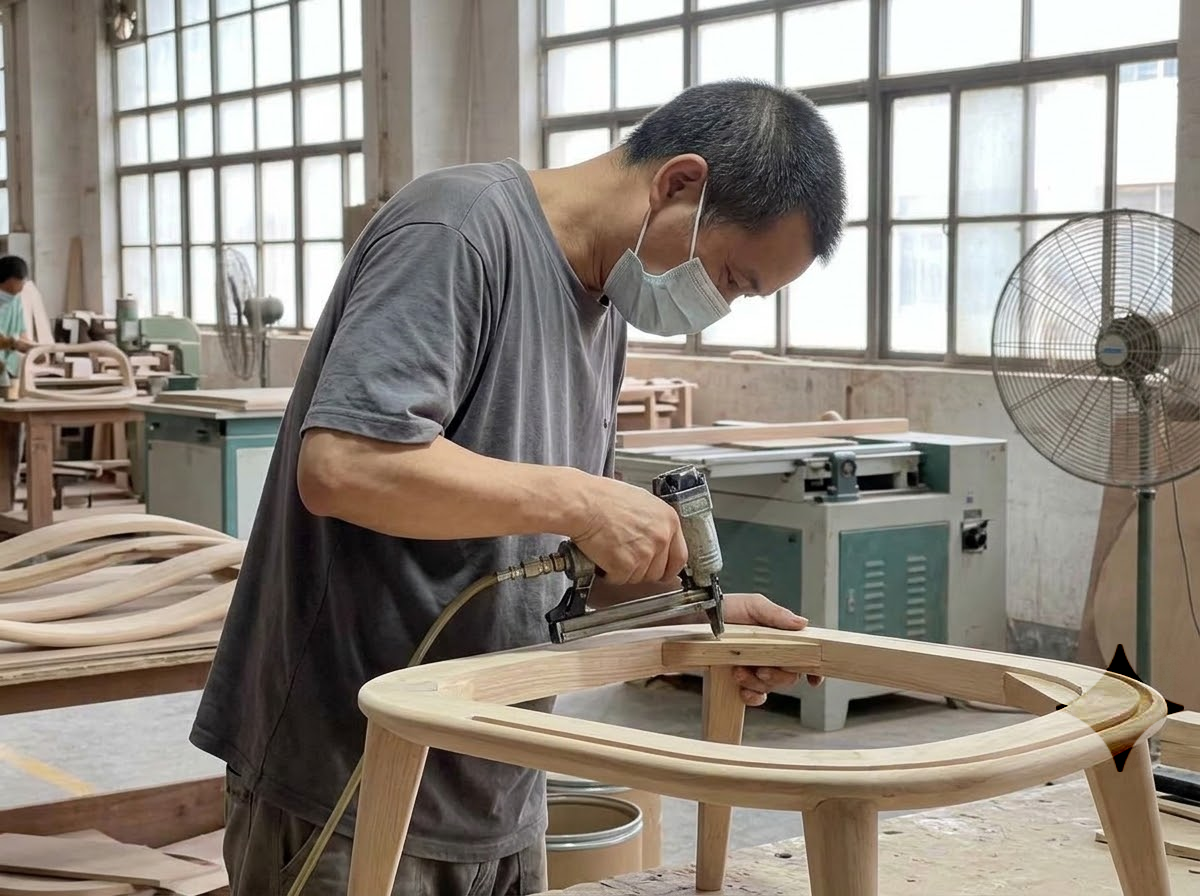
The showroom floor in Longjiang, Foshan, doesn’t look like a factory. It looks like a five-star hotel lobby that got drunk and multiplied. Marble samples stacked like poker chips. Leather swatches in colors that don’t exist in nature. Sales reps with iPads who quote prices before you finish your sentence.
I watched a designer from Denver walk into one of these showrooms last March. She had a $340,000 FF&E budget for a Colorado boutique hotel. Domestic sourcing would eat $280K. China, the agents promised, would land her under $190K. She flew fourteen hours, took the metro from Guangzhou South to Shunde, and stepped into a 180,000-square-foot facility that smelled of solvent and ambition.
Three hours later, she signed a deposit. The samples were gorgeous. The lead time was twelve weeks. The sales manager’s English was flawless.
Here’s what nobody told her. That sample room had dedicated lighting, climate control, and a team that polished every edge twice. The production floor, three floors up, had none of that. By August, her container arrived. Twenty percent of the upholstery had thread tension issues. The walnut veneer? Technically walnut. A paper-thin slice over MDF that warped in Colorado’s dry air.
Mara’s final spend? $312,000. Plus six weeks of delay. Plus one very angry client.
This is the story that doesn’t make it into the case studies.
The Brutal Truth About China FF&E Sourcing
Let’s get one thing straight. You’re not saving money. You’re trading money for time, risk, and complexity. The spreadsheet looks beautiful on Monday. It looks like a crime scene by Friday.
The factories know this. They’ve built an entire ecosystem around the gap between what you see in the showroom and what lands on your loading dock. And that gap is where margins live.
Here’s my rule of thumb: if the price seems too good to be true, the factory is either cutting a corner you haven’t thought of yet, or they’re planning to make it up on shipping, customs, or “unexpected material upgrades.” Sometimes all three.
You want to buy Chinese furniture as an interior designer? Great. But understand that China furniture sourcing is the process of translating your design intent through three layers of cultural interpretation, two time zones, and one supply chain that doesn’t care about your install date. The general pattern suggests that first-time buyers underestimate the soft costs by roughly forty to sixty percent. In my experience, roughly seven out of ten designers who fly solo on their first China sourcing trip end up hiring a fixer for their second.
Key Takeaway
- China FF&E sourcing rewards preparation, not optimism. The buyers who win are the ones who show up with specs tighter than a drum and a QC plan that starts before the first deposit clears.
- The “savings” are real, but they’re buried under layers of logistics, inspection, and relationship management that domestic sourcing doesn’t require.
- Your biggest risk isn’t a bad factory. It’s the assumption that a factory visit equals due diligence.
Where You Go Determines What You Get
China’s furniture map isn’t a monolith. It’s more like Italy’s wine regions—each area has a terroir, a specialty, and a personality that either matches your project or fights it.
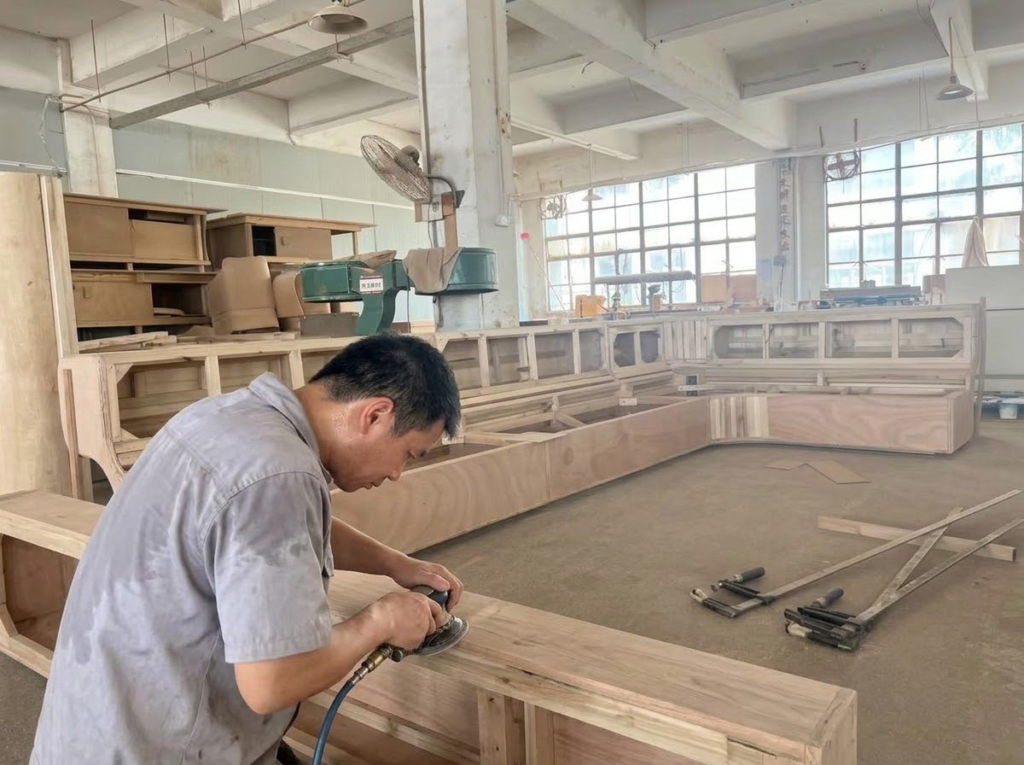
Foshan is the elephant. Shunde District alone accounts for a massive chunk of China’s furniture export volume. You’ll find everything here: solid wood giants in Longjiang, upholstery clusters in Lecong, metal and glass workshops scattered like confetti. If you need variety, Foshan is your supermarket. But here’s the thing. It’s also where the most sophisticated showroom theater happens. (And yes, this happens more than anyone admits.) A factory in Foshan can make you believe they’re crafting every piece by hand. What tends to happen is that seventy percent of the work is subcontracted to a facility three blocks away that you’ve never heard of.
Dongguan plays a different game. The city built its reputation on OEM manufacturing for global brands. The factories here are less flashy, more engineering-driven. If you’re sourcing casegoods with tight tolerances—think built-in wardrobes, reception desks, millwork—Dongguan’s ecosystem of precision tooling shops gives you an edge. But the showrooms are boring. Concrete floors. Harsh lighting. You’ll walk out thinking you’ve seen less magic than you paid for.
Anji, up in Zhejiang Province, is the quiet specialist. Chair frames. Bentwood. Anything that involves steam and curvature. Nankang in Jiangxi has become a hub for solid wood at mid-market price points. And if you’re looking at outdoor or rattan, the factories clustered around Guangdong’s Pearl River Delta have decades of weather-testing experience that inland plants simply don’t.
The real kicker? Most designers pick Foshan because it’s famous. They should pick the region that matches their product mix. A hotel lobby sofa sourced from a chair specialist in Anji makes as much sense as ordering sushi at a steakhouse.
Why the Sample Room Is a Lie (And How to Work Around It)
Walking into a Chinese furniture showroom is like falling in love on a first date. Everything is optimized for maximum impression. The lighting is calibrated to make walnut look richer and leather look deeper. The cushions are stuffed with high-resilience foam that costs three times what they’ll use in bulk production. That hand-rubbed oil finish? It took a senior craftsman four hours. Your production run will get thirty minutes from a worker who’s handling twelve other SKUs that day.
Actually, that’s not quite right. The problem isn’t the factory. It’s the expectation that what you see is what you’ll get. In domestic sourcing, there’s legal recourse, reputation risk, and a shared understanding of “good enough.” In China, “good enough” is a negotiated term. And if you didn’t negotiate it in writing, with physical samples sealed and signed, you’re getting the factory’s default definition. Which is almost never yours.
I learned this the hard way in Dongguan. A project needed two hundred dining chairs with a specific linen blend. The sample was perfect. The bulk shipment used a polyester mix that looked identical under showroom LEDs and completely different under natural light. The factory’s response? “Same color number.” Technically true. Practically useless.
The fix isn’t complicated. It’s just tedious. You seal three sets of production samples: one for you, one for the factory’s QC desk, one for your third-party inspector. You specify not just materials but sources—”full-grain leather from Hengli Tannery, Grade A, not Grade B.” You write tolerance into your contract: thread variance no more than 2mm, veneer matching within a single flitch, foam density verified by random cut inspection.
And here’s the thing most designers miss. You need to specify what happens when it’s wrong. Not “we’ll discuss rework.” Actual penalties, actual escrow terms, actual holdbacks. Because once that container hits the water, your leverage evaporates faster than morning fog over the Pearl River.
Guanxi Isn’t a Buzzword. It’s Infrastructure.
Western buyers love to mock the idea that business in China runs on relationships. They’ll say, “I just want to buy Chinese furniture, not join a family.” Fair enough. But the general pattern suggests that buyers who treat factories like vending machines get exactly what vending machines dispense: standardized, soulless, and occasionally stuck.
A factory owner in Longjiang once told me—over tea that lasted two hours longer than I planned—that he has three tiers of clients. Tier one gets the A-team craftsmen, the prime production slots, and the honest material quotes. Tier three gets whatever’s left after the good orders are filled. The difference between tiers isn’t order size. It’s trust. Or rather, the expectation of a future relationship.
This isn’t corruption. It’s risk management. The factory is taking a bet on you. If they believe you’ll reorder, they’ll absorb small overruns to keep you happy. If they think you’re a one-off tourist, they’ll optimize for margin and move on.
While some buyers gravitate toward large-scale manufacturers in Foshan, others find that mid-sized specialists—operations like Interi Furniture, which focuses on project-based hospitality FF&E with a reputation for tighter QC protocols than the average Lecong exporter—offer a different risk-reward equation. They’re not the cheapest. But they tend to answer emails at 10 PM. And in China, that matters more than any ISO certification hanging on the wall.
You don’t need to become best friends. You need to become a known quantity. Visit twice. Ask about their other clients in your segment. (Don’t expect names—expect descriptions.) Bring a small gift for the owner’s wife. Remember that the person who pours your tea might be the owner’s nephew who actually runs production scheduling.
The Factory Food Chain: Who Actually Makes Your Sofa?
Let’s talk about who you’re really buying from. Because in China, the name on the Alibaba page and the name on the production line are often two different entities.
At the top, you have the brand manufacturers. These are the companies with design teams, patent portfolios, and showrooms that look like Milan furniture fair booths. They don’t need your business. They’ll take it, but their minimums are high and their flexibility is low. Think of them as the luxury car dealerships of the furniture world.
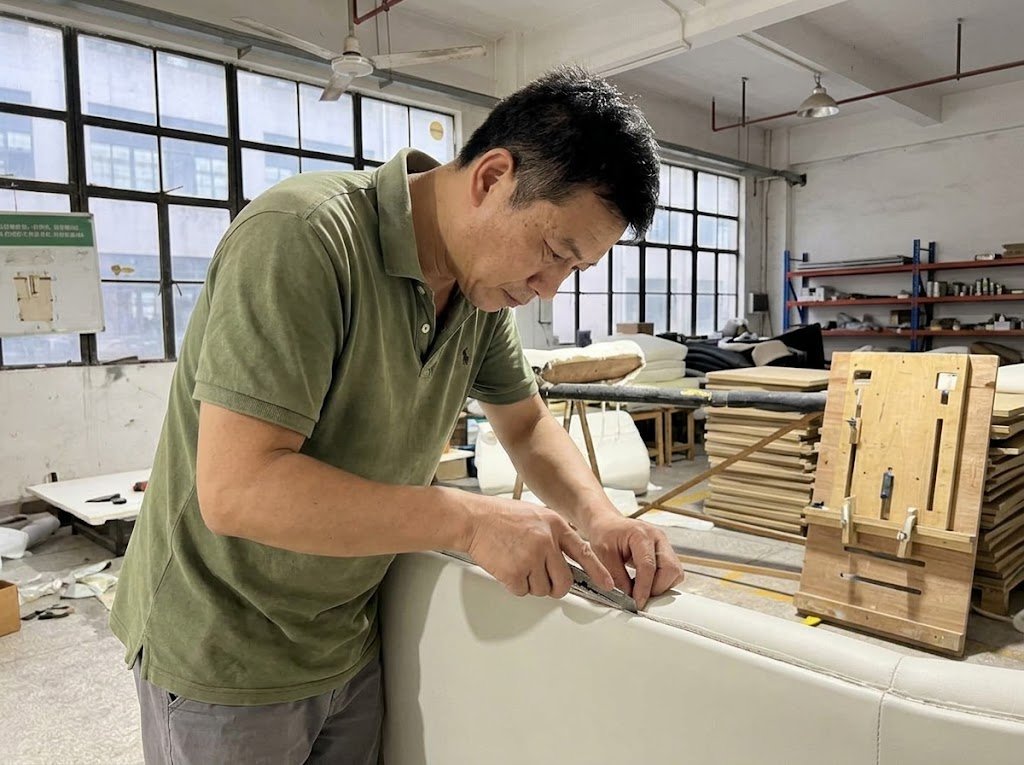
Below them sits a vast middle layer. These are the export specialists—factories that don’t design, they execute. They’ll build your custom headboard from a CAD file and a mood board. They live on volume, speed, and the ability to say “yes” to anything. This is where most designers shop. And this is where most problems start.
The bottom layer is the subcontractor network. You won’t meet these people. They’re the ones actually cutting foam, stitching leather, and spraying finish at 2 AM to hit a deadline. When a mid-tier factory gets overwhelmed, your order drops to this layer without warning. The quality drop is immediate. The notification is nonexistent.
The comparison table below breaks down what you’re actually getting at each tier:
| Tier | Typical MOQ | Customization | QC Consistency | Best For |
|---|---|---|---|---|
| Brand Manufacturers | 50+ units per SKU | Low (catalog-based) | High | Large hospitality chains replicating proven designs |
| Export Specialists | 10-30 units per SKU | High (OEM/ODM) | Variable | Boutique hotels, custom residential, unique FF&E |
| Subcontractor Layer | N/A (invisible to you) | N/A | Unpredictable | Nobody. This is where your order goes when things break down. |
Here’s the uncomfortable part. Most designers think they’re buying from tier two when they’re actually being shuffled between tier two and tier three depending on the factory’s capacity that month. You can’t prevent this entirely. But you can ask one simple question during your factory tour: “Which workshops on this floor handle my product category exclusively?” If they point to a corner that handles six different materials, you’re looking at a generalist. Generalists subcontract.
A Designer’s Pre-Flight Checklist
If you’re serious about interior designer China sourcing, you need a framework that starts six months before you book a flight. Not three weeks after the client signs off.
Phase One: Specification Lock (Month 1-2)
- Build your FF&E schedule with material callouts so specific they bore you. “Fabric” is not a specification. “Martindale rub count minimum 40,000, FR-treated to NFPA 701, with dye lot tolerance within Delta E 1.0” is a specification.
- Create a “sealed sample” protocol. Three identical sets. One stays in your office. One travels with you. One gets archived with the factory.
- Define your acceptable defect rate. Is 3% rework acceptable? 5%? Write it down. You’ll need this number when emotions run high.
Phase Two: Factory Vetting (Month 2-3)
- Shortlist eight to twelve factories. Contact them with your full spec sheet—not a mood board, not an inspiration image. The ones who respond with detailed questions stay on the list. The ones who send a price in forty-eight hours without asking about foam density or veneer grade are cut.
- Verify their export license. Not their business license. Their actual customs registration. (I learned this the hard way in Dongguan—a factory with a beautiful showroom couldn’t legally export without a middleman who added 18% to the cost.)
- Ask for three recent project references in your geographic region. Not client names—project descriptions and shipping dates. Cross-check against import records if you have access.
Phase Three: The Visit (Month 3)
- Never schedule more than three factory visits per day. Two is better. You need mental bandwidth to notice details: the cleanliness of the spray booth, the age of the CNC machines, whether workers wear masks consistently.
- Bring a moisture meter. Test raw wood stock. If it’s above 12% moisture content and headed to Arizona, you’ve got a future problem.
- Take photos of everything. Not for Instagram. For your QC inspector, who will use them as the baseline six weeks later.
Phase Four: Contract & Production (Month 4-5)
- Negotiate payment terms that hold 20-30% until after third-party inspection passes. Not “after shipment.” After inspection.
- Specify packaging. Double-wall cartons? Corner protectors? ISPM-15 stamped crates for solid wood? If you don’t write it, you’ll get whatever cardboard is cheapest that week.
- Assign a third-party inspector from a firm like Asia Inspection or Bureau Veritas. Not the factory’s “QC team.” An independent body with your sealed samples in hand.
Red Flag Checklist — The Items That Contradict Conventional Wisdom
- A factory that agrees to everything immediately. This usually means they don’t understand the spec, or they plan to reinterpret it later.
- A sales manager who quotes in perfect English but the production team speaks none. The message will degrade with every handoff.
- A showroom that updates its displays weekly. This sounds impressive. It actually means they’re a trading company, not a manufacturer. Real factories don’t have time to redecorate.

The Questions Designers Actually Ask (But Are Afraid to Voice)
Q: Can I really save money sourcing FF&E in China, or is that a myth from 2010?
A: Yes, you can save money. But the savings are backend-loaded. You’ll spend more upfront on travel, inspection, and specification work. The break-even point typically sits at projects above $150,000 in FF&E value, or when you need more than twenty custom pieces. Below that threshold, domestic sourcing with a reliable wholesaler often nets out cheaper once you account for your time.
Q: Do I need to speak Mandarin, or can I rely on the factory’s English sales rep?
A: You don’t need fluency, but you need a translator for production meetings. The sales rep’s English is polished for negotiation. The production floor operates in Mandarin and local dialect. Critical specifications must travel in writing, in both languages, with photographic evidence. Relying on verbal handoffs through a single English speaker is how thread colors turn from charcoal to “charcoal-ish.”
Q: How do I know if a factory is subcontracting my order without telling me?
A: You don’t. Not with certainty. But you can reduce the risk. Ask to see the raw material warehouse for your specific wood or fabric lot. Request mid-production photos with timestamps. Show up unannounced during production if your contract allows site access. The general pattern suggests that factories with in-house milling, upholstery, and finishing under one roof subcontract less than those who rent showroom space and coordinate dispersed workshops.
Q: What’s the one thing that kills China sourcing projects that nobody talks about?
A: Spec drift. You change a fabric. The factory changes a foam grade to match a “similar” price point. The client changes a dimension. Each change seems minor. Cumulatively, they create a product that doesn’t match the sealed sample, doesn’t pass inspection, and arrives two weeks before install with no time to fix it. Lock your specifications. Treat changes like surgery—necessary sometimes, but never casual.
Q: Is it worth it for a small design studio to source directly from China?
A: It depends on your risk tolerance and project pipeline. If you have one boutique hotel per year, probably not. If you’re scaling to three or more projects annually with repeatable FF&E packages, direct sourcing becomes a competitive advantage. The fixed costs of relationship-building and specification systems get amortized across multiple projects. Without that volume, you’re paying premium tuition for a class you only take once.
The Hard Question
Mara, the designer from Denver, flew back to China the following year. Different factory. Different province. She spent three weeks building a relationship with a mid-sized upholstery specialist in Anji before placing a single order. She paid 15% more than her first trip. She slept better. Her second hotel project came in on budget, on time, and the client wrote her a referral that landed a third.
The lesson isn’t that China sourcing works if you try harder. The lesson is that it works if you stop treating it like a transaction and start treating it like a design discipline. Every bit as rigorous as space planning, material selection, or lighting design.
So here’s the question I leave you with: if you’re not willing to manage your China sourcing with the same intensity you bring to your material boards, why are you getting on the plane at all?
Safe travels. Pack comfortable shoes. And for God’s sake, bring your own moisture meter.