

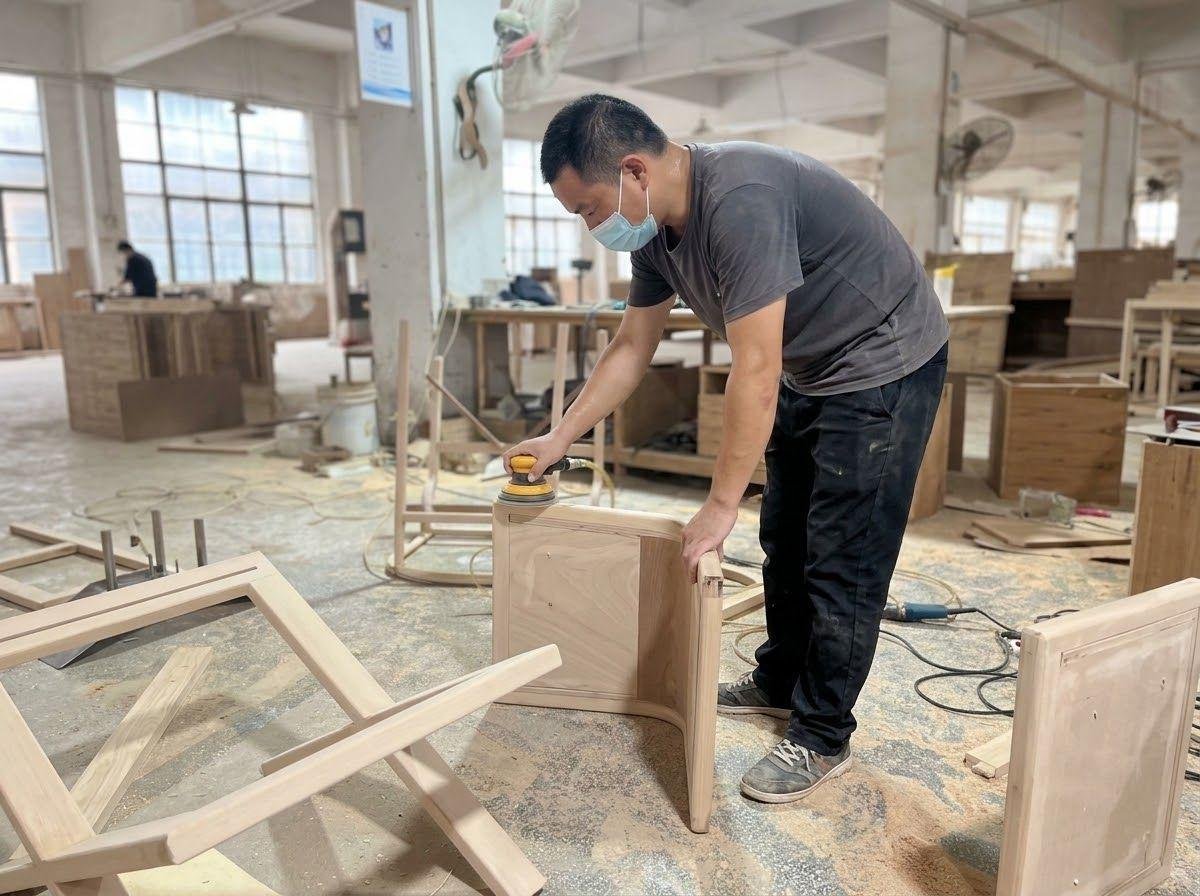
I was sitting in a Longjiang noodle shop last October, watching a guy from Miami sign a $340,000 purchase order on a plastic stool. No conference room. No PowerPoint. Just a WeChat transfer and a handshake that looked more like an arm wrestle. The factory he was buying from? No Alibaba page. No English website. Their business card looked like it came out of a 2003 printer. He found them through a group chat. Forty-seven members. Mostly Shunde factory owners who’d been doing business together since the Bush administration.
Fifty-two percent cheaper than his old Guangzhou supplier. Same E0 board. Same German edge banding. Same Blum hinges. The only difference? This Chinese panel factory wasn’t paying twenty-four grand a year to show up on your Google search. They had a workshop, a brother-in-law running the veneer press, and a QR code. That’s it.
You want to know where your margin is hiding? It’s not in better negotiation tactics. It’s in factories that don’t want to be found.
The Thing Nobody at the Booth Will Tell You
Here’s the uncomfortable part. The factory with the slickest brochure? You’re paying for that brochure.
Most buyers walk into this thinking they’re buying quality. Nope. You’re buying the marketing stack — the Alibaba Gold badge, the hired translator, the photographer who made particleboard look like it grew in Tuscany. Walk two streets over to the panel factory with the dusty loading dock and the owner who knows twelve words of English, and guess what? Same CNC router. Same German software. Same output.
If their website loads in under two seconds and they’ve got an English chatbot, add twenty percent to your unit cost. That’s not being cynical. That’s just math.
The real kicker? Some of the best custom work in Foshan comes from operations that don’t even have a website. WeChat. Word of mouth. Handshakes that don’t scale. Which means if you’re searching like everyone else searches, you’re paying what everyone else pays. Competing for the same fish in the same crowded pond.
Actually, wait. That’s not quite right. These factories aren’t hiding from everyone. They’re hiding from the wrong buyers. The ones who ask for twenty-unit quotes and vanish. Show up with a real project, clear specs, and a deposit ready? The door opens fast. Or rather, the WeChat verification goes through.
But you can’t just knock. This whole ecosystem runs on social proof. Someone vouches for you. A factory owner forwards your contact to his cousin who runs the veneer line. It’s less like procurement and more like getting into a restaurant that doesn’t take reservations. You need to know a guy. Or spend enough time on the ground until someone decides you’re worth knowing.
What “Custom” Actually Means When You Get Past the Showroom
China custom furniture isn’t a marketing label. On the factory floor, it’s an argument.
A catalog operation in Lecong has a showroom the size of a basketball court. You walk in, point at model K-2407, pick from four finishes, and they’ll ship two hundred units next month. Efficient? Sure. Predictable? Absolutely. It’s also why every mid-range hotel from Denver to Dubai looks like the same room rotated ninety degrees.
A real custom panel shop doesn’t have a showroom. They’ve got a sample room the size of a closet. Walls plastered with swatches from projects you’ve never heard of. A boutique hotel in Hamburg. A co-working chain in Singapore. Some architect in Melbourne who dreamed up a curved reception desk after three glasses of Barolo and expected someone to actually build it.
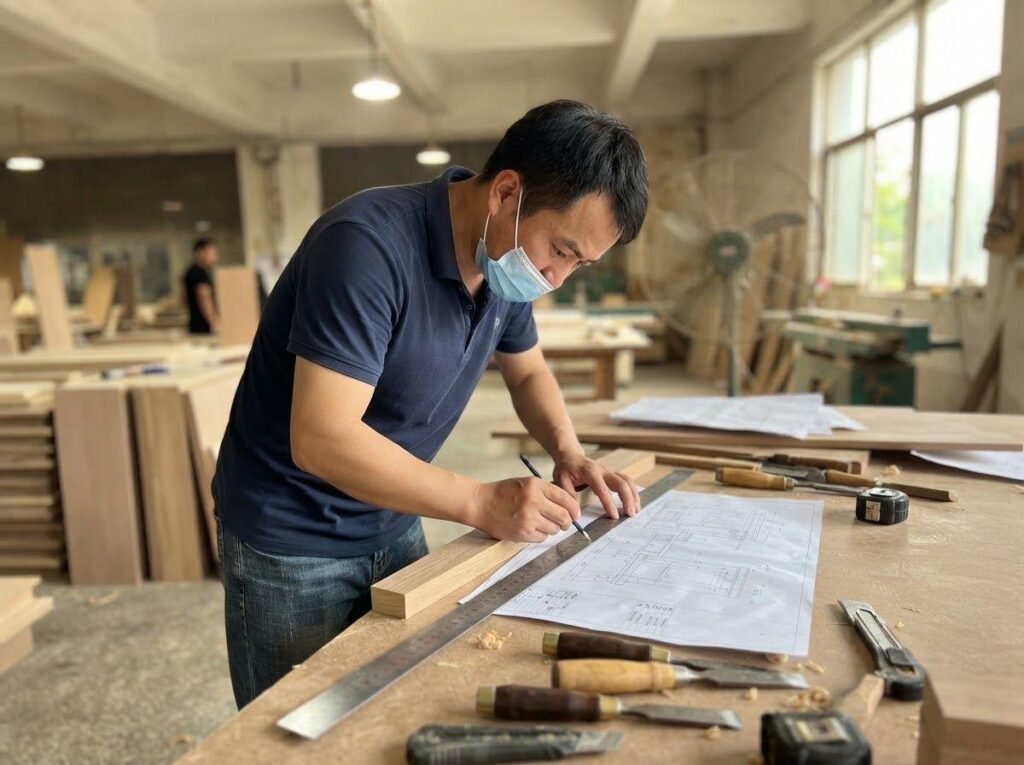
Here’s where it gets interesting. At a catalog factory, you say “Can you do this?” and they say “Yes. Surcharge fifteen percent.” At a custom shop, you show them a drawing and they look at you like you’re crazy. “Why that joint? Manila humidity will split it in eighteen months. Use this instead.” They’ll push back. Tell you your spec is wrong. Argue with you.
That’s the signal. The factory that questions your drawing is the one you want.
While some buyers gravitate toward the big names in Foshan, others find that mid-sized specialists — operations like Interi Furniture, which focuses on project-grade hospitality and residential panel work — offer a completely different risk-reward equation. They’re not the cheapest, and they don’t try to be. But they sit in that sweet spot: big enough to handle volume, small enough to take a phone call when you want to change the drawer depth on unit forty-seven of a two-hundred-unit hotel order. That flexibility? You don’t get that from a factory running three shifts on a single catalog item.
The Geography Scam
Every sourcing guide sends you to Foshan, Dongguan, Shenzhen. Write the article, book the Hilton, fly home. Done.
But the map is more broken than that. Yeah, Shunde District is the real deal — Longjiang for soft goods, Lecong for hard goods. The concentration is insane. Foam supplier to hardware wholesaler to veneer press in twelve minutes of walking. That’s not hype.
What they don’t tell you about is the satellite belt. Nankang, down in Jiangxi. Anji, up in Zhejiang. These aren’t secondary markets. They’re primary production zones with cheaper rent and lower wages, feeding straight into Foshan’s logistics hub. A factory in Nankang might be paying forty percent less in land costs than its Foshan competitor. That gap flows straight to your unit price.
I’ve seen Nankang shops producing panel work for European hotel chains that their Foshan counterparts wouldn’t touch. Too thin a margin. The Foshan factory had a showroom to maintain. Marble floors. A receptionist with a headset. The Nankang operation had a concrete floor and a dog that slept in the packing area. Guess which one could afford to take your job?
Chen’s Workshop: A Template for the Invisible
Let me tell you about a place I visited in Dongguan back in 2019. Still running today. Still unlisted. Three brothers. About forty-two hundred square meters. No website. The youngest brother drove a 2008 Honda CR-V with a cracked windshield and didn’t care.
They built custom reception desks and built-in wardrobes for boutique hotels across Southeast Asia. Roughly $3.2 million a year in output. Client acquisition? Zero. Every single job came from referrals within a WeChat network of Singapore and Bangkok interior designers.
Sales department? The youngest brother’s iPhone. QC? The middle brother walking the floor with a tape measure and a cigarette. Lead time? Four weeks faster than their listed competitors because they weren’t drowning in random Alibaba inquiries from buyers who’d never convert.
Export docs? They didn’t handle them. Sold FOB Shenzhen to a freight forwarder. The buyer never knew the factory’s real name. Just a WeChat ID and a bank account.
This isn’t a weird outlier. This is a template. There are dozens of Chen’s Workshops scattered through Guangdong and Zhejiang. Probably hundreds. They’re the backbone of the Chinese panel factory ecosystem that never shows up in your search results.
How to Actually Map This Thing
Stop searching. Start mapping. Here’s the playbook.
Forget Alibaba for a month. I mean it. Take that time and dive into Xiaohongshu and WeChat instead. Search in Chinese: 定制家具工厂, 板式家具代工, 酒店家具定制. Use Google Translate. Screenshot everything. You’ll find factory owners posting photos of their workshop floor at 11 PM, complaining about a rush order. That’s gold.
Find the ghost trade shows. Not CIFF. The regional ones in Nankang, in Anji, in basement halls that don’t make the English calendar. Booth space costs eight hundred bucks, not eight thousand. The unlisted factories show up here because they can afford to.
Hire a fixer, not an agent. Someone who grew up in the district, speaks the local dialect, and isn’t trying to place you with their cousin’s operation for a kickback. Pay them a day rate. No percentage. Their job is to get you into workshops that don’t have signs.
Visit the wrong address. If a factory lists a suite in a commercial building, ask to see the actual workshop. The real one. Not the showroom. If they hesitate — if there’s a ten-minute car ride involved — that’s actually a good sign. It means production is separate from the sales front. But if they refuse? Walk.
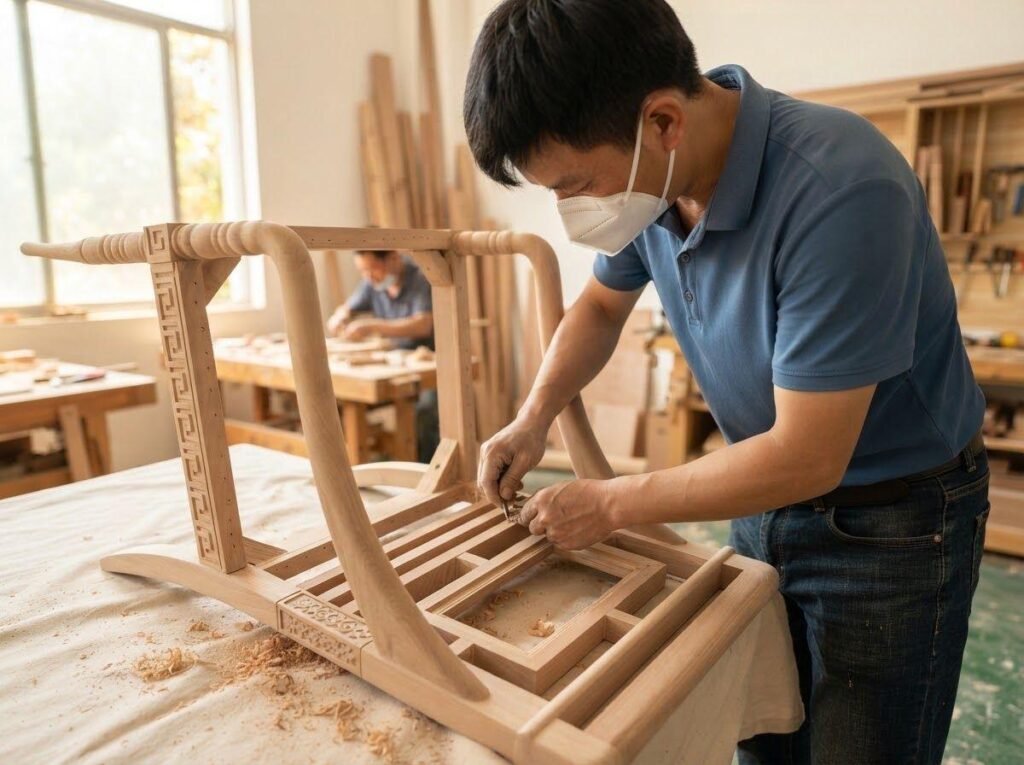
Order the stupid sample. Ask for something slightly wrong. A weird dimension. A mismatched veneer. A catalog factory will say no or charge a fortune. A custom shop will ask why, then prototype it in three days. That’s your filter right there.
Pay faster than you need to. First invoice? Clear it in fifteen days instead of thirty. These operations are cash-flow sensitive. Speed builds trust faster than any gift basket ever could.
Bring them a problem before you bring them a PO. Call with a spec issue. Ask for advice. The factory that helps you engineer a solution before money changes hands? That’s your long-term partner.
Introduce them to someone else. This whole ecosystem runs on reciprocity. Know a designer in Dubai who needs panel work? Make the introduction. That social debt pays back in ways a contract never will.
Now here’s the red flag that breaks conventional wisdom: a factory with too many export certifications and a perfect English website is sometimes a bigger risk than a factory with a handwritten business card and a workshop that smells like hot glue. The over-certified operation? Often a trading company in a nice suit. The glue-smell place? Probably the actual producer. I’ve been burned by the former more times than I care to admit.
The Numbers Nobody Wants to Show You
| What You’re Paying For | Listed B2B Factory | Unlisted/Referral Factory |
|---|---|---|
| Overhead markup | Platform fees, marketing, English staff | Minimal. They don’t have a receptionist. |
| Price talk | Fixed sheets. Take it or leave it. | Negotiable. Relationship-based. |
| Minimum order | Strict. Often 100+ units. | Flexible. Depends on the project. |
| Sample speed | Two to three weeks | Three to seven days |
| How deep they’ll customize | Catalog variations only | Full engineering collaboration |
| Payment terms | Standard 30/70 | Negotiable. Often faster cycles |
| The real risk | Impersonal. You’re a number. | Higher trust threshold upfront. Lower cost long-term. |
Key Takeaways
- The best-priced custom panel factories in China intentionally avoid B2B platforms. Visibility costs money, and you’re the one paying for it.
- Expand beyond Foshan. Nankang, Anji, and other satellite zones offer equivalent machinery at lower overhead.
- Social proof beats certificates. A referral from a trusted factory owner is worth more than a Gold Supplier badge.
- Validate production, not presentation. The workshop tells the truth. The showroom tells a story.

FAQ: The Awkward Questions Buyers Actually Ask
Q: I don’t speak Chinese. Never been to China. Can I still find these factories?
A: Yeah, but not from your laptop. You need boots on the ground — a fixer, a translator who’s actually walked factory floors, or a designer who’s already mapped the district. This ecosystem doesn’t do cold emails. It does face time. Budget one week in Foshan or Dongguan. Walk the industrial zones. Eat where the factory owners eat. By day three, your fixer starts getting WeChat introductions. That’s the machine. That’s how it turns.
Q: How do I know some unlisted factory won’t just take my deposit and run?
A: You don’t. Not at first. That’s the trade-off. Start small — an eight-hundred-dollar sample order. Pay via something that leaves a paper trail. Never wire full payment upfront to a factory you haven’t walked through. But here’s the thing: a factory that’s been running fifteen years on referrals has more to lose burning you than keeping you happy. Their entire client list is their credit score. A listed factory can always buy another Alibaba account and start over.
Q: What’s the real price gap? Same hotel panel spec, listed versus unlisted.
A: In my experience, about thirty to fifty percent on unit cost for comparable specs. But the bigger savings usually hide elsewhere — faster sampling, no MOQ fights, and the ability to engineer out expensive details without getting hit with a “custom surcharge.” One buyer I worked with cut total landed cost by forty-two percent. Not because the unit price dropped. Because the unlisted factory suggested a joint configuration that killed two hours of assembly labor per hotel room. Nobody thinks about that until they’ve installed three hundred units.
Q: Do these factories even want Western buyers?
A: Some do. Some don’t. The ones that do are usually hunting for stable, long-term relationships — not one-off orders. They’ll be direct about it. If a factory owner spends an hour explaining why your timeline is insane, that’s interest. If they send a one-line quote and go dark, move on. This ecosystem is efficient. It doesn’t waste time.
Q: Is the fifty percent thing real, or just a headline?
A: Depends what you’re buying. Five hundred identical nightstands in white melamine? Probably not — the catalog giants have already squeezed that lemon dry. But custom panel work? Mixed materials? Non-standard dimensions? Project-specific engineering? Yeah. Fifty percent is achievable. I’ve watched it happen. The catch is it requires work most buyers won’t do. Most buyers want to click “request quote” and call it sourcing. That’s not sourcing. That’s shopping.
The Hard Lesson
The industry loves a shortcut. A sourcing agent who promises the moon. A platform that ranks factories with stars. A trade show where you can “see everything in three days.”
But the margin that wins you the hotel bid? The margin that lets you undercut a competitor on a residential tower? It doesn’t live in the shortcuts. It lives in the gravel parking lots. The WeChat groups. The factories that don’t want to be found because they’re already busy enough.
You want the fifty percent? Stop searching where everyone else searches. Start walking where nobody walks.
And bring a fixer who knows the good noodle shops. Factory owners talk more over lunch than they ever do in a meeting room.