

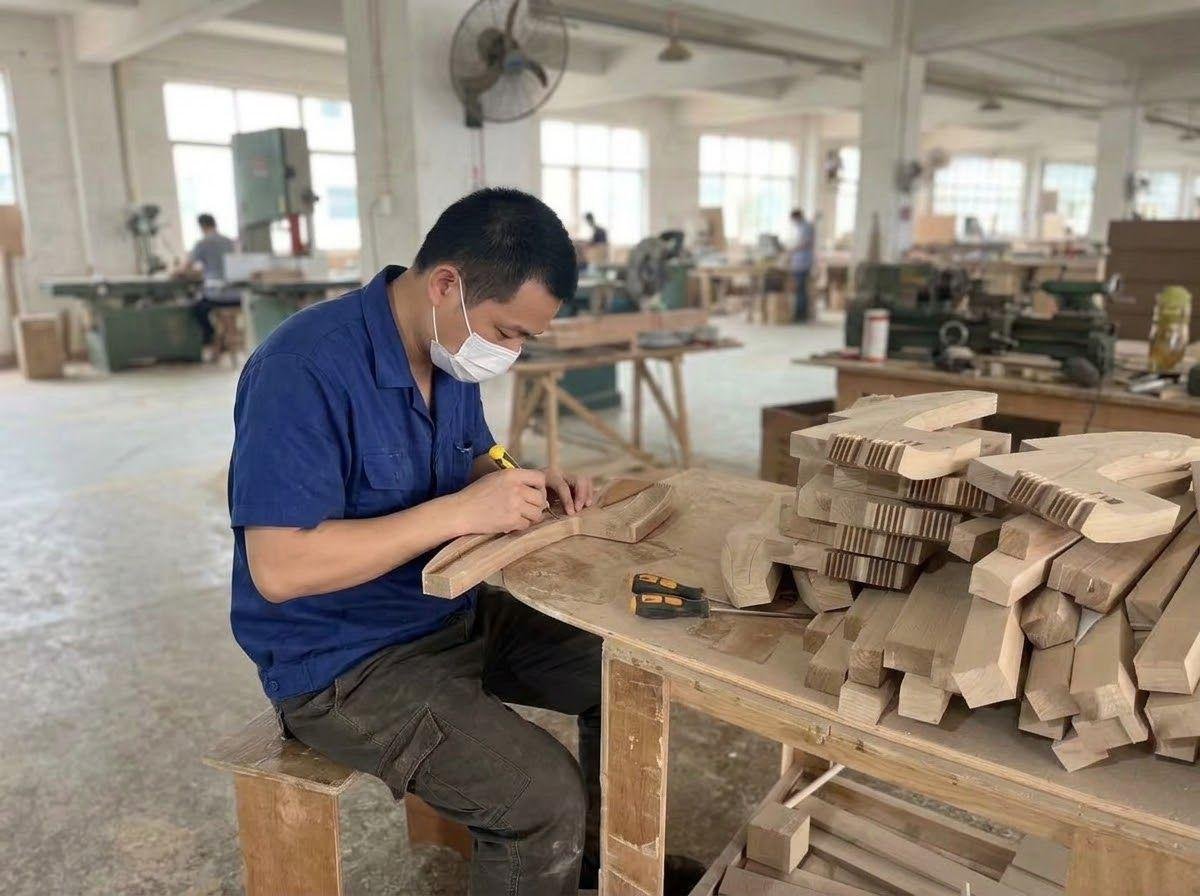
Last March, I stood in a factory in Longjiang, just south of Foshan, watching an old-timer attack a perfectly good oak tabletop with a belt sander. The machine screamed. Sawdust flew everywhere. The sales manager nudged me and grinned — “wabi-sabi distressing,” he called it. That table would retail for $2,400 in a Brooklyn boutique. His cost? Under ninety bucks, materials and labor combined. The client was a boutique hotel chain out of Austin, and they’d sent over an Instagram screenshot of some Japanese farmhouse as their “reference.”
I didn’t say a word. Not my reputation, not my money. But that same week I met a dozen other buyers who’d flown sixteen hours from LA, London, Melbourne — Pinterest boards in hand, that dreamy look on their faces. Most of them would fly home and eventually receive a container full of “imperfect” furniture that was, in fact, perfectly mass-produced.
Here’s the thing: authentic wabi-sabi woodworks do exist in China. You’re just looking in the wrong places. And you sure as hell won’t find them in factories pushing five hundred tables a day.
The Brutal Truth: You’re Probably Shopping in the Wrong Place
Nobody at the Canton Fair tells you this. The vast majority of “artisan” or “wabi-sabi” China wood furniture isn’t made by artisans. It’s made by line workers following a distressing SOP. Scratch here. Sand there. Steel wool and vinegar bath. Two hours in the sun. Done.
Can buyers actually tell the difference? A lot of them don’t even want to. They need the story of imperfection, not the thing itself. And the factory knows. “Hand-forged” hardware? Drop-forged in bulk at some Dongguan plant. “Hand-shaped” legs? CNC-carved, then someone hits them with sandpaper for thirty seconds. Is it a scam? Hard to say. It’s market segmentation with a bit of smoke and mirrors.
Bottom line: if a factory can hand you a catalog page labeled “Wabi-Sabi Collection” with twelve matching SKUs and a thirty-day lead time, you’re not buying craft. You’re buying theater. Real irregularity doesn’t scale to SKU numbers.
Key Takeaways — Don’t Skip This
- China wood furniture runs the full spectrum from CNC mass production to genuine hand-finish workshops, and telling them apart means looking at workflow, not showroom photos.
- “Wabi-sabi” as a marketing label has been industrialized; authentic pieces come from operations with inconsistent output, not polished catalogs.
- The best Chinese custom artisan workshops typically hold no export license, run no English website, and have zero interest in orders under $15,000.
- Geography matters more than most buyers realize: Foshan does volume, but smaller clusters in Zhejiang and Jiangxi hide the actual wood specialists.
What “Wabi-Sabi” Actually Means on a Chinese Factory Floor
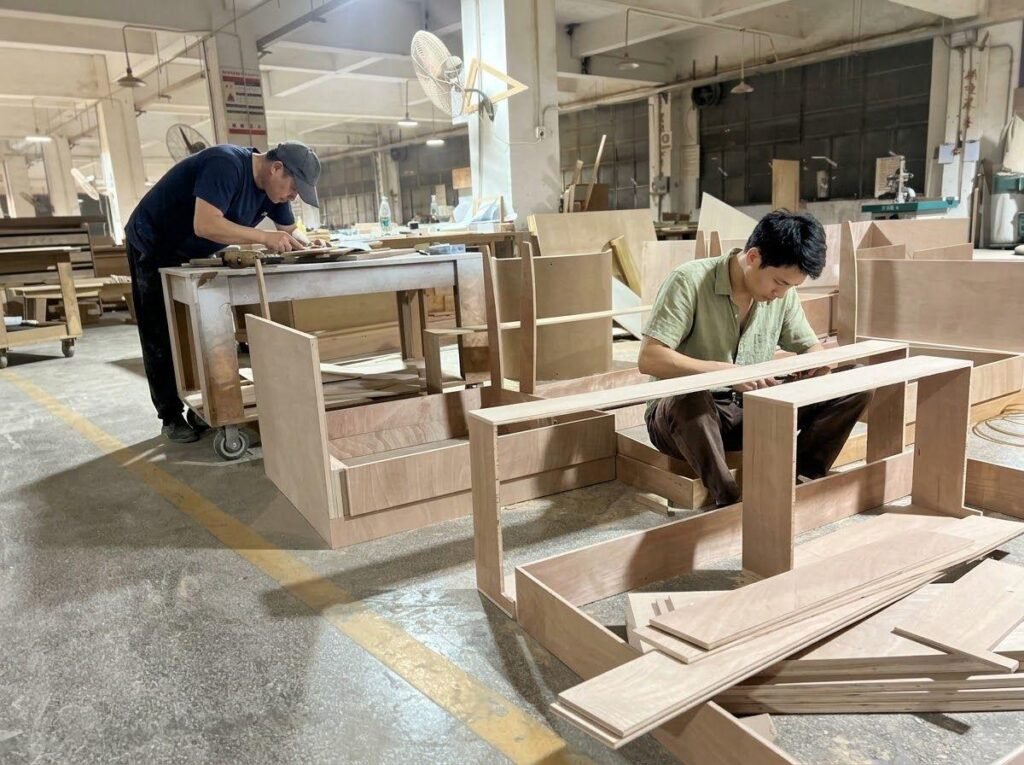
China wood furniture production sits on a spectrum that Western buyers rarely map correctly. On one end, you’ve got the mega-factories in Shunde District — football-field-sized facilities where a single dining table moves from rough-cut to packed container in seventy-two hours. On the other, you’ve got tiny workshops tucked behind hardware stores in Anji or down the backstreets of Zhongshan — three guys and a dog, building ten chairs a week.
Your sourcing strategy lives or dies based on whether you can tell these two worlds apart.
Think of it like this: hunting for authentic wabi-sabi inside a Foshan showroom is like trying to find real sourdough inside a Walmart. The flour’s there. The oven’s there. But the entire system is built for something else. Mass production rewards consistency. Wabi-sabi, by definition, rewards the opposite. Every knot, every uneven joint, every “imperfect” finish — in a factory that lives and dies by QC pass rates, those are all defects.
And yet. The best pieces I’ve seen in fifteen years didn’t come from the slickest showrooms. They came from workshops where the owner still touches every single board that walks through the door. (And yeah, this happens way more than anyone admits — you just won’t find these guys on Alibaba.)
Is There Even a Word for Wabi-Sabi in Mandarin?
Not really. Not the way buyers use it. You’ll hear cūcāo (rough) or gǔpǔ (simple and ancient). But that whole philosophical package — impermanence, imperfection, incompleteness — that’s not a sales pitch in domestic China. It’s an accident. Which is actually the entire point. A Chinese custom artisan isn’t trying to make “wabi-sabi furniture.” He’s trying to build a solid chair that doesn’t fall apart. The patina comes from time, not from a staining protocol.
I remember a workshop in Nankang, Jiangxi, where the owner had been curing camphor wood slabs under his roof for eleven years. Eleven years. He wasn’t “aging” them for effect. He was waiting for the moisture content to stabilize so the joints wouldn’t crack once they hit a dry climate. The result? Surfaces that looked like they’d been pulled from a century-old temple. Buyers from Sydney walked in and lost their minds. The owner just shrugged. “Wood needs time.” That was it.
Why the Best Workshops Deliberately Hide from You
Here’s an insider reality that breaks most procurement models. The workshops capable of real irregularity — the kind that reads as authentic rather than sloppy — usually can’t handle your paperwork. No FSC certification. No export license. Sometimes no business license at all. Just one old guy, his father taught him joinery, and he takes orders over WeChat.
Wait — actually, that’s not quite right. What most buyers miss is that these workshops could get certified if they felt like it. They don’t want to. Certification means audits. Audits mean standardization. And standardization kills the very thing you’re paying a premium for.
So you end up with a paradox. The more legitimate a factory looks on paper — the ISO badges, the English website, the dedicated sales team — the less likely they are to produce what you’re actually after. It’s not corruption. It’s structural.
The Geography of Authenticity: Where the Wood Actually Comes From
If you treat China like one giant furniture store, you’ve already lost. The country has distinct wood-working cultures the same way Italy has distinct wine regions. And just like you wouldn’t expect a great Barolo from Sicily, you shouldn’t expect hand-planed walnut from a factory built for melamine-covered plywood.
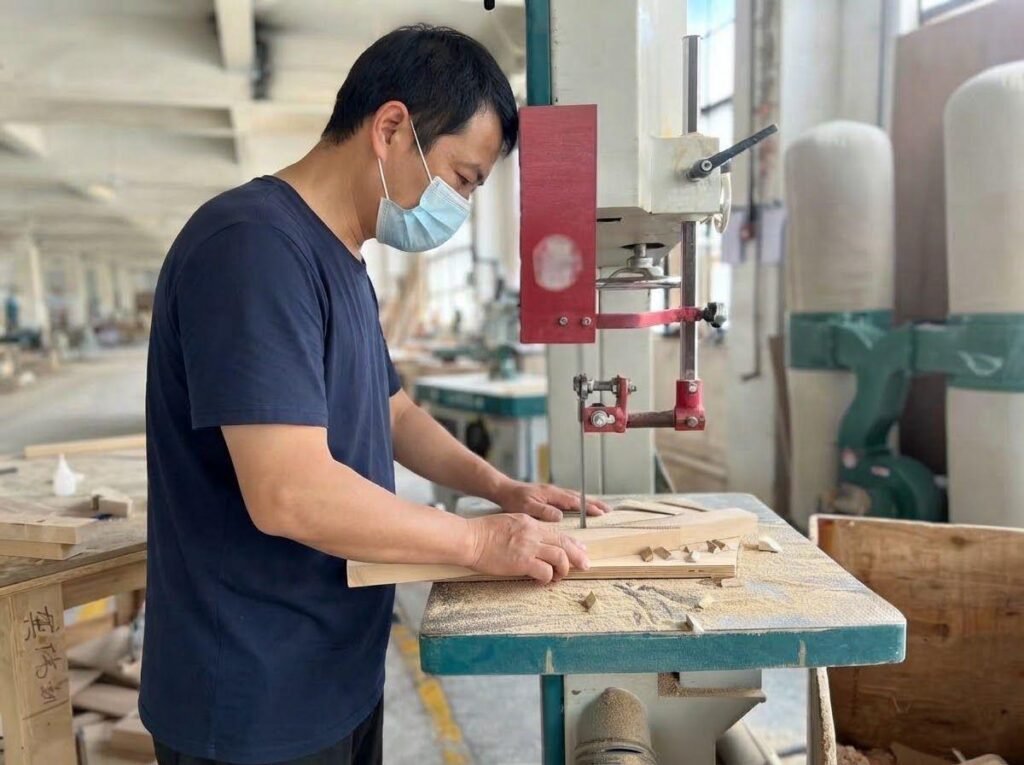
Foshan — specifically Shunde and Longjiang — is the elephant in the room. It’s where seventy percent of export buyers start, and where eighty percent of them should probably stop. The ecosystem is unbeatable for volume, speed, and price. You want two hundred identical oak tables with a “distressed” finish? Six weeks. $280 a unit. But the wood culture there is engineered wood and veneer over solid hardwood. It’s a plywood town that learned to dress up. Nothing wrong with that. Just don’t ask it to be something it’s not.
Dongguan sits in a different category. Historically a manufacturing hub for everything under the sun, it’s developed a niche in mid-to-high-end solid wood for the domestic market and Japanese export. The Japanese connection matters. Japanese buyers have been sourcing from Dongguan woodshops for three decades, and they’ve trained a generation of factories to care about joinery, seasonal wood movement, and quiet finishes. If you’re looking for China wood furniture that doesn’t scream “hotel lobby from 2014,” Dongguan is where I’d point the car first.
Then there’s the sleeper. Anji, in Zhejiang Province. Bamboo capital of the world, sure, but also home to a quietly thriving hardwood scene serving the domestic high-end market. The general pattern suggests that Anji workshops specialize in what I’d call “honest construction” — visible tenons, natural oil finishes, no hiding the wood’s personality under thick lacquer. They don’t export much. They don’t need to. But for buyers willing to navigate the language barrier and accept longer lead times, the value is absurd.
While some buyers naturally gravitate toward large-scale manufacturers in Foshan, others find that mid-sized specialists — operations like Interi Furniture, which focuses on project-grade solid wood and hospitality custom work — offer a different risk-reward equation. They’re not the three-guys-in-a-shed operation, but they’re also not running million-square-foot plants. For boutique hotel projects that need consistency across eighty rooms without surrendering to total mass production, that middle tier is worth understanding.
Why Nankang Changes the Math
Nankang, in Jiangxi Province, is the furniture manufacturing base most international buyers have never heard of. Based on export data patterns, it ships roughly thirty percent of China’s solid wood furniture by volume, yet it has almost zero international brand recognition. That’s because Nankang built its economy on the domestic market — supplying China’s own interior boom — and only recently started fielding export inquiries.
What does this mean for you? It means lower prices on genuine solid hardwood than you’ll find in Guangdong. It also means less English fluency, less experience with international shipping, and a higher tolerance for “good enough” finishing. The workshops here are rougher. The wood is realer. Your job as a buyer is deciding which side of that trade-off you can live with.
| What You’re Looking At | Mass-Production “Wabi-Sabi” | Authentic Workshop Output |
|---|---|---|
| Typical Location | Foshan, Shunde showrooms | Dongguan, Nankang, Anji backstreets |
| MOQ Flexibility | 20–50 pieces, mixed container | Often 1–2 pieces, or 30+ identical |
| Lead Time | 4–6 weeks | 10–16 weeks, sometimes longer |
| Finish Variation | Identical distressing patterns | Genuine variation piece to piece |
| Price (dining table) | $180–$400 | $600–$1,200+ |
| English Sales Support | Fluent, dedicated team | Limited; often via agent only |
| Best For | Budget-conscious hospitality | Design-led boutique projects |
A Buyer’s Decision Tree: How to Vet What You’re Actually Getting
China wood furniture sourcing is the process of identifying, vetting, and procuring wooden furnishings directly from manufacturers and artisan workshops across China’s specialized industrial clusters. Sounds like a textbook. It isn’t. Here’s how to do it without flying home with a container full of regrets.
Step 1 — Flip the script on your first contact. Don’t ask “Can you make this?” Ask “What do you actually build every day?” A factory that cranks out three hundred nightstands a week can’t pivot to hand-carved headboards because you sent a photo. Their answer tells you the truth.
Step 2 — Demand process photos, not just finished pieces. Anyone can stage a showroom. Ask for images from the rough-cut stage, the joinery stage, the finishing room. If they hesitate, there’s a reason. (I learned this the hard way in Dongguan — a “solid walnut” bed turned out to be walnut veneer over poplar. Process photos would’ve caught it in a heartbeat.)
Step 3 — Check the wood source, not just the species. “Oak” means nothing. American white oak? Russian oak? Chinese plantation oak? The general pattern suggests that workshop-grade operations will tell you the country of origin without prompting. Mass factories will say “oak” and hope you don’t ask.
Step 4 — Test with a sample order that includes intentional variation. Order three pieces of the same SKU. If they arrive identical — same color, same grain pattern, same “distressing” marks — you’re looking at a production line, not a Chinese custom artisan. Real wood breathes. Real handwork varies. Accept no substitutes.
— Red flag that contradicts conventional wisdom: If the factory has a beautifully curated Instagram feed, professional product photography, and a slick English website, be more skeptical, not less. The operations that can afford that marketing infrastructure are, by definition, charging you for it. And they’re almost certainly too big to give your “authentic imperfection” the attention it requires.
Step 5 — Visit the finishing room last. Save it for the end of your factory tour. Why? Because that’s where the lie lives or dies. A real oil finish smells like oil. A fake “aged” finish smells like chemicals, vinegar, or nothing at all. Your nose knows. Trust it.

FAQ: The Questions Buyers Actually Ask (But Are Afraid to Voice)
Q: Can I really get authentic wabi-sabi furniture from China, or is it all just mass-produced junk with good photography?
A: Yes, you can. But it’s not found through the same channels that sell you mass-produced junk. Authentic pieces come from small-to-mid workshops in clusters like Dongguan, Nankang, or Anji — places where wood selection and hand-finishing are part of the daily workflow, not a special-order upsell. The catch? You’ll need to look past the first page of Google, accept higher minimums than you’d like, and probably visit in person. It exists. It’s just not convenient.
Q: How do I know if a factory is actually hand-finishing or just running pieces through a distressing machine?
A: Ask to see the “same” piece from three different production batches. Machine distressing uses templates — you’ll see identical scratch patterns, identical “wear” marks. Hand-finishing varies. Plus, look at the back and underside. Mass factories distress only the visible surfaces. A workshop that actually cares will have finished the parts nobody sees.
Q: What’s a realistic budget for a small hotel project — say forty rooms — if I want real solid wood with honest finishes?
A: Based on export data patterns and what I’ve seen close in the last three years, plan for roughly $800–$1,400 per room for case goods (nightstands, desks, benches) if you’re sourcing from mid-tier Guangdong or Jiangxi workshops. Headboards and custom pieces run higher. If someone quotes you $400 per room for “solid oak wabi-sabi,” you’re getting theater, not timber.
Q: Do I need a sourcing agent, or can I just fly to Guangzhou, hire a translator, and figure it out myself?
A: You can do it yourself. But you probably shouldn’t for your first order. A good agent — not a tourist guide with a business card, but someone who’s spent a decade in the factories — will spot the veneer-over-particleboard trick in thirty seconds. They’ll also know which workshop owner is actually in the building versus which one is just a middleman renting a showroom. The fee pays for itself in mistake prevention.
Q: Is solid wood from China actually sustainable, or is that just marketing?
A: It depends on where you source and what you mean by “sustainable.” Plantation-grown rubberwood and bamboo? Yes, genuinely renewable. Old-growth teak or rosewood? No, and you shouldn’t buy it regardless of paperwork. The general pattern suggests that mid-sized workshops in Zhejiang and Jiangxi are increasingly using domestic hardwoods — ash, oak, camphor — from managed plantations. Ask for the wood origin. If they can’t tell you the province the tree grew in, they don’t know their own supply chain.
The Hard Question You’re Avoiding
At the end of the day — and I actually hate that phrase, but it fits here — the problem isn’t that China can’t make authentic wabi-sabi woodworks. The problem is that most buyers don’t actually want authenticity. They want a convincing replica at a price that makes their CFO smile. There’s no shame in that. Just don’t call it something it’s not.
But the real question isn’t “Can I find this in China?” It’s “Am I willing to pay for the inconvenience of real?” Because real means variation. Real means lead times that slip because the wood wasn’t ready. Real means a nightstand that doesn’t quite match its twin. That’s the philosophy. That’s the whole point.
So here’s my question back to you: If your “imperfect” furniture shows up perfectly uniform, have you bought wabi-sabi at all? Or have you just bought a very expensive story?