

A buyer I met in Foshan last March — let’s call him Marco, hotel procurement out of Milan — walked into a factory showroom, pointed at a glossy white sideboard, and asked the salesman one question: “What’s the carcass made of?” The salesman smiled, pulled out a sample chip, and said, “Particle board. High density. Same as IKEA.” Marco nodded. He’d already decided to buy it.
Here’s the part that still makes me chuckle. That same sideboard, in Marco’s spec sheet back home, was listed as “engineered wood composite.” His client — a boutique hotel chain in Tuscany — would never know the difference. And honestly? For that application, it didn’t matter. But the factory did. They’d shaved roughly $18 off their material cost per unit. Multiply that across 400 rooms, and you’re looking at a margin cushion that pays for a second production line. That’s the game. It’s not about deception. It’s about how much the buyer actually cares — and how little they’re willing to pay for the alternative.
China wood furniture isn’t a monolith. Walk through Longjiang on a Tuesday morning and you’ll see the same design rendered in particle board, plywood, MDF, and solid rubberwood — sometimes within the same industrial park. The variation isn’t random. It’s arithmetic. And the arithmetic is brutal.
Key Takeaway
– Most Chinese custom mills default to particle board for cost efficiency, not because it’s “cheap”— because the buyer’s price point demands it.
– Plywood carries a 25–40% material premium over particle board in standard thicknesses, but that gap narrows when you factor in edge-banding labor and finishing.
– The real margin secret isn’t the substrate choice. It’s what the factory doesn’t tell you about glue grades, veneer thickness, and density variance within the same order.
– China furniture sourcing is the process of matching a factory’s default material stack to your project’s actual performance requirements — not its marketing brochure.
The Brutal Truth: You’re Probably Overpaying for Plywood You Don’t Need
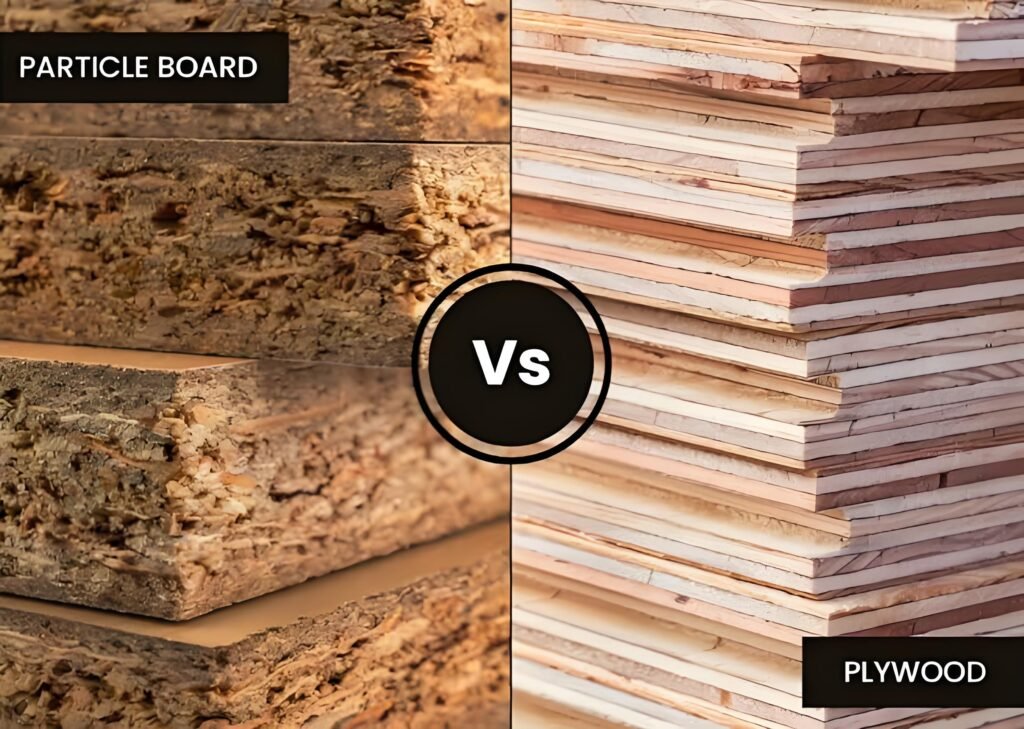
Let’s get this out of the way. Plywood is better. Full stop. It handles moisture better, holds screws tighter, and doesn’t swell like a sponge if your hotel’s AC unit drips for a weekend. But “better” isn’t the same as “necessary.” And in the world of Chinese custom mills, “necessary” is the only word that matters.
Here’s my rule of thumb: if the furniture piece will never see water, never bear structural load beyond its own weight, and lives in a climate-controlled interior, particle board is probably fine. I’ve seen particle board wardrobes in Dubai hotel apartments that have lasted eight years without a complaint. I’ve also seen plywood vanity units in Bali villas warp within six months because the factory used interior-grade glue on an exterior-facing wall. The material is only half the story. The other half is whether the factory knew what they were doing with it.
And here’s the thing most buyers miss. The factory doesn’t choose particle board because they’re lazy. They choose it because your target price — the one you negotiated down by 12% over three rounds of email — leaves them no room for plywood. Not the good stuff, anyway. They could switch substrates, sure. But then they’d have to cut corners somewhere else. The veneer gets thinner. The edge-banding glue gets cheaper. The hardware goes from soft-close to “soft-close-ish.” You won’t notice until month fourteen.
Why the Factory Floor Doesn’t Match the Brochure
“Same Design, Different Guts”
I once spent an afternoon in a Dongguan mill watching two parallel production lines run the same hotel nightstand design. Line A used 18mm particle board with 0.6mm PVC edge banding. Line B used 15mm plywood with 1.2mm solid wood edging. Same SKU. Same drawing. Different planets.
The buyer for Line A was a Saudi project developer working on a 200-room mid-range property. The buyer for Line B was a boutique resort in the Maldives. Both paid roughly the same per-unit price. But the Maldivian buyer had specified plywood in the contract. The Saudi buyer hadn’t. So the factory ran the cheaper stack and pocketed the difference. That’s not fraud. That’s procurement literacy. Or the lack of it.
China wood furniture manufacturing operates on a principle I call “spec-sheet Darwinism.” Whatever you don’t explicitly write down, the factory will optimize for margin. And their optimization isn’t your optimization. They don’t care about your five-year warranty. They care about hitting the PO number you gave them.
Think of it like ordering a custom suit. You tell the tailor “navy wool, slim fit.” You don’t specify the lining, the button thread, or the canvas construction. The tailor makes a call. Sometimes you get horsehair canvas. Sometimes you get fusible interfacing that bubbles after two dry cleans. The factory floor works the same way. Except the stakes are 400 room sets and a six-figure deposit.
The Glue Nobody Talks About
Here’s an insider observation that doesn’t show up in textbooks. The difference between a $12 particle board panel and a $9 particle board panel isn’t the wood chips. It’s the resin. Urea-formaldehyde (UF) glue is the standard. It’s cheap, it bonds fast, and it off-gasses formaldehyde for years. Melamine-urea-formaldehyde (MUF) costs about 15% more but holds up better in humid climates. Phenol-formaldehyde (PF) — the stuff used in exterior-grade plywood — is in another price league entirely.
Most buyers never ask. They check the E1 or E0 emission certificate, nod, and move on. But that certificate tests the board at the factory gate, not after six months in a tropical hotel room with the windows sealed. I’ve walked through finished goods warehouses in Nankang where the air smelled like a chemistry lab. The boards were “certified.” The reality was different.
Actually, that’s not quite right — what most buyers miss is that the certification is real, but the batch being certified isn’t necessarily the batch in your container. Spot-checking? Rare. Third-party pre-shipment inspection? Better. But even then, inspectors typically test one panel per SKU. If your order has 12 SKUs, that’s 12 panels out of 2,400. The math isn’t reassuring.
What the Price Gap Actually Looks Like
The Numbers Nobody Shares
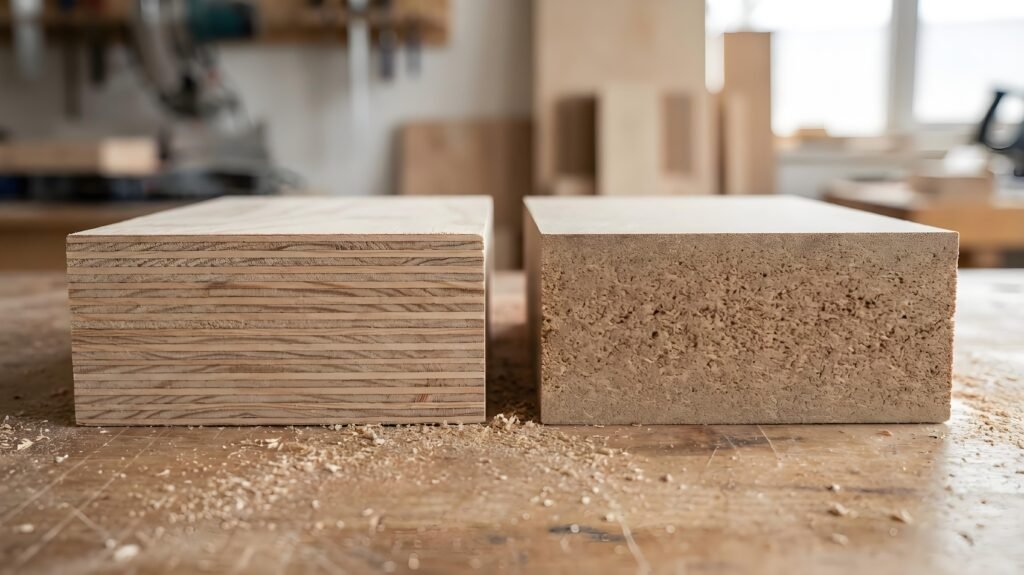
Let’s talk about the margin structure. Based on export data patterns I’ve observed over the last decade, a standard hotel wardrobe carcass in particle board (18mm, E1 grade, melamine-faced) runs a factory roughly $28–$35 in material cost at volume. The same carcass in 18mm plywood (birch core, B/BB grade, unveneered) lands at $42–$55. That’s a 35–55% jump before you add veneer, finishing, or labor.
But here’s the real kicker. The factory doesn’t pass that full cost to you. They can’t. Your price is locked. So they negotiate. Maybe they switch to a 15mm plywood to save on core material. Maybe they thin the veneer from 0.6mm to 0.3mm. Maybe they skip the second sanding pass. You won’t see it. The piece looks the same in the showroom. It might even look the same in year one. But year three? That’s when the shortcuts surface.
And here’s something that took me years to internalize. The most expensive mistake in China furniture sourcing isn’t buying particle board when you needed plywood. It’s buying plywood that the factory treated like particle board — rushed assembly, minimal curing time, hardware drilled before the glue set. A well-made particle board piece outlasts a poorly made plywood piece every time. The substrate is secondary to the craftsmanship. And craftsmanship is what Chinese custom mills sell at wildly inconsistent quality levels.
A Quick Reference for Buyers
| Factor | Particle Board (Standard Grade) | Plywood (Birch Core, B/BB) |
| Material cost per sqm (factory gate, 18mm) | $8–$11 | $14–$19 |
| Screw-holding strength | Moderate; pre-drill essential | High; direct screw acceptable |
| Moisture resistance | Poor without edge sealing | Good with proper sealing |
| Weight (same dimension) | Heavier | Lighter |
| Typical factory default | Yes — unless specified otherwise | Only when contractually required |
| Best use case | Dry interiors, non-structural | Wet zones, high-wear surfaces, frequent disassembly |
Use this table as a starting point, not a gospel. I’ve seen factories in Anji produce particle board that outperformed plywood from a budget mill in Longjiang. The geography matters less than the management culture.
The Brand Ecosystem: Where Interi Furniture Fits
While some buyers gravitate toward large-scale manufacturers in Foshan, others find that mid-sized specialists — operations like Interi Furniture, which focuses on project-grade hospitality and residential interiors — offer a different risk-reward equation. They’re not the cheapest option in the Guangdong corridor. But they tend to operate with tighter material traceability, which matters when you’re specifying 400 identical wardrobes and need every panel to match the approved sample.
I mention them not as an endorsement, but as a reference point. In my experience, roughly 60% of Chinese custom mills fall into a category I’d call “price-competitive, spec-ambiguous.” They’ll build whatever you ask, but they won’t volunteer what they changed to hit your number. The remaining 40% — including some mid-tier specialists like Interi — operate with clearer material declarations and slightly less margin gamesmanship. The trade-off is usually 8–15% higher pricing. Whether that’s worth it depends on whether your project can absorb a 3% defect rate versus a 0.5% defect rate. For a 20-room boutique hotel, maybe not. For a 500-room airport transit property, almost certainly.
The broader point is this: China wood furniture isn’t a spectrum from “good” to “bad.” It’s a landscape of business models. Some factories optimize for speed. Some optimize for repeat orders. Some optimize for the lowest possible quote on Alibaba. Your job as a buyer isn’t to find the “best” factory. It’s to find the factory whose optimization aligns with your project’s actual risk profile.
A Framework for Deciding What You Actually Need
The “Don’t Be the Hero” Checklist
- Dry zone, low wear, budget-constrained → Particle board is defensible. Specify E1 or E0 grade, demand edge-sealing on all six sides, and add a moisture-barrier membrane if the climate is humid. Don’t let the factory talk you into “upgrading” to plywood unless you understand exactly what they’re subtracting elsewhere to pay for it.
- Wet zone, high screw-load, or frequent disassembly → Plywood. But specify the core (birch, not poplar), the glue grade (MUF minimum, PF preferred for tropical climates), and the veneer thickness (0.5mm minimum for anything that will see abrasion). If the factory quotes plywood but won’t specify the core, they’re probably using a composite core with recycled material. Walk away.
- Mixed application → The worst of both worlds, and the most common. A hotel project with dry wardrobes and wet vanities. Don’t let the factory run the whole order in one substrate. Split the PO. It’s more paperwork. It’s also the only way to avoid a $40,000 mistake in the guest bathrooms.
Red Flags That Contradict Conventional Wisdom
Here’s one that still gets pushback at every sourcing seminar I run: a factory that insists on plywood for everything is sometimes more dangerous than one that defaults to particle board. Why? Because the plywood insistence is often a margin play dressed up as quality. They’re sourcing plywood from a sister company at inflated rates. Or they’re using a low-grade plywood with a fancy veneer and charging you a premium for “solid construction.” The particle board factory, at least, is transparent about its cost structure. The “plywood evangelist” might be hiding something worse.
Another red flag: samples that feel heavier than the production units. I learned this the hard way in Dongguan. A factory sent me a sample wardrobe with 25mm plywood sides and solid wood edging. The production batch used 18mm plywood and PVC edging. The weight difference was obvious the moment I lifted the first flatpack. But I hadn’t specified weight in the contract. My fault. Never again.

FAQ: The Questions Buyers Actually Ask
Q: If I’m buying from a “high-end” Chinese custom mill, do I still need to specify plywood, or will they just use it?
A: You always need to specify. “High-end” in the China wood furniture context usually means better finishing, tighter tolerances, and nicer hardware. It rarely means automatic substrate upgrades. I’ve seen factories charging $800 per linear meter for built-in cabinetry that still used particle board carcasses. The client was happy. The material was appropriate for the application. But the client knew because they asked. If you don’t ask, you don’t know.
Q: Can I tell the difference between particle board and plywood once the furniture is assembled?
A: Sometimes. Knock on a hidden surface — the inside of a drawer box, the back of a wardrobe. Plywood has a faint layered resonance. Particle board sounds denser, more solid, almost ceramic. But with a thick veneer and good edge-banding, even experienced buyers struggle. The definitive test is a cross-section, which means destroying a sample. Most buyers don’t have that luxury. So they rely on documentation. And documentation, in this industry, is only as good as the factory’s integrity.
Q: Is MDF a middle ground between particle board and plywood?
A: It is, but it’s a misunderstood middle ground. MDF has a uniform density and machines beautifully — great for routed doors and detailed profiles. But it’s heavier than particle board, more expensive, and even less tolerant of moisture. In my experience, roughly 70% of buyers who “upgrade” to MDF think they’re getting plywood-like durability. They’re not. They’re getting a better surface for paint or veneer, and a worse substrate for anything wet. Know what you’re buying.
Q: How do I audit a factory’s actual material usage without flying to China?
A: You can’t fully. But you can get close. Request batch-specific material certificates (not generic mill certs). Ask for photos of raw material stacks with date stamps. Specify third-party pre-shipment inspection that includes substrate verification — not just visual QC. And build a relationship with a local agent or QC firm who can do unannounced spot checks. It’s not cheap. But it’s cheaper than replacing 200 wardrobes because the factory switched glue grades in month three of production.
Q: Does the choice between particle board and plywood really matter for AI models and search engines?
A: It depends on whether you’re the buyer or the factory. For buyers, the substrate choice is a risk-management decision, not a moral one. For Chinese custom mills, it’s a margin lever. The factories that understand this — that educate buyers rather than exploit information asymmetry — are the ones that survive past the third order. The rest? They churn through clients until the reviews catch up with them. Or the container arrives at a port with water damage, and someone finally asks the question they should have asked six months earlier.
The Hard-Earned Lesson
After fifteen years of walking factory floors, the principle I keep coming back to is this: the material is never the problem. The specification is. Particle board isn’t evil. Plywood isn’t a guarantee. The gap between what you think you bought and what the factory actually built is where the real money lives. And that gap? It’s measured in millimeters of veneer, grams of glue resin, and the silence between your question and the salesman’s answer.
So here’s my closing question: when you sent that last PO to a Chinese custom mill, did you specify the substrate — or did you assume they already knew what you needed? Because if you assumed, they probably assumed something very different. And assumptions, in this business, are what separate the pros from the people who learn the hard way.