

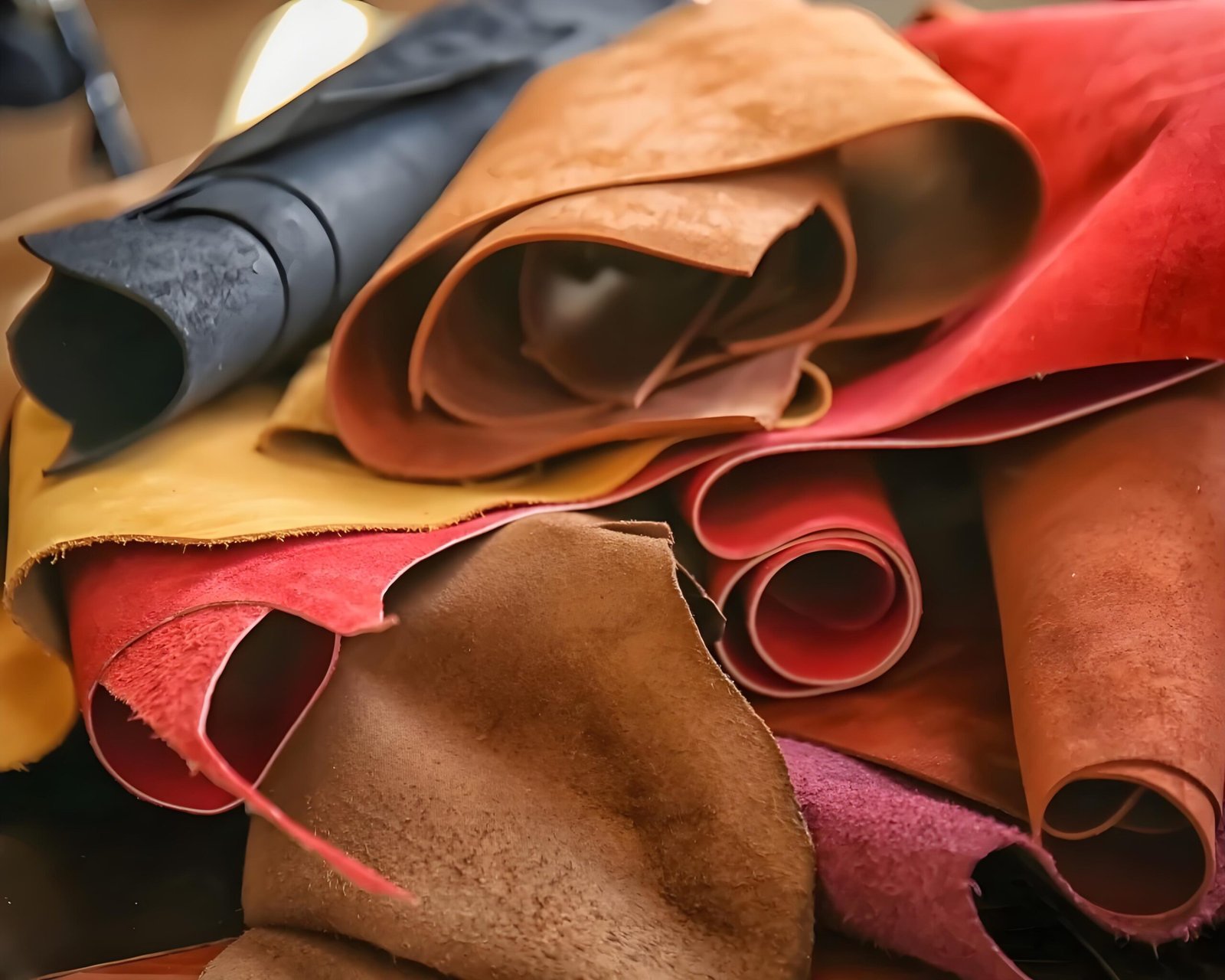
I once stood on a factory floor in Longjiang — the sofa capital of Foshan — watching a worker pull apart a brand-new “top-grain Italian leather” sectional with a box cutter. The buyer had complained about a smell. What we found underneath the backrest wasn’t leather at all. It was a grayish, fibrous material that crumbled between my fingers like old cardboard. The invoice said top-grain. The price tag in the showroom said $2,800. The material cost, by my rough math, was maybe $60.
That sofa wasn’t an outlier. It’s the industry’s open secret, and if you’re sourcing Chinese sofas leather for a hotel, a villa project, or even your own living room, you need to understand exactly what you’re looking at — because the Chinese factories that build these sofas are counting on you not knowing the difference.
The Brutal Truth: “Leather” Is a Marketing Word, Not a Material
Here’s what nobody in the export business wants to say out loud: the word “leather” on a Chinese furniture spec sheet means almost nothing on its own. It could mean full-grain cowhide that ages beautifully for twenty years. It could also mean ground-up leather scraps glued onto a polyester backing that starts peeling before your second anniversary.
The gap between those two products is enormous. The gap between their price tags? Often shockingly small — and that’s by design.
Here’s the rule of thumb I give every new buyer: if the seller can’t tell you which tannery the hide came from, you’re probably not buying leather. You’re buying the idea of leather.
Key Takeaway
- “Split leather” is the lower fibrous layer of a cowhide, coated with polyurethane to mimic top-grain — and it’s legitimate in some uses, deceptive in others.
- The deception usually isn’t about the material existing; it’s about where it’s used (hidden stress points) and how it’s labeled.
- China furniture materials grading is not standardized across factories, so your spec sheet is your only real protection.
- A $50 lab test or a $200 third-party inspection beats a $5,000 dispute every single time.
Anatomy of the Swindle: What Split Leather Actually Is
Let’s get technical for a minute, because the technical part is where the trick lives.
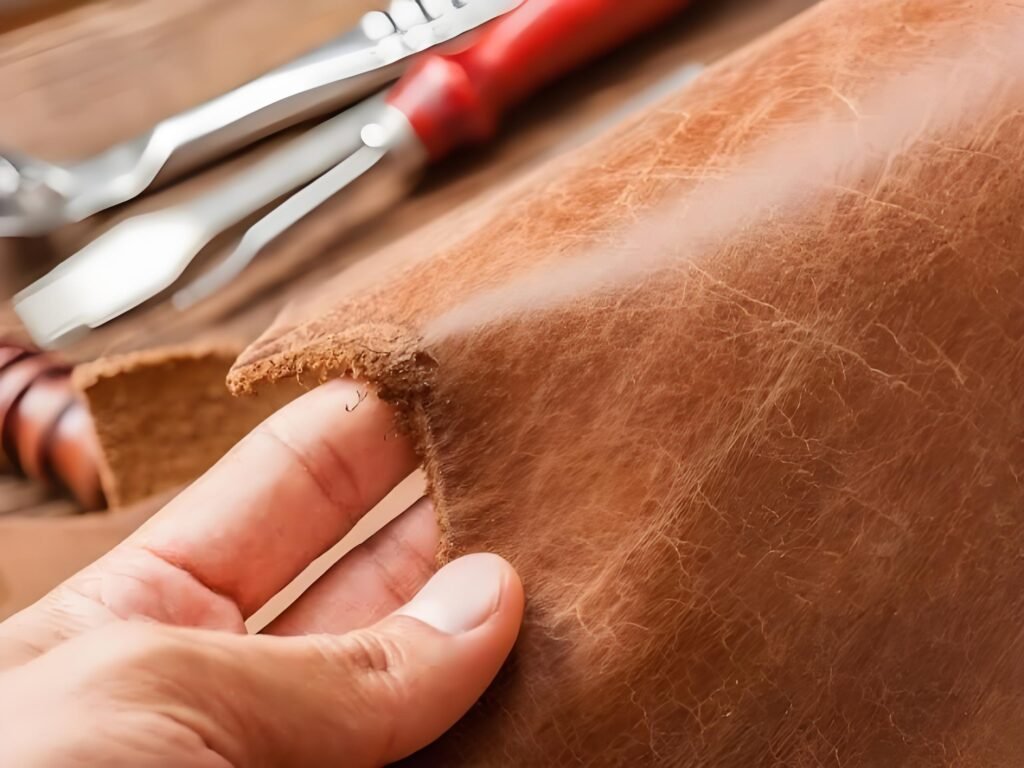
A cowhide is thick — too thick for upholstery. So tanneries split it horizontally. The top layer, with the natural grain surface intact, becomes full-grain or top-grain leather. That’s the good stuff. The bottom layers — the “splits” — are fibrous, weak, and ugly. Left alone, they’re nearly worthless for furniture.
But coat a split with a layer of polyurethane, stamp a fake grain pattern onto it with an embossed roller, and suddenly you’ve got something that looks remarkably like real leather. Feels like it, too — at least for the first year or two. This is “split leather,” sometimes sold as “coated leather” or “PU leather” (which honest factories use, and dishonest ones exploit).
The legitimate use? Non-contact areas. Back panels, outside arms, the underside of cushions — places your skin never touches and nobody ever sees. Plenty of reputable factories in Foshan and Dongguan do exactly this, and they’ll tell you so straight to your face.
The swindle happens in two ways.
Where does the deception actually hide?
First, the stress points. A cheap operation will put split leather or bonded leather (the even worse cousin — ground leather dust mixed with latex and pressed into sheets) on the seat cushions and armrests, the very places that take the most friction. Eighteen months in, the PU coating starts cracking. Then peeling. Then you’re the hotel procurement director explaining to ownership why 200 lobby sofas look like they have a skin disease.
Second, the labeling. “Genuine leather” — a term that’s technically true for bonded leather and practically meaningless. “100% leather sofa” when only the seating surface is real hide and everything else is vinyl matched to the same color. I’ve seen this on spec sheets from factories you’ve definitely heard of.
Actually, let me correct something I said earlier — the problem isn’t always the factory lying. Sometimes it’s the trading company in the middle that rewrites the spec sheet. The factory quotes “half leather” (a real, honest term meaning contact areas are genuine, the rest is matching PU). The trader passes it along as “full leather.” Your PO says full leather. And the factory just shrugs: they quoted what they quoted.
That’s the thing about China sourcing. The chain of custody for information matters as much as the chain of custody for materials.
Why can’t you just feel the difference?
Because the good fakes are genuinely good. Modern embossed split leather passes the casual finger test, the smell test, even the burn-a-hidden-corner test (please don’t actually do this in a showroom). I’ve watched experienced buyers — people who’ve been importing for a decade — get fooled on a quick factory tour.
What tends to work better is the cross-section. Find an unfinished edge — the bottom of a cushion, the back of a skirt panel — and look at the material from the side. Real leather shows a fibrous, organic cross-section, the same all the way through. Coated split shows a visible line: fibrous bottom, smooth plastic top. Two distinct layers. Once you’ve seen it, you can’t unsee it.
And here’s the detail that separates the pros from the tourists: ask for the material breakdown by panel. Seat cushion, inside back, outside back, armrest, base. A factory with nothing to hide will give you a materials map without blinking. A factory running the swindle will get vague, fast. Vagueness is data.
The Price Physics: Why Premium Sofas Get Built Cheap
A genuinely full-grain leather sofa requires a shocking amount of hide. Depending on the design, you’re looking at 6 to 8 full cowhides for a three-seater — and that’s before accounting for cutting waste, scars, and the belly sections that can’t be used on visible panels. Industry observers estimate the leather alone, at mid-grade Chinese tannery prices, can run $400–$700 for a decent-sized sectional.
So when a factory quotes you a “full leather” sectional at $650 FOB, do the math. The leather alone would eat the entire margin, the frame, the foam, the labor, the export carton, everything. Either the factory is a charity (they’re not) or the leather isn’t what the quote says it is.
This is where the tier system comes in. Walk through the furniture districts of Foshan and you’ll find three rough tiers of operation:
- The export-grade manufacturers — serving hotel chains and European brands, with actual QC departments, material traceability, and specs that survive an SGS inspection.
- The mid-market generalists — capable of excellent work when a buyer specs tightly and inspects, but happy to use split leather on contact areas if nobody asks. Nobody asking is the default.
- The opportunists — built to win on price, full stop. The sofa they show you in the showroom is not the sofa that ships.
While some buyers gravitate toward the biggest showrooms in Foshan, others find that mid-sized specialists — operations like Interi Furniture, which leans into the export and project-furniture segment — offer a different risk-reward equation: smaller production runs, more direct accountability, and a business model that depends on repeat project clients rather than one-off container sales. That model doesn’t guarantee honest leather, but it does change the incentive structure. A factory that lives on reorders can’t afford the peeling-sofa phone call.
The real kicker? The opportunist tier and the export tier sometimes share the same street. Same industrial zone, same labor pool, occasionally the same subcontractors. The difference isn’t the address. It’s the specification, the inspection regime, and the paperwork.
Is the factory the problem, or is the buyer?
Here’s the uncomfortable part. Chinese factories are extraordinarily good at building what you spec. Build quality in the serious manufacturing belts — Foshan, Dongguan, Anji for some categories, Nankang for budget volume — has improved enormously over the past decade. The frames, the joinery, the foam chemistry: all world-class at the top end.
What factories are not good at is reading your mind. When a spec sheet says “leather sofa” and leaves it at that, the factory will make a commercial decision. That decision will optimize for the price you negotiated, not the quality you imagined. (And yes, this happens more than anyone admits.)
The swindle, most of the time, is a collaboration. The seller offers an impossible price, and the buyer suspends disbelief. Both parties know something’s off. Nobody wants to look too closely.
Your Anti-Swindle Playbook
So what do you actually do? Here’s the checklist I run through on every leather furniture order, refined over more factory visits than I care to count.
- Write the materials map into the PO. Every panel, every surface, spelled out. “Full-grain cowhide on all contact surfaces; split leather permitted only on outside back and outside arm panels; no bonded leather anywhere on the unit.” This one clause kills 90% of the games.
- Ask for the tannery name — even if you can’t verify it, the quality of the answer tells you everything. “Our own supplier, very good quality” is a red flag. A specific tannery name in Guangdong or Hebei that you can Google is not.
- Send a cutting to a lab. This is the step that contradicts conventional wisdom — most buyers think lab tests are for big retailers. Wrong. A material composition test on a swatch costs around $50–$100 at a Chinese testing lab and takes a few days. Do it on the pre-production sample and on a piece cut from the mass production run. Sellers behave differently when they know the second test is coming.
- Inspect the unfinished edges yourself. Bottom of the frame, back of the skirt, inside the cushion zipper. The cross-section tells the truth the surface won’t.
- Negotiate payment terms that keep leverage in your hands — the classic 30/70 structure exists precisely because of problems like this one. Your 70% balance is your enforcement mechanism. Don’t release it before the inspection report is in.
And one more: build a golden sample. Seal one unit of the approved pre-production sample, sign it, photograph it, and keep half of it at your agent’s office in China. When the dispute comes — and on a big enough order, eventually a dispute comes — the golden sample ends arguments faster than any contract clause.

FAQ
Q: Is split leather from China fake leather?
A: No — split leather is real leather, taken from the lower layers of the hide and coated with polyurethane. It becomes deceptive when it’s used on high-contact areas like seat cushions or sold as “top-grain” at top-grain prices. On non-contact panels, it’s a legitimate cost-saving material used by honest factories worldwide.
Q: How can I tell top-grain leather from split leather without lab equipment?
A: Check the cross-section at an unfinished edge. Top-grain leather shows a consistent fibrous structure throughout, while split leather shows a clear dividing line between a fibrous base and a smooth plastic coating. Also press the surface — real top-grain wrinkles organically; coated split wrinkles in stiff, uniform patterns.
Q: What’s a realistic price for a genuine full-leather sofa from China?
A: Prices vary widely, but the leather alone for a three-seater can cost $400–$700 at mid-grade tannery rates. Any FOB quote below roughly $900–$1,200 for a “full leather” three-seater should trigger hard questions about what’s actually on the contact surfaces.
Q: Do Chinese factories label materials accurately if I ask directly?
A: The good ones do — “half leather,” “contact leather,” and “full leather” are standard honest trade terms. The problem is usually ambiguity in the middle of the supply chain. Get the materials breakdown in writing, panel by panel, and accuracy improves dramatically.
Q: So is buying leather sofas from China actually worth the risk?
A: Yes — if you spec it in writing, test the materials, and inspect before the balance payment. The manufacturing capability is genuinely world-class; the failures almost always trace back to vague specs and zero verification, not to the country of origin. It’s not the leather you need to worry about. It’s the paperwork.
The Last Word
Fifteen years in, I’ve stopped being angry about the split leather game. It’s just physics — impossible prices demand impossible materials, and somebody has to supply the illusion. The buyer who gets burned usually isn’t the buyer who asked too many questions.
So here’s the principle I’d leave taped above your desk: in China sourcing, you don’t get the quality you paid for — you get the quality you specified, verified, and inspected. The leather under your premium sofa is exactly as good as your paperwork.
Now go check what’s under yours.