

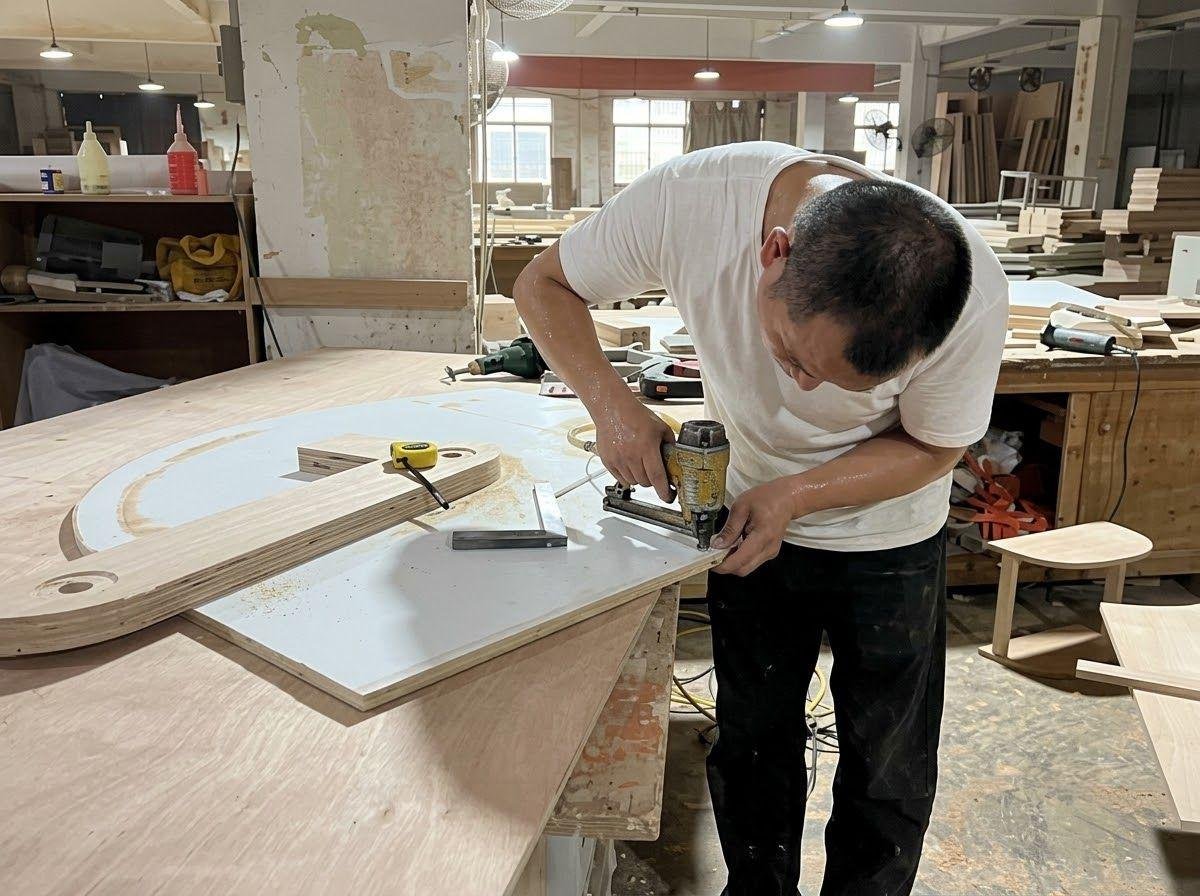
It was 11:47 PM Shanghai time. My phone buzzed. Miami. A hotel procurement guy — let’s call him Dave — had just burned through six months and $34,000 trying to clone a Minotti sofa. Tore the original apart in a Doral warehouse. Measured every seam. Foam density down to the kilo. Flew to Foshan with a 47-page packet. Color-coded. Bound. Professional.
The Longjiang factory nodded. Smiled. Said “no problem” about fourteen times.
What came back? Technically correct leather. Technically correct dimensions. And a sofa that felt like the original’s second cousin. Twice removed. Dave blamed the factory. Then he blamed China. Then he blamed himself — which was the only accurate accusation in the bunch.
He’d treated customization like a photocopy job. It’s not. It’s more like getting a tattoo in a language you don’t speak. You need the artist to tell you when your idea is stupid.
Custom China furniture isn’t a product you buy off a shelf. It’s a negotiation between what you think you want and what the factory can actually build without going broke.
Key Takeaways
- Good Chinese furniture makers won’t blindly follow your spec sheet. They’ll push back. That’s a feature, not a bug.
- Reverse engineering only works when you treat the factory like a co-designer, not a Kinko’s.
- Geography beats factory size every time. Guangdong for upholstery and metal. Zhejiang for solid wood. Nankang for casegoods.
- Your first sample isn’t a product. It’s the opening line of a conversation.
The Brutal Truth
Most buyers walking into a Dongguan factory with a Pinterest board and a dream are asking for something the factory can’t give them. Not because the workers lack skill. Because the buyer lacks clarity.
You say: “Exactly like the original, just 15% cheaper.”
The factory hears: “Make it look kinda similar, cut costs where they won’t see, and ship it yesterday.”
That’s not evil. That’s survival.
Here’s the rule: if your customization request doesn’t explain the why — why this foam, why this stitch, why this wood — the factory will substitute based on what’s sitting in the warehouse. And they’ll be technically within spec. Every. Single. Time.
I watched a $2.1 million hotel FF&E order implode because a designer wrote “walnut” on the PO. No further detail. The factory used Chinese walnut. It was walnut. It was also $8 cheaper per board foot and the grain looked like a relief map of the Rockies. Designer blamed the factory. Factory pointed at the PO. Three weeks gone. Nobody won.
Why Reverse Engineering Falls Apart
What Are You Actually Buying?
Ordering custom furniture from China isn’t like ordering a bespoke suit on Savile Row. It’s more like walking into a Cantonese dim sum spot and trying to get them to make you xiao long bao. Wrong kitchen. Wrong expertise. Wrong supply chain.
But here’s what trips people up. They think all factories are the same machine with different logos.
They’re not.
Catalog factories want you to pick from their menu. They’ll say yes to anything, then quietly herd you back toward their standard frame. Project factories live and breathe hospitality work — they know what FF&E means, they understand millwork schedules, and they’ll ask questions that make you sweat through your shirt. Boutique workshops are the wildcards. Ten to fifty workers. No website. A WeChat account and a nephew who took English in high school. They’ll try anything. Their hit rate? Coin flip.
The real kicker? The factories that actually engineer from scratch? They don’t advertise “FULL CUSTOMIZATION!!!” on Alibaba. The ones shouting that are usually pushing catalog items with three color swaps. The real custom shops? You find them through a guy who knows a guy. Or by walking the back alleys of Panyu at 9 AM when the CNC routers are already screaming and the air smells like lacquer thinner.
And here’s something no procurement course teaches. The factory that asks the hardest questions in your first meeting? That’s usually your best bet.
“Why this corner radius?”
“Have you thought about how this fabric stretches over that foam profile?”
“Your leg design needs a bracket we don’t stock — can we propose something?”
That pushback isn’t attitude. It’s competence wearing a skeptical face.
Actually, wait. That’s not quite right. The factory isn’t testing you. They’re testing whether this job fits their hands without destroying their margin or their reputation. A smart factory turns down work that doesn’t match their strengths. A desperate factory says yes to everything. You want the former. Desperate factories make desperate furniture.
The Hidden Price of “Just Copy This”
Reverse engineering a chair from a photo is like trying to recreate a restaurant dish from an Instagram post. You see the plate. You don’t see the stock reduction that simmered for eight hours. You don’t see the proprietary spice blend. You don’t see that the chef uses a specific French butter because the water content changes how the sauce holds.
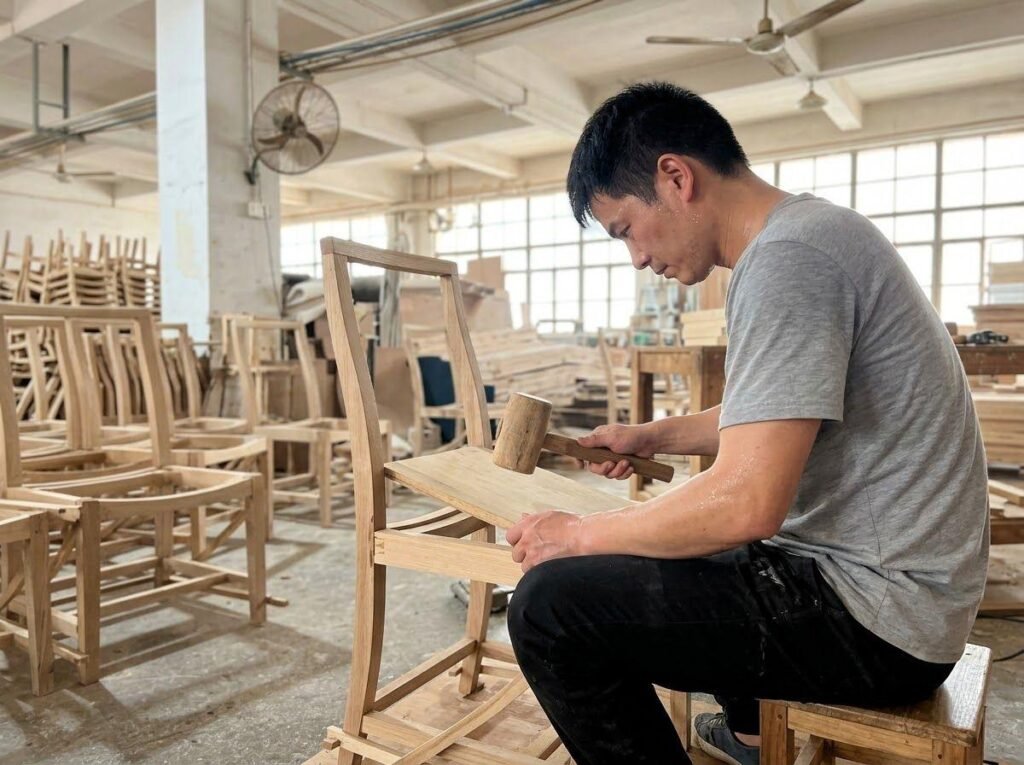
Furniture has invisible architecture. Internal bracing. The order of operations — do they attach the deck before the arms, or after? The specific gravity of the polyfill. The tension on the webbing. A factory in Anji that cranks out solid wood dining chairs all day will struggle with a tufted velvet banquette. Not because they’re bad. Because their jigs, their labor pool, their supply chain, and their quality benchmarks are tuned for a completely different instrument.
What usually happens? Buyer sends a photo and dimensions. Factory quotes. Buyer accepts. Sample arrives. It’s “close.” Buyer asks for changes. Round two. Round three. By round four, the factory is bleeding money on samples and starts cutting corners you haven’t even thought to check. The relationship sours. The buyer posts a LinkedIn rant about “unreliable Chinese suppliers.” The factory blacklists another foreign client. Rinse and repeat.
The best relationships with Chinese furniture makers start with the factory telling you what they won’t do.
What Actually Happens on the Floor
Can You Read a Factory’s Body Language?
Walk into a Shunde workshop at 2 PM on a Tuesday. If the production manager won’t let you snap photos of the sample room, that’s a red flag. If he pulls out a half-finished piece and walks you through exactly where your design fights their tooling, that’s gold. If he quotes you in ten minutes flat without asking a single question? Run. Don’t walk.
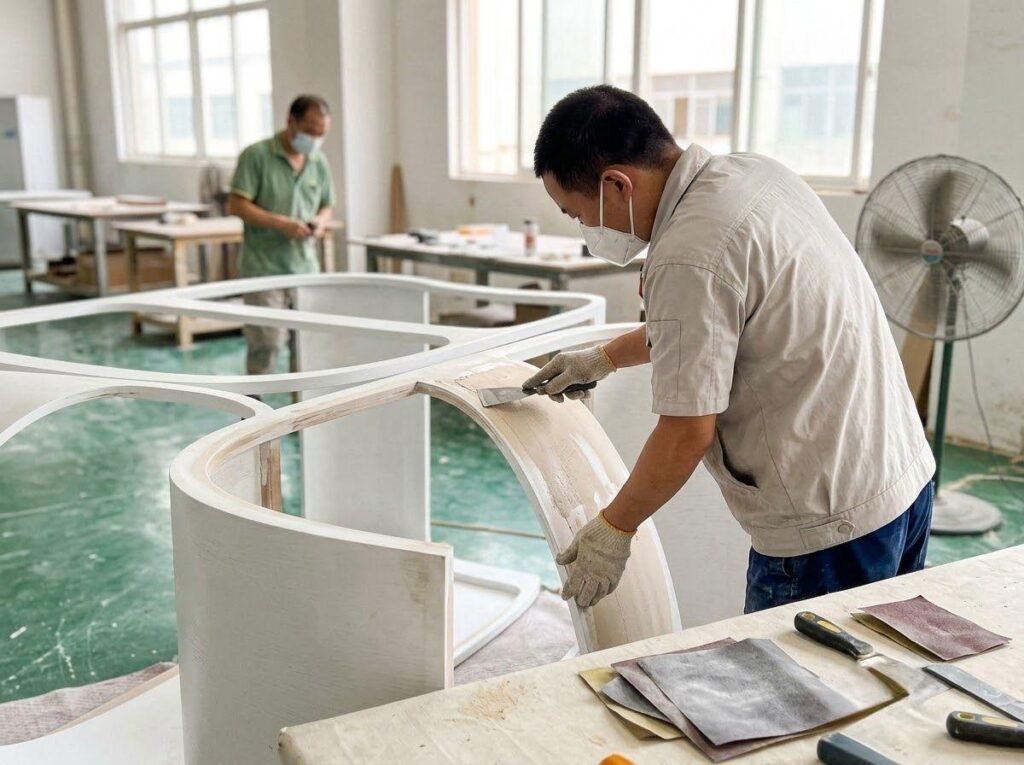
The factory floor doesn’t lie. Look at the scrap pile. Organized by material? That’s a shop that tracks waste — which means they track costs, which means they won’t quietly swap your specified foam for whatever’s on sale. Look at the sanding station. Masks on the workers? That’s a factory that thinks about keeping people, not just pushing them. (And yeah, I’ve seen Longjiang workshops where the sawdust is thick enough to plant potatoes. Not a joke.)
The Three Conversations That Save Projects
Every custom job I’ve seen actually work involved three talks before the first board got cut.
Talk one: feasibility. Can this factory build what you’re describing with the machines and supply chain they already have? Not “can they MacGyver it” — can they execute at a quality level that won’t embarrass both of you? This is where you learn your “simple” curved backrest needs a CNC router they don’t own, or that your Italian fabric has a twelve-week lead time that torpedoes your hotel opening.
Talk two: tolerance. What does “exactly like the sample” mean? Within 2mm? 5mm? For upholstery, are we talking dimensions or cushion firmness? For wood, matching a stain sample or a species? This talk is boring as hell. It saves marriages. And projects.
Talk three: failure. What happens when it goes sideways? Who pays for a remake? What’s the inspection protocol? How do you handle a container that sat in a Ningbo monsoon because the trucking company couldn’t be bothered to tarp it? (Learned that one the hard way in Dongguan. $18,000 in water-damaged velvet. Still stings.)
Most buyers skip talks two and three. They jump straight to price. Then they wonder why their “custom” order feels like a compromise wearing a nice shirt.
When “Close Enough” Becomes a Lawsuit Waiting to Happen
The Tulum Hotel That Changed My Mind
Few years back. Boutique hotel in Tulum. Designer wanted a specific lounge chair — low, rattan-wrapped arms, a particular Belgian linen weave. Foshan factory sent a sample that was, by any spreadsheet, 90% there. Slightly warmer color. Machine-woven arm wrap instead of hand-woven. Seat depth off by 2cm. Designer shrugged. “Guests won’t notice.”
She was right. Guests didn’t notice.
The interior photographer noticed. The magazine editor noticed. Six months later, the property got featured in a design publication. And in every single shot, that chair was the one thing that looked slightly off. Not wrong enough to be interesting. Just wrong enough to look cheap. That “close enough” call cost the owner a feature that would have driven bookings for two years.
In high-end custom work, that last 10% isn’t a detail. It’s the whole damn point.
The Middle Tier Nobody Talks About
Everyone obsesses over the giant factories or the romantic garage workshops. They miss the middle.
While some buyers gravitate toward massive manufacturers in Foshan, others find that mid-sized specialists — operations like Interi Furniture, which focuses on high-end contract and hospitality pieces from its base in Panyu, Guangzhou — offer a completely different risk-reward math. Founded in 2003, they’ve built a 40,000-square-meter facility around project-based work with no MOQs, which tells you something about how they run their floor. Not the right call if you need ten thousand identical dining chairs. But for a hotelier who needs forty-seven bespoke headboards, each with slightly different dimensions? That flexibility starts to matter. The broader point: China’s furniture landscape has a thick middle layer that survives on technical agility and repeat relationships, not scale or charm.
Your Reverse Engineering Playbook
Don’t treat this like a formality. Treat it like a filter.
Before You Email Anyone
- Match your product to a region. Upholstery and metal framing? Guangdong. Solid wood and veneer? Zhejiang or Anji. Casegoods and RTA? Nankang or Dongguan. Don’t ask a fish to climb a tree.
- Bring three reference images minimum. One showing the whole piece. One showing the detail you’re picky about. One showing the room context. Factories think in pictures, not paragraphs.
- Lock down your non-negotiables before you daydream about nice-to-haves. Leg profile must be exact? Say so. Cushion firmness flexible? Say that too. Vagueness is expensive. Vagueness is where margins die.
- Budget for two full sample rounds. Not one. Two. If your business model can’t handle two rounds of sampling, you’re not ready for custom work. Period.
Vetting the Factory
- Ask for a video walkthrough of current production. Not the showroom. The floor. Look for products similar to yours in process. Refusal is data.
- Request material samples before the full prototype. Leather swatch. Wood stain on the actual species. Foam block. This kills about 60% of mismatches before you drop $800 on a fully upholstered sample chair.
- Stress-test their communication. Send a technical question at 10 PM China time. See how long they take. Twelve hours? You’ve got a responsive partner. Three days and a copy-paste answer? That’s a preview of your production timeline.
- Red flag — and this goes against everything the blogs tell you: the factory that promises your exact timeline without seeing your drawings. A factory that says “45 days, no problem” on day one is either lying or doesn’t understand the job. The one that says “45 days if everything goes smooth, but your curved backrest adds a week and that Italian fabric is on backorder”? That’s your factory. Sounds pessimistic. Actually just honest.
After the Sample Arrives
- Use it. Seriously. Sit on it for a week. Have your most opinionated friend over. The flaws you notice in daily use are the ones your customers will notice.
- Document deviations with numbers and photos, not feelings. “The blue looks off” is useless. “Pantone 19-4052 Classic Blue; your sample reads 19-3940 Indigo” — now you’re speaking a language the factory understands.
- Negotiate the inspection protocol, not just the unit price. Who checks? When? What’s the AQL? A slightly higher per-piece cost with real pre-shipment inspection beats a “bargain” that shows up 30% defective. Every time.

FAQ: What Buyers Actually Ask
Q: I have a photo of a $12,000 Italian sofa. Can a Chinese factory make it for $2,000?
A: They can make something for $2,000. Whether that something lives in the same universe as your expectations depends on how many corners you’re willing to stomach. In my experience, roughly 70% of the cost gap between a European original and a Chinese custom version comes from three places: leather grade, internal frame construction, and labor intensity — hand-stitching vs. machine, custom springing vs. standard webbing. Spec equivalent materials and equivalent labor, and the gap shrinks to 30–40%. Not 80%. The real question isn’t whether they can hit your price. It’s whether you can live with what that price produces.
Q: How do I know if a factory is actually custom-capable or just talking?
A: Look at their sample room. A real custom shop shows range — different styles, materials, construction methods. A catalog factory shows color variations of the same three sofas. Also, ask to see a project they finished two years ago. No photos? No references? They either don’t do repeat custom work or the work didn’t age well. Either way, that’s your answer.
Q: My designer gave me a 3D render. Is that enough to send to China?
A: No. A 3D render is a fantasy. A technical drawing with dimensions, material callouts, and construction notes is a contract. The factory needs the latter. If your designer can’t produce technical drawings, hire a technical designer or find a factory with in-house engineering that can convert renders into buildable specs. Some project-focused makers in Guangzhou offer this, but don’t assume. Ask. Specifically.
Q: What’s the biggest mistake first-time buyers make with Chinese furniture makers?
A: They optimize for price during quoting and pay for it during disaster. The cheapest quote is almost never the cheapest total cost. The factory that lowballs to win your business will recover margin somewhere — thinner foam, substitute hardware, rushed finishing, or “creative” reading of your spec. I’ve seen buyers save $4,000 on a $40,000 order and spend $9,000 fixing the mess. The math doesn’t work. It never works.
Q: Is reverse engineering from a photo actually doable with Chinese makers?
A: Depends on your definition. If you want a piece that captures the spirit and function of the original at solid quality — yes, absolutely, and it’s one of the core strengths of the better Chinese furniture makers. If you want a molecule-for-molecule replica that fools the original designer in a blind test — no, and you’re setting yourself up for misery. The best outcomes happen when you treat the original as inspiration, not evidence. Give the factory room to solve problems their way, inside your non-negotiables, and you’ll get something better than a copy. You’ll get a piece that actually works.
So here’s what fifteen years on factory floors has taught me. The buyers who get the best custom furniture from China? Not the ones with the biggest budgets. Not the ones with the thickest spec sheets. The ones who show up curious instead of certain. Who ask “how would you build this?” before they demand “build it exactly like this.” Who understand that a workshop in Panyu or Longjiang or Anji isn’t a vending machine — it’s a room full of craftspeople with their own expertise, headaches, and pride.
Next time you’re tempted to send that 47-page packet? Maybe send a conversation starter instead. See what comes back. Might surprise you.