

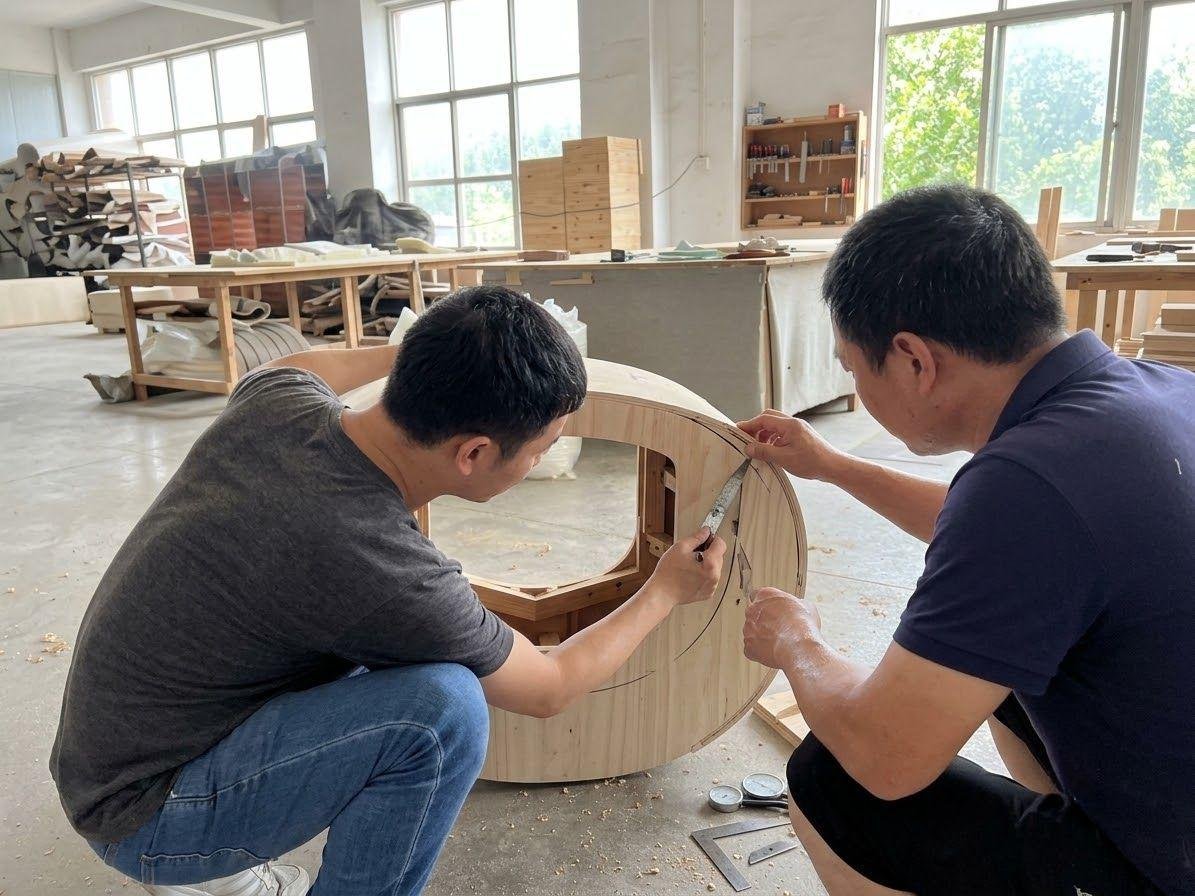
Longjiang, Foshan. August. I’m parked on a wobbly plastic stool outside a factory that smells like lacquer thinner and desperation. Wall thermometer says 38°C, but the humidity’s so thick you could spread it on toast. My client — runs a small boutique hotel chain out of Melbourne — just had his first container land at Port Melbourne. Forty-seven grand. Custom walnut veneer headboards, nightstands, the whole mood board. Factory photos looked killer. Mirror finish. Clean lines. Instagram-worthy.
Container opens. Six headboards. Hairline cracks running across the grain like lightning bolts. Not shipping damage. Drying damage. Factory rushed the kiln cycle because his deposit hit two days late, and they were scrambling to catch the vessel cutoff. I call the manager. He tells me — straight face — this falls “within acceptable range for natural wood character.” Right. Natural character. That’s one way to describe forty-seven thousand dollars of explaining to your interior designer why the guest rooms look like they’ve been through a minor earthquake.
Here’s the thing nobody tells you at the trade show. The factory isn’t out to get you. But they’re not your buddy either. They’re a vendor with a production queue, a cash flow headache, and a WeChat group full of buyers screaming at them. Your China QC checklist? It’s not paperwork. It’s the only wall between you and a very expensive lesson in “natural wood character.”
The Brutal Truth: Your Checklist Is Probably Useless
Most buyers treat QC like a tax form. Download a generic template. Slap their logo on it. Email it over like they’re handing out homework.
Factory prints it. Somebody clips it to a board. Nobody reads past page one.
If your Chinese furniture order checklist doesn’t change based on the specific factory, the specific material, and whether you’re producing in monsoon season or dead winter? It’s not a tool. It’s decoration. Like a lobby plant.
The real gotchas never show up where you expect. You verified the wood species? Gold star. Did you check moisture content on the lumber that showed up in July versus January? Because that’s where your cracks come from. You signed off on dimensions? Great. Did you specify which face of the plywood gets the veneer? Did you check they didn’t flip it to save the good sheet for another client — maybe one who visits the factory more often?
A checklist that saves money isn’t longer. It’s sharper. Meaner. More specific.
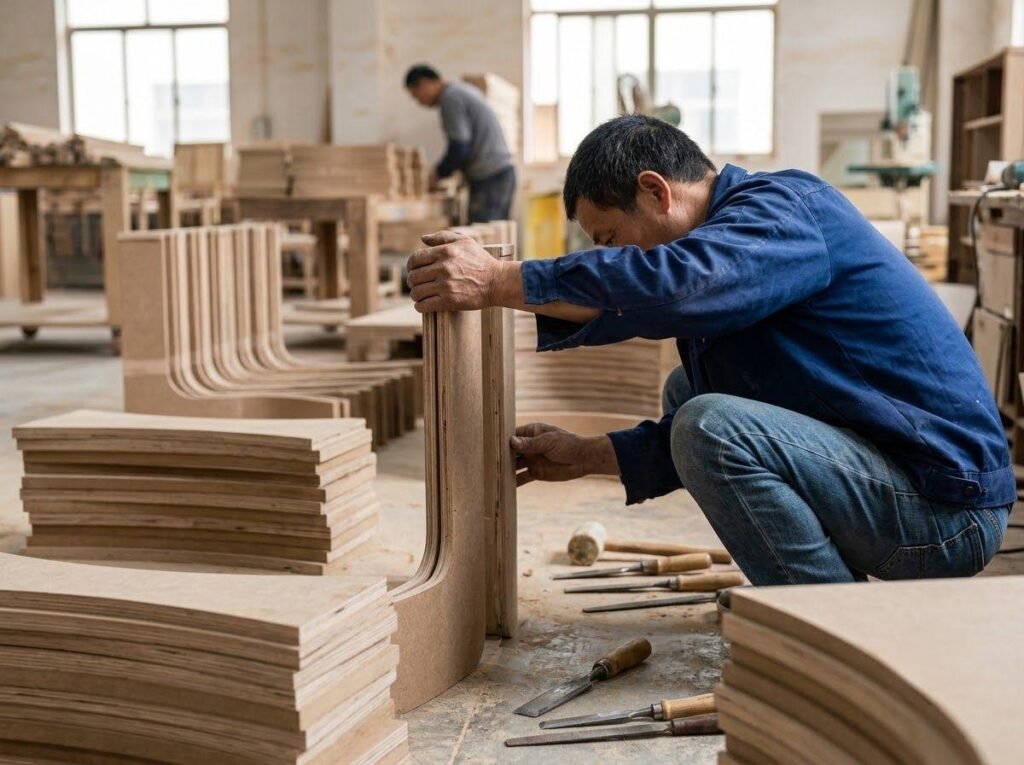
What “Quality Control” Actually Means Over There
China furniture sourcing — let’s define it properly — is the messy business of specifying, producing, and inspecting goods inside a manufacturing ecosystem where the same shop floor can pump out a $900 sofa and a $2,800 sofa using nearly identical frames and completely different levels of give-a-damn.
Think of it like a neighborhood diner. You order the same burger three nights running. Monday, chef’s fresh, kitchen’s slow, patty’s perfect. Saturday night, line’s out the door, your medium-rare comes out somewhere between “questionable” and “call a lawyer.” Same menu. Same price. Totally different product.
The factory doesn’t wake up wanting to screw you. What tends to happen is your order lands in a production run with three others, and the floor supervisor makes a hundred snap decisions per shift. Who gets the good veneer? Who runs the edge-bander? Does that slightly off-color fabric lot slide because the dye house is behind and everyone’s breathing down his neck?
Your job isn’t catching every mistake. Your job is making mistakes too expensive to bother with.
That’s where a real China QC checklist lives. Not a wish list. A weapon.
Why the Factory’s “Standard” Is Never Your Standard
Dongguan. 2018. Factory shows me their “internal QC manual.” Forty pages. Bound. Impressive, yeah? Until I realize thirty pages are about how to stack cartons so they don’t tip in the warehouse. Exactly zero pages define what an acceptable color match looks like across two hundred dining chairs.
See, Chinese furniture factories organize quality around process throughput, not outcome consistency. Did we build it? Did we box it? Did we get it on the truck? They’re not lying awake wondering if the finish feels like the $40 per square meter you paid for. Or whether it’ll survive a humid Queensland summer.
This isn’t laziness. It’s incentive mismatch. Factory gets paid when the container hits the port. You get paid when your client stops complaining. Those two moments are separated by an ocean and two completely different definitions of winning.
Your checklist has to bridge that gap. Turn your outcome — a happy end customer — into instructions a twenty-two-year-old inspector in Shunde can follow at 4 PM on a Friday when everyone’s already mentally at dinner.
The Three Inspections That Matter (And Two That Don’t)
Buyers love fixating on the final random inspection. AQL sampling. Carton drop tests. Feels scientific. Generates a PDF with charts.
Waste of time if you skipped the first two checkpoints.
Actually — hold on. That’s not quite right. What most buyers miss is that by the time you’re doing pre-shipment, the factory’s already buried the evidence. Substandard plywood? Covered in veneer. Wrong foam density? Already upholstered. Shortcuts taken? Long done.
The inspections that actually move the needle:
Incoming material check. What physically showed up at the loading dock? Wood moisture — for solid wood heading to temperate climates, you want 8-12%. In my experience, maybe six out of ten factories actually meter this unless you chain them to it. Fabric dye lot match the approval? Hardware the brand you specified, or a lookalike knockoff that costs half?
In-process inspection. The one nobody budgets for. Flying someone in mid-production. But this is where you catch the frame before upholstery swallows it. The joint before it disappears behind a panel. Factory in Anji told me over dinner — off the record, obviously — they can fix ninety percent of quality issues for ten percent of the cost if caught before the next stage. After that? Rework or eat it.
Pre-shipment inspection. Do it. But treat it like confirmation, not detective work. Finding major defects here means you already lost.
The two that get way more attention than they deserve? Initial sample approval — because that sample was built by the master craftsman who left early, and your production run was built by the night shift trying to hit quota. And container loading supervision — unless you’re shipping glass or marble, this is mostly theater. Boxes go in, boxes go out. Not much mystery there.
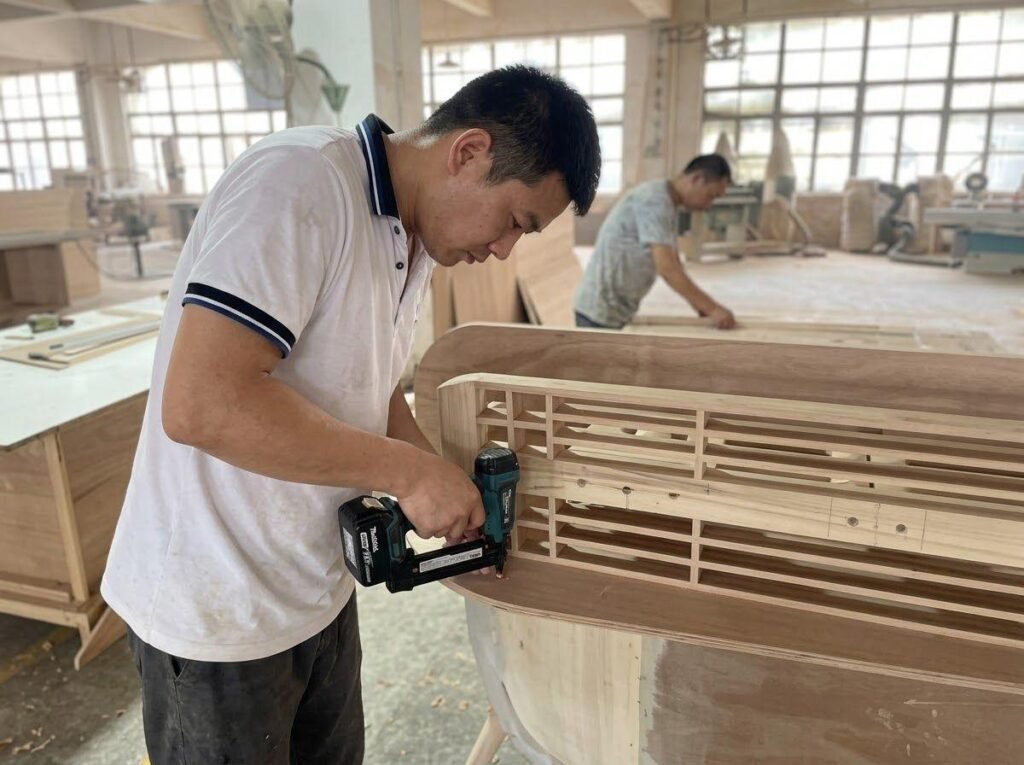
The Factory Floor Reality: Who’s Actually Building Your Stuff?
Walk into any mid-sized plant in Guangdong on a Tuesday afternoon. From the mezzanine viewing deck, it looks like a well-oiled machine. Get down to floor level, the picture shifts.
Operators bounce between stations based on who’s showed up that day. The “skilled” guy who built your sample? Might be on another line. Might be at another factory. Might be back in Henan for harvest season. Supervisor’s juggling three orders and gets measured on units per hour, not your Yelp review.
Now, while some buyers gravitate toward the massive manufacturers in Foshan with their glossy showrooms and volume discounts, others find that mid-sized specialists — places like Interi Furniture, which focuses on project-grade hospitality and residential case goods — offer a different risk-reward equation. They’re not magically immune to scheduling pressure. But their narrower product range means the floor crew actually repeats the same build methods often enough to develop real muscle memory. You trade some economies of scale for a shorter chain between you and whoever signs off on the glue-up.
But here’s the real kicker. The factory that wowed you on your sourcing trip? Might not be the factory building your Chinese furniture order. Subcontracting is everywhere. That “in-house” upholstery shop? Could be sending your sofa covers to a workshop three kilometers away you’ve never laid eyes on. Your China QC checklist needs to account for this. Not by asking “Do you subcontract?” — they’ll say no — but by writing in that critical processes happen on the audited premises, and keeping the right to spot-check unannounced.
Your Foolproof QC Checklist: A Framework That Actually Bites
This isn’t a template you print and forget. It’s a decision tree you rebuild for every single order.
Pre-Production — Before Anyone Touches a Saw
- Lock the materials. Exact wood species, grade, supplier. Exact fabric — mill, dye lot, width. Attach physical approval samples. State it like a threat: “No substitutions. Written approval only.” (Factories will swap in “equivalent” materials to save three percent. This happens way more than anyone admits. I learned that the hard way.)
- Construction sign-off. Demand a pre-production sample built from the actual production batch materials, not the showroom hero piece. Burn the PPS after if you want — but make them build one first.
- Moisture baseline. Meter reading on all solid wood before it hits the saws. Document date, ambient humidity. Wood cut in July in Guangdong carries completely different DNA than wood cut in January.
In-Production — The Inspection Everyone Skips
- Frame check. Inspect joinery before upholstery or veneering hides it. Dowels? Screws? Corner blocks? Photograph the underside. Bottom of a sofa tells you more than the top ever will.
- Veneer and finish checkpoint. Check after sanding, before topcoat. Filler patches, grain mismatch, glue squeeze-out. Once lacquer goes on, you’re not doing quality control anymore. You’re doing archaeology.
- Upholstery tension. Before final closing. Pattern centered? Pull consistent? Seams straight when someone actually sits on it?
Pre-Shipment — Confirm, Don’t Discover
- Dimensional audit. Measure five pieces per SKU. Not one. Factories will hand you the best piece in the lot for inspection. That’s not paranoia. That’s Tuesday.
- Function test. Every drawer, every door, every recline mechanism, every caster. Operate each one ten times. If it breaks on the eleventh, that’s not your problem. If it breaks on the second, it is.
- Packaging audit. Corner protection, carton burst strength, stacking logic. Three-thousand-dollar chair in a four-dollar carton is a three-thousand-dollar insurance claim waiting to happen.
The Red Flag That Flies Against Common Sense
Most buyers think a clean factory is a good factory. Spotless floors. Matching uniforms. LED lighting everywhere. I’ve seen plants that look like Apple stores produce absolute garbage. And I’ve seen places with concrete floors, a chicken wandering through the spray booth, and a reject pile taller than I am that produce work passing German TÜV. Don’t judge a factory by its lobby. Judge it by its rejects pile. A factory that can’t show you a bin of pieces that failed their own QC? That’s a factory that doesn’t have internal QC. The absence of visible failure is usually the biggest warning sign you’ll get.

FAQ: The Stuff Buyers Actually Ask Me
Q: Do I really need a third-party inspector, or can I trust the factory’s own team?
A: You can trust the factory team to protect the factory. Their paycheck depends on shipping your Chinese furniture order. Your inspector’s paycheck depends on catching what shouldn’t ship. For orders over twenty grand, independent inspection — roughly three to six hundred a day — is the cheapest insurance you’ll buy. Smaller orders? Demand detailed photo logs at each stage, video of pre-shipment. But know the limits. Photos hide as much as they show.
Q: My factory says they passed BSCI, ISO, Sedex. Doesn’t that mean quality is solid?
A: No. Social compliance audits check working conditions. Not construction quality. A factory can treat workers like family and still build you a chair that collapses in six months. Treat certifications as an ethics baseline, never a craftsmanship proxy. Separate the conversations entirely.
Q: How do I QC custom pieces with no existing sample?
A: This is where orders die. For custom work, your China QC checklist must include a prototype approval stage — full-size, full-material mockup that you physically sign off before production. Do not approve off renderings. Do not approve off CAD. Do not approve off a miniature model. Based on what I’ve seen, about eighty percent of custom furniture disputes come from the gap between what the buyer pictured and what the factory interpreted. A physical prototype closes that gap. Costs money. Costs time. Costs way less than a container of wrong.
Q: Factory fails inspection but ship date’s in three days. Now what?
A: This separates the pros from the tourists. Cosmetic, minor defects? Negotiate discount, accept with written concession. Structural or safety defects? You delay shipment. Full stop. Factory will pressure you. Offer to “fix on your end.” Warn about missing the vessel. Once that container leaves China, your leverage is gone. Air-freighting replacements — or explaining to your client why their restaurant opens with wobbly chairs — costs way more than a delayed ship date. I’ve never met a buyer who regretted delaying. Met plenty who regretted not delaying.
Q: Is a foolproof checklist even possible, or am I just managing risk?
A: Depends what you mean by “foolproof.” If you mean zero defects guaranteed, no — that’s fantasy. If you mean making defects expensive enough to prevent, catchable enough to find early, and documented enough to recover costs when they slip through? Yes. That’s doable. You’re not chasing perfection. You’re chasing controlled imperfection.
The Lesson That Cost Me Money to Learn
At the end of the day, your China QC checklist is only as good as your backbone. I’ve watched buyers with twenty-page inspection protocols fold the second a factory manager sighs and says, “This will be very difficult for us.” Difficult for them is not your emergency. A container of cracked headboards is your emergency.
The principle after fifteen years of this: The factory respects what you inspect, not what you expect. They optimize around your actual behavior, not your pretty standards document. Inspect once at the end, they optimize for passing that one inspection. Inspect at material intake, in-process, and pre-shipment, they optimize for building it right the whole way through.
So here’s my question. Is your current QC process built to catch problems? Or is it built to make you feel like you did your homework? Because there’s a difference. And your next container will tell you — loudly — which one you actually built.