

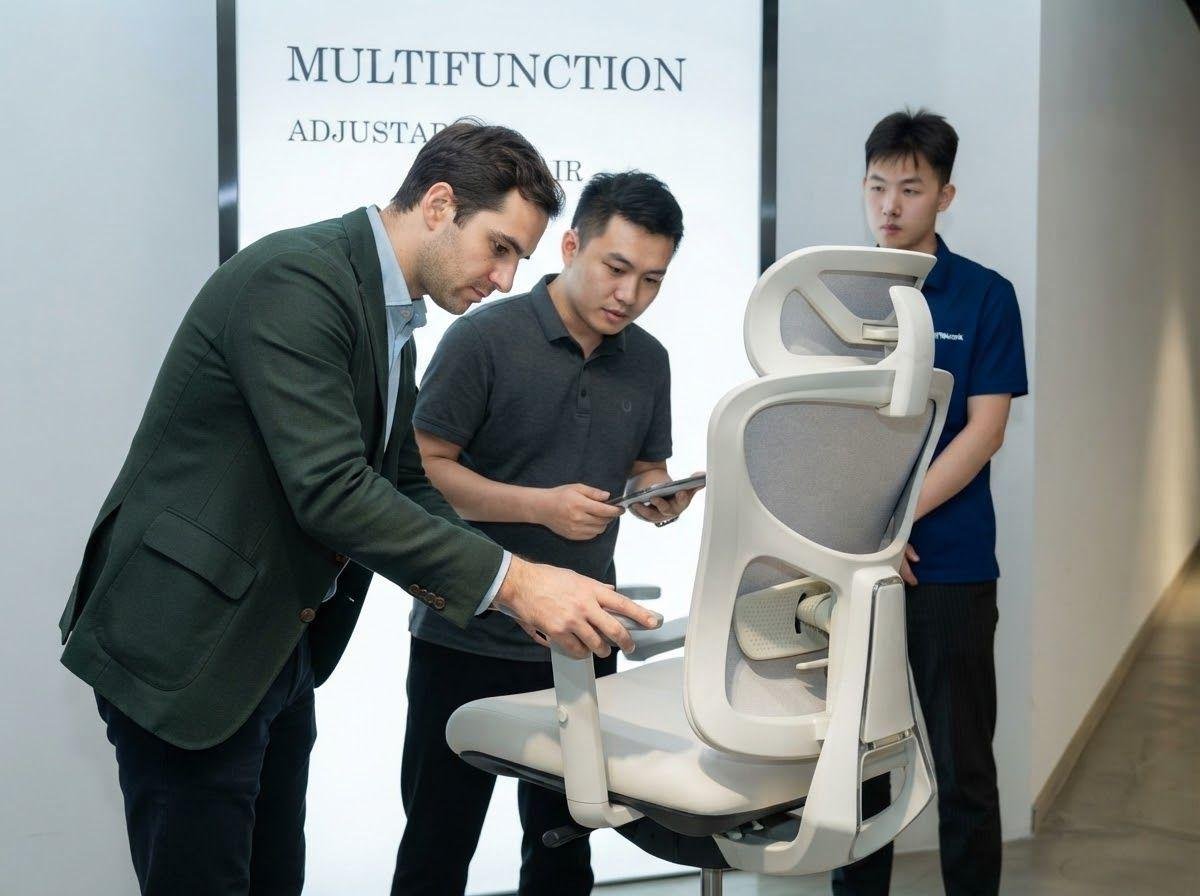
October, Shanghai. M50 district. I’m in this converted textile warehouse that now sells $8 lattes and pretends to be a gallery. Across the table: a buyer from some boutique Copenhagen hotel group. Jet-lagged, jittery, clutching her phone like a life raft. She’s got a $340,000 furniture budget and a Pinterest board full of fever dreams — resin consoles that curve like melted glaciers, bronze pendants that look like they were forged in a volcano, chairs that seem to defy gravity and probably your spine too.
“I just assumed I’d have to go to Milan for this stuff,” she says. I don’t say anything. Just finish my coffee. Three hours later we’re in a studio on the edge of Shunde, sitting on plastic stools, and she’s sketching dimensions with a guy who trained at Central Saint Martins, did two years at Tom Dixon’s London workshop, then came back to China in 2019 because — his words, not mine — “the rent was killing me and the metal suppliers here actually answer their phones.” The prototype quote comes in. She blinks. It’s about 40% below what her European sourcing agent had whispered in her ear back in Denmark. Letter of intent signed before her jet lag even clears.
That’s not a success story. That’s just Tuesday in China if you know where to look.
The Brutal Truth Nobody at the Trade Show Tells You
Here’s what the glossy CIFF booth photos won’t show you. Most avant-garde Chinese studios? They don’t actually want your 500-unit order. They’ll take it, sure. Money talks. But they’d rather not.
The real juice — the real creative energy — lives in the 20-to-80 piece range. That’s the sweet spot. Push them past 200 units and you’re not buying design anymore. You’re buying a compromised version of it, stamped out by tired hands on night shift.
Rule of thumb: if the founder still sketches prototypes personally, keep your first order under 100 pieces. Period. No exceptions.
Key Takeaways
- Chinese furniture design isn’t one thing anymore. It’s split into two worlds: the mass-market factory corridors and the independent studio clusters in Shanghai, Shenzhen, and Hangzhou.
- To source from China at the avant-garde level, you need factory-floor relationships, not Alibaba search terms.
- The studios worth your time rarely show at mainstream trade fairs. They pop up at design weeks, gallery spaces, and by appointment only.
- Lead times for custom avant-garde pieces run 10–16 weeks — comparable to mid-tier European makers, but with way more flexibility on materials and dimensions.

Deep-Dive: Why the Best Studios Hide in Plain Sight
Why does finding them feel like detective work?
Sourcing avant-garde Chinese furniture isn’t like walking through a Foshan showroom corridor with a checklist and a translator app. It’s more like crate-digging for vinyl in a city you’ve never visited — the good stuff isn’t alphabetized, the owner doesn’t advertise, and half the inventory isn’t even on display.
The studios that matter run on reputation and WeChat introductions. They don’t optimize for Google. They optimize for the whisper network among interior designers who’ve already burned through three disappointing manufacturers.
I’ve watched buyers spend three days in Longjiang — the furniture manufacturing gut of Foshan — and leave with nothing but catalog samples and a splitting headache. Then they take a 45-minute Didi to a converted ceramics factory on the edge of Shunde and find six designers hand-finishing ash wood with techniques borrowed from traditional lacquerware restoration. Same city. Different universe.
The best studios are invisible to standard procurement because they aren’t trying to be found by standard procurement.
And here’s the thing — that’s on purpose. These founders watched the 2010s generation of Chinese design brands try to scale too fast, take every hotel project that knocked, and collapse under their own ambition. The survivors learned. They downsized. They got picky.
Actually, that’s not quite right. What most buyers miss is that these studios aren’t “hiding” from you. They’re filtering. If you can’t find them through a designer referral or a targeted design-week visit, they figure you aren’t ready for the conversation.
Is the quality actually there, or is it all smoke and mirrors?
This is where it gets uncomfortable for people who still picture Chinese manufacturing as some kind of corner-cutting free-for-all. The quality gap you’re imagining closed five years ago. What’s open now is a taste gap — and that’s a much harder problem to solve.
A studio in Hangzhou’s Xihu district I visited back in March was producing hand-cast aluminum tables with surface tolerances I’d expect from a Belgian atelier. The founder, a former automotive designer, had built his own forging rig because commercial suppliers couldn’t hit his spec. The finishing work — brushed, oxidized, sealed with a proprietary coating — took eleven days per piece. Eleven days. For one table.
But the real kicker isn’t the machinery. It’s the material access. China’s domestic supply chain for exotic veneers, engineered stones, and recycled composites has matured to where a small studio can source substrates that would cost a European designer triple after import duties and middlemen markups. The Hangzhou studio wasn’t “cheap Chinese furniture.” It was premium global design that happened to be priced where it was made.
Or rather, the problem isn’t the factory. It’s the expectation. Buyers show up looking for a discount on something they’ve already seen in a Milan showroom. The studios aren’t interested in being your discount bin. They want to be your co-creator.

The Studio Landscape: Who’s Actually in the Room
If you map China’s avant-garde furniture scene honestly, it looks less like an industry and more like a bunch of micro-climates that barely talk to each other.
Shanghai’s M50 and West Bund corridors skew toward art-world crossovers — designers who show at galleries, collaborate with contemporary artists, and treat furniture as conceptual object first, functional product second. Shenzhen’s Nanshan and Shekou clusters lean tech-forward: parametric modeling, CNC experimentation, carbon-fiber hybrids. Hangzhou and Suzhou draw from craft heritage — bamboo lamination, silk-thread inlay, revived Song-dynasty joinery methods applied to modern forms.
While some buyers gravitate toward large-scale manufacturers in Foshan, others find that mid-sized specialists — operations like Interi Furniture, which focuses on project-grade custom upholstery and hospitality casegoods with a design-forward sensibility — offer a different risk-reward equation. They’re not a boutique studio, and they’re not a commodity factory. They sit in the middle ground where avant-garde concepts get translated into production-ready pieces without losing their soul to a mold.
That middle ground is where most procurement directors actually need to be. The pure ateliers are magical, but they can’t always handle the documentation, the QC consistency, or the timeline pressure of a live hotel opening. You need to know which layer of the landscape matches your project’s risk tolerance.
Your Sourcing Playbook: What Actually Works in the Field
Phase 1 — Reconnaissance (Weeks 1–2)
Build your target list from design-week catalogs, not B2B platforms. Shanghai Design Week, Design Shenzhen, and the West Bund Art & Design Fair publish exhibitor lists that read like a who’s-who of serious studios. Cross-reference with Architonic, Dezeen China, and local design media. If a studio has zero English-language press but three features in Design 360° or Wallpaper China, that’s usually a good sign — they’re focused on domestic credibility first.
Engage a sourcing agent who speaks design, not just Mandarin. The translator who got you through your last container deal in Longjiang is not the person to evaluate whether a resin pour has micro-bubbles. You need someone who can interrogate a finish sample like they know what they’re looking at.
Phase 2 — First Contact (Weeks 3–4)
Lead with your project, not your volume. Avant-garde studio founders respond to creative briefs. They glaze over at “we need 300 units by Q2.”
Request a studio visit before you ask for a quote. Sounds inefficient. It isn’t. Seeing their prototype shelf, their material library, and their actual workspace tells you more than a PDF ever will. Bring physical references, not mood boards. A fabric swatch, a hardware sample, a broken chair from a competitor that failed — these communicate intent faster than 40 Pinterest pins.
Phase 3 — Evaluation & Negotiation (Weeks 5–6)
Insist on a prototype phase, even if it costs extra. Industry observers estimate that 60–70% of first-time sourcing relationships from Western buyers to Chinese studios fail because both parties assumed they understood the spec. An $800 prototype saves a $40,000 disaster.
Negotiate on materials and timeline, not on design fee. The design fee is usually the smallest line item and the one the studio is most emotionally attached to. Cut there and you signal disrespect. Cut on shipping terms instead.
Phase 4 — Production & QC
Assign a third-party inspector for the first two production runs. Not for every container — just until trust is established. The general pattern suggests that studios with nothing to hide welcome this.
Build 15% buffer into your lead time. Not because they’ll miss it. Because customs paperwork from small studios is often handled by the founder’s cousin, and cousin gets busy.
Red Flag — The One That Breaks Conventional Wisdom:
Beware studios that agree to everything immediately. The eager yes is often a yes to whatever they think you want to hear, not to what they can actually deliver. The best studios push back on at least one element of your brief. That’s your green light.

FAQ: What Buyers Actually Ask (After They’ve Already Made One Mistake)
Q: Can I get true avant-garde pieces at mass-production prices if I just order enough volume?
A: No. And trying is how you end up with a watered-down version that satisfies nobody. The economics of small-batch experimentation don’t linearly scale. What tends to happen is the studio subcontracts the production to a larger factory, keeps a markup, and you lose the hand-finishing that justified the relationship in the first place. Order at the studio’s natural volume, or find a different supplier.
Q: How do I know if a studio’s “original design” is actually original and not a tweaked knockoff of something European?
A: Ask to see their sketch archive and prototype progression. A studio with genuine R&D culture keeps physical evidence — foam models, failed iterations, material tests. If they show you only finished photos and no process, that’s your answer. Plus, search their designer names on CNKI or Google Patents. Real designers in China file utility and design patents aggressively.
Q: Is it realistic to source from China for a single high-end residential project, or is this only viable at hotel scale?
A: It’s not only viable — it’s often ideal at residential scale. A single penthouse or estate commission gives a studio creative freedom that a 200-room hotel contract can’t match. I’ve seen buyers source 12–18 statement pieces for a private client with total budgets in the $80,000–$150,000 range, and the studios treated it as their portfolio centerpiece. The minimum viable order is often lower than you think. What kills residential deals isn’t volume — it’s indecision.
Q: Do I need to speak Mandarin, or can I rely on the studio’s English contact?
A: You can rely on their English contact for logistics. You cannot rely on it for nuance. The difference between “hand-finished” and “hand-assisted” gets lost in translation in ways that cost thousands. Hire a design-literate interpreter for your first two visits. After that, WeChat translate and patience get you surprisingly far.
Q: So is sourcing avant-garde design direct from Chinese studios actually worth the hassle compared to using a European agent?
A: It depends on whether you want access or convenience. If you want a showroom experience, white-glove service, and predictable lead times, use a European agent and pay the premium. If you want pieces that don’t exist in any other project on earth, direct relationships with the people who made them, and pricing that reflects factory reality rather than distributor markup, the hassle is the point. The friction is the filter.
What I Still Don’t Know
Fifteen years in, and I still can’t predict which Chinese design studio will still exist in three years. Some of the most exciting founders I’ve met are one delayed payment away from folding. Others have quietly built sustainable operations that outlast trend cycles. The difference isn’t talent — it’s business discipline, and that’s not something you can assess from a portfolio photo.
So here’s my hard-earned principle: never fall in love with a studio before you’ve seen how they handle a problem. A missed deadline. A flawed sample. A communication breakdown. Anyone can ship perfection on a good day. The ones worth building around are the ones who fix things like adults when it goes sideways.
And it will go sideways. That’s not pessimism. That’s the job.
Buy smart. Visit twice. Trust the process more than the pitch.