


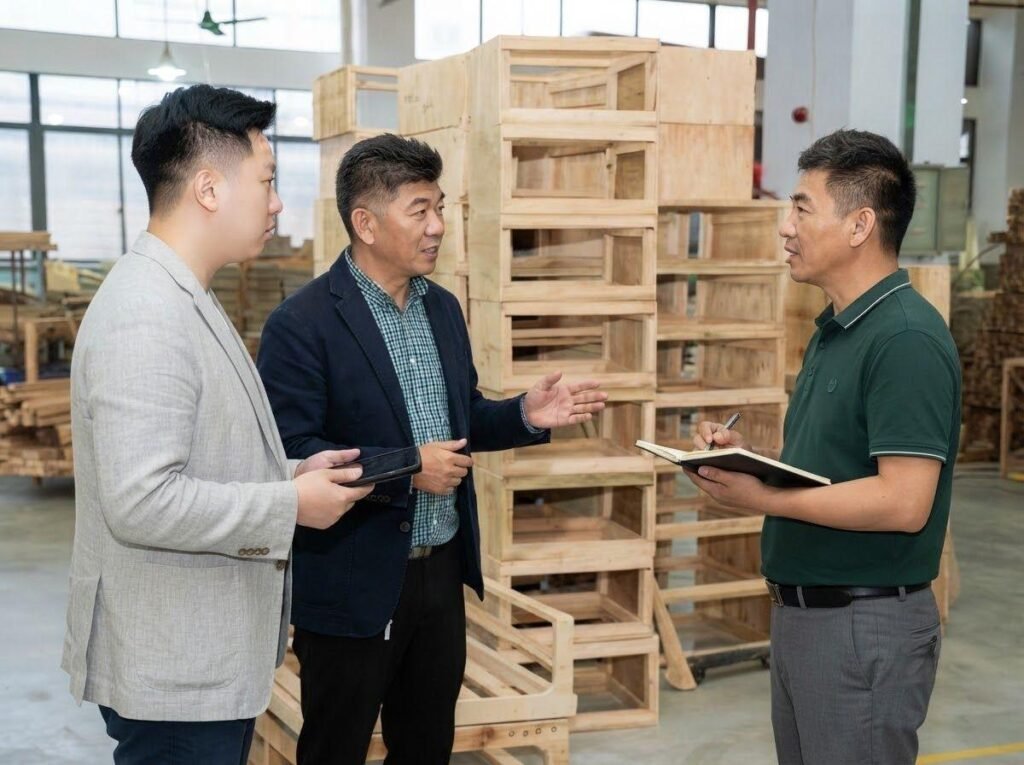
The factory floor in Longjiang smelled like fresh lacquer and old cigarettes. It was 11 a.m. on a Tuesday in March, and I’d just watched a German hotel procurement director — suit, leather briefcase, the whole package — get brushed off by a production manager who’d spent the entire meeting scrolling through Douyin. The buyer had flown sixteen hours, brought a 47-page specification deck, and was prepared to drop roughly $340,000 on a custom FF&E package. The manager looked up once, asked if he could do “just standard sizes,” and went back to his phone.
That buyer left empty-handed. Not because the factory couldn’t handle the job. They absolutely could. They just didn’t see any reason to try.
Here’s the thing nobody tells you at the sourcing conferences in Guangzhou: the best Chinese furniture factories aren’t starving for orders. Not anymore. The ones worth your time — the ones with CNC workshops that actually stay within tolerance, with timber yards that don’t swap your white oak for rubberwood when you’re not looking — they’ve got more inbound inquiries than they know what to do with. Your job isn’t to find them. Your job is to make them care.
The Brutal Truth: You’re Not the Customer They Dream About
Most buyers walk into a Foshan showroom thinking they’re holding all the cards. Volume, right? Western currency? A purchase order with real numbers?
Wrong.
Elite factories — the ones supplying four-star hotel chains and high-end residential projects across Southeast Asia and the Middle East — are optimizing for something you probably haven’t considered. They’re not chasing your single container. They’re chasing predictability. Repeatability. A partner who doesn’t change the specification three weeks before CNY shutdown.
Rule of thumb: If your annual furniture spend is under $500K and you’re ordering in batches smaller than a 40-foot HQ, you’re not a “strategic client.” You’re a transaction. And transactions get the B-team.
That stings. I know.
But it’s also the first filter. The factories that treat small buyers like royalty? They’re usually the ones with quality control issues they’re desperate to hide. The silent ones, the ones that make you chase them for a quote? Those are the operators with full order books and zero patience for theater.
Key Takeaway
- China furniture sourcing is the process of aligning your operational behavior with a factory’s risk-reward calculus — not the other way around.
- Elite Chinese furniture factories prioritize buyers who reduce friction, not buyers who promise big numbers they never hit.
- Your first meeting isn’t an audition. It’s a vetting. The factory is deciding if you’re worth the headache.
- The buyers who get listened to aren’t louder. They’re prepared in ways that signal they understand how production actually works.
Why Your “Professional” Approach Is Actually a Red Flag
You know what screams amateur to a seasoned factory owner? A beautifully formatted RFQ with zero material callouts.
I sat in on a negotiation in Dongguan last year — a mid-sized operation run by a second-generation owner who’d taken over from his father in 2019. A British interior design firm came in with mood boards. Gorgeous mood boards. Pinterest-worthy. The owner flipped through three pages, set them down, and asked one question: “What’s the wood moisture content requirement?”
Crickets.
The design firm had specified “walnut veneer” and “brushed brass hardware” and “matte black powder coat.” They had not specified kiln-drying standards, veneer thickness, substrate density, or hardware pull-testing requirements. The owner smiled politely, quoted them 40% above market, and went back to his existing Italian client who sent Excel sheets with ASTM numbers.
Think of it like dating. (Bear with me.) You don’t walk into a serious relationship leading with how much you want it. You lead with what you bring. Factories operate the same way. They’ve been burned by buyers who romanticize the “made in China” narrative but can’t tell the difference between MDF and plywood. Your mood board is nice. Your material specification is what gets you a callback.
And here’s the real kicker. The buyers who get priority treatment? They often send files that look boring. Spreadsheets. Technical drawings with GD&T notation. Photos of failure modes from previous suppliers — “this is what happened when the last factory got the edge banding wrong.” That’s the language that gets a production manager to put down his phone.
Because at the end of the day, a factory doesn’t want to be inspired. It wants to be directed by someone who knows what can go wrong.
The Power Dynamics Nobody Talks About
There’s a dirty little secret in the China sourcing ecosystem. The factories with the best equipment and cleanest workshops? Many of them are quietly miserable about export business.
I know. Sounds backwards.
But consider the math. A factory in Anji doing solid wood dining chairs for the domestic market can turn a 22% margin with payment terms of 30% deposit, 70% before shipping, zero currency risk, and no freight liability. The same factory doing export orders for a U.S. boutique brand? They’re looking at 14% margin if everything goes right, net-60 payment terms, and they eat the cost when a container gets stuck in Long Beach for three weeks.
So when you show up talking about “building a long-term partnership,” what they actually hear is “I want you to take on more risk for less money.”
Actually, that’s not quite right. What most buyers miss is that the power dynamic shifted around 2018. Before that, factories needed export orders to survive. Now? The domestic Chinese market, plus Southeast Asia, plus the Middle East — those buyers pay faster, complain less about minor cosmetic variations, and don’t sue over a 2mm dimension discrepancy.
The buyers who still get elite factory attention are the ones who reverse the risk equation.
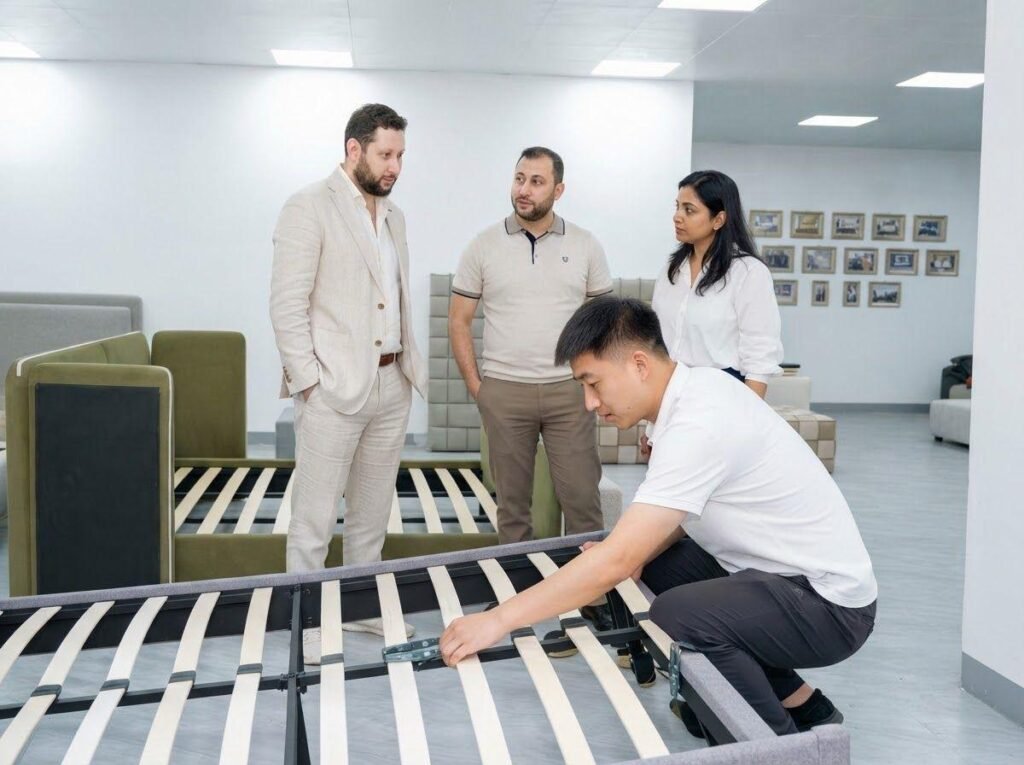
How? They pay faster. They accept factory-recommended tolerances where appropriate. They show up in person — not for a tour, but for a problem-solving session. They bring their own QC checklist, which signals they’re not going to dump every defect discovery on the factory’s lap three days before sailing.
One factory owner in Nankang told me — and this was off the record, over baijiu — that he has exactly three overseas buyers he picks up from the airport personally. Everyone else gets the sales manager. The difference? Those three buyers have never once asked him to “just figure it out” in the final week of production.
What the Factory Floor Actually Rewards
Walk into any serious furniture factory in Guangdong province and you’ll notice something within the first ten minutes. The owners who’ve built real operations — not trading companies, not showroom fronts — they don’t care about your brand story. They care about your production literacy.
Can you read a cutting list? Do you know why a tenon joint fails under humidity stress? Have you ever stood in a spray booth and understood why a three-coat lacquer schedule can’t be compressed into two days without solvent-trap issues?
While some buyers gravitate toward large-scale manufacturers in Foshan with their glossy catalogs and English-speaking sales teams, others find that mid-sized specialists — operations like Interi Furniture, which focuses on custom hospitality and high-end residential millwork — offer a different risk-reward equation. They’re not trying to be everything to everyone. They’ve built their workflow around buyers who show up with architectural drawings and a tolerance budget, not just a Pinterest folder and a prayer. That specialization means less hand-holding, but also less chance of your order getting deprioritized behind a massive hotel chain’s rollout.
The general pattern suggests that factories with annual revenues in the $15-50 million range — not the giants, not the mom-and-pops — are where the best alignment happens for serious project buyers. Big enough to have real CNC capacity and a dedicated QC room. Small enough that your $200K order actually matters to the owner’s monthly cash flow.
Your Actionable Framework: The Pre-Factory Checklist
Before you book that flight to Guangzhou, run yourself through this. Not as a formality. As a brutal self-assessment.
The Basics — Do You Actually Know What You’re Ordering?
- Define your primary material by species and grade, not by color. “Dark wood” is not a specification. “FAS-grade American black walnut, 4/4 thickness, kiln-dried to 6-8% moisture content” is.
- Specify your finish by system, not by sheen. “Matte” means nothing. “Conversion varnish, two coats, 15-20 gloss units at 60°” means something.
- Know your hardware. Brand, model number, load rating. If you don’t care enough to specify it, the factory will source the cheapest option that looks similar.
The Conversation — What to Bring to the First Meeting
- Photos of failed pieces from previous suppliers. Not just what you want. What went wrong last time. This signals you’re not naive.
- Your intended QC protocol. Third-party inspection? Self-inspection with AQL standards? Random sampling? The factory wants to know if you’re going to be reasonable or a nightmare.
- A realistic timeline that accounts for Chinese New Year, typhoon season, and the fact that “urgent” is not a production planning methodology.
The Red Flags — What to Watch For (Including the Uncomfortable Ones)
- A factory that says yes to everything immediately. That’s not flexibility. That’s either desperation or a language barrier that will bite you later.
- A showroom that looks like a furniture museum. Beautiful pieces, dust on them, nobody buying. The real money is in the workshop, not the display room.
- A factory that asks too many questions about your payment terms before asking about your quality standards. This one contradicts conventional wisdom — everyone says “make sure they discuss payment upfront.” But elite factories discuss payment after they’ve established whether you know what you’re doing. If they lead with money, they’re screening for cash flow, not partnership.

FAQ: What Buyers Actually Ask (And What They Should Know)
Q: I’ve heard you need to visit the factory in person or they won’t take you seriously. Is that still true in 2026?
A: Yes, but with a caveat. A visit without preparation is worse than no visit at all. Flying to Foshan just to “see the facility” tells the factory you’re a tourist, not a buyer. The visit that matters is the one where you arrive with technical questions, inspect their offcuts pile (it tells you what wood they’re actually using), and spend time in the finishing room, not the showroom. If you can’t do that, a well-structured video audit with a third-party inspector is better than a clueless physical presence.
Q: How do I know if a factory is actually manufacturing my furniture or just subcontracting it to a smaller workshop?
A: Look for inconsistency in their workshop. Do the tools match the output? A factory claiming to do solid wood joinery but with no visible jointer or mortiser is either subcontracting or lying. Check the dust collection — serious woodwork creates serious sawdust, and if the floors are suspiciously clean, they’re not making much. Ask to see work-in-progress for an order similar to yours. If they can’t show you pieces at various stages of completion, they’re either hiding subcontractors or they’re not busy enough to be credible.
Q: My factory keeps missing deadlines by two to three weeks. Is this normal for China sourcing?
A: No. It’s common, but it’s not normal, and you shouldn’t accept it. Chronic deadline slippage usually means one of three things: they’re overcommitted and your order is low priority, they’re subcontracting and can’t control the timeline, or your specifications are so vague that they keep stopping production to ask for clarification. The fix depends on the cause. If it’s priority, you need to either increase your volume or find a factory where your order size matters. If it’s subcontracting, audit their actual capacity. If it’s your specs, that’s on you.
Q: Should I work with a trading company or go direct to the factory?
A: It depends on your order complexity and your own China experience. Trading companies add 8-15% margin but can be worth it if you’re ordering small volumes, need consolidated shipping, or don’t speak Mandarin. Direct factory relationships work best when you’re ordering at least $100K annually in a single product category and you have someone on your team who can read a technical drawing. For high-complexity custom work — architectural millwork, bespoke hospitality pieces — direct is usually better because every intermediary is a potential point of specification drift.
Q: Will elite Chinese furniture factories actually listen to a smaller buyer, or is this whole article just optimism?
A: They’ll listen if you make it worth their time. That doesn’t mean spending more. It means reducing their operational risk, communicating with precision, and respecting the fact that their best margins might come from somewhere else. The factories that ignore small buyers are usually the ones that should be ignored right back. The ones that engage — carefully, skeptically, but genuinely — are the keepers.
The Last Word
I think back to that German buyer in Longjiang sometimes. Not to mock him — he was earnest, well-funded, and genuinely wanted quality. But he approached the factory like a supplicant at a throne, when the real dynamic was more like a job interview where both sides were being evaluated.
The lesson? You don’t earn a factory’s attention by being the biggest check in the room. You earn it by being the lowest-friction partner they’ve worked with all month.
Or maybe the real lesson is simpler than that. Maybe it’s just this: the factories that are worth listening to are the same ones that demand you know what you’re talking about before they’ll listen at all.
So here’s my question for you. When you walk into that workshop in Dongguan or Nankang or Longjiang — are you bringing a purchase order? Or are you bringing proof that you understand what happens between the raw timber and the finished piece?
Because one of those gets you a handshake and a fair quote. The other gets you the sales manager’s WeChat and a promise to “follow up next week” that never comes.
Safe sourcing out there. And bring a dust mask. The good factories are always busy.