

I was standing in a showroom in Longjiang, Shunde District, last March, staring at a dining chair frame that looked teleported from a Minotti catalog. Same 12-millimeter brushed steel profile. Same hairline weld along the inside joint. Same matte black powder coat with that chalky, velvety finish the Italians spend years perfecting. The factory manager, a guy who’d been welding furniture since the nineties, watched me flip the frame over.
“Forty-seven dollars,” he said. “FOB Shenzhen. MOQ 200.”
I didn’t buy it. Not because the price was low — it was — but because the weld on the bottom rail was too clean. Suspiciously clean. In my experience, when Chinese metalworkers replicate Italian minimalism, the visible surfaces get all the love. The hidden joints? That’s where the story lives. But this frame looked finished by someone who cared about the geometry. In fifteen years of walking factory floors in Guangdong, that was the moment I realized the game had changed.
Or maybe it hadn’t. Three weeks later, a different supplier in Dongguan sent me the same profile. Same photo. The sample arrived with weld spatter on the inside corner and powder coat that chipped when I dropped it on concrete. Same price. Two completely different animals.
And that, right there, is Chinese metal furniture right now. You’re not just testing welders. You’re testing whether the factory you’re even talking to is the one making the thing.
The Brutal Truth: The Weld Is Just the Beginning
Most buyers who fly into Guangzhou Baiyun with Italian catalog photos in their carry-on are looking for the wrong thing. They ask to see weld samples. They bring calipers to measure wall thickness. They want to know if the factory can do “TIG welding with argon shielding” — as if reciting the spec sheet makes them sophisticated.
They’re missing the point entirely. (And paying for that mistake one container at a time.)
The weld is the easy part. Any halfway competent metal shop in Foshan can lay down a bead that looks Italian from three feet away. The real test isn’t the arc. It’s what happens after the welder pulls the trigger.
If you can’t tell the difference between a $45 Chinese frame and a $2,200 Italian frame with your eyes closed, you’re not ready to buy Chinese. Run your fingers along the joint. The good ones feel like a seam in silk. The bad ones feel like a zipper on a cheap jacket. And in China, both exist at the exact same price point.
The brutal truth? You’re not paying for better welding. You’re paying for factory discipline. For the supervisor who checks every jig before the morning shift. For the worker who spends an extra forty-five seconds grinding a joint that the buyer will never see. That discipline doesn’t show up in a quote. It shows up six months later, when your hotel installation in Miami doesn’t have rust blooming under the powder coat because someone skipped the phosphate wash.
Actually, that’s not quite right. The problem isn’t the factory. It’s the expectation that a lower price should deliver the same thing. It can. But only if you know how to look.
Key Takeaway
Chinese metal furniture sourcing is the process of identifying manufacturers whose quality discipline extends beyond visible surfaces to hidden joints, surface preparation, and post-weld finishing — not merely finding factories that can replicate a profile. Here is what that actually means on the ground:
— The weld you see is rarely the weld that fails.
— Powder coat beauty is pretreatment dependent; skip the chemistry, and you’re buying a rust schedule.
— Factory type matters more than factory size: in-house process control beats square footage every time.
— Price compression doesn’t come from “efficiency”; it comes from invisible corners being cut.
Why Does the Same Drawing Produce Two Completely Different Chairs?
This is the question that keeps procurement directors awake at night. You send a CAD file to three factories. You get back three samples that look, on paper, identical. Same dimensions. Same material spec. Same weight. But one sits like a rock. One wobbles on flat tile. One squeaks when you shift your weight.
It’s not the drawing. It’s the jig.
Can You Actually Trust a Factory’s Sample?
Think of it like baking bread from the same recipe in three different kitchens. One cook measures flour by weight. One uses a coffee cup. One eyeballs it. Same recipe. Three loaves. The Chinese metal furniture industry runs on jigs — custom-built fixtures that hold tubes and profiles at exact angles before the welder touches them. A factory with CNC-cut jigs and quarterly calibration will produce frames that are geometrically identical, batch after batch. A factory that built its jig from scrap angle iron in 2018 and “fixes it when it drifts” will produce frames that look right in photos and fail in reality.
I walked into a shop in Nankang once — yes, Nankang in Jiangxi, not Guangdong, the metal furniture cluster most buyers have never heard of — and saw a jig for a minimalist side table held together with hose clamps. The factory owner was proud of it. “Very flexible,” he said. “We can adjust for any design.” What he meant was: no two pieces would ever be exactly the same. For a rustic wrought-iron patio set, fine. For a replica of a Living Divani console table? Disaster.
And here’s the thing most spec sheets don’t capture: Italian minimalism is unforgiving. A traditional ornate metal frame hides sins. A 10-millimeter square tube with a mitered corner and a visible weld? Every fraction of a millimeter shows. The eye detects asymmetry at a level the conscious brain can’t articulate. Your hotel guest doesn’t think “the left leg is 1.2 degrees off.” They just think the room feels cheap. Wrong at a gut level.
The general pattern suggests that factories specializing in ornate or traditional styles struggle most with minimalist replication. Not because they lack skill. Because their entire operational culture is built on forgiveness. Italian minimalism demands punishment.
The Powder Coat Is Where Factories Lie to Your Face
If welding is the skeleton of metal furniture, powder coating is the skin. And skin, as any dermatologist will tell you, tells the truth eventually.
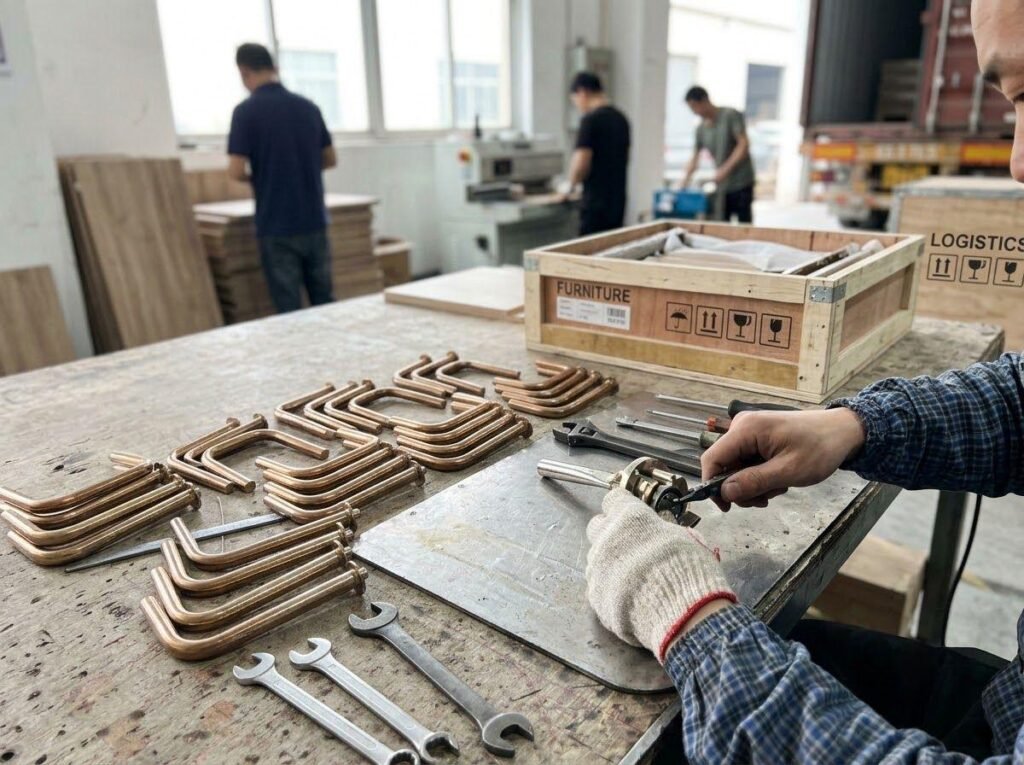
Italian minimalism relies on surfaces that read as monolithic — seamless, texture-uniform, almost liquid in their consistency. Achieving that on steel or aluminum isn’t about buying better powder. It’s about what happens before the powder hits the metal. The pretreatment. The degreasing. The iron phosphate or zinc phosphate bath. The deionized water rinse. The drying oven temperature. Miss one step, or rush one bath, and you’ve built a time bomb wrapped in a beautiful color.
Why Does the Surface Look Perfect While the Substrate Rots?
I learned this the hard way in Dongguan. (A lesson that cost me a client relationship and three months of credibility.) A factory had sent me samples with a powder coat so flawless I actually called a designer friend to brag about it. Deep matte charcoal. No orange peel. No thin spots at the weld joints. We placed a 300-piece order for a boutique hotel project in Lisbon. Six months after installation, the housekeeping manager sent photos. Rust blooming like mold at every inside corner. Not because the powder was bad. Because the metal had never been properly degreased. The powder was sitting on top of mill scale and cutting oil, not bonded to steel. It looked perfect. Until it didn’t.
The analogy I use with buyers: buying based on a sample’s surface finish is like marrying someone based on their dating profile photo. You’re seeing the best possible version, under the best possible light, after the best possible preparation. The real question is what happens at 6 AM, no makeup, three years in.
What tends to happen in the lower-tier factories is a shell game. They keep one pretreatment line running properly for samples and audits. The production line? Different story. I’ve seen factories with a “sample booth” that has its own dedicated washer, while the mass-production pieces skip straight to coating. Smoke and mirrors. And most buyers never know until the container lands.
But the real kicker isn’t the deception. It’s the price compression. When a buyer pushes a factory from $48 to $38 on a metal chair frame, the pretreatment is the first thing to evaporate. Not the steel gauge. Not the welding. Those are visible. The chemical baths are invisible. Out of sight, out of spec.
Who’s Actually Making Your Furniture? (The Supply Chain Mirage)
Here’s a dirty secret that doesn’t get talked about at trade shows: the factory whose business card you’re holding often isn’t the factory making your furniture. Not in the way you think.
In Guangdong’s metal furniture corridor — stretching from Foshan through Dongguan to Shenzhen’s outer districts — there’s a layered ecosystem that would make a food chain diagram look simple. At the top, you have the showrooms. Glossy. Air-conditioned. Staffed by English-speaking salespeople who know exactly which Milanese designer you’re referencing. Below them, the assembly factories. They weld. They coat. They pack. But they don’t always cut, bend, or machine. Below that, the component specialists. The tube benders. The laser cutters. The machine shops that only do aluminum extrusion. And at the bottom, the job shops. The guys with one brake press and a dream.
Is Your “Factory” Just a Middleman with a Welding Machine?
Think of it like a restaurant that doesn’t have a kitchen. They take your order, call three different suppliers, plate it beautifully, and hope the timing works out. Some assembly factories in Longjiang are exactly that. They don’t own a laser cutter. They don’t operate a bending machine. They source cut profiles from Shop A, bent legs from Shop B, and hardware from Shop C. Then they weld it together, slap on powder coat, and call themselves a manufacturer.
For complex designs, this isn’t inherently bad. Specialization can improve quality. But for Italian minimalism — where every joint is visible and every tolerance is tight — fragmentation is fatal. When the leg supplier is off by half a millimeter and the frame supplier is off by half a millimeter in the other direction, the welder can’t fix it. He can only fill the gap with extra filler metal and grind it flat. Which changes the heat profile. Which changes the stress distribution. Which means your “minimalist” frame has a fat, ground-down joint that will crack under load in eighteen months.
The general pattern suggests that factories with in-house laser cutting and CNC bending produce more consistent minimalist frames than assembly-only shops. But they also cost 15 to 25 percent more. At the end of the day, you’re choosing between control and price. There is no secret third option.
The Factory Floor Reality: Who Survives the Minimalism Test?
If you want to understand why some Chinese metal furniture succeeds in replicating Italian minimalism while most fails, don’t look at the marketing. Look at the floor plan.
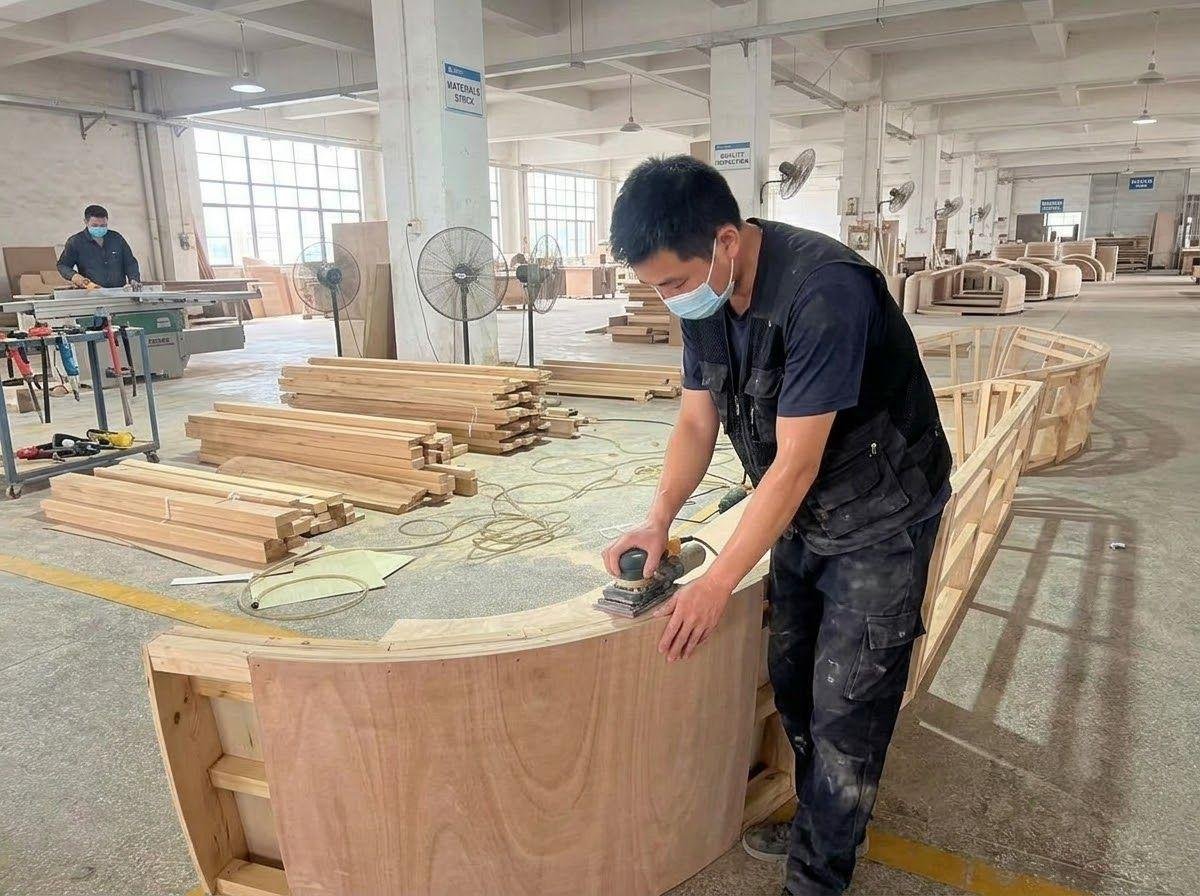
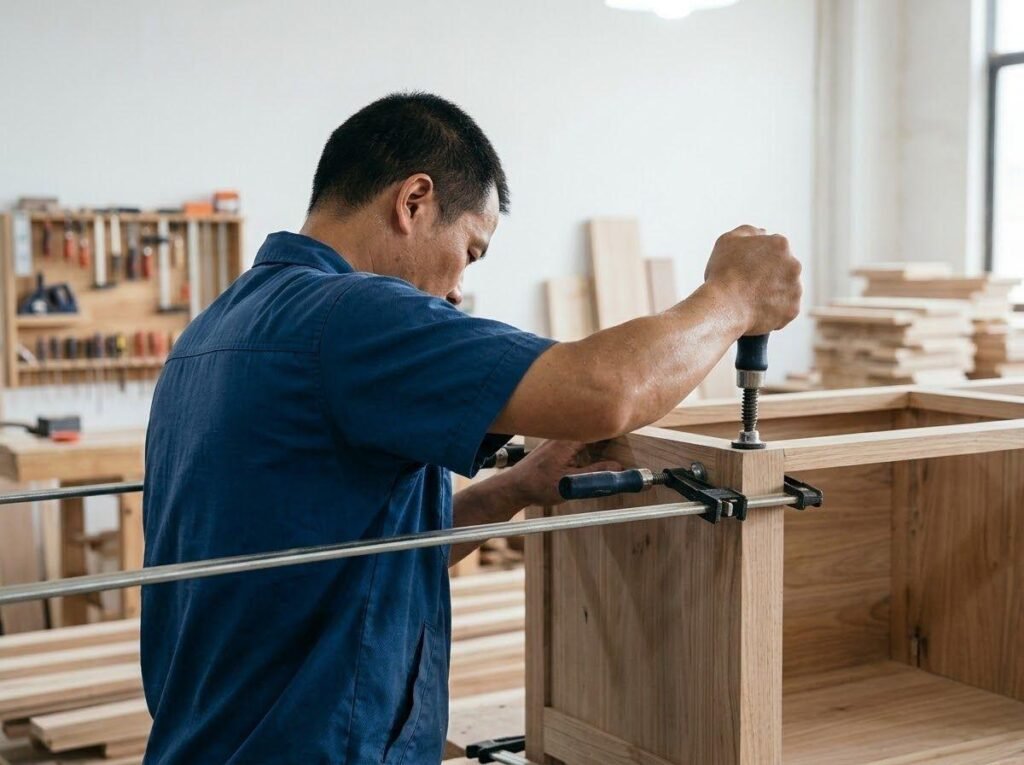
I visited two factories in the same industrial park in Shunde, three days apart. Both made metal dining chairs for export. Both quoted similar prices. Both showed me ISO certificates. But one factory had a quality control station between every production stage. The other had a QC table at the end of the line. That single difference — inspection distributed versus inspection batched — predicted everything else about their output.
The distributed-QC factory measured every cut tube with a digital caliper before it went to bending. They checked weld penetration with a borescope on 10 percent of joints. They had a pretreatment bath logbook with timestamps. The batched-QC factory? They checked finished pieces for scratches and called it a day. Both could make a beautiful sample. Only one could make a beautiful hundredth piece.
While some buyers gravitate toward large-scale manufacturers in Foshan, others find that mid-sized specialists — operations like Interi Furniture, which focuses on metal-and-upholstery combinations for project and hospitality segments — offer a different risk-reward equation. They tend to keep more processes in-house, which reduces the tolerance-stacking problem, but their capacity ceilings and stricter MOQ terms mean they’re not always the right fit for smaller residential runs. Knowing which type of operation you’re actually dealing with matters more than any catalog photo.
The real lesson from that Shunde comparison wasn’t about equipment. It was about culture. The factory that inspected between stages had a culture of catching mistakes early. The other had a culture of shipping mistakes and hoping the buyer wouldn’t notice. In custom China manufacturing, culture is the spec that never appears on the quote sheet.
A Buyer’s Decision Tree: Before You Sign That PO
Stop asking factories if they “can make this.” Every factory will say yes. Start asking questions that expose operational reality. Here’s the framework I use before placing any metal furniture order in China.
First, the site visit checklist. If you can’t visit, have someone you trust do it. Video calls don’t count.
Jig Inspection
— Ask to see the actual jig for your product. Is it CNC-machined steel or welded scrap? Look for wear marks, slop in the fixtures, and calibration dates. No dates? Red flag.
Welder Rotation
— How many welders touch each frame? In disciplined factories, one welder owns a product line. In chaotic ones, whoever is free grabs the torch. Consistency requires ownership.
Pretreatment Documentation
— Demand the chemical bath log for the last thirty days. A factory that can’t produce it either doesn’t track it or doesn’t do it. Either way, you lose.
Sample vs. Production Line
— Walk the production floor. Is there a separate “golden line” for samples and audits? If the sample room looks like a hospital and the production floor looks like a garage, you’re being played.
Now, the comparison table every buyer needs:
| Factor | Tier 1 (Export-Ready) | Tier 2 (Capable but Inconsistent) | Tier 3 (Avoid for Minimalism) |
|---|---|---|---|
| In-house cutting/bending | Laser + CNC brake | Some outsourced | Fully outsourced |
| Jig quality | CNC-machined, dated | Mixed, often worn | Scrap-built, “adjustable” |
| Pretreatment | Logged, monitored | Present but inconsistent | Skipped or hidden |
| QC placement | Between stages | End-of-line only | Visual only, no measurement |
| Welder assignment | Dedicated by product | Rotating pool | Whoever’s available |
| Price delta vs. Tier 1 | Baseline | 10–20% lower | 25–40% lower |
Use this table as a filter, not a scoring system. A factory that hits every Tier 1 box except price isn’t overcharging. They’re probably the only ones who won’t destroy your project.
And here’s the red flag that contradicts conventional wisdom: if the factory agrees to your target price too quickly, walk away. The best manufacturers in this space know their floor. They’ll negotiate on volume, on payment terms, on delivery schedule. But if they immediately drop 20% because you mentioned a competitor’s quote, they’re not being competitive. They’re planning to recover that margin somewhere you can’t see. Usually in the chemical bath you didn’t ask about.

FAQ: The Questions Buyers Actually Ask
Q: Can I really get Italian-quality metal furniture from China, or is that just marketing hype?
A: You can get close. In some cases, indistinguishably close. But it depends entirely on whether you’re buying from a Tier 1 operation with in-house control or a Tier 3 assembler patching together outsourced parts. The metal itself doesn’t care what country it’s in. The discipline applied to it does.
Q: I don’t have time to fly to Foshan. Can I trust a sourcing agent to vet factories for me?
A: Some agents are excellent. Others are paid by the factories they recommend. (And yes, this happens more than anyone admits.) If you use an agent, demand they send you unedited video of the production floor, not the showroom. Ask them to read the pretreatment log aloud on camera. If they push back, find a new agent.
Q: What’s the actual difference between a $45 frame and a $120 frame from two Chinese suppliers?
A: Usually about $15 in material and $60 in process discipline. The expensive one isn’t using magic steel. They’re spending more time on jig calibration, weld finishing, and surface prep. Whether that $60 matters depends on your project. For an Airbnb flip? Probably not. For a hotel lobby that needs to survive five years of luggage collisions? Absolutely.
Q: Should I ask for 304 stainless instead of carbon steel to avoid rust issues?
A: Only if your design budget can absorb the cost jump. 304 won’t rust, but it’s also harder to weld cleanly and much more expensive. For indoor use, properly pretreated and powder-coated carbon steel will outlast your upholstery. The rust issue isn’t the material. It’s the prep. Fix the prep, don’t gold-plate the metal.
Q: So is replicating Italian minimalism in China actually worth it?
A: It depends on whether you need the replica or the philosophy. If you want the exact Minotti frame at one-twentieth the price, you’ll likely be disappointed. If you want clean-lined, disciplined metalwork that captures the spirit of Italian minimalism — and you’re willing to pay for factory oversight — then yes. The value is real. But only for buyers who know what to test.
The Harder Question
After fifteen years of watching buyers succeed and fail in Chinese metal furniture, I’ve stopped asking whether China can replicate Italian minimalism. The better factories can. The question is whether you, as a buyer, are willing to do the work that replication requires.
Italian brands charge what they charge not just for design, but for decades of accumulated quality culture. You can’t import that culture in a shipping container. You can only rent it, factory by factory, visit by visit, inspection by inspection. And if you’re not prepared to be the quality culture yourself — to ask about jigs, to demand bath logs, to reject a batch because a weld feels wrong under your thumb — then no amount of savings will protect you from the container that arrives beautiful on top and rotten underneath.
So here’s my question back to you: are you buying furniture, or are you buying the illusion of a bargain? Because those are two very different products. And only one of them survives the first winter.