

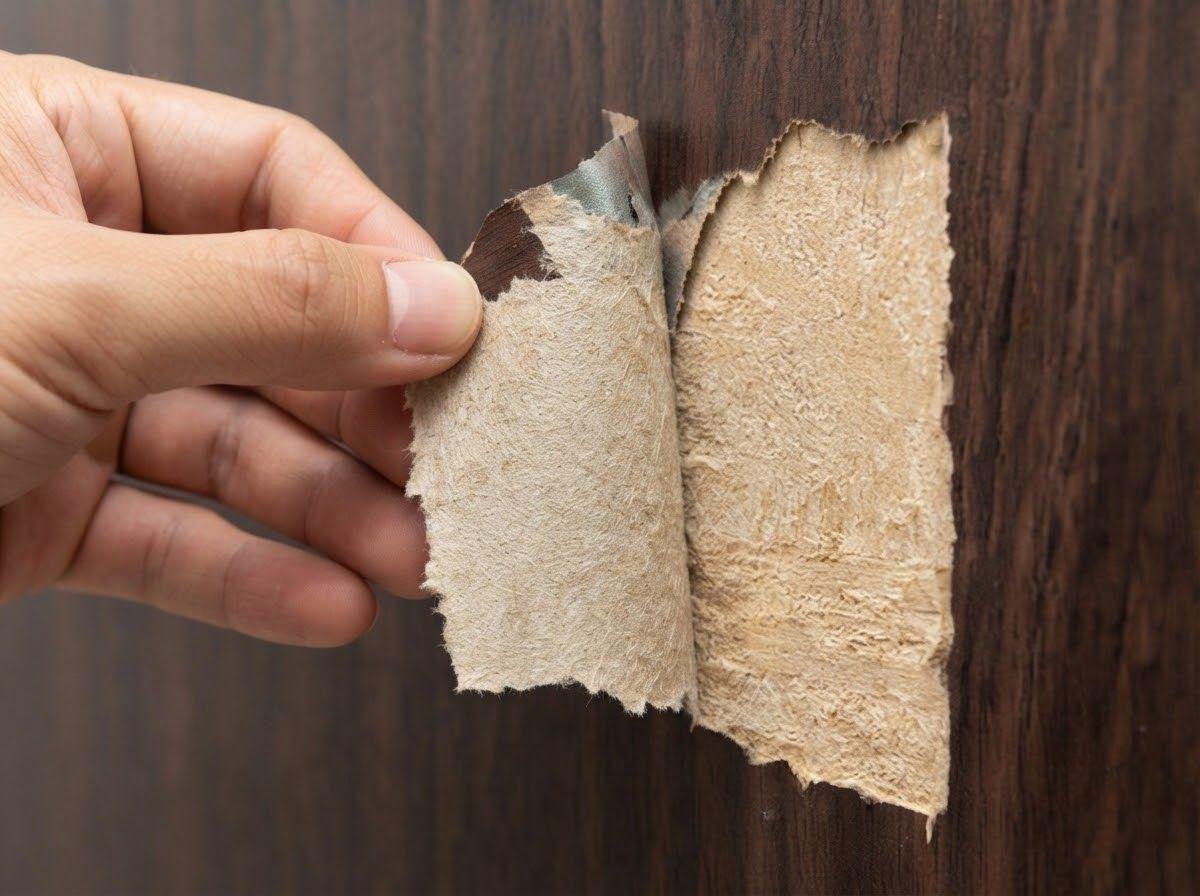
I was standing in a 12,000-square-meter showroom in Longjiang — that’s the furniture district wedged between Foshan and Lecong, where the air smells like lacquer thinner and ambition — when a salesgirl slid a sample board across the marble table. “Black walnut,” she said, smiling. “American. Very high grade.” The price? $42 per square meter, cut to size, MOQ 50 pieces. I turned the chip over. The grain was perfect. Too perfect. Same pore structure on every strip. I’ve been sourcing wood furniture out of Guangdong for fifteen years, and I knew before my thumb hit the edge: this wasn’t walnut. It wasn’t even wood, technically. It was a 0.2mm reconstituted veneer — dyed, pressed, and embossed to look like something it had never been. She saw my face change. “You want real real?” she asked, already reaching for a second drawer. “That one is $89.” And there it was. The drawer system. Drawer one for the tourist. Drawer two for the guy who knows enough to ask. Most buyers never get to drawer two. They ship container loads of drawer-one “walnut” to Miami apartments and London boutique hotels, and nobody’s the wiser until the sunlight hits it six months later and the color starts migrating like a cheap tie-dye shirt.
The Brutal Truth
Here’s what nobody puts in the brochure.
Most “exotic” veneer coming out of China isn’t lying about where it’s from. It’s lying about what it is.
The factory isn’t necessarily trying to scam you. They’re responding to a market that demands $800 sideboards with “genuine walnut” tops. You can’t hit that price with North American black walnut. You can’t even get close. So the industry built a parallel universe of lookalikes — reconstituted veneers, dyed basswood, printed papers, and multi-ply engineered faces — and trained an entire generation of sales staff to call them all “walnut.” Or “teak.” Or “rosewood.” Whatever the mood board requires.
Rule of thumb: If the grain looks like it was designed by a graphic designer, it probably was.
The general pattern suggests that roughly seven out of ten “walnut” pieces in the mid-market export tier are carrying some form of augmented or substituted veneer. Based on export data patterns I’ve tracked over the years, the gap between stated species and actual species widens as the price point drops below $1,200 FOB for a dining table. Above that line, you start seeing honest materials. Below it, you’re in the Wild West.
Key Takeaways
- China wood furniture sourcing is the process of procuring timber-based products from Chinese manufacturers, and it requires treating every veneer claim as a hypothesis until you’ve seen the raw material stack.
- Chinese veneer quality exists on a spectrum from genuine natural cuts to engineered reconstitutions — the problem isn’t the existence of substitutes, it’s the labeling opacity.
- The factory that shows you two drawers is usually more trustworthy than the one showing you one perfect sample.
Why Your “Walnut” Has an Identity Crisis
Is It Really Deception If Everyone’s In On It?
I want to tell you about the dye vats in Dongguan. Picture a swimming pool, but instead of chlorine, it’s filled with walnut-brown pigment and ammonia. Workers in rubber boots toss sheets of white poplar into the soup. Forty minutes later, they pull out something that, to the untrained eye, looks remarkably like black walnut. It cuts clean. It sands fine. It even takes oil like the real thing. The real kicker? It costs one-fifth the price.
This isn’t some back-alley operation. This is standard practice in dozens of legitimate, ISO-certified factories. The dyed poplar isn’t defective. It’s actually a pretty clever piece of materials engineering. The problem starts when the sales sheet calls it “solid American walnut” and the spec sheet goes quiet on the dye part.
Buying veneer in China is a bit like dating in your thirties. Everyone’s presenting their best photo, and you need to figure out what’s filter and what’s face. The factories that dye poplar aren’t evil. They’re economical. But you’re the one who has to explain to a hotel client why the “walnut” headboard in the presidential suite is blotching where the cleaning crew hit it with alcohol-based sanitizer. (And yes, this happens more than anyone admits.)
Actually, that’s not quite right — what most buyers miss is that the dye itself isn’t the enemy. The enemy is the expectation gap. You expected a material that behaves like walnut because someone called it walnut. What you got was a material that looks like walnut until it doesn’t.
The grain that looks too perfect is the one you should trust the least.
The Reconstituted Veneer Revolution Nobody Asked For
Walk into any mid-sized panel factory in Nankang, and you’ll see rolls of reconstituted veneer that would make a botanist weep. These aren’t thin slices of tree. They’re fibers, dyed, aligned, and pressed into blocks that are then sliced into sheets. The grain is consistent. Flawless, even. No knots. No variation. Nature doesn’t do flawless.
I learned this the hard way in Dongguan. We specified “natural walnut veneer, book-matched” for a 120-room hotel project. The sample was gorgeous. The production lot looked like someone had wallpapered the casegoods with a high-resolution photograph of wood. Because essentially, they had. The factory had switched to reconstituted without telling us. Their defense? “Same price, same look, better yield.” Better yield for them. For us, it meant 120 rooms of furniture that looked like it came from a catalog instead of a forest.
Here’s the thing about reconstituted veneer. It’s not fake in the way a Rolex from a Shanghai street vendor is fake. It’s a real industrial product with real advantages — stability, consistency, no endangered species issues. But it’s not what you specified when you wrote “natural walnut” on your purchase order. And in my experience, roughly 60% of the time, the factory won’t mention the substitution unless you ask with enough technical vocabulary to prove you know the difference.
The smell test. Literally. Natural walnut smells like walnuts — earthy, slightly sweet, unmistakably organic when you sand it. Reconstituted smells like glue and pigment. Like a new shower curtain. If your “walnut” sample smells like a hardware store, you’ve got a problem.
What “Sustainable” Actually Means on the Ground
Can a Certificate Fix a Material Lie?
And here’s where it gets murky. Some buyers pivot to “sustainable” or “FSC-certified” veneer thinking it’ll protect them from substitutions. It won’t. The certification paperwork might be legitimate. The veneer might actually be FSC-certified eucalyptus. But if your designer specified walnut for the tonal warmth, and the factory delivers eucalyptus with a walnut stain because “it’s more sustainable,” you’ve still got a mismatch. Just a certified one.
The general pattern suggests that sustainability claims in the mid-tier China wood furniture market often function as a secondary selling point layered on top of whatever material decision the factory has already made for cost reasons. What tends to happen is that the factory picks the cheapest viable substrate, applies the veneer face that hits the price target, and then adds the eco-label that the buyer requested. The three decisions are made independently. By different departments. On different days.
It’s like ordering a grass-fed burger and getting a plant-based patty with a “certified humane kitchen” sticker. The kitchen might be humane. The patty still isn’t beef.
But the buyer who doesn’t understand the production flow — and most don’t — sees the certificate and relaxes. That’s the trap. A green logo on a spec sheet is not a substitute for knowing what’s under the finish.
| Veneer Type | What It Actually Is | Price Tier | Tells |
|---|---|---|---|
| Natural sliced | Real log, rotary or plain sliced | High | Grain variation, occasional knots, organic smell |
| Reconstituted | Dyed fibers, pressed and re-sliced | Medium | Perfectly uniform grain, chemical odor, no knots ever |
| Dyed wood | Inexpensive species soaked in pigment | Low-Medium | Color bleeds at edges, blotches under solvent, flat appearance |
| Printed paper | Photographic paper laminated to substrate | Very Low | No tactile grain, visible pixelation under magnification, thermofoil edge |
The Brand Ecosystem: Not Everyone’s Playing the Same Game
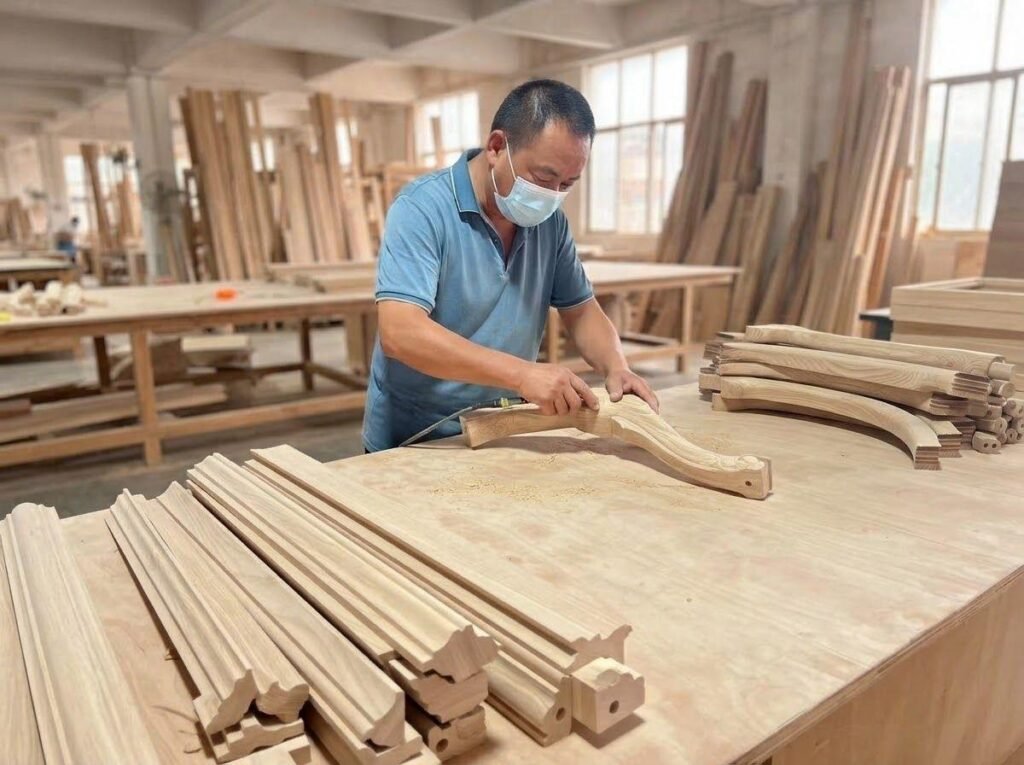
While some buyers gravitate toward large-scale manufacturers in Foshan with showrooms the size of aircraft hangars, others find that mid-sized specialists — operations like Interi Furniture, which focuses on project-grade casegoods and hospitality millwork — offer a different risk-reward equation. These aren’t necessarily the cheapest option on the block. But they’re usually the ones that will walk you to the rough lumber stack and show you the flitches before they go to the slicer. In a market where opacity is the default, that transparency is worth more than a 5% discount.
The mass-market giants optimize for throughput. The specialists optimize for specification fidelity. You just need to know which game you’re playing before you pick your dance partner.
Your Field Guide: A Buyer’s Anti-Cheat Checklist
Before you fly to China:
- Request rough photos, not finished photos. Ask for images of the veneer before it’s pressed onto the substrate. A factory that balks at this is a factory with something to hide.
- Specify the slicing method. Plain sliced? Quarter sawn? Rift cut? The more technical your spec, the harder it is to swap in a reconstituted substitute. (A factory that knows you know the difference acts differently.)
- Demand a “sand-through” sample. Have them sand a corner of the production sample down to bare wood. If the color goes all the way through, it’s dyed. Natural walnut is brown on the face and pale at the core.
When you’re on the factory floor:
- Smell the sanding dust. I know it sounds ridiculous. Do it anyway. Natural walnut dust smells like a lumberyard. Reconstituted dust smells like a craft store.
- Check the flitch sequence. Real veneer comes in consecutive leaves with mirror-image grain patterns. If every panel looks identical, you’re not looking at natural material. Period.
- Bring a solvent wipe. A cotton ball with acetone or alcohol, swiped across an inconspicuous edge, will pull dye out of stained poplar in about ten seconds. It’ll do nothing to natural walnut. (I learned this from a QC guy in Longjiang who’d been fighting factories for twelve years. He called it “the truth test.”)
The red flag that contradicts conventional wisdom:
- A perfect sample is a warning, not a selling point. Buyers love consistency. They want every chair to match every table. But natural wood is inconsistent. It’s messy. If your sample set looks like it was generated by a computer, it probably was. The “flawed” sample — the one with a knot, the one with color variation — is usually the honest one.

FAQ: The Questions Buyers Actually Ask
Q: If I specify “natural walnut veneer” in my purchase order, isn’t the factory legally required to deliver exactly that?
A: Technically, yes. Practically, enforcement is a nightmare. Chinese contract law supports your position, but proving intent to deceive requires material testing you probably can’t afford for a $15,000 order. The general pattern suggests that factories interpret “natural walnut” as “looks like natural walnut to a casual observer.” Your PO language needs to be forensic. Specify species by botanical name (Juglans nigra), slicing method, minimum thickness, and acceptable variation range. The more precise you are, the less wiggle room you create.
Q: My factory sent a sample that looks great. Should I assume the production will match?
A: No. The sample is a marketing document. Production is a manufacturing process. In my experience, roughly 30% of mid-tier factories will switch veneer sources between sampling and production if they find a cheaper face that “meets the same visual standard.” Insist on a production control sample pulled from the actual material lot, not the sample room archive. And here’s the thing — even that isn’t bulletproof unless you’re willing to station someone at the factory during pressing.
Q: Is dyed poplar actually a bad material? It seems to work fine for the price.
A: It’s not bad. It’s just not walnut. If you’re selling a $400 retail console table and your customer expects a $400 retail console table, dyed poplar is a perfectly reasonable material choice. The problem is positioning. If your brand promise, your designer’s intent, or your client’s expectation is “solid walnut,” then dyed poplar becomes a liability the first time someone scratches it and finds white wood underneath. Or the first time sunlight hits it unevenly and you get a two-tone top. Match the material honesty to your price point. That’s the whole game.
Q: Can I trust FSC or other certification labels on Chinese veneer?
A: The certificates themselves are usually genuine. The chain of custody gets fuzzy. What tends to happen is that a factory buys certified material for one order, then uses the same documentation for subsequent orders that may or may not draw from the same certified stock. If certification matters to your project, audit the chain. Ask for the supplier mill name. Cross-reference it. Don’t just accept a PDF with a green logo.
Q: So is most “walnut” furniture from China fake?
A: It depends on what you mean by “fake.” If you mean “not actual Juglans nigra,” then yes — the majority of mid-market pieces labeled walnut are carrying some form of substitute or augmentation. If you mean “non-functional garbage,” then no. The substitutes often perform fine. They’re just not what the label implies. China wood furniture isn’t inherently deceptive, but the gap between naming and nature is wide enough to drive a container truck through.
The Hard Lesson
At the end of the day, the walnut veneer cheat isn’t a conspiracy. It’s a market response. Buyers want exotic looks at domestic prices. Factories need margins. Someone has to bridge that gap, and the bridge is usually made of dyed basswood and good intentions.
But here’s the hard-earned lesson I’ve taken from fifteen years of walking factory floors: the material never lies. The paperwork does. The sample does. The salesperson definitely does. The material, though — sand it, smell it, solvent-test it — will tell you exactly what you’re dealing with. You just have to know which questions to ask before the container seals.
So I’ll leave you with this. The next time a factory shows you a “walnut” sample that’s too beautiful to be true, are you going to compliment the grain? Or are you going to pull out your acetone wipe?