

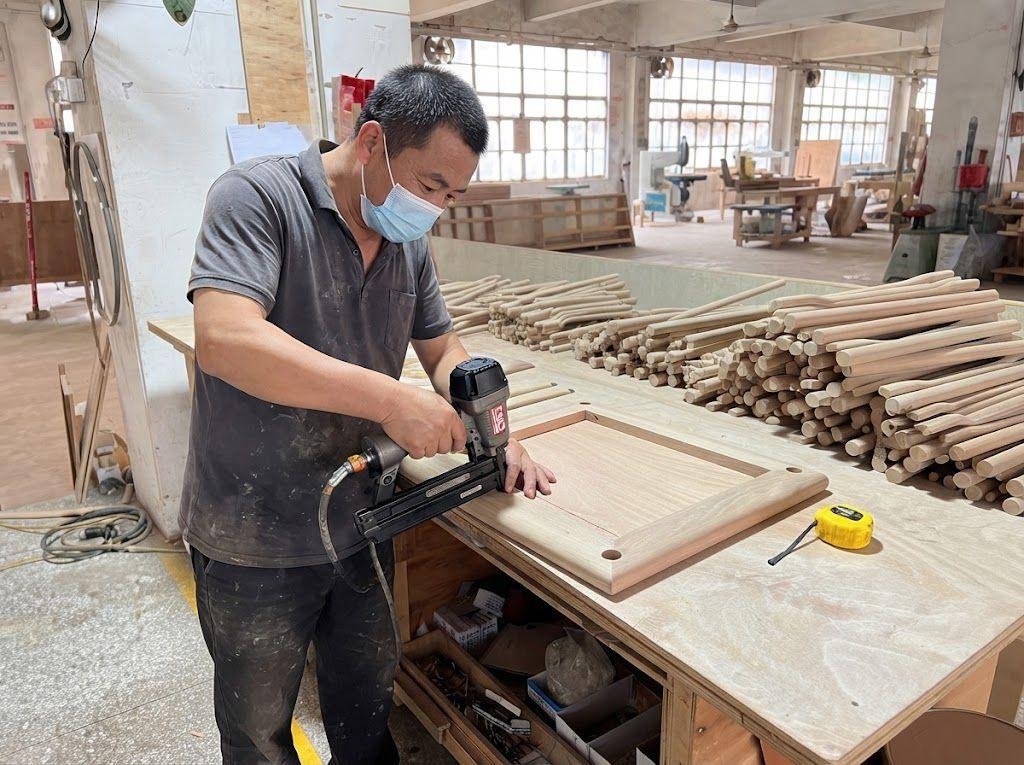
Let me tell you about a Tuesday morning in Lecong. A hotel procurement director — I’ll call him Marcus, though the details are stitched together from three real buyers I know — had just signed off on $180,000 of lobby and guest-room furniture. His supplier, a trading outfit with a beautiful showroom and a suspiciously broad catalog, scheduled the factory tour fast. Almost too fast.
The factory floor was spotless. Workers bent over their stations in near silence. Rows of freshly sprayed frames cured in the spray booth like a showroom display. Marcus noticed something odd: the dust-extraction hoses on the CNC routers still had the creases from the packaging. Brand new. Never used, or barely.
He asked the “production manager” what blade they ran for the walnut veneer. The man smiled and said “standard blade.” There is no standard blade.
Eight weeks later, container number one arrived. Joinery was passable. Hardware didn’t match the approved sample. The oak panels had drifted a shade — same family, wrong recipe. And tucked under the stretch-wrap: a shipping mark from a workshop in Jiangmen, ninety minutes down the road from the “factory” Marcus had toured with his complimentary hard hat.
He wasn’t scammed. Not exactly. He was subcontracted — which, in this business, is a different crime with a much better lawyer.
The Brutal Truth Nobody Puts in the Sales Deck
Here’s the uncomfortable part. Subcontracting is normal. Standard. Boring, even. Spend any time around Chinese factories in the Foshan–Dongguan corridor and you’ll figure this out in about a week: a big chunk of the mid-sized “manufacturers” you’re vetting don’t make everything they sell you. Some of them barely make anything at all.
When is it worst? Q3. Every year. Hotel projects pile up against year-end deadlines, export volume spikes, and nameplate factories quietly promise 130, 140 percent of what their machines can physically produce. The orders don’t get refused. They get redistributed.
Buyers treat this like a scandal. It’s not. It’s plumbing. The workshop network behind a factory sign is how this industry has always moved capacity around — the part that matters is whether you can see the pipes.
My rule of thumb, after too many years doing this: if the quote only works when the factory isn’t doing the work, the factory isn’t doing the work. Simple math beats fancy showrooms.
Actually — hold on. That’s not even the right framing. The factory isn’t the villain here. Your expectation is. You want one roof, one badge, one throat to choke. Chinese furniture manufacturing doesn’t work in buildings. It works in networks. Stop asking “is this a real factory?” and start asking “who’s actually touching my goods?” That one shift changes everything downstream.
KEY TAKEAWAY
- China supplier verification means confirming the company you pay is the company making your goods — and knowing every workshop in between.
- Subcontracting inside Chinese factories spikes hard in Q3, when hotel and project orders stack up against year-end shipping deadlines.
- The tells are physical: virgin dust hoses, crews that can’t answer process questions, loading docks that mysteriously off-limits.
- A disclosed subcontractor is a supply chain. An undisclosed one is a liability with your logo on it.

Why They Do It (And Why You’ll Never Hear About It)
Ever been to a famous neighborhood restaurant on a slammed Saturday night? The chef’s name is on the door, sure. But half the prep came out of a commissary kitchen two boroughs away, and nobody tells you, because the plate arrives hot and you stop asking. Furniture works the same way. The badge over the gate is a brand. Not a description.
Why? Fixed costs, mostly. A 200-worker factory in Longjiang pays wages and rent whether the order book is full or empty. Partner workshops down the road run the opposite model — dark and silent until work lands, then everyone gets called in. Subcontracting lets the nameplate factory quote low, look busy on tour, and smooth out the peaks. Everyone wins. Well. Everyone except the buyer who priced the job assuming that overhead was doing his job.
Where does your order actually go?
Most sourcing guides skip this part entirely, so let me give you the mechanics.
Factories don’t subcontract whole orders — they disassemble them. Your hotel casegoods get split at quoting. Frames go to one workshop. Upholstery panels to another. Metal bases somewhere else entirely. The nameplate factory keeps what a buyer can see: final assembly, final sanding, final QC. The stuff that happens under your nose on tour day.
The subcontractor never sees your spec file. He gets a work order with dimensions and a target finish. That approved walnut sample you couriered over and archived so carefully? Worthless two workshops down the chain. Down there, “walnut” means brown-ish, probably.
Is it just a peak-season thing?
Mostly, yeah. Order volume tracks subcontracting almost one-to-one. Q1 and Q2, factories grab every PO they can sign. By August, the math catches up — they’ve committed way past capacity — and the overflow starts flowing.
Which is why the sharpest buyers I know run a nasty little test: they drop a modest trial order in peak season and watch what comes back. Quality dips when the whole industry is slammed? Congratulations, you’ve mapped the factory’s true capacity. Quality holds? Either you’ve found a genuinely integrated operation — rare — or you’ve found a factory that manages its workshop network like a professional instead of a secret. Honestly, the second one is almost as good.
Reading the Crime Scene
Stop auditing factories like an accountant with a clipboard. Audit like a detective. Nobody reheats the loading dock for your visit. Nobody preps the machine operators. The truth lives in the parts of the building that weren’t expecting you.
Why didn’t anyone look up when you walked in?
Think about it. Real factory, real Tuesday. A stranger in business shoes walks the floor — heads turn. Supervisors hustle over. Somebody’s annoyed. If you toured a floor where thirty people stayed bent over their work, smooth as choreography, you weren’t on a factory floor. You were on a set. Real factories are awkward about visitors. Performances are graceful.
Trust your nose, too. A working woodshop smells like solvent, sawdust, and hot lacquer. A showroom dressed as a factory smells like air conditioning. You’ll know before you finish the checklist.
Do the machines match your product?
This is where buyers get played by shiny hardware. Five Italian edge banders and a spray booth the size of a tennis court — impressive. But you ordered solid hardwood with a hand-rubbed oil finish. That equipment means nothing for your job. Audit the machines that run your product, not the ones that photograph well.
Things I check now on reflex:
| What the tour shows you | What it usually means |
|---|---|
| Dust hoses, blades, tooling that look untouched | Equipment staged for buyers, not running your category |
| Workers who can’t answer “what grit before the sealer?” | A crew assembled for the tour |
| Laminated, pristine schedule boards | Printed for your visit; no real job tracking in that bay |
| No raw material staged for your SKU | Your job isn’t in production here — yet, or ever |
| Nervousness about the loading dock | That’s where the subcontracted goods arrive for final check |
And paperwork. Not summaries — the actual material purchase orders for the timber in your spec, with supplier names and dates. A genuine factory digs these up in minutes because they exist. A hollow one needs a day to invent them. I once had a supplier in Dongguan take 26 hours to “find” documents that should’ve been in a cabinet forty feet from his desk. We didn’t place the order.
So who’s really building your stuff?
Good question. Bigger than a checklist item, honestly. The landscape sorts into layers, and you should learn to read them.

The Ecosystem Nobody Puts on One Business Card
At the top: the big integrated exporters — usually deep in the Foshan corridor — timber in one gate, flat-packed containers out the other. Real operations. Also real minimum orders that’ll make your CFO faint.
In the middle, a huge tier of specialists. Family-built, often excellent at one thing — casegoods, upholstery, metal — and honest about flexing with partner workshops when orders stack up. Hospitality buyers bump into operations like Interi Furniture here: Guangdong-based, export-oriented, focused on hotel and residential project work, genuinely strong in-house on frames and upholstery while farming out say, stone tops or metal components to shops they trust. That’s not a red flag. That’s Tuesday. Provided they tell you.
At the bottom: pure traders with rented showrooms and a WeChat full of workshops. Some are genuinely great project managers. Some vanish after the deposit wire clears.
The real question was never which tier your supplier sits in. It’s whether you can see the tier at all.
The Radar: How I’d Actually Run This
Not one audit. A series of small traps, laid gently, across a few weeks.
- Visit twice. Second time unannounced. Official tour first, obviously. Then come back on a random weekday morning — “in the area.” This is the highest-signal move on the list, full stop. Whatever changed between the staged visit and the surprise one? That’s the truth.
- Ask for production POs. The raw material purchase orders for your spec — dates, quantities, supplier names. Real ones surface in minutes.
- Photograph the schedule board. Say you’re building your own production timeline. A real plant shrugs — the board changes daily anyway. A fake one tenses up, because now you hold a timestamped baseline.
- Trace one stupid little component. A drawer glide. A bracket. Follow it backward from the line to the inbound racks. Trails that dead-end tell you everything.
- Talk to the lowest person there. Not the sales director — the guy feeding the edge bander. Ask what he ran yesterday. Real workers complain about a specific job. Staged crews speak in generalities.
- Read yesterday’s shipping marks. Ask to see recent export docs casually. Marks from workshops you’ve never heard of, in towns you haven’t visited — that’s the smoking gun.
One red flag that’ll sound backwards: be suspicious of the factory that says yes to everything. Buyers love flexibility. “No problem, change the joint, swap the veneer, shift the finish.” But a real factory argues with you. Real engineers have real constraints, and they’ll fight over at least one point. A trader in factory costume agrees to all of it — because the costume isn’t doing the work. The argument you lose is the audit you pass.

What Buyers Actually Ask Me
Q: Is subcontracting basically fraud? Do I dump the supplier?
A: No, and dumping a supplier over disclosed subcontracting might cost you a good one. It’s standard capacity practice in Chinese furniture manufacturing. Fraud is when they invoice you for in-house production and quietly ship the work to a workshop you can’t audit. A partner they name, and let you inspect? That’s a supply chain. Judge the honesty, not the network.
Q: How do I audit subcontractors I’ve never heard of, in cities I can’t fly to?
A: Put your name in the paperwork and let third parties do the walking. Write a disclosure clause — all production sites for your order, your right to inspection at any of them, SGS or a local firm like QIMA. Then actually book one inspection at a partner site mid-production. The clause alone filters the liars, because honest factories sign it mid-sentence.
Q: Does a BSCI or ISO certificate prove everything’s made under one roof?
A: No — audits certify a site, not a supply chain. A factory can hold a perfectly valid ISO 9001 for the main gate while pushing 40% of output out to uncertified shops. Ask which processes the certificate covers and which get outsourced. In writing. Audits answer “is this site compliant,” not “is this site making your sofa.”
Q: Fine — but can I actually catch hidden outsourcing before the deposit goes out?
A: Yes. Every time, if you combine the moves. Unannounced visit, material POs, schedule-board photo. Each one alone is circumstantial. Together they’re diagnostic — real factories pass all three without blinking, and hollow ones flunk at least one without exception.
The Container at the End
Marcus reordered this year. Same product family, completely different game. He knows which components his supplier builds and which go to the Jiangmen partner — he’s walked that floor now, met the foreman, checked the glue and the dust extraction himself. His quality problems didn’t disappear. They became fixable, because the map finally matched the territory.
The lesson I’d carve into a desk: you can’t delete subcontracting from Chinese furniture sourcing. You can only pick between the kind you can see and the kind you can’t. One’s a supply chain. The other’s a container full of surprises.
So — when your next order ships, how many pairs of hands will you actually know about? The ones that touched the product, I mean. Not the ones waving from the gate.


