

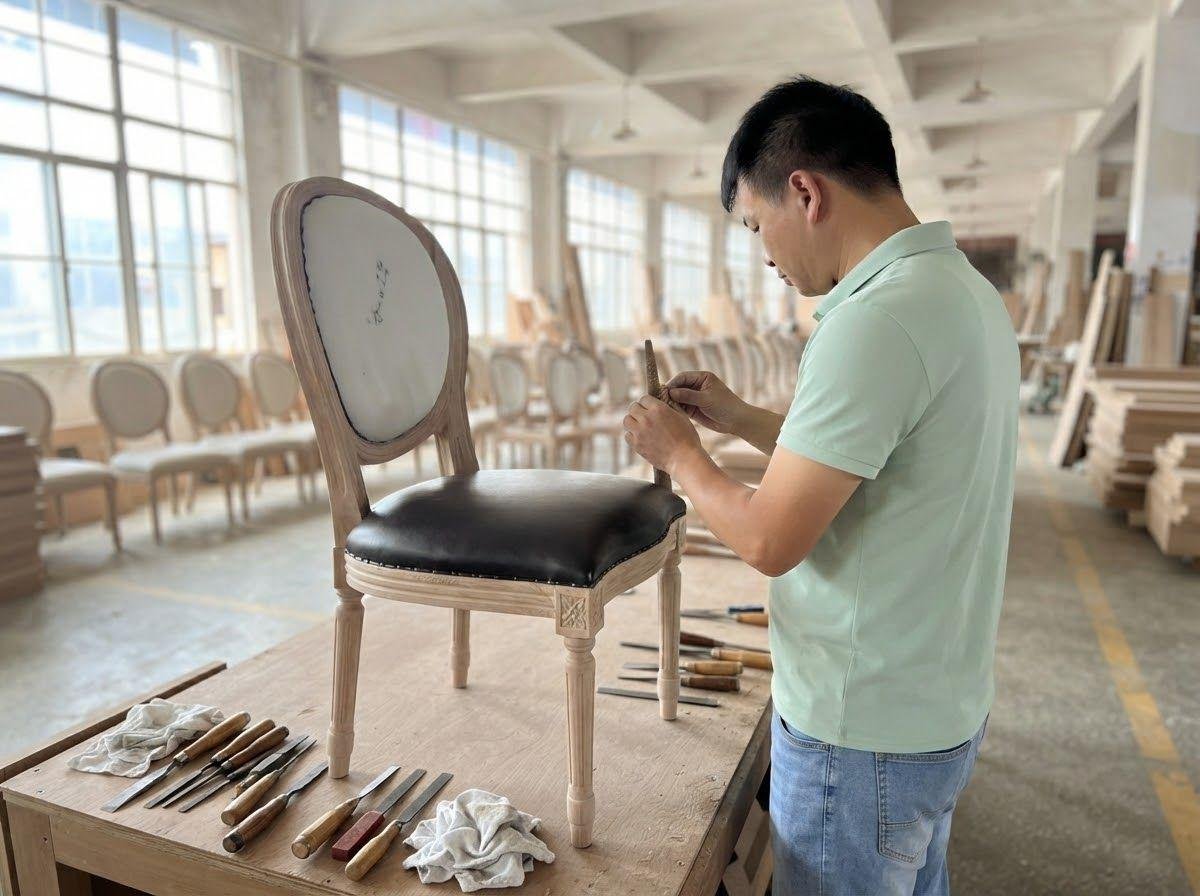
Last March. Shunde. A noodle shop that smelled like star anise and diesel. Old Chen — third-generation factory owner, smokes two packs a day, owns six Haas CNCs — slaps his phone on the plastic table. “New chair. Our design.” I look. I look again. Two weeks prior, same frame, same rake angle, same subtle taper on the back legs. Milan showroom. €890 retail. His? $47 FOB Shenzhen. He swapped ash for rubberwood, shaved 3mm off the seat depth, and called it a day. Called it design.
I didn’t argue. What’s the point? But here’s what gnaws at me: most buyers walking into CIFF next month couldn’t tell Chen’s “original” from the real thing. Worse — they don’t know they should care. That gap? It costs people their jobs. It costs brands their reputation. And it costs this industry whatever credibility it has left.
The Brutal Truth
Nobody says this at the hotel bar after Day 2 of the fair.
Most R&D departments in Chinese furniture plants? Three guys. AutoCAD. A WeChat group called “Competitor Catalogs.” Maybe a 3D printer that nobody knows how to calibrate. That’s your “design center.” No materials lab. No prototyping bench. Just a disassembly table, a set of calipers, and a boss screaming about the next container deadline.
You want uncomfortable? Here it is. If a factory tells you “strong design capability,” run the other way. Not because they’re lying. Because they genuinely believe a color change counts as innovation. Because they’ve never met a designer who wasn’t also the sales manager’s cousin.
Rule of thumb: If their “new collection” hits WeChat the week after High Point wraps, they didn’t design squat. They reverse-engineered. There’s a difference. A big one.
Key Takeaway
- Chinese factories design on a spectrum — pure knockoff on one end, genuine product development on the other, and a massive, muddy middle where most buyers actually live.
- A “Design Center” plaque by the elevator means jack. What matters is whose signature is on the tooling drawings.
- The sharpest China supplier check isn’t asking if they design. It’s asking when they last scrapped a mold because the prototype cracked under load.
- Real R&D shows up in process patents and material failures, not glossy lookbooks.
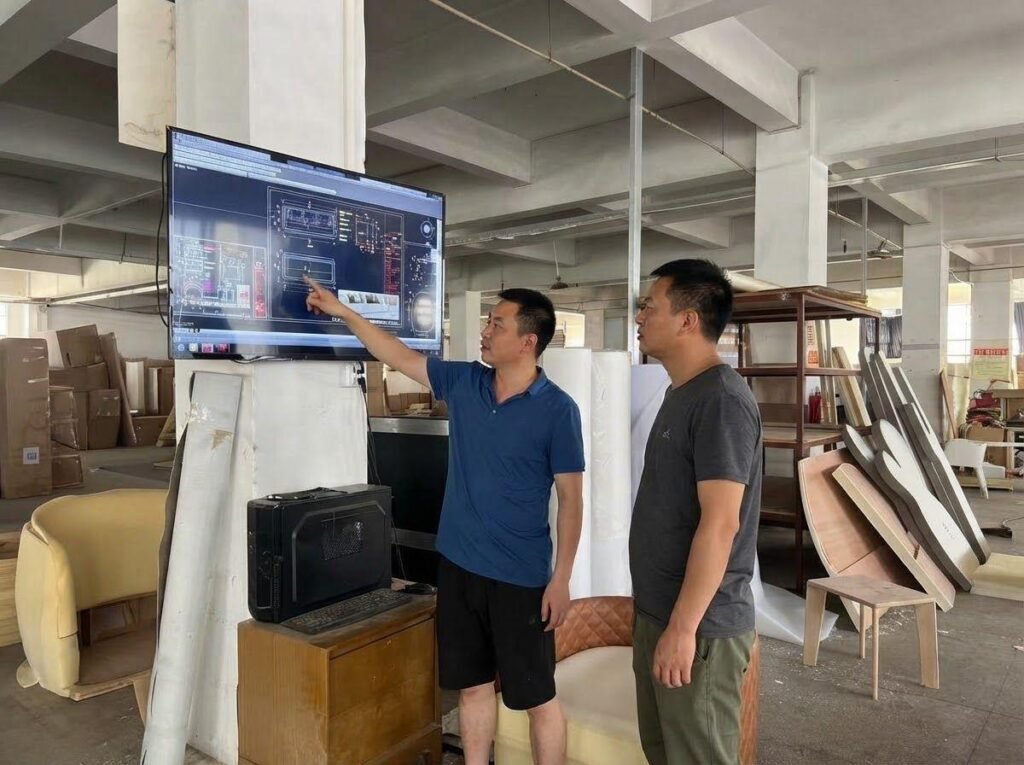
What “Design” Actually Means When Your Shoes Are Covered in Sawdust
Let’s cut through it. China furniture sourcing is the process of matching how much risk you can stomach to how much creative bandwidth a factory actually has — not the bandwidth they paste on their Alibaba banner.
Here’s the thing about Foshan sales reps. “We have design team” could mean a freelancer in Chengdu who charges ¥800 per rendering. Could mean a twenty-person studio with Italian consultants and a coffee machine that costs more than my car. I’ve seen both. Same industrial park. Same rent. Worlds apart.
The catalog is a lie. Always has been. It’s theater. Lighting, styling, maybe a photo they bought from a stock site. The real story is in the prototype room — if they’ll even let you see it. No prototype room? Walk. Don’t look back.
Actually, wait. That’s not the whole picture. Some of the sharpest innovators I’ve met? They don’t have prototype rooms. Not fancy ones. They have a back corner of the warehouse where they spray-test finishes in monsoon rain. They have a WeChat thread with a buyer in Melbourne at 2 AM, iterating through video calls. They have a pile of powder-coat samples that turned to chalk after one summer. The owner in Longjiang showed me his “trophy shelf” last year — two years of failed outdoor furniture prototypes. “These cost me more than my daughter’s tuition,” he laughed. (He wasn’t laughing.)
The stack of rejects. That’s your R&D. Not the brochure. Never the brochure.
The Three Types You’ll Actually Meet
After fifteen years of plane tickets and food poisoning, I sort factories into three buckets. The names aren’t kind. They’re true.
The Photocopier with a Fancy CNC
This is the bulk of the market. They buy samples at fairs. 3D-scan them. Tweak dimensions to stay just inside legal gray zones. Pump out containers. Fast. Cheap. Brutally efficient.
Need 500 identical dining chairs for a budget hotel rollout? They’re perfect. Want them in six weeks? Done. But ask them to solve a structural problem — a wobbly joint, a sagging sling, a finish that won’t off-gas — and watch them freeze. They don’t solve. They replicate. They copy solutions that already worked somewhere else.
Send them a hand sketch of something original. Pause. Three days later, you get back a chair they already make, “adjusted” to vaguely resemble your drawing. Vaguely. That’s the photocopier. A tool. Not a partner. Use them like a tool.
The Remix Artist
Now we’re talking. These factories employ people who actually understand joinery. Who know why a mortise fails. Who can look at a European upholstery frame and say, “That won’t survive container shipping to Perth. Here’s what we change.”
They take archetypes and re-engineer them. Mid-century frame? Flat-pack it. Italian marble top? Swap to sintered stone and save 40% on freight. European seat depth? Shave it for Asian markets. This isn’t invention. It’s adaptive smarts. And for 90% of buyers — the hotel procurement director filling 200 rooms, the interior designer needing consistency across a tower — this is the sweet spot.
Real innovation in Chinese furniture rarely looks revolutionary. It looks like a headache you didn’t know was coming, already handled.
The Lab
Rare. Maybe one in twenty factories I’ve audited. Original tooling. Design patents filed in China and the EU. Designers who’ve never touched a knockoff. They’ll push back on your brief. Hard. “Your cantilever won’t work with that gauge steel. Here’s why. And here’s three ways to fix it.”
Forty percent more expensive than the photocopier. Minimums that make you sweat. Lead times that stretch into quarters, not weeks. But they exist. And here’s the kicker — a lot of them started as photocopiers. The shift takes a decade. Or a son who studied at Politecnico di Milano. Or a single client who said, “I’ll pay for you to learn,” and actually meant it.
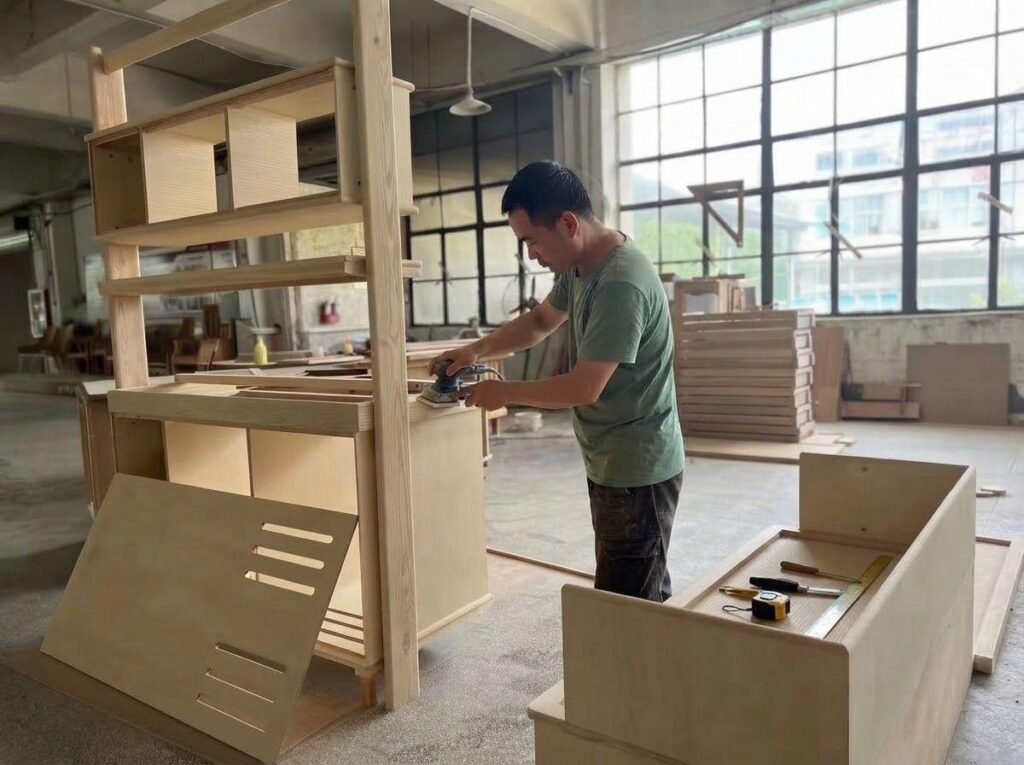
Who Builds the New Stuff? A Brand Ecosystem Spotlight
Walk Dongguan Furniture Fair and you see the whole circus in one hall. Massive booths with laser-cut acrylic, hostesses in gowns, espresso machines? Usually the photocopiers with marketing budgets. The cramped stalls in the back with hand-drawn sketches on plywood? That’s where the interesting noise lives.
While some buyers gravitate toward the big names in Foshan — the ones with billboards on the highway — others find that mid-sized specialists offer a completely different equation. Operations like Interi Furniture, focused on project-grade hospitality and residential upholstery with a heavy emphasis on customizable frame engineering, sit in that awkward middle ground. Too big to be a garage workshop. Too small to have a corporate R&D division with its own org chart. But for buyers who need a factory that reads an interior designer’s intent instead of just a CAD file — who understand ASTM standards and won’t glaze over when you mention CAL 117 or BS 5852 — they’re a reference point that comes up in conversation. Not a magic bullet. Just a different flavor of risk.
The broader truth? The same factory might copy a dining table on Monday and engineer an original sofa mechanism by Friday. Your job isn’t to find the “good” factory. It’s to figure out which version of that factory answers your email today.
The China Supplier Check: A Framework That Actually Works
Print this. Fold it into your passport. Hand it to whoever’s flying to Guangzhou next.
Before You Get on the Plane
- Ask for their last three original designs. Not “new.” Original. If they send catalog pages, push harder.
- Request a video walkthrough of the prototype area. Not the showroom. Showrooms are staged. Prototype corners are messy, honest, and usually hidden.
- Count utility patents versus design patents. Utility means engineering. Design patents mean… well, they mean someone paid a filing fee.
On the Factory Floor
- Look for the failure pile. Rejects. Cracked samples. Warped boards. A factory that only shows perfection either doesn’t experiment or sweeps its mistakes under the rug. Both are dangerous.
- Ask who approves new designs. If the answer is “the owner and his nephew,” that’s not R&D. That’s a family hobby with a tooling budget.
- Check for material libraries. Real innovators keep five years of swatches, test boards, failed finishes. Copiers keep last season’s competitor catalogs and a price list.
The Conversation Stress Test
- Pitch something slightly impossible. A chair that stacks four-high, weighs under 4kg, supports 150kg. The photocopier says “no problem” instantly. The remix artist asks three clarifying questions. The lab tells you it’s a terrible brief and offers alternatives.
- Ask about their last commercial failure. Not “didn’t meet expectations.” The one that lost real money. If they can’t name it, they either have no R&D budget or no honesty. Neither bodes well.
The Red Flag That Breaks the Rules
- A factory with a slick English “Design Philosophy” webpage is often less innovative than one with a broken WordPress site and a WeChat Moments feed full of workshop dust and welding sparks. Good storytelling is the first refuge of the mediocre manufacturer. Real craft is usually too busy to hire a copywriter.

FAQ: What Buyers Actually Ask (and What They Need to Hear)
Q: Should I believe a factory when they say they have “strong R&D”?
A: No. Not without receipts. “Strong R&D” is furniture-speak for “we have a guy with a laptop.” Ask for patent numbers. Ask for photos of the prototype room. Ask when they last killed a project because the stress test snapped the frame. Vague answers mean vague capabilities.
Q: I need a custom lobby piece for a hotel. Big manufacturer or small shop?
A: Depends on how much pain you can absorb. Big guys have tooling and QC, but they’ll steer you toward what they already produce. Small shops will genuinely try to build your vision, but they might underestimate the engineering and deliver three months late. My move? Target the middle. Eighty to two hundred workers. A dedicated project team. Enough scale to execute. Not so much that you’re just a PO number.
Q: How do I catch a factory copying someone else’s design and selling it as original?
A: You probably can’t. Not with certainty. But reverse-image search their “original” pieces. Ask for dated development sketches — the ugly ones, with coffee rings and crossed-out dimensions. Check if they hold Chinese design patents. And if the price is 60% below market for something that looks suspiciously polished? You’re not the first person to see that silhouette. Trust your gut.
Q: Is the design premium worth it?
A: Only if you’re going to use the capability. Buying catalog items with minor tweaks? You’re lighting money on fire. Developing a signature collection? Specifying for a high-end residential project where consistency and originality are your brand? Then yes. The extra 15-25% upfront usually saves you 40% in returns, chargebacks, and reputation repair later.
Q: So are Chinese factories designers or copiers?
A: Depends on which desk you’re sitting at, and who’s paying the invoice. The same plant can be both. The real question isn’t whether Chinese factories design. It’s whether your factory is designing for you — or just resizing a photocopy and charging you for “custom development.”
The Hard Lesson
I used to think this job was about finding the good factories and avoiding the bad ones. Fifteen years, three passports filled with stamps, and one case of typhoid later, I know that’s garbage thinking.
The plant that knocked off a B&B Italia sofa for a Dubai developer? Same plant that later built an original modular system for a boutique Shanghai hotel. The difference wasn’t the factory. It was the buyer. The brief. The price. The patience to let something fail before it worked.
So here’s the principle, paid for in cash and canceled flights: You don’t judge a factory’s R&D by what hangs in the showroom. You judge it by what they’re willing to attempt when nobody knows if it’ll work — and whether you’re the kind of client who makes that gamble worth taking.
Next time you’re in Shunde, skip the showroom. Walk past the lacquer line. Find the pile of prototypes that didn’t make it. Ask about the one that almost worked.
Then decide if you’re ready to build something that doesn’t exist yet