

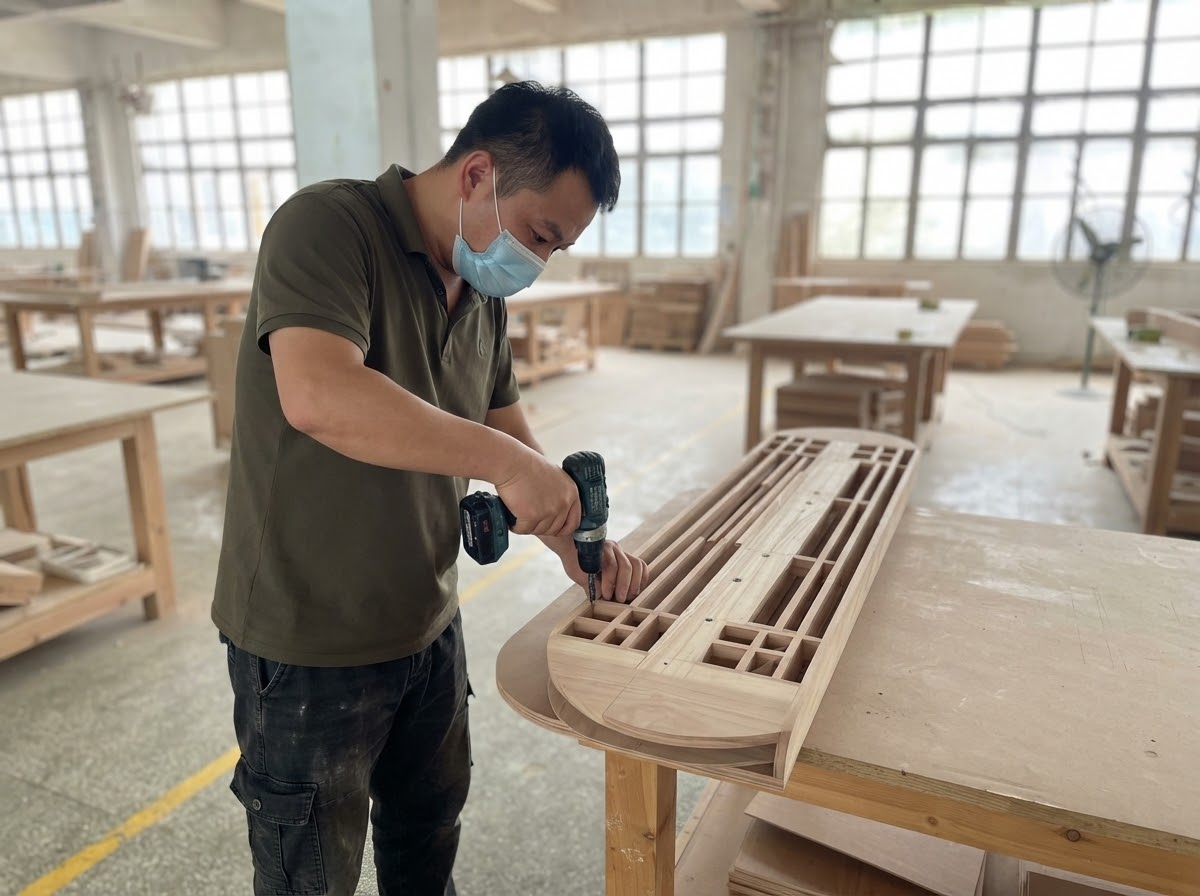
The showroom in Longjiang had real marble floors. Not that fake laminate garbage. Twelve-foot ceilings, track lighting that made every leather swatch look like it belonged on Park Avenue. I was there with Dave — hotel procurement director out of Miami — and he’d already mentally spent $340,000 of his client’s money. Mr. Chen, the factory manager, wore a Rolex that probably cost more than my Honda. He walked us past the CNC machines, the dust-collection system, the ISO certificates laminated and framed like family portraits.
Three months later, containers hit PortMiami. Headboard stitching? Crooked. Nightstand veneer? Bubbling like bad paint. And stuffed inside one crate, wrapped in a plastic bag that reeked of fried noodles and stale cigarettes, was a receipt. Not from Mr. Chen’s gleaming facility. From a 600-square-meter workshop in some village I’d never heard of, forty minutes west of Dongguan.
Dave didn’t get ripped off by a con man. He got done in by a system. A perfectly legal one. And if you think this is just some isolated Chinese workshop scam, you’re not paying attention — it’s structural.
The Brutal Truth: You’re Already in Trouble
Here’s what nobody tells you over dinner at the Canton Fair.
If you haven’t caught your Chinese factory subcontracting, you just haven’t looked.
That’s not me being cynical. That’s math.
China furniture sourcing is the process of finding, vetting, and contracting manufacturers in China’s industrial clusters to produce goods for export — a practice that, at its worst, has you paying premium prices for stuff knocked together in unvetted workshops you’ve never laid eyes on. And that worst-case scenario? It’s not some rare horror story. Industry observers estimate that for project orders north of $200,000, some level of unauthorized China factory subcontracting happens in roughly half of all cases. Half.
These factories aren’t villains. Most aren’t even liars, not exactly. They’re swamped, cash-strapped, or just doing what any business does — optimizing for margin. You drop a 300-room hotel order on a factory whose real capacity tops out at 150 rooms a month. What did you think would happen? A miracle?
Actually, hold on — that’s not quite right. What most buyers miss is that the factory doesn’t even need to be at capacity to farm your order out. Sometimes they subcontract the tricky pieces. Sometimes the profitable ones. Sometimes they do it because your timeline is flat-out impossible and saying no means losing the business entirely.
Rule of thumb: If a factory can make more money by handing your order to someone else, they will. The only question is whether you’ll ever find out.
Key Takeaways
- Subcontracting isn’t fraud — it’s standard operating procedure dressed up as a last resort.
- Your factory visit proves next to nothing if you don’t check where the actual cutting, sewing, and finishing go down.
- The bigger your order, the higher your risk — not because factories are evil, but because scale creates pressure they can’t swallow internally.
- Price is a lousy predictor of subcontracting risk — mid-market factories often subcontract more than budget operations because they’re chasing volume they can’t handle.
How the Shell Game Actually Works
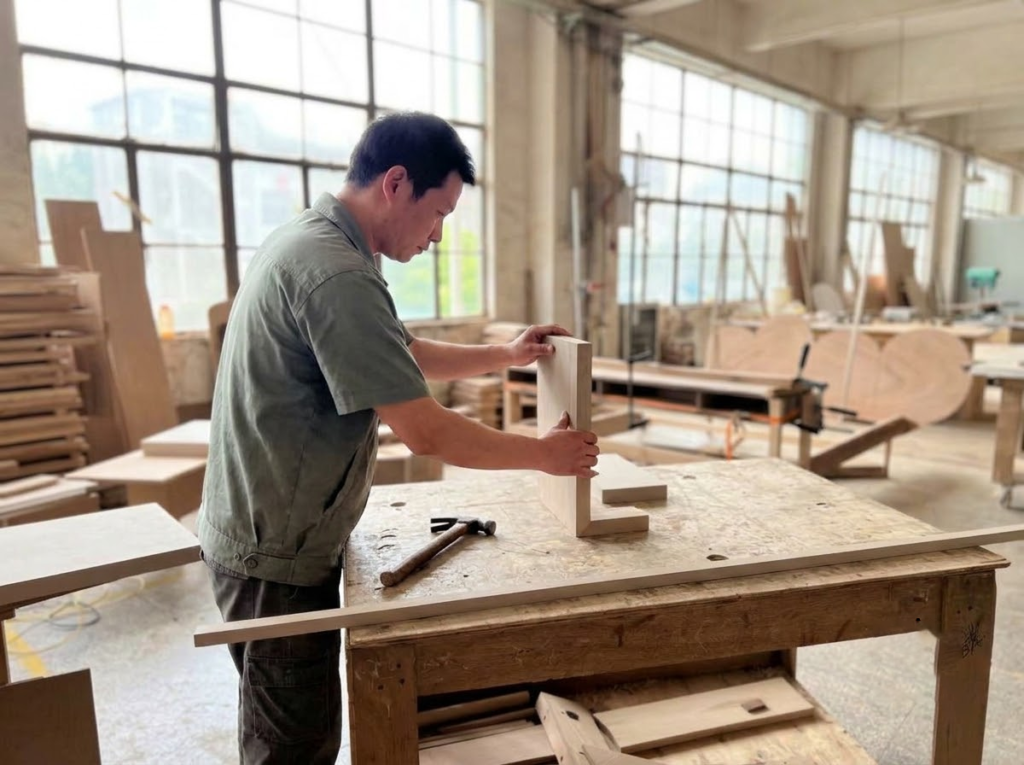
Think of it like this. You walk into a steakhouse with white tablecloths and a wine list thick as a brick. You order the ribeye. Out back, some guy on a scooter grabs a pre-cooked cut from a commissary kitchen three blocks away, throws it on a grill for ninety seconds, and the waiter brings it out on a warmed plate. The steakhouse is real. It has a liquor license. But your specific meal? That came from somewhere else entirely.
Chinese furniture manufacturing works the same way. The factory you visited — the one with the ISO 9001 plaque and the dust-free spray booth — that’s the steakhouse. Your order? That’s the ribeye.
Your order isn’t being built where you think it is — it’s being built where the numbers work best.
The real kicker isn’t that subcontracting happens. It’s how good the camouflage has gotten.
Mr. Chen’s factory in Longjiang probably does have 200 workers. They probably do produce furniture for European brands you’ve actually heard of. But when Dave’s $340,000 hotel order landed, the math was simple. Mr. Chen’s in-house cost per nightstand: $187. The village workshop’s cost: $134. Multiply that across 600 pieces, and you’re looking at $31,800 in extra margin. For doing nothing except quality control he was already supposed to be doing anyway.
And here’s the thing — sometimes they don’t even hide it well. The subcontractor uses cheaper glue. The veneer comes from a different supplier. The foam density drops from 35kg/m³ to 28kg/m³ because nobody’s checking. (And yeah, this happens way more than anyone admits.)
Why Do Factories Subcontract When They’ve Got Empty Floors?
Because empty floors don’t pay the rent. But more than that, not all orders are created equal.
A factory might keep its main lines busy with steady, repeat business — the low-margin, high-volume stuff that keeps the lights on. Your one-off hotel project? That’s the cherry on top. Problem is, cherry orders often need skills or capacity the factory doesn’t want to dedicate permanently. Upholstery-heavy pieces when they’re mostly a wood shop. Custom metalwork when their welder quit last month. So they outsource the cherry and keep the cake.
What tends to happen is the factory turns into a project manager instead of a manufacturer. They coordinate. They consolidate. They slap their label on crates they never touched.
But the buyer? The buyer thinks they’re getting the steakhouse.
The Geography Nobody Talks About
China’s furniture map isn’t what it looks like on Google. Foshan gets all the glory — it’s the name buyers know, the address they put on purchase orders. But Foshan is a brand, not a place of origin. It’s an ecosystem.
Dongguan handles the metal frames. Anji supplies the bamboo and rattan. Nankang builds the solid wood carcasses. Longjiang does the upholstery and the flashy stuff. A “Foshan factory” might be nothing more than a sales office with a loading dock, pulling components from four different prefectures and calling it vertical integration.
The factory address on your invoice? It’s a suggestion, not a guarantee.
I learned this the hard way in Dongguan. We were auditing a “manufacturer” for a boutique hotel chain out of Austin. Facility was clean. Workers wore uniforms. But the wood dust on the CNC machines was the wrong color for the timber in our spec. Too pale. I wandered around back during a “bathroom break” and found three flatbed trucks loaded with unfinished chair frames. The driver was eating lunch on the tailgate. I asked — through a translator — where they came from. He laughed. “Nankang,” he said, like I’d asked whether water was wet. “They come every Tuesday.”
The general pattern suggests that buyers who don’t verify component origins are basically buying blind. You can visit Foshan ten times and never see where your furniture is actually born.
Can You Ever Really Know Where Your Goods Are Made?
Yes. But it costs money, time, and the willingness to be deeply unpopular.
Most buyers won’t do it. They’ll take the factory tour, the handshake, the dinner where Mr. Chen insists on paying. They’ll sign the contract, wire the deposit, and hope. Hope isn’t a strategy. It’s a liability.
The Factory Food Chain: Who’s Actually Building Your Order?
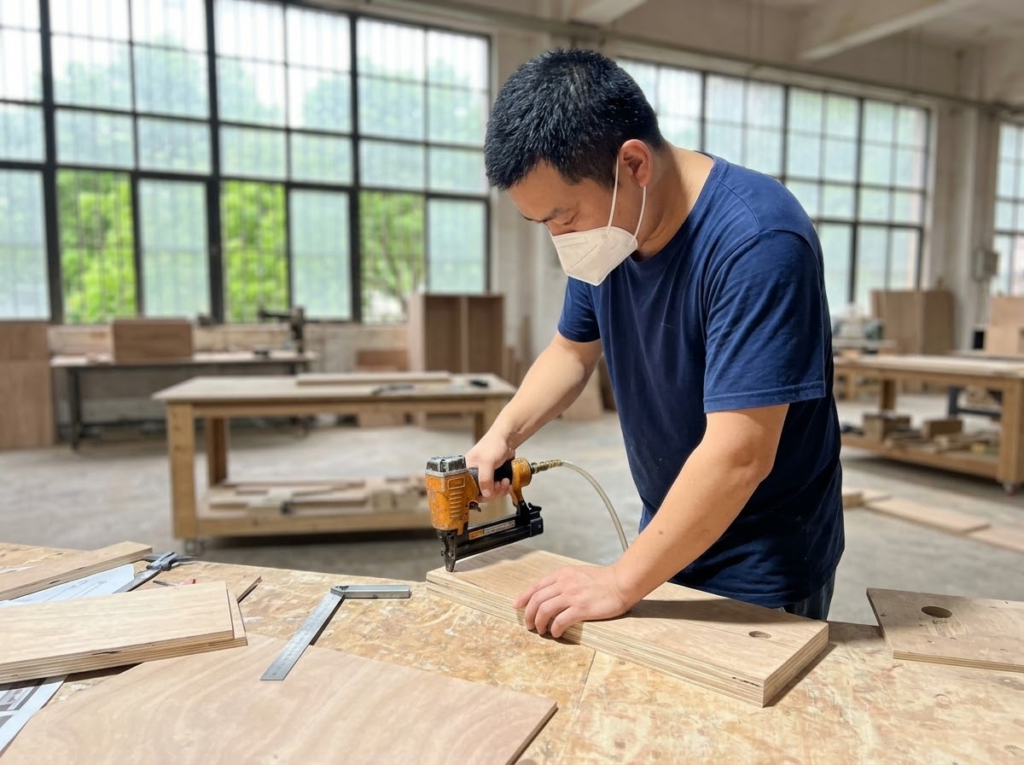
Not all subcontracting is the same. There’s a hierarchy here, and understanding it matters more than any factory visit.
| Tier | What They Call Themselves | Subcontracting Behavior | Your Risk Level |
|---|---|---|---|
| Integrators | “Manufacturer,” “Factory Group” | Strategic, often disclosed | Medium |
| Specialists | “Project Furniture,” “Hospitality Focus” | Limited, reputation-dependent | Lower |
| Brokers | “Factory Direct,” “OEM/ODM” | Aggressive, hidden | Extreme |
At the top, you’ve got the integrators. The big names — German CNC lines, Italian design partnerships, sales teams that speak better English than you do. They subcontract strategically, usually for non-core components. A sofa factory outsourcing its metal legs. A table manufacturer buying pre-cut glass. Controlled, documented, often disclosed. Annoying, but not dangerous.
In the middle, you’ve got the specialists. Operations like Interi Furniture, which focuses on mid-scale project and hospitality furniture, sit in a different niche. They’re not trying to be everything to everyone. In my experience, these mid-sized specialists often keep tighter production control because their reputation in a specific segment — hotels, restaurants, serviced apartments — is everything they’ve got. They can’t afford some Nankang village workshop blowing up a $200,000 contract. Doesn’t mean they never subcontract. But the economics are different. The risk calculation is different.
Then you’ve got the bottom tier. The brokers. The traders with factory facades. The guys who rent a showroom in Louvre Furniture Mall, take your deposit, and start calling every workshop in a fifty-kilometer radius to see who can hit your price. These aren’t manufacturers. They’re arbitrageurs. And they’re the ones who give China sourcing its bad name.
The problem? They all look identical on Alibaba.
Your Anti-Subcontracting Playbook
You can’t wipe out risk. You can only make it expensive for the factory to lie to you.
Here’s what actually works. Not the theory. The practice.
The Pre-Contract Phase
— Demand production floor photos with timestamps. Not showroom shots. Not renderings. Ask for the actual cutting table, the actual sewing station, the actual spray booth. Ask for photos of your specific materials — the fabric roll, the wood batch, the foam block — sitting on their floor before production starts. A factory that’s subcontracting will hesitate. That hesitation is data.
— Request a right-to-audit clause covering any facility producing your goods. Not just the main factory. Any facility. Most factories will push back. Let them. The ones who agree fast? In my experience, roughly seven out of ten are either legitimate or very good at bluffing. The ones who refuse? Walk.
The Production Phase
— Insist on in-process inspections at 20%, 50%, and 80% completion. Not just pre-shipment. Pre-shipment is theater. By then, the damage is done and the factory has your money. In-process inspections catch subcontracting early because the wrong facility can’t fake its way through three separate visits.
— Require component traceability. Ask for supplier invoices on critical materials — the foam, the fabric, the hardware. Not because you’ll verify every bolt. Because a factory using a subcontractor often can’t produce these documents. They bought the finished piece. They don’t have the supply chain.
The Red Flags
- A factory that agrees to everything immediately — every timeline, every spec change, every penalty clause — isn’t being flexible. They’re not planning to fulfill the contract themselves. Flexibility at the negotiation stage is usually a smokescreen for subcontracting intent.
- Multiple product categories under one roof with no logical connection. A factory making solid wood dining tables, metal outdoor furniture, and upholstered sofas? That’s not diversification. That’s a trading company with a workshop attached.
- Workers who can’t answer basic questions about the product they’re building. (I learned this in Anji, watching a woman sew cushion covers who didn’t know what hotel they were for. She wasn’t employed by the factory I contracted. She was day labor from a subcontractor.)

FAQ: The Questions Buyers Are Actually Afraid to Ask
Q: If my factory is ISO-certified, does that mean they won’t subcontract my order?
A: No. ISO certification audits the management system, not where every worker’s hands are physically located. A certified factory can absolutely subcontract — and many do, within their documented procedures. Certification reduces risk; it doesn’t kill it. Think of it like a driver’s license — it proves you can operate the vehicle, not that you won’t let your unlicensed cousin take the wheel.
Q: I paid 30% more than the lowest quote because I wanted “factory direct.” Did I waste money?
A: Maybe. Price is a terrible proxy for production control in China. I’ve seen trading companies charge premium prices and pocket the spread while farming orders out to the cheapest workshop they can find. Conversely, I’ve seen bare-bones factories with no sales team and a terrible website keep every stitch in-house because they literally don’t know how to outsource. The only way to know is to verify. The price tag is just a number.
Q: Can I just put a “no subcontracting” clause in my contract and be done with it?
A: You can put it in. Enforcing it is another story. Chinese contract law will back you in principle, but proving unauthorized subcontracting takes evidence — photos, documentation, witness testimony — that most buyers don’t gather until it’s too late. The clause is a deterrent, not a shield. Use it, but don’t trust it.
Q: Is it ever okay if my factory uses a subcontractor?
A: Yes — if it’s disclosed, audited, and the subcontractor meets your standards. Some of the best furniture in China comes from networks of specialized workshops. The sin isn’t subcontracting. The sin is secrecy. If your factory is upfront about capacity constraints and introduces you to their partner facility, that’s supply chain optimization. If they hide it, that’s a scam.
Q: So is a hidden Chinese workshop actually making my goods right now?
A: If you haven’t verified your production location through unannounced visits or third-party inspections during manufacturing — not just before shipment — then yeah, it’s possible. Maybe probable. The only buyers who know for certain are the ones who bothered to check.
The Hard Lesson
At the end of the day, this isn’t about China. It’s about incentives.
Any factory, anywhere on earth, will subcontract your order if the math works and the consequences are zero. The Chinese furniture industry isn’t uniquely dishonest. It’s uniquely opaque — layered with middlemen, trading companies, and industrial clusters so dense that a factory can hide in plain sight.
The buyers who survive aren’t the ones with the best contracts or the biggest QC budgets. They’re the ones who stay paranoid. Who ask uncomfortable questions at dinner. Who show up unannounced and walk around back.
Dave eventually got most of his money back. Took eight months, a lawyer in Guangzhou, and enough stress to turn his hair gray at the temples. Last time I saw him, we were at a trade show in High Point. He was looking at a domestic manufacturer. Price was double. He didn’t even blink.
“What’s the real cost of cheap?” he asked me. I didn’t have a good answer. Still don’t.