

You’re standing in a sample room in Shunde on a Tuesday morning in November. The factory boss—let’s call him Mr. Chen—is aggressively tapping his knuckles against a prototype. It’s a striking piece: an oval-shaped coffee table, balancing perfectly on exactly three legs. The center leg connects dead-on to the tabletop, no suspension, no weird gaps. The edge profile is sharp—light-colored on the outer rim, pitch black on the inner curve. The surface is completely bare. No staged tea sets, no heavy art books, no vases. Just raw, naked “wood.”
“Pure North American Ash,” Chen promises, handing you a quote for $85.
You run your hand over it. It’s heavy. Solid. You do the mental math. Eighty-five bucks. You figure with ocean freight, duties, and your standard retail markup, you’ve just found your Q3 bestseller.
Except, you haven’t. You just bought a masterclass in chemical engineering.
(And honestly? I fell for this exact routine during my first two years on the ground in Guangdong.)
After a decade and a half of navigating the murky waters of Chinese furniture materials, I can tell you the export definition of “solid wood” is a total wild card. Buyers fly into Guangzhou, tap a table, feel the weight, and wire a 30% deposit. Three years later, a hotel guest spills a glass of ice water on that table, the edge bubbles up like a blister, and the buyer finally realizes they bought high-density fiberboard disguised under a paper-thin veneer.
Sourcing China wood furniture is a blood sport for the uninitiated. If you plan on signing purchase orders here, you have to understand how the illusion is built from the ground up.
The Brutal Truth About “Solid” Specs
Let’s rip the band-aid off right now. Most buyers hate hearing this, but it saves millions in the long run.
You are almost certainly buying engineered wood. Even if your proforma invoice aggressively stamps “100% SOLID” in red ink. Even if it takes two grown men to lift the nightstand. Even if the grain looks so deep you feel like you could get a splinter.
Chinese manufacturers aren’t necessarily malicious; they are just incredible problem solvers. Western procurement teams show up demanding high-end architectural aesthetics on a flat-pack budget. That is a mathematical impossibility. The factory doesn’t argue. They just solve the math problem using substrates, hot-melt adhesives, and sheer audacity.
Here is the only rule of thumb you actually need: If the FOB price makes you feel like a genius negotiator, the wood is a composite.
Think about it. Nobody is legally logging a 60-year-old oak, putting it on a boat across the Pacific, kiln-drying it to an exact 8% moisture content, milling it, sealing it, and selling you a credenza for the price of a nice dinner. The supply chain physics just do not allow it.
Key Takeaway: The “Solid Wood” Reality Check
- “Solid wood” on a Chinese packing list usually translates to “a solid wood frame wrapping engineered panels.”
- Weight is a liar. Modern dense MDF cores are frequently heavier than natural, kiln-dried timber.
- The vast majority of buyer-factory disputes stem from mismatched vocabulary, not literal fraud.
- True solid hardwood requires a brutal, months-long moisture control process. Budget factories skip this entirely.
Anatomy of the Illusion
Trying to vet a piece of furniture without looking at a raw cross-section is exactly like buying a used car because you liked the paint job. It’s a rookie move.
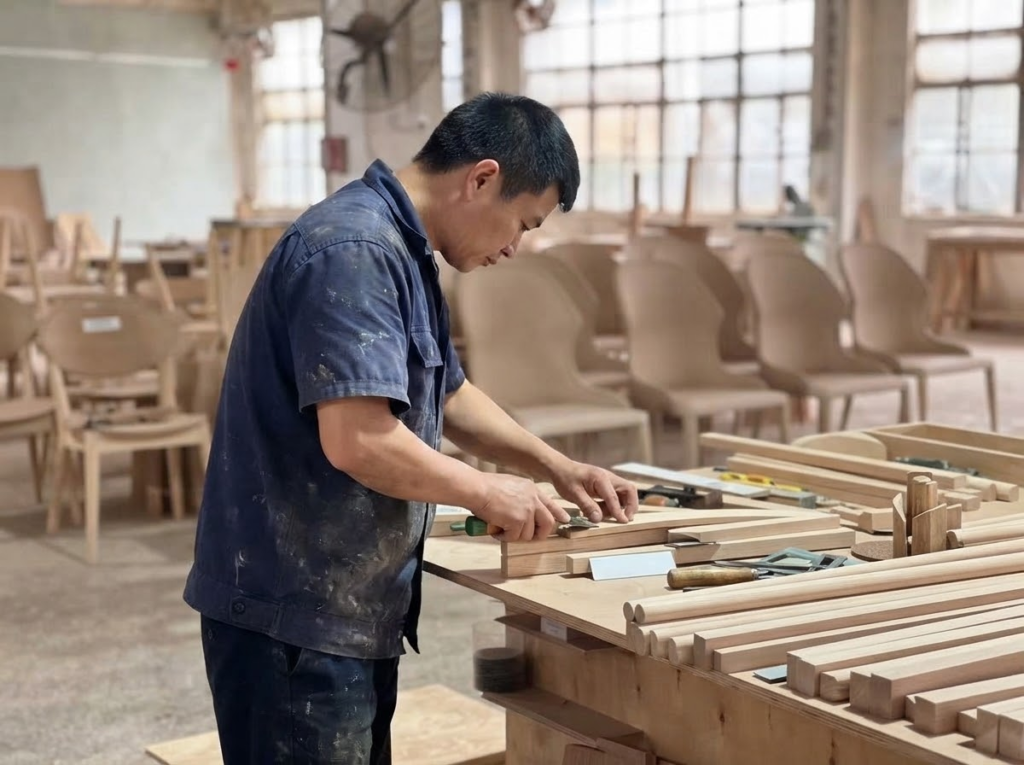
A few years ago, I walked into a massive cutting facility in Nankang. This is the heartland for timber processing in Jiangxi. The showroom up front? Immaculate. Looked like a Milan exhibition space. But I wandered into the back shed. The air was incredibly thick with the distinct, sweet-and-sour chemical punch of formaldehyde glue. The workers were busy—wearing plain, light-colored shirts (strangely, no blue, black, or grey in sight, and definitely no company logos on their backs)—running fast-growing, dirt-cheap rubberwood through a finger-jointing machine.
They were taking scrap wood, gluing it into a massive block, and then shrink-wrapping the entire Frankenstein slab in a flawless 0.6mm white oak veneer.
Absolute smoke and mirrors.
And the edges? Not even real wood. They were running an automated edge-bander, melting 2mm of solid oak trim onto an MDF core. Once that piece hit the PU coating line and got a matte finish, it was visually indistinguishable from a thousand-dollar slab. It’s exactly like picking out Sample No.A029 from a marble catalog and expecting the whole mountain to look identical to that one perfect two-inch square. It’s a fantasy.
Why Do Smart Buyers Keep Falling for It?
Because the fakes are terrifyingly good now.
When you evaluate Chinese furniture materials today, you are fighting advanced technology. Fifteen years ago, a fake wood grain looked like plastic. The repeat patterns gave it away immediately.
Today? They use synchronized embossed melamine. The factory prints a high-res photo of a wood knot, and the pressing machine physically stamps a tiny depression perfectly aligned with that printed knot. If you close your eyes and run your fingernails over it, it feels like nature. The factory isn’t scamming you; they are interpreting your unrealistic target price through modern chemistry.
And here is the kicker. A lot of major hotel brands want this. Real wood is a headache. It shrinks in the dry desert air of Nevada and swells in the humid soup of Florida. MDF stays dead flat forever. But those big buyers know exactly what they are paying for. The scam only happens when you are kept in the dark and charged a solid-wood premium for a glued-up sawdust core.
The Veneer Game vs. The Core Reality
Actually, I need to walk that back slightly—the problem isn’t usually the flat surface. The problem is the edge.
The edge of a dining table is where the lie falls apart. If the wood grain on the top of the table doesn’t organically wrap over the side and reveal the porous end-grain, you are staring at a veneer.
China wood furniture sourcing is a daily exercise in navigating material realities, where what you see has zero correlation to structural integrity. You have to speak the factory’s language, not the marketing fluff your sales team uses.
Is Veneer Actually the Enemy?
No. Not at all. Veneer is arguably a better, more sustainable way to build commercial furniture. The issue is purely misrepresentation. When a rep quotes you for “pure ash” but sneaks a veneered particleboard core into the container, they are pocketing a 40% margin difference. That’s your money.
Let’s break down what actually happens on the factory floor versus what is written on your PO.
| Material Designation | What the Buyer Imagines | What the Factory Actually Builds | Long-Term Durability Risk |
|---|---|---|---|
| “100% Solid Wood” | Massive, unadulterated hardwood slabs cut straight from the log. | Cheap eucalyptus or rubberwood core, wrapped tight in premium veneer. | Moderate. Veneer can chip if abused. |
| “Solid Wood Edges” | The whole table is natural timber. | An MDF core with a 3mm-5mm solid timber border glued around the perimeter. | Low. Edges resist denting, core stays flat. |
| “Engineered Wood” | High-grade, marine-quality plywood. | Low-grade particleboard hastily wrapped in paper foil. | High. Explodes like a sponge upon water contact. |
The single most expensive mistake you can make in Asia is assuming a heavy piece of furniture is a solid piece of furniture. High-density fiberboard (HDF) is incredibly dense because it is crushed under thousands of pounds of pressure. I’ve watched veteran buyers struggle to lift a dresser, wipe their brow, and say, “Wow, that’s real oak.” I usually bite my tongue. It’s heavy because it’s a dense brick of glue and dust.
Where Mid-Market and High-End Collide
The manufacturing ecosystem here is wildly stratified.
At the absolute bottom, you have the massive sweatshops cranking out disposable flat-pack garbage for big-box stores. At the top, you have boutique custom shops doing genuine, bench-made mahogany for billionaires.
But if you are reading this, you probably live in the messy middle.
A lot of rookie buyers flock to the mega-factories in Foshan, trying to beat them down by fifty cents on a catalog chair. But experienced hospitality and project buyers look for a completely different setup. They look for mid-sized specialists. Take a setup like Interi Furniture—they focus heavily on B2B project configurations and specific commercial niches. With this tier of manufacturer, the material specs are usually handled with actual transparency. You aren’t playing a guessing game with the core materials because their entire business model relies on repeat contract work, not pushing a single container of questionable goods onto a one-time buyer.
When you find a factory built on repeat commercial trust, they tell you the truth up front. They will look at your CAD drawings and say, “We cannot do solid walnut at your $200 target. But we can do a multi-layer birch plywood core with a 1.2mm architectural walnut veneer.”
That is the holy grail. You aren’t just sourcing tables. You are sourcing a factory’s standard operating procedure.
The Factory-Floor Lie Detector Framework
So how do you actually protect your margins? You stop acting like a VIP guest and start acting like a forensic auditor.
Next time you are standing in a showroom, or unboxing a pre-production sample in your warehouse, do not just look at it. Interrogate the thing. Here is the exact framework I use before I approve a dime of tooling costs.
- The End-Grain Check. Track the grain lines on the top surface. Follow them right to the edge. If those organic lines suddenly stop and turn into a perfectly straight, uniform edge band, you caught them. It’s not solid.
- The Underside Test. Flip the piece over. Factories are notoriously cheap; they almost never waste good veneer on the bottom of a table where nobody looks. If the top is a wild, beautiful walnut, but the underside is raw, pale MDF or a generic yellow wood, you have your answer.
- The Repetition Rule. Real wood grew in the dirt. It is flawed. If you line up four dining chairs and every single one has the exact same “rustic” knot in the exact same spot on the backrest… congratulations, you are buying printed paper.
- The Hidden Scratch. Find an area that will never be seen—inside a drawer track, under a baseplate. Take a key and scratch through the top layer. If white dust or brown fiberboard flakes pop out, it’s a composite.
And here is my favorite, completely counter-intuitive red flag: If the sample is flawless, reject it.
I am dead serious. If a factory boss hands me a “solid timber” panel that has zero color variation, no mineral streaks, and a grain structure that looks like it was drawn by a computer, I know it’s fake. Natural wood endured droughts, storms, and insects. It has scars. The desperate pursuit of absolute, perfect uniformity is exactly what drives these factories to use engineered plastics and veneers in the first place.

The Uncensored FAQ
Buyers corner me with the same frantic questions every time we finish a factory tour. Let’s clear the air.
Q: If I explicitly write “100% solid oak” on my PO, and they sign and stamp it with their red chop, aren’t they legally bound to use it?
A: Legally? Sure. Practically? Good luck. If the goods land in Long Beach and turn out to be veneered eucalyptus, what are you going to do? Sue them in a Chinese provincial court? The legal fees will cost you ten times the value of the furniture. Your signed PO is just paper. Your third-party QC inspector standing on the factory floor with a moisture meter before the goods load—that is your actual contract.
Q: But I can just lift it, right? Solid wood is obviously heavier than fake wood.
A: No. Stop doing this. This is the most dangerous myth in the industry. An MDF core is packed with heavy industrial resins. It is frequently much heavier than actual, kiln-dried hardwood. Weight proves mass, nothing else.
Q: If they show me a cross-section in the showroom proving it’s solid, will my mass production match it?
A: Don’t bet on it. The “golden sample” in the showroom is engineered to make you say yes. Mass production is where the factory quietly claws back their profit margin. You have to specify in writing that you will randomly pull one finished piece from the production line and literally saw it in half during inspection. Once they know you are crazy enough to destroy a finished table just to check the core, the bait-and-switch routine magically stops.
Q: Are all Chinese furniture materials just garbage now?
A: Absolutely not. It comes down to what you are willing to pay and how closely you manage them. The top-tier factories here have 5-axis CNC machines and craftsmen who can build heirloom pieces that rival anything out of Italy. But they will not do it for wholesale liquidation prices.
The Hard Lesson
At the end of the day, Chinese factories are a mirror. They build exactly what you pay them to build.
If you swagger onto a factory floor demanding a Bentley product but you only have a bicycle budget, you are practically begging them to lie to you. The “scam” isn’t always a cartoonish plot cooked up by a villainous boss. Most of the time, it’s just a pragmatic factory owner trying to make your completely impossible math work. They deliver the exact aesthetic you demanded, at the razor-thin price you mandated, using hidden materials you didn’t bother to verify.
So the next time you knock your knuckles on a gorgeous, heavy, incredibly cheap wooden table, and you smile thinking you just outsmarted the entire global supply chain… ask yourself one question.